
If you're standing in a flooring showroom in Cumming, looking from hardwood to LVP to carpet to tile and then back to laminate, you're not alone. Most homeowners start with a simple goal like replacing worn floors, updating a rental, or getting a house ready to sell, and then run into a wall of product terms that all sound close but matter a lot in practice.
One of the options that gets attention for good reason is attached underlayment laminate flooring. It solves a real problem. Instead of buying laminate planks and then choosing a separate pad to go underneath, the padding is already bonded to the back of each plank. That makes the project simpler, faster, and easier to get right.
After decades of helping North Atlanta homeowners sort through flooring choices, the pattern is pretty consistent. Some homes need the flexibility of a separate underlayment. Others benefit more from the speed and simplicity of an all-in-one laminate system. The right answer depends less on trends and more on your subfloor, your moisture conditions, how long you plan to stay in the home, and how much disruption you can tolerate during installation.
Your Guide to Simplified Flooring in North Atlanta
A lot of flooring projects begin the same way. A homeowner comes in thinking they want hardwood flooring installation, then sees the maintenance demands. They shift to luxury vinyl plank flooring, then ask whether laminate might feel more solid underfoot. They still need to think about bedrooms, stairs, pets, budget, and how long the house will be out of commission.
That confusion is normal. Flooring isn't one decision. It's a stack of decisions.
Why attached underlayment gets attention
Attached underlayment laminate flooring has become popular because it removes one of those decisions. The underlayment is already part of the plank, so you don't have to match a separate pad, wonder if the thickness is right, or worry that an installer used a product the manufacturer doesn't approve.
For remodeling projects in places like Cumming and Forsyth County, that's a practical advantage. In 2024, the laminate category remained significant even though the broader market softened, and new home construction accounted for 12.7% of laminate sales, while 49% of flooring projects in North America were driven by remodeling, a setting where noise control and moisture management matter for homeowners choosing attached underlayment systems (fcnews.net laminate market report).
Where it fits best
This kind of laminate usually makes the most sense for homeowners who want:
- A cleaner decision process instead of comparing multiple underlayment products
- Faster floor replacement with fewer installation steps
- A budget-conscious update that still looks polished
- A reliable option for everyday living in family rooms, bedrooms, hallways, and many main-level spaces
Practical rule: If the room has a sound subfloor and no unusual moisture risk, attached underlayment laminate often gives you the smoothest path from selection to installation.
It isn't the answer for every house. Homes on concrete slabs, rooms below grade, and second-floor spaces with stricter sound concerns sometimes need a more specific assembly. But for many North Atlanta homeowners, especially those comparing affordable flooring options for a fast renovation, attached underlayment laminate is one of the easiest categories to evaluate because the trade-offs are clearer than they are with some other materials.
What Is Attached Underlayment Laminate Flooring
You walk into a North Atlanta home, pull back the old floor, and find a concrete slab with a little seasonal moisture or a wood subfloor that is not perfectly uniform. That is where attached underlayment laminate needs a clear definition, because the product sounds simpler than the decision sometimes is.
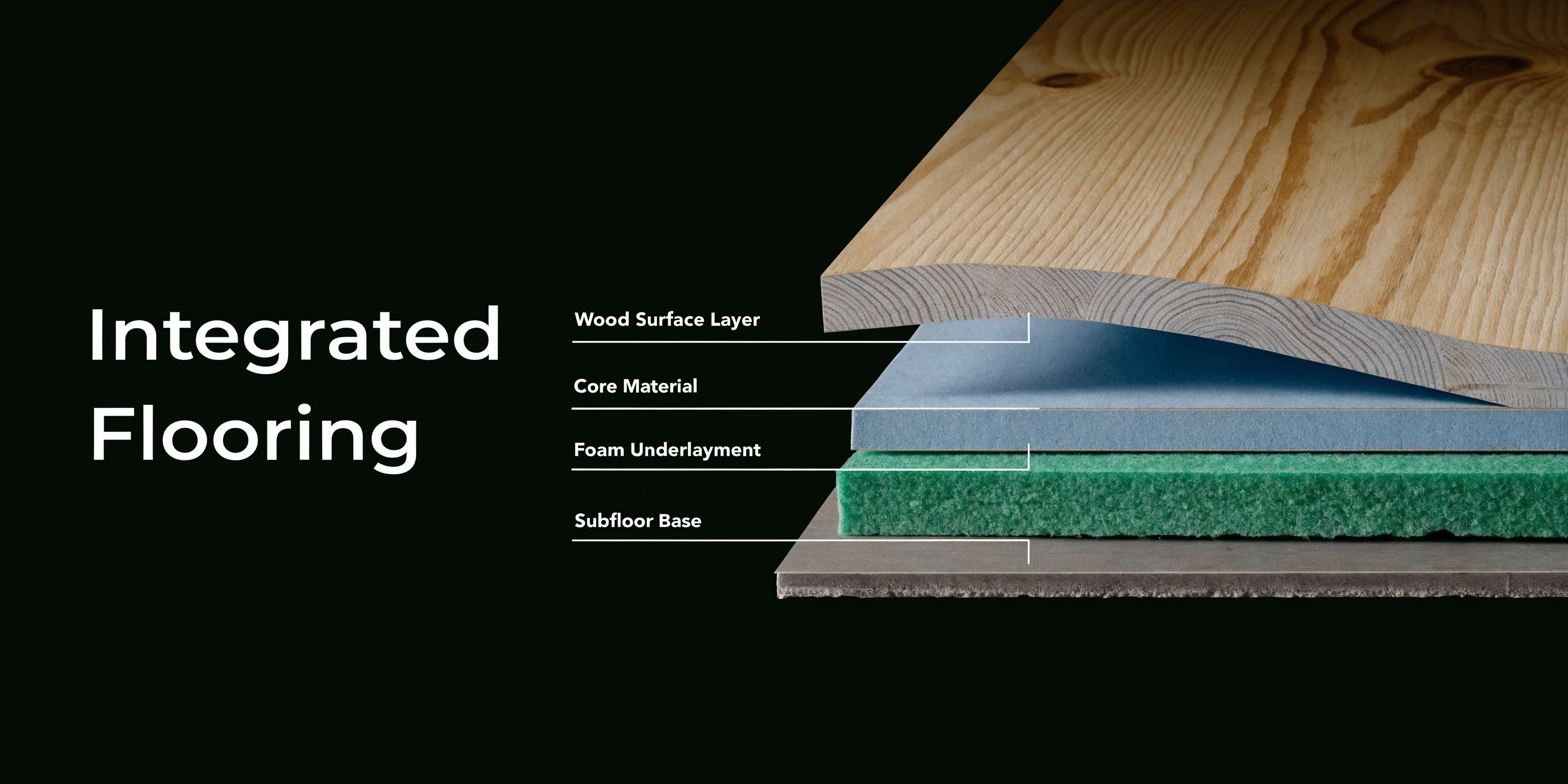
Attached underlayment laminate flooring is a laminate plank with a pad already bonded to the back at the factory. In many products, that pad is a thin foam layer, and the idea is straightforward. The floor and the cushion are sold as one system instead of two separate materials. The North American Laminate Flooring Association explains laminate construction and installation components in a way that lines up with what we see on real jobs.
What the plank is made of
Laminate is a layered product. The top wear layer protects the surface from everyday scuffs. Below that sits the printed design layer. The core, usually high-density fiberboard, gives the plank its body and supports the locking system. A bottom balancing layer helps keep the plank stable.
Attached underlayment adds one more factory-applied layer under that stack.
If you want a closer look at how those layers work together before comparing product lines, this guide to what laminate flooring is made of is a useful starting point.
What the attached pad actually does
The built-in pad has a job. Usually several.
- Softens the feel slightly underfoot compared with laminate installed directly over a hard subfloor
- Cuts some of the hollow sound that older floating floors often had
- Adds a small amount of thermal resistance because foam underlayments provide some insulation, as explained by the U.S. Department of Energy's insulation guidance
- Removes one installation step in rooms where a separate specialty underlayment is not required
That last point is the one homeowners usually notice first. There is less material to choose, less chance of pairing the wrong pad with the floor, and less labor handling loose rolls across the room.
What attached underlayment does not do
It does not fix a bad subfloor.
That matters in Georgia homes. On a clean, dry, flat upstairs plywood subfloor, attached pad laminate can be a very practical option. On a slab in Cumming or anywhere across North Atlanta, the built-in pad does not replace a moisture strategy if the manufacturer calls for one. It also does not correct dips, ridges, or patchwork in the slab. I tell homeowners this all the time. The attached pad helps with comfort and sound. It is not a cure for slab moisture or floor prep issues.
Why the product appeals to homeowners
The biggest advantage is predictability. The pad and plank were designed to work together, so there is less guesswork than there is with a separate underlayment. That can make product selection easier, especially if you want a faster remodel and do not want to sort through multiple pad options.
Still, convenience is only part of the story. In homes with humidity swings, concrete foundations, or stricter sound expectations, the right question is not just "Does it have attached underlayment?" The better question is whether the attached pad fits the subfloor conditions in that specific room.
Attached vs Separate Underlayment A Detailed Comparison
For a lot of North Atlanta homeowners, this decision gets real on installation day. The laminate you like may come with pad attached, the room may look simple at first glance, and then we test the slab and find moisture concerns or spot low areas near an exterior wall. At that point, convenience is still valuable, but site conditions matter more.
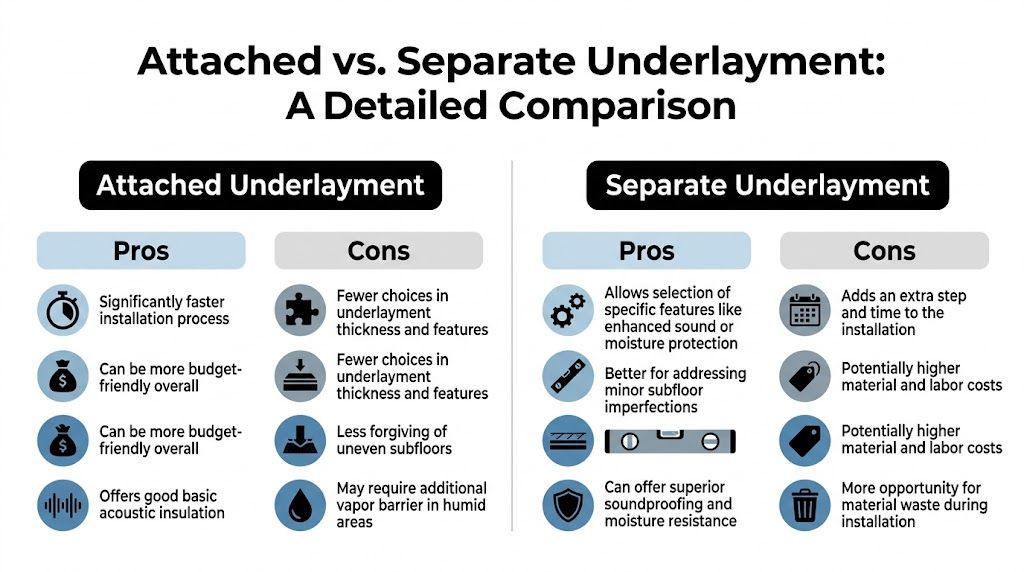
Attached underlayment works best when the room is already a good candidate for a floating floor. Separate underlayment makes more sense when the floor system needs to do a specific job beyond basic cushioning and sound control.
The short version
Use attached underlayment when the subfloor is flat, dry, and uncomplicated.
Use separate underlayment when you need to address sound, moisture, or a manufacturer requirement for the exact room and subfloor. Industry guidance from the North American Laminate Flooring Association and installation standards published by the National Wood Flooring Association both point back to the same idea. The right system depends on the product and the conditions underneath it.
Comparison table
| Factor | Attached Underlayment | Separate Underlayment |
|---|---|---|
| Installation speed | Faster because the pad is already bonded to the plank | Slower because the pad must be rolled out, trimmed, and taped or fitted as required |
| Product matching | Factory-paired system reduces selection mistakes | Requires choosing a pad that matches the floor and site conditions |
| Warranty risk | Lower if the manufacturer approves the attached pad for that installation | Higher if the wrong pad is used or an extra layer is added against instructions |
| Acoustic flexibility | Usually adequate for standard rooms | Better if you need a pad designed for stronger sound reduction |
| Moisture strategy | Limited to what the product includes and what the manufacturer allows underneath | Better for rooms that need a separate moisture barrier or a more specific assembly |
| Subfloor forgiveness | Does little to hide poor prep | Some products help with minor irregularities, but they still do not fix a bad subfloor |
| Project complexity | Fewer materials and fewer installation steps | More choices, more prep, and more room-specific planning |
When attached underlayment wins
On a typical bedroom or living room over a well-prepped wood subfloor, attached underlayment is often the practical choice. The crew handles fewer materials, the floor goes down faster, and there is less chance of pairing the laminate with an underlayment the manufacturer does not approve.
That is a real advantage in resale updates and occupied homes where the goal is a clean, efficient installation.
I also like attached pad products for straightforward upstairs rooms in Cumming homes where the subfloor is in good shape and no special sound assembly is required. In those cases, the built-in pad usually does what the room needs without adding another layer to buy, carry, cut, and tape.
When separate underlayment wins
Separate underlayment earns its keep when the room has a demand the attached pad cannot meet. That comes up often in Georgia homes built on slab foundations, lower-level spaces with a history of seasonal humidity, and upstairs areas where homeowners want better sound control underfoot.
A separate product gives you more control over the full assembly. You can choose a manufacturer-approved moisture barrier for concrete, or a pad built for stronger acoustic performance if the room calls for it. That does not make it automatically better. It makes it more adjustable.
The trade-off is time, cost, and decision-making. More parts in the system means more chances to get one part wrong.
If the room has a specific problem to solve, separate underlayment usually gives you more options. If the room is already in good shape, attached underlayment usually keeps the job simpler.
Practical decision points
Before choosing one or the other, ask five plain questions:
- What is under the floor? Plywood upstairs and concrete slab on the main level do not get the same recommendation by default.
- Has the subfloor been checked for flatness and moisture? Attached pad will not make prep problems disappear.
- Is sound a major concern? Bedrooms over living areas and townhome layouts often benefit from a more targeted underlayment choice.
- Does the laminate manufacturer allow an additional layer? Some products do not. Ignoring that can create performance and warranty problems.
- Is the priority speed or site-specific performance? Faster is great, but only if the floor system matches the room.
What works and what doesn't
What works is matching the underlayment approach to the actual conditions in the house. In North Atlanta, that often means attached underlayment on stable wood subfloors and a more deliberate approach on concrete slabs or rooms with higher moisture exposure.
What does not work is assuming the attached pad built into the plank handles every slab, every sound issue, and every humidity swing. It does not. The better choice depends on the room, the subfloor, and what the manufacturer allows for that exact product.
The Main Benefits for North Atlanta Homeowners
A common Cumming remodel goes like this. The old floor is out, furniture is stacked in the dining room, and the homeowner wants the new laminate installed quickly without turning the house upside down for a week. In that kind of job, attached underlayment has a real advantage because it simplifies the floor system and cuts down on decisions that can slow the project down.

Faster installation with fewer variables
With an attached pad, the installer is working with one product instead of managing planks and a separate underlayment layer across the whole room. That saves time on layout, trimming, taping, and keeping the pad flat while rows are locked together.
For homeowners, the benefit is practical. Rooms get put back together sooner, other trades are less likely to be delayed, and there is less opportunity for an avoidable installation mistake caused by mixing materials that were never meant to go together.
That convenience matters most in occupied homes.
A strong fit for projects where speed is key
Attached underlayment laminate usually makes the most sense when the room does not need a highly customized assembly and the goal is a clean, efficient replacement.
It often fits well in situations like these:
- A rental update where shorter downtime affects income
- A resale project where appearance and schedule matter more than building a specialized floor system
- A family home refresh where bedrooms, hallways, or living spaces need a durable floor without adding extra labor
- A budget-conscious remodel where keeping the product stack simple helps control cost
In North Atlanta, that can be a very sensible middle-ground choice. Many homeowners want a floor that looks good, installs cleanly, and does not create extra complexity unless the room conditions call for it.
Less product confusion and fewer warranty mistakes
I have seen plenty of homeowners walk into a showroom assuming any underlayment will work under any laminate. That is where problems start. Some separate pads are too thick for the locking system. Some add cushion the floor was not designed to have. Some miss the moisture protection needed over a slab.
An attached pad cuts down that risk because the manufacturer has already paired the laminate with a specific backing. That makes product selection simpler and reduces the odds of a warranty issue tied to the wrong underlayment choice. The North American Laminate Flooring Association also notes that underlayment selection affects performance, sound control, and subfloor compatibility in laminate installations, which is why matching the system matters from the start (NALFA laminate flooring installation guidance).
For homeowners comparing options, that built-in compatibility is often the biggest selling point.
A practical choice for the way many Georgia homes are built
North Atlanta homes are not all the same. Some have stable wood subfloors upstairs. Some sit on concrete slabs that need a much more careful moisture plan. Attached underlayment laminate tends to perform best where the subfloor is already in decent shape and the installation does not require a specialty layer for sound or moisture control.
That is why we tell homeowners to treat attached pad as a convenience feature, not a cure-all. If the room is over concrete, review the manufacturer requirements and make sure the floor has the right moisture barrier for laminate flooring over concrete before the first plank goes down. If the lower level has had musty odors or past dampness, basic moisture prevention habits matter too, and even a general guide on how to avoid mold in basements can help homeowners spot warning signs early.
A sensible middle option in the showroom
Attached underlayment laminate fills a useful spot between categories. Hardwood still wins on longevity and refinishing potential. LVP is often the better pick where water exposure is a concern. Carpet still makes sense for homeowners who want a softer feel underfoot.
Laminate with attached pad earns its place because it keeps the install simpler while delivering a clean finished look in dry living areas. For many homes in Cumming and the surrounding North Atlanta area, that balance of speed, appearance, and fewer moving parts is the primary benefit.
Subfloor and Moisture Issues in Georgia Climate
Georgia humidity changes the conversation. So do concrete slab foundations.
A floor that performs well in one room can fail early in another if the subfloor wasn't evaluated carefully. Attached underlayment laminate flooring helps with sound and comfort, but it doesn't replace moisture testing, subfloor prep, or common sense about where laminate belongs.
Concrete slabs need closer attention
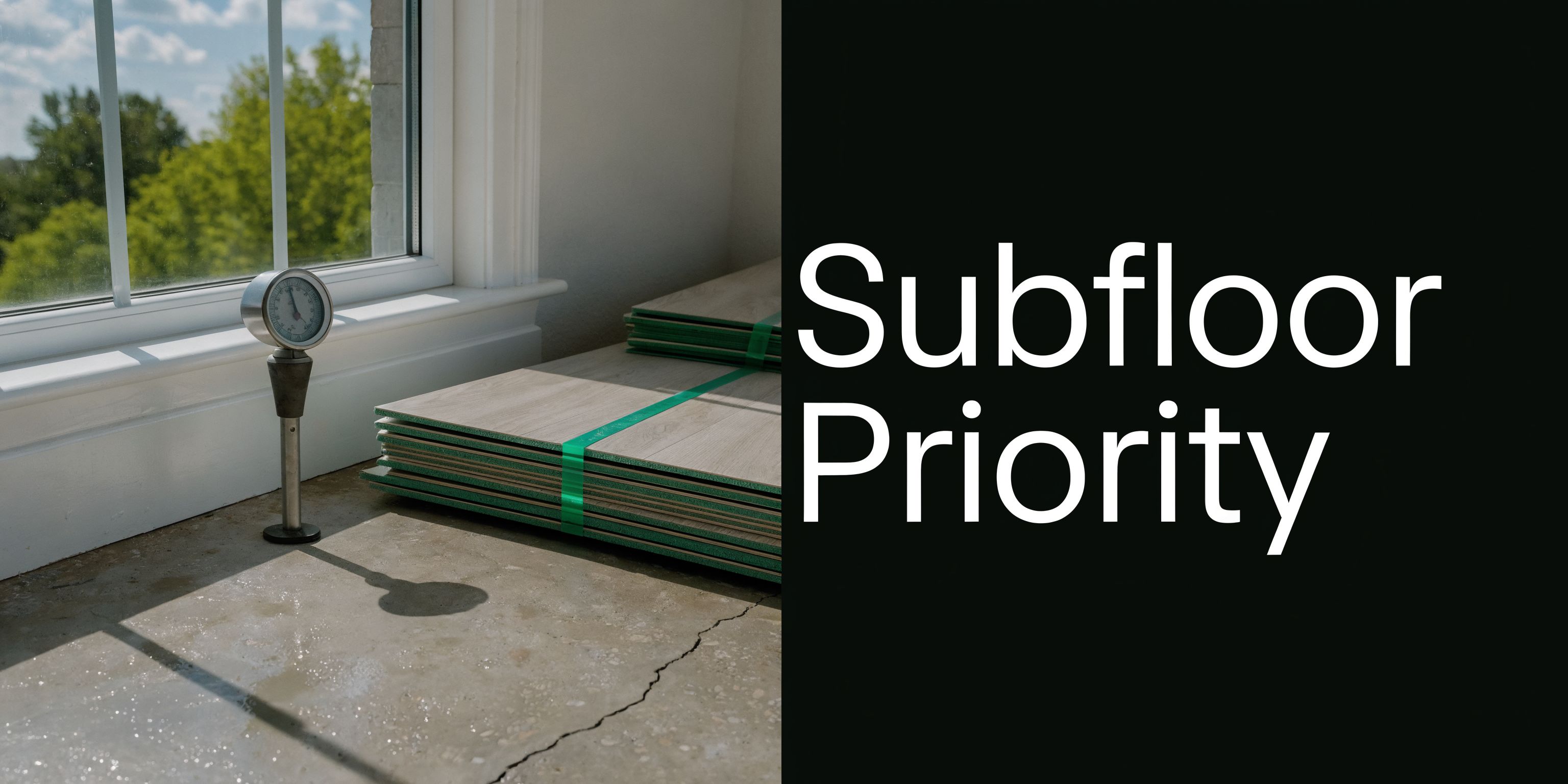
Many homes in Cumming, Forsyth County, and nearby areas sit on slab construction. Concrete looks solid and dry on the surface, but it can still hold or transmit moisture. That's where homeowners get into trouble. They assume the attached pad means the floor is ready to float directly over the slab with no other planning.
Sometimes it is. Sometimes it isn't.
In the global underlayment market, North America holds 27% of share, and the region is heavily driven by 49% remodeling, with integrated vapor barriers found in 44% of products, which shows how often moisture resistance is part of the underlayment conversation for renovation work (Data Insights Market floor underlayment report).
That doesn't mean every attached underlayment laminate product has the right moisture profile for every slab. It means you need to verify the system, not assume.
What attached underlayment cannot fix
Expectations matter here.
An attached pad can help with comfort, sound, and some degree of separation from the subfloor. It cannot make an unfit subfloor acceptable.
It won't solve:
- Meaningful unevenness
- Heaving or cracked areas that are moving
- Persistent moisture migration
- Old adhesive residue or contamination that interferes with installation
- Structural softness in wood subfloors
A thin attached pad follows the subfloor beneath it. If the base is wrong, the floor above it won't stay right.
Laminate failures often start below the plank, not on top of it.
Humidity and below-grade spaces
Humidity is one issue. Below-grade installation is another.
Basements and lower-level rooms need a stricter standard because moisture isn't always obvious until the floor reacts. If you're dealing with a basement project, it helps to think beyond flooring alone. This guide on how to avoid mold in basements is useful because it focuses on the broader moisture conditions that can undermine finish materials long before visible damage shows up.
For homeowners trying to sort out whether they need additional protection under laminate, this overview of a flooring moisture barrier gives the right framework for evaluating slab and moisture conditions before the material is selected.
What usually leads to better outcomes
Good outcomes come from matching the flooring system to the site.
That usually means:
- Testing first. Don't guess about moisture.
- Leveling the floor where needed. A smoother base protects the locking system.
- Checking the manufacturer instructions. Some attached-pad products still require additional moisture protection depending on the subfloor.
- Being honest about the room's use. A basement rec room, upstairs bedroom, and sunroom don't present the same risks.
If a room has significant moisture concerns, some homeowners end up deciding that waterproof flooring in another category makes more sense than laminate. That's not a knock on laminate. It's just the right call when the room itself is the bigger issue.
Installation Tips and Long-Term Care
Attached underlayment laminate flooring is simpler to install than a multi-part assembly, but it still has to be installed correctly. Most avoidable problems come from skipping basic prep, rushing the acclimation period, or cleaning the floor with products that leave too much moisture behind.
Before the first plank goes down
Three things matter at the start: the subfloor must be clean, flat, and dry.
Dust, drywall debris, paint overspray, and raised fasteners all create issues under a floating floor. If the room is on wood subfloor, check for squeaks and movement first. If it's on concrete, verify moisture conditions before installation begins.
Then let the flooring acclimate in the room. Leave the unopened boxes in the space for at least 48 hours so the planks can adjust to the home's temperature and humidity before they lock together.
Leave room for movement
Laminate expands and contracts. That's normal.
You need to leave a 1/4-inch expansion gap around the perimeter of the room so the floating floor can move without pushing into walls, cabinets, or fixed objects. When that gap is skipped or pinched tight, the floor can bind and create visible problems later.
A few reminders help:
- Check door jambs: Undercut where needed so the floor can move freely.
- Watch heavy built-ins: Islands, cabinets, and fixed partitions change how a floating floor should be planned.
- Don't trap the floor: Tight trim work can create pressure points around the room.
Installer's note: A floating floor needs space to float. Clean cuts matter, but the hidden expansion space matters more.
Daily care that protects the floor
Laminate is low maintenance, but low maintenance doesn't mean no maintenance.
For long-term performance:
- Use felt pads under furniture legs. Chairs and stools often do more damage than expected.
- Place mats at entry doors. Grit acts like sandpaper on any hard surface floor.
- Clean spills quickly. Don't let liquid sit on seams.
- Sweep or dust mop regularly. Fine debris is what dulls the floor over time.
- Vacuum without a beater bar. That keeps the surface from taking unnecessary abuse.
For routine product guidance, this page on padding for laminate floor installation also helps clarify how support beneath the planks affects long-term performance.
What not to use
A lot of laminate damage comes from good intentions and bad cleaning habits.
Avoid:
- Steam cleaners
- Soaking wet mops
- Abrasive powders or scrub pads
- Oil soaps or cleaners that leave residue
- Too much water of any kind
Use a damp mop only when the cleaner is approved for laminate floors, and keep the moisture light. The goal is to clean the surface, not saturate the edges.
What holds up best over time
Homes with the best long-term results usually follow a simple pattern. They control dirt at the doors, protect the legs of heavy furniture, and respond quickly to spills. The floor doesn't need constant treatment. It needs consistent habits.
Your Attached Underlayment Questions Answered
Some of the most important questions about attached underlayment laminate flooring are the ones that come up after you've narrowed down your options. These are the questions homeowners usually ask when they're close to making a decision.
Can I install attached underlayment laminate over concrete
Sometimes, yes. But concrete is where shortcuts cause trouble.
The product may be approved for concrete, but that doesn't remove the need to check moisture conditions and follow the manufacturer requirements for that exact floor. If the slab has moisture concerns, the safer approach may involve extra protection or a different flooring category altogether.
Is attached underlayment enough for sound control upstairs
Often for basic residential use, yes. For more demanding sound situations, maybe not.
If the goal is to reduce everyday footfall noise inside a single-family home, attached pad products can do a good job. If you're trying to meet stricter condo expectations or minimize sound transfer to a room below, a separate acoustic underlayment may give you better control over the result.
Does attached underlayment make the floor softer
It usually makes the floor feel a bit more comfortable underfoot than laminate without that built-in cushion. But don't expect a soft, carpet-like feel. Laminate is still a hard surface floor.
The value is in taking the edge off the firmness, reducing some noise, and making the installation system more complete.
Can attached underlayment hide an uneven subfloor
No. This is one of the biggest misunderstandings.
A thin factory-attached pad is not a floor-leveling product. If your slab or subfloor has dips, humps, cracks, or movement, those issues still need to be corrected before installation. Ignoring that step is one of the fastest ways to create squeaks, joint stress, and visible movement.
Is attached underlayment laminate better than LVP flooring
Not across the board. They're different tools for different conditions.
Laminate often appeals to homeowners who like its visual depth and hard-surface feel in dry living spaces. LVP flooring becomes the stronger candidate when the room has more direct water exposure or when waterproof performance is the top priority. The right comparison isn't "which is better." It's "which is better for this room."
Is it a good choice for resale or rental property updates
In many cases, yes. It can be a smart option when you want a clean appearance, a straightforward installation path, and practical everyday durability. Rental and resale decisions usually benefit from materials that are easy to specify and easy to replace room by room if needed later.
What matters most before buying
If you strip the decision down to the essentials, focus on these:
- The subfloor condition
- The room's moisture exposure
- The noise expectations
- The installation timeline
- Whether you want convenience or customization
If those answers point to a standard dry room with a sound base, attached underlayment laminate flooring is often a very sensible choice. If the room presents special conditions, the smarter move may be a separate underlayment system or a different flooring category.
If you're comparing laminate flooring, waterproof flooring, hardwood, or LVP for a home in Cumming, Johns Creek, Milton, or anywhere in Forsyth County, Flacks Flooring can help you sort through the practical trade-offs. Their team offers in-home guidance, practical product recommendations, and installation insight shaped by more than 30 years of local flooring experience.