
When you’re looking for the best flooring for a concrete slab basement, your go-to options are going to be Luxury Vinyl Plank (LVP), epoxy coatings, and engineered waterproof flooring. These aren’t just stylish choices; they’re specifically built to handle the constant, low-level moisture that concrete naturally releases. This is what saves you from the mold, warping, and musty smells that plague the wrong kind of flooring.
Why Your Basement’s Concrete Slab Demands the Right Flooring
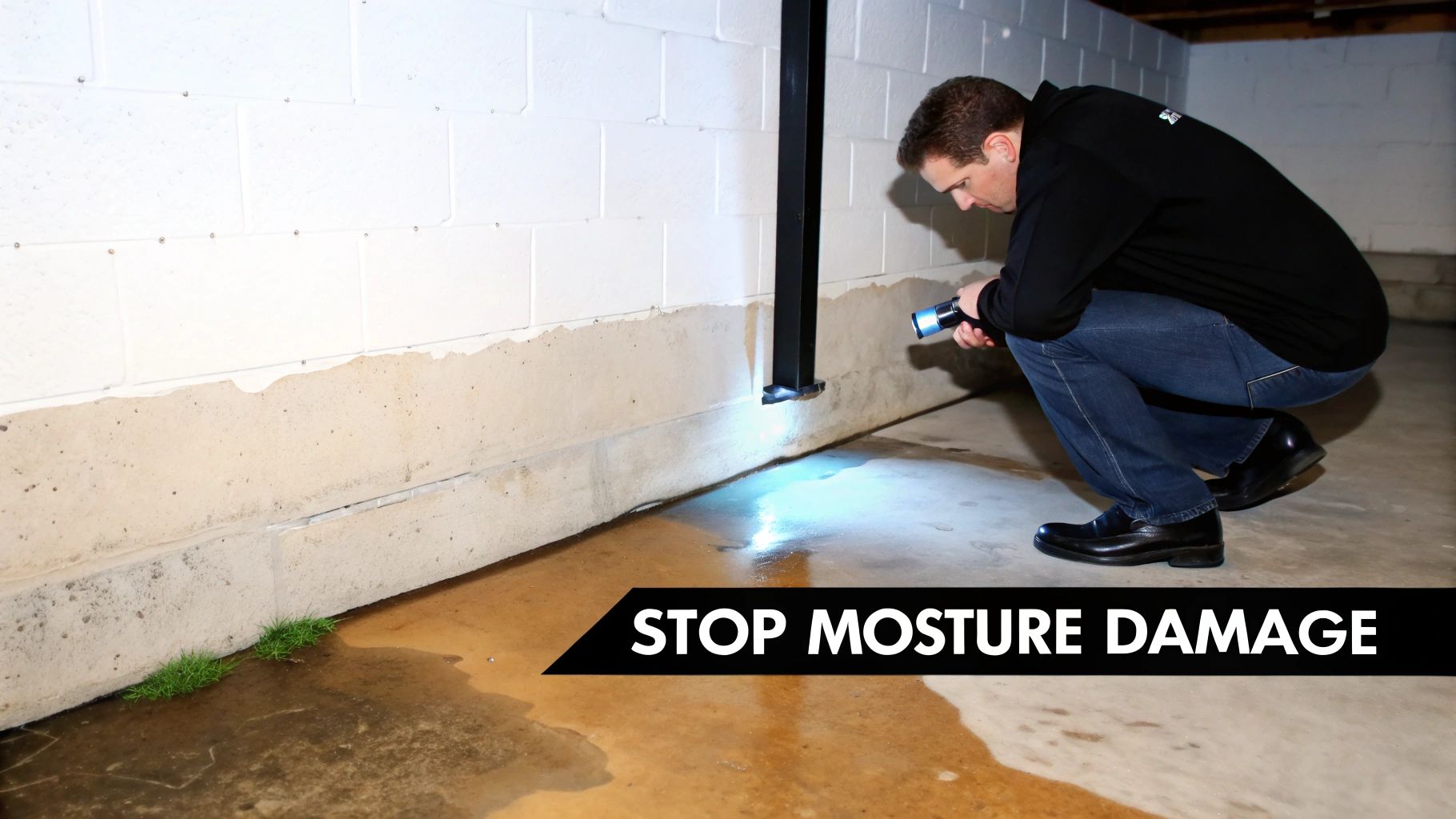
Picking flooring for a basement, especially with Georgia’s humidity, is way more than just about looks. It’s a foundational decision for the health of your home. A concrete slab isn’t the solid, dry barrier you might think it is. It’s actually porous, acting like a giant, slow-moving sponge that constantly pulls moisture up from the ground.
This process is a constant reality for any below-grade space. Water from the soil exerts what’s known as hydrostatic pressure, forcing water vapor up through the concrete. This is why putting something like traditional solid hardwood in a basement is a recipe for disaster—it will inevitably warp, cup, and become a breeding ground for mold.
The Science Behind Concrete and Moisture
To really get why basements are so tricky, it helps to know how that slab got there in the first place. The process involves technical steps like concrete slab shuttering to create the foundation. Even a perfectly poured slab has to cure, and it will always have a relationship with the ground it sits on.
Because of concrete’s inherent nature, you’re always fighting a low-grade battle against dampness. This is why your flooring choice is so critical. You need something that can either let that vapor pass through harmlessly or create a 100% waterproof barrier, all without breaking down over time.
Think of your basement floor as a living, breathing surface, not just a static platform. It’s constantly reacting to ground moisture and temperature changes. The best flooring is one that works with these conditions, not against them.
Local Climate Considerations for North Georgia
Here in areas like Cumming, Johns Creek, and Milton, we live with serious humidity for much of the year. When we get heavy rains, the ground gets saturated, which dramatically increases the amount of moisture being pushed up through your foundation. This makes choosing a moisture-proof floor completely non-negotiable.
Finding the best flooring for a concrete slab basement in our region means you have to plan for the worst-case scenario. You need a floor that delivers on three key fronts:
- Waterproof or High Water-Resistance: The material must handle everything from high vapor transmission to a potential plumbing leak without failing.
- Mold and Mildew Resistance: Look for inorganic materials. Mold can’t feed on vinyl or epoxy, which is a huge win for your indoor air quality.
- Durability and Stability: Your floor needs to stay put and look good in a cool, potentially damp environment without buckling, peeling, or degrading.
Once you understand what your concrete slab is actually doing, you can avoid expensive mistakes. You’ll be able to choose a floor that truly transforms your basement from a damp, iffy space into a comfortable and valuable part of your home.
The Critical First Step: Preparing Your Concrete Slab for Success
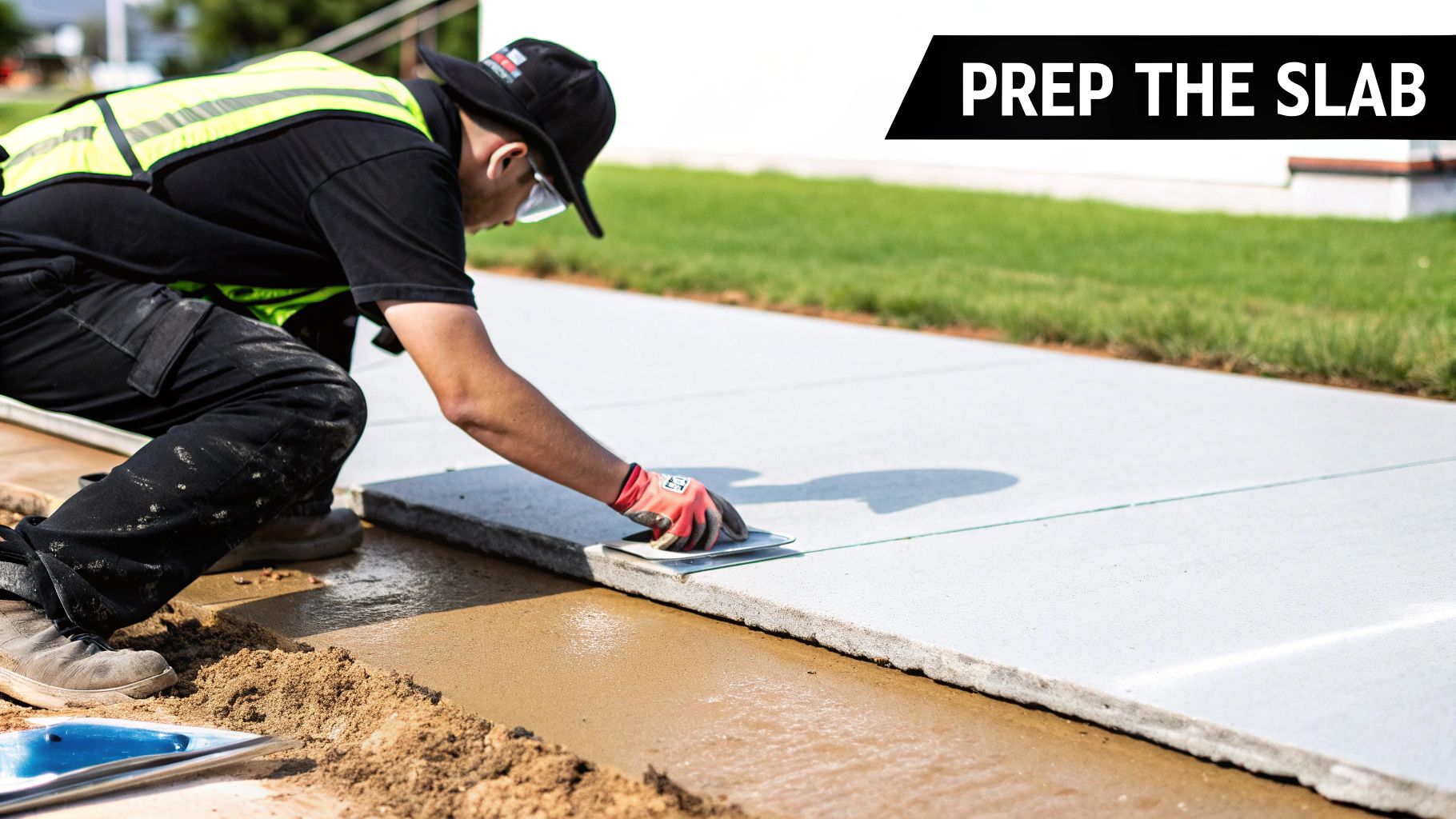
A beautiful basement floor isn’t really about the planks or tiles you see on top. The true secret to a floor that lasts is hidden underneath, in the preparation of the concrete slab itself. This is the one step you absolutely cannot skip.
Think of it like trying to stick a decal on a dusty, bumpy wall. It’s never going to lay flat, the edges will peel, and it will look awful in no time. Your basement floor is no different. You can buy the most expensive LVP or hire the best tile installer, but if the concrete isn’t properly prepped, you’re setting yourself up for failure.
Taking the time to get the slab right protects your investment. It’s what stops vinyl from bubbling up, prevents epoxy from cracking, and keeps tiles from sounding hollow underfoot. It creates the perfect canvas for a flawless installation.
Diagnosing Your Slab with Moisture Testing
Before you even think about cleaning or leveling, you have to figure out what’s going on with moisture. Concrete is like a sponge; it can hold a surprising amount of water vapor, which is the number one enemy of most flooring. Even a slab that feels bone-dry can be quietly releasing moisture, causing adhesives to fail and creating a breeding ground for mold.
This is why professional moisture testing is so important. A simple DIY plastic sheet test might tell you if you have a problem, but it won’t tell you how big the problem is. To learn more about the methods we use, check out our guide on how to test concrete for moisture.
Never, ever assume a concrete slab is dry enough for flooring just because it looks and feels dry. The only way to know for sure is with a proper moisture test—it can save you from a catastrophic failure down the road.
Once you have a clear picture of your slab’s moisture levels, you can confidently move on to the physical prep, knowing exactly what kind of vapor barriers or sealers might be necessary.
Creating the Perfect Canvas
With the moisture situation under control, the next goal is to get the slab perfectly clean, smooth, and level. Every little imperfection in the concrete will eventually telegraph through your new floor, creating visible flaws and weak spots.
The process usually breaks down into a few key steps:
- Deep Cleaning: The slab has to be completely free of dirt, dust, old paint, or drywall mud. We often use industrial grinders with powerful vacuum attachments to get rid of old adhesives and open up the pores of the concrete so new materials can get a solid grip.
- Crack and Pit Repair: Any cracks, holes, or divots are filled with a high-strength concrete patching compound. This ensures a uniform surface and prevents these flaws from affecting the new floor.
- Grinding High Spots: We grind down any bumps, ridges, or high spots to create a flat, even plane. This is absolutely critical for rigid flooring like LVP and tile, which can crack or separate over an uneven subfloor.
Achieving a Flawless Finish with Self-Leveling Compounds
For slabs with significant dips, waves, or general unevenness, a self-leveling underlayment is the gold standard. We pour this cement-based mixture in liquid form, and it naturally flows across the floor, filling in all the low spots and curing into a perfectly smooth, level surface.
This process creates an ultra-smooth, incredibly durable base that’s ideal for any type of flooring. It’s especially good at smoothing out imperfections up to a 1/4-inch deep, which helps prevent 90% of the stress cracks that can plague other toppings. For homeowners in the Milton area, these systems also add a bit of thermal stability, which helps keep basements more comfortable and energy-efficient during our temperature swings.
Your Best Defense Against Moisture with Vapor Barriers and Sealers
Think of your basement’s concrete slab as a giant sponge. Even after it’s been perfectly cleaned and leveled, it’s constantly wicking moisture up from the ground beneath your home. Installing beautiful new flooring directly on that slab without a protective layer is like building a house without a roof—it’s only a matter of time before water damage ruins everything.
This is where a vapor barrier or sealer comes in. It’s the essential raincoat for your basement floor, creating a critical line of defense between the porous concrete and your new flooring. This barrier stops the slow, invisible creep of moisture vapor, which is the number one cause of mold, failing adhesives, and warped floorboards.
Understanding the Two Types of Moisture Barriers
When it comes to protecting your floor, you have two main options. They both achieve the same goal—stopping moisture—but they work in completely different ways. Your choice will really depend on your specific flooring and the moisture conditions of your slab.
- Physical Vapor Barriers: This is usually a heavy-duty sheet of 6-mil polyethylene (poly) film. You simply roll it out over the concrete before installing a “floating floor” like Luxury Vinyl Plank or laminate. It creates a physical shield that moisture can’t get through.
- Liquid-Applied Sealers: These are advanced coatings that you paint or spray directly onto the prepped concrete. They soak into the pores and chemically bond with the slab, forming a seamless, impenetrable membrane that essentially becomes part of the concrete itself.
A physical barrier is like laying a waterproof tarp on the ground. A liquid sealer is more like giving the concrete a permanent, rubberized coat of paint. Both are effective, but liquid sealers tend to offer more complete, long-term protection, especially for floors that are glued down.
Why Sealing Your Slab is a Critical Investment
Sealing a concrete slab before you put down any flooring is the single best thing you can do to prevent moisture-related failures. It’s a foundational step that protects the long-term value of your renovation.
Properly sealed slabs reduce the risk of delamination by 60%, helping floors like engineered wood or LVP last two to three times longer. Considering the North American cast-in-place concrete market was worth $3.2 billion in 2023, protecting that investment is just smart. For homeowners right here in Cumming, this simple step can help you avoid the $5,000-$15,000 repair bills that roughly 25% of unsealed basements eventually face. You can find more details in this concrete sealer market report.
Your flooring is only as good as the surface it’s installed on. A vapor barrier or sealer isn’t an optional upgrade; it’s essential insurance for your investment, protecting it from the silent threat of moisture from below.
For a truly professional job, the application has to be perfect. To get that seamless, uniform coverage with a liquid sealer, contractors often rely on specialized tools. For instance, using a Graco airless paint sprayer allows for a quick and even coat across a large basement, ensuring there are no pinholes or weak spots. This approach guarantees a genuinely waterproof shield, protecting your flooring and your home’s air quality for years.
Comparing the Top Flooring Options for Concrete Basements
With your concrete slab properly prepped, cleaned, and sealed, you’ve laid the perfect groundwork. Now for the fun part—choosing the flooring that will finally transform your basement into a livable, comfortable space. This is where your vision for the room really starts to come to life.
But let’s be clear: this isn’t like picking flooring for an upstairs bedroom. The best flooring for a concrete slab basement has to do more than just look good. It needs to be a tough, moisture-resistant workhorse. Let’s put the top contenders head-to-head and see how they stack up against the unique challenges of a below-grade environment.
Luxury Vinyl Plank (LVP): The Versatile Champion
It’s no surprise that Luxury Vinyl Plank, or LVP, has become the top choice for basements everywhere. It’s the perfect marriage of stunning aesthetics and practical, basement-proof engineering. LVP is specifically designed to give you the gorgeous look of real hardwood but with a core that’s completely waterproof.
That means it simply won’t swell, buckle, or warp when exposed to the moisture vapor that’s always coming through a concrete slab. On top of that, it’s incredibly durable, making it a fantastic choice for high-traffic areas like a family den or kids’ playroom. It just stands up to daily life.
For homeowners in places like Cumming and Forsyth County, choosing a waterproof flooring like LVP is a no-brainer. Interior designers love it because it mimics real hardwood with 100% waterproof cores that handle spills without a problem. It’s a world away from traditional carpet, which can absorb 20-30% more moisture and leads to mold in an estimated 70% of unsealed basements. Contractors appreciate it too, since it can often be installed directly over the slab, cutting labor costs by up to 25%.
Epoxy Coatings: The Durable Modernist
If you’re aiming for a sleek, industrial-chic look for a home gym, workshop, or a modern entertainment space, epoxy coatings are a phenomenal choice. This isn’t just paint. It’s a two-part thermosetting resin that chemically fuses with the concrete, creating an incredibly hard, durable, and non-porous surface.
An epoxy floor is completely waterproof and ridiculously easy to clean, making it bulletproof against spills, stains, and any mold or mildew growth. While you’ll see DIY kits at the hardware store, professional installation is the way to go here. Proper prep and bonding are everything, and that’s the key to a finish that lasts.
A true professional-grade system often uses a polyurea base coat with a polyaspartic top coat. This combination is far more flexible, allowing it to handle the concrete’s natural expansion and contraction without the cracking that plagues older, more rigid epoxy formulas.
Engineered Hardwood: A Touch of Warmth
For anyone who just has to have the timeless, authentic look of real wood, engineered hardwood is your only viable option for a basement. Unlike solid hardwood, its layered construction gives it much better dimensional stability, so it’s less likely to react to swings in humidity.
But—and this is a big but—it’s crucial to understand that engineered wood is water-resistant, not waterproof. It can only ever succeed in a basement with a perfectly dry slab and a high-performance vapor barrier underneath it.
Installing engineered hardwood in a basement is a high-stakes game. Your success hinges entirely on meticulous moisture control. Without a flawless vapor barrier and a bone-dry slab, you’re just asking for expensive damage down the road.
If you decide to go this route, a “floating” installation is almost always the right call. This lets the floor expand and contract as a single unit without being glued down to the unforgiving concrete.
This decision tree shows the basic strategy for defending against moisture.
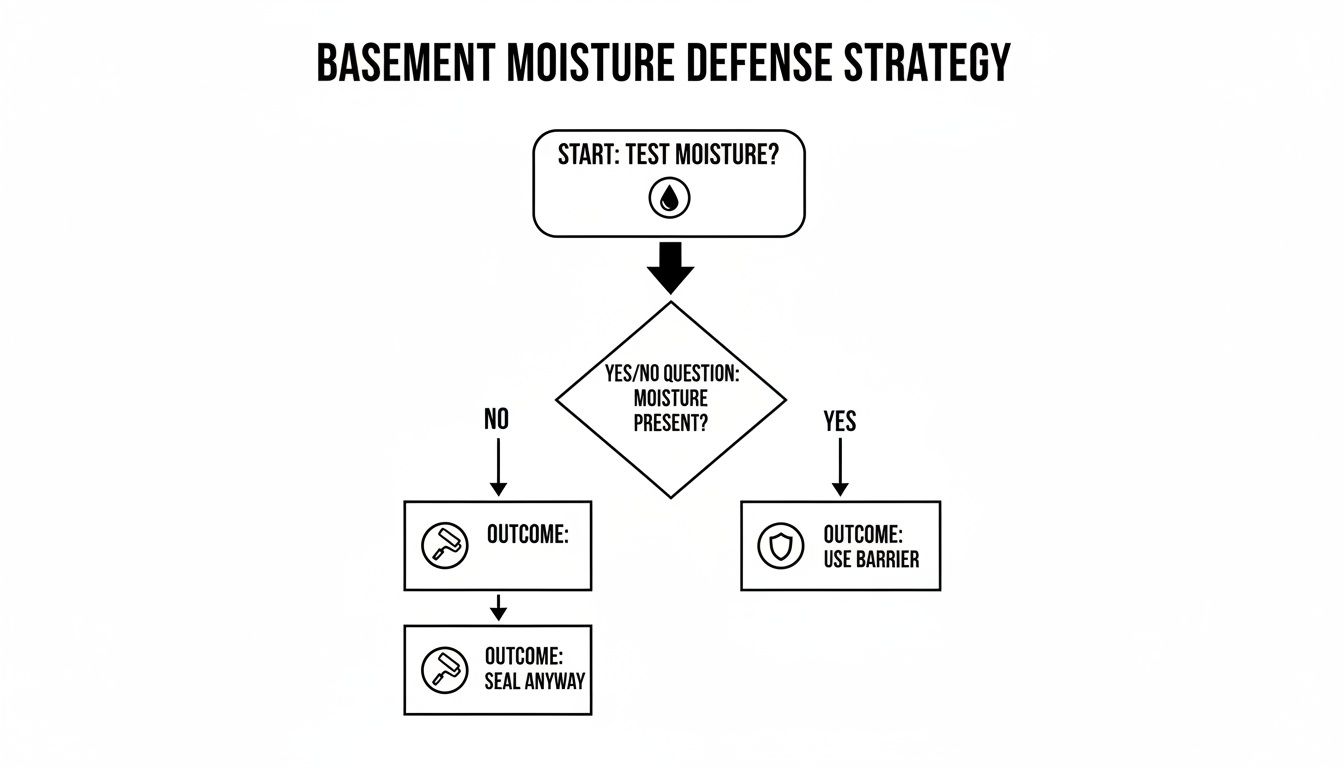
The key takeaway is simple: proactive moisture management, whether it’s a barrier or a sealer, is a non-negotiable first step for any basement flooring project.
Ceramic and Porcelain Tile: The Indestructible Classic
When it comes to pure, raw durability and water impermeability, nothing outdoes ceramic or porcelain tile. Once it’s installed and grouted, it creates a surface that water simply cannot get through. This makes it an outstanding choice for basement bathrooms, laundry areas, or any spot where spills or potential leaks are a concern.
The main tradeoff is comfort. Tile is cold and hard underfoot, which might not be what you want for a cozy family room unless you plan on using plenty of area rugs. Installation is also more labor-intensive and requires a perfectly level slab to prevent the tiles or grout from cracking over time. If this timeless option is on your list, our guide on the best waterproof flooring for basements digs into tile in more detail.
Basement Flooring Comparison for Concrete Slabs
To help simplify your decision, we’ve created a side-by-side comparison of these top contenders. This table breaks down how each option performs on the key factors that matter most in a basement.
| Flooring Type | Moisture Resistance | Durability | Avg. Cost/Sq. Ft. (Installed) | Best For |
|---|---|---|---|---|
| Luxury Vinyl Plank (LVP) | Excellent (100% Waterproof) | Very High | $6 – $12 | Family rooms, play areas, all-purpose spaces |
| Epoxy Coating | Excellent (Seamless Barrier) | Highest | $5 – $10 | Home gyms, workshops, modern utility areas |
| Engineered Hardwood | Fair (Resistant, not waterproof) | High | $8 – $15 | Living spaces with strict moisture control |
| Ceramic/Porcelain Tile | Excellent (Impermeable) | Very High | $10 – $20+ | Bathrooms, laundry rooms, high-moisture zones |
Ultimately, the best flooring for your concrete slab basement really comes down to how you plan to use the space and what your tolerance for moisture risk is. By matching a material’s strengths to your lifestyle and design goals, you can choose a floor that not only looks incredible but also gives you decades of worry-free performance.
Choosing the Right Floor for Your North Georgia Home
Generic basement flooring advice you find online often misses one huge detail: our local climate. Here in North Georgia, we get a double whammy of sweltering summer humidity and heavy seasonal rains. A one-size-fits-all approach to picking the best flooring for a concrete slab basement just doesn’t work here. The materials that perform beautifully in a dry, arid state could fail spectacularly in our backyards.
If you live in Cumming, Forsyth County, or Milton, you’re dealing with a unique set of pressures. When our ground gets saturated from all that rain, it creates hydrostatic pressure that literally pushes moisture vapor up through the concrete slab of your foundation. This isn’t a small problem; it’s a constant, invisible force that’s always working against your floor.
That’s why your choice has to be a smart one, built for our specific conditions—something that will look good and feel comfortable all year long.
Adapting to Our Humid Climate
The biggest battle we fight in North Georgia is humidity. From May through September, the air is thick with moisture, and your basement naturally becomes the coolest, dampest spot in the house. Unfortunately, this creates the perfect breeding ground for mold and mildew if you install the wrong kind of floor.
This is exactly why porous, organic flooring materials are almost always a bad idea down there.
- Carpet: It feels cozy, sure, but a traditional carpet and its pad act like a giant sponge. It will trap moisture from the air and condensation coming off the slab, leading to musty smells and, eventually, mold.
- Solid Hardwood: This is a complete non-starter. The constant moisture and humidity swings will make solid wood planks warp, cup, and buckle. It’s not a matter of if, but when.
- Waterproof Alternatives: This is where you want to focus. Materials like Luxury Vinyl Plank (LVP) and professional epoxy coatings are fantastic because they’re inorganic and 100% waterproof. Mold and mildew simply have nothing to feed on.
In a climate like ours, your basement flooring is more than just a surface—it’s part of your home’s moisture management system. Choosing a truly waterproof material is the single most important decision you can make to protect your home’s air quality and foundation.
Considerations for Year-Round Comfort
Our climate isn’t just about summer stickiness; our winters can get pretty cool and damp, too. A bare concrete slab or even a tile floor can feel shockingly cold underfoot during those months, which doesn’t exactly make you want to go hang out downstairs.
This is where you need to think about comfort. If you’re planning a cozy family room or a media space, look for flooring systems that provide some insulation. Many modern LVP products come with an attached underlayment that creates a thermal break, separating your feet from the chilly concrete.
You can find more information about waterproof flooring options in North Georgia that are perfect for these types of installations.
Walk-Out Basements and Transitional Spaces
Lots of homes in Johns Creek and the surrounding areas have walk-out or daylight basements. These spaces are a bit different because the flooring has to handle below-grade moisture and the traffic, sunlight, and temperature swings that come with an exterior door.
In these transitional spots, durability is just as crucial as moisture resistance. You need a floor that can stand up to tracked-in dirt, mud, and UV rays without scratching or fading. This is another area where high-quality LVP and professionally installed polyurea/polyaspartic coatings really shine, giving you a tough, UV-stable finish that will look great for years.
By thinking through the specific realities of your home’s layout and our local environment, you can guarantee a beautiful, long-lasting result you’ll be happy with.
Your Basement Flooring Questions, Answered
Even with all the options laid out, you’re bound to have a few nagging questions. It’s a big project, and it’s smart to be thorough. We get these questions all the time from homeowners, so let’s tackle them head-on with some clear, practical answers.
Think of this as your final check-in. We’ll clear up any lingering doubts about materials, installation, and that all-important moisture factor so you can move forward with total confidence.
Can I Install Engineered Hardwood Directly on a Concrete Slab?
The short answer is: you can, but you have to be incredibly careful. While engineered wood’s layered design makes it more stable than solid hardwood, it is not waterproof. One moisture event could ruin the entire floor.
If you’re set on this look, your concrete slab must be bone-dry, and you need professional testing to prove it. The slab also has to be perfectly level and protected by a top-tier vapor barrier or a specialized liquid-applied sealer.
Most manufacturers will void your warranty unless you use a “floating” installation. This means the planks click together and float over an underlayment, never getting glued directly to the concrete. This not only gives the wood room to expand and contract but also creates a vital thermal break from the cold, hard slab. Always, always read the fine print on the manufacturer’s warranty for any below-grade installation.
What Is the Cheapest Way to Cover a Concrete Basement Floor?
If budget is the primary driver, your most affordable routes are typically staining or painting the concrete, rolling on an epoxy coating, or laying down sheet vinyl. Each strikes a different balance between cost, toughness, and looks.
- Painting or Staining: This gives you a clean, minimalist look for the lowest upfront cost. The downside? It provides zero warmth or comfort and can easily chip or peel if the concrete prep isn’t perfect.
- Epoxy Coatings: A step up in price, but a huge leap in durability and moisture resistance. This is fantastic long-term value, especially if your basement will be a home gym, workshop, or laundry area.
- Sheet Vinyl: For a more traditional floor feel on a tight budget, sheet vinyl gives you a seamless, waterproof surface.
Just remember, cheaping out on slab prep is a recipe for disaster. A peeling epoxy floor or bubbling vinyl will cost you far more to fix down the road than it would have to do it right the first time.
Is an Underlayment Always Necessary on Concrete?
Yes. In nearly every situation, think of underlayment as non-negotiable. This thin layer of material sits between your new floor and the concrete, and it does some seriously heavy lifting.
An underlayment is your floor’s best friend for a few reasons. It often includes a vapor barrier for an extra line of defense against moisture. It also acts as a thermal break to keep the floor from feeling ice-cold, and it helps deaden sound to reduce that classic basement echo.
Think of underlayment as the shock absorber for your floor. For floating floors like LVP or laminate, it provides cushioning and helps smooth over minor imperfections in the concrete, leading to a better-feeling, longer-lasting installation.
Some floors even come with an underlayment pad already attached. If yours doesn’t, investing in a good one is one of the smartest moves you can make for the comfort, performance, and lifespan of your new basement floor.
How Can I Tell if My Basement Floor Has a Moisture Problem?
Sometimes, the signs are screaming at you. You might see dark, damp patches on the concrete, smell a musty, mildewy odor, or notice a chalky white powder called efflorescence. That powder is the mineral salts left behind after water evaporates out of the concrete.
But here’s the tricky part: just because you don’t see those things doesn’t mean your slab is dry. Concrete can push out a surprising amount of invisible moisture vapor without any obvious clues.
The only way to know for sure is to test it. A simple DIY method is the plastic sheet test: use painter’s tape to seal a 2’x2′ square of plastic sheeting to the floor. Leave it for 24 to 48 hours. If you pull it up and see condensation on the underside of the plastic, you have moisture.
For a definitive answer, pros use quantitative tools like calcium chloride tests or in-situ relative humidity (RH) probes. These give us the hard numbers on exactly how much moisture vapor is coming out of the slab, which is critical information before we can recommend or install any type of flooring.
At Flacks Flooring, we understand that finishing your basement is a major investment in your home. Our team has the expertise to guide you through every step, from moisture testing and slab preparation to selecting the perfect waterproof flooring for your North Georgia home. If you’re ready to transform your space with confidence, visit us to explore your options at https://flacksflooring.com.