
Picking the best type of flooring really boils down to the room you're working with, your day-to-day life, and what you're looking to spend. If you need something that can stand up to anything—especially water in a kitchen or basement—Luxury Vinyl Plank (LVP) is a serious front-runner. But if you’re after that classic, timeless beauty that actually adds to your home's value, it's hard to beat genuine hardwood.
Comparing Your Top Flooring Choices

Choosing the right floor is one of the biggest calls you’ll make for your home’s look and feel. It’s not just something you walk on; it’s the design foundation that sets the mood for every room. The flooring industry has grown into a massive global market, valued at around USD 360.7 billion in 2024, which shows just how much people have come to see it as a key lifestyle and design choice. You can find more details on this growing market trend here.
To make a smart choice, you first need to get a handle on the basic pros and cons of each material. Every option offers a different mix of features, and the "best" one is simply the one that fits your family's needs. For instance, a household in Cumming, GA, with kids and pets running around will have very different priorities—like scratch resistance and easy cleanup—than someone looking for a sleek, modern floor for a quiet condo.
This guide is here to help you sort through all the options with practical, straightforward comparisons. We'll look at how things like Forsyth County's humidity, heavy foot traffic, and long-term upkeep should shape your decision.
Quick Flooring Comparison At a Glance
Let's start with a simple snapshot. This table gives you a high-level look at the most popular flooring materials we see today. Think of it as a cheat sheet to quickly compare your options before we get into the nitty-gritty details of each one.
| Flooring Type | Best For | Durability | Water Resistance | Average Cost (per sq. ft.) |
|---|---|---|---|---|
| Solid Hardwood | Living Rooms, Bedrooms, Timeless Appeal | High (can be refinished) | Low (prone to water damage) | $8 – $25 |
| Luxury Vinyl (LVP/LVT) | Basements, Kitchens, Bathrooms, Pets | Very High (scratch-resistant) | Excellent (100% waterproof) | $3 – $10 |
| Porcelain/Ceramic Tile | Bathrooms, Kitchens, Mudrooms | Excellent (resists chips/cracks) | Excellent (waterproof surface) | $5 – $20 |
| Carpet | Bedrooms, Low-Traffic Living Areas | Varies (depends on pile/material) | Low (absorbs spills) | $2 – $12 |
This quick rundown helps frame the conversation, but remember that the numbers and "best for" labels are just a starting point. Your specific situation is what truly matters.
A Detailed Comparison of Popular Flooring Materials
Going beyond a simple pros and cons list is where you find the right floor for your home. When you get into the details, you start to see the critical differences that will affect your daily life, your home's long-term value, and how happy you are with the final choice. Let's put the top contenders head-to-head to see how they really perform in the real world.
This kind of careful analysis is more important now than ever. We're seeing a huge market trend toward durable, high-quality flooring. Non-resilient materials like hardwood, ceramic, and stone are projected to command a massive 36.2% of the consumer market, which tells us that homeowners are choosing long-term value and beauty over a quick, cheap fix.
Solid Hardwood Versus Engineered Wood
The age-old debate between solid and engineered hardwood really boils down to one thing: stability. Both give you that timeless, authentic wood aesthetic, but how they’re built determines where they’ll thrive—and where they’ll struggle.
Solid hardwood is just what it sounds like—one solid piece of wood from top to bottom. Its biggest selling point is its incredible lifespan. You can sand and refinish it over and over, meaning it can easily last for a century or more. The catch? It’s very sensitive to humidity and temperature swings, which makes it a poor choice for basements or full bathrooms.
Engineered hardwood, on the other hand, is constructed with a real hardwood veneer on top, bonded to multiple layers of high-quality plywood. This layered design gives it fantastic dimensional stability, making it much better at resisting the expansion and contraction that can damage solid wood. This construction makes it a far more flexible option, perfect for installation over concrete slabs and in places with fluctuating moisture.
Key Differentiator: The decision really hinges on location and your long-term plans. If you want a floor you can refinish for a lifetime in a stable, above-grade room, solid hardwood is the classic choice. For basements, rooms over concrete, or our humid Cumming, GA climate, the superior stability of engineered wood is the smarter move.
Luxury Vinyl Plank Versus Laminate
At a quick glance, Luxury Vinyl Plank (LVP) and laminate flooring look almost identical. They are both excellent, budget-friendly alternatives to real wood and are built to be durable. But their core materials create a world of difference, especially when water enters the picture.
Laminate flooring is made with a fiberboard core, which is basically a wood byproduct. While the top wear layer is incredibly tough against scratches and can handle spills, it's not invincible. If water finds its way into the seams and soaks that core, the board will swell and warp, and the damage is permanent. While modern laminates have great water resistance, they are not truly waterproof.
LVP, however, is built from 100% synthetic materials, mostly PVC. This means it’s completely immune to water damage. You could literally leave an LVP plank at the bottom of a pool, let it dry out, and it would be perfectly fine. This makes LVP the hands-down winner for any room with moisture.
- Laminate's Strength: It often feels a bit more rigid and wood-like underfoot and has an exceptionally hard top layer that resists scratches beautifully.
- LVP's Advantage: Being 100% waterproof makes it the go-to floor for bathrooms, kitchens, laundry rooms, and basements where you just can't risk water damage.
For a busy family with kids and pets, that peace of mind in the kitchen is priceless. If you're digging deeper into materials for high-traffic zones, this guide on the best kitchen flooring options is a fantastic resource.
Ceramic And Porcelain Tile Versus Natural Stone
When you need a floor that’s practically indestructible, tile and stone are in a league of their own. Both offer incredible longevity and a high-end look, but they are very different when it comes to maintenance, consistency, and cost.
Ceramic and porcelain tiles are man-made. They are fired in a kiln at extreme temperatures, creating a surface that is incredibly hard, dense, and non-porous. Porcelain gets fired even hotter than ceramic, making it the tougher of the two. Because they’re manufactured, you get consistency in color and pattern, and their surfaces laugh at stains, scratches, and water.
Natural stone—think marble, travertine, or slate—is cut directly from the earth. Every single piece is unique, with one-of-a-kind patterns and color variations that simply can't be replicated. While its beauty is undeniable, stone is naturally porous. It needs to be sealed regularly to protect it from stains and moisture. It’s also typically softer than porcelain, making it more vulnerable to scratches and chips.
| Feature | Porcelain/Ceramic Tile | Natural Stone |
|---|---|---|
| Durability | Excellent; highly resistant to scratches and chips. | Good to Very Good; can be prone to scratching. |
| Water Resistance | Excellent; virtually waterproof surface. | Good, but requires sealing to prevent absorption. |
| Maintenance | Low; requires minimal upkeep beyond regular cleaning. | High; needs periodic sealing and specialized cleaners. |
| Consistency | High; uniform color and pattern for a consistent look. | Low; every single piece is naturally unique. |
| Cost | More budget-friendly. | Higher initial investment and ongoing upkeep. |
The choice between tile and stone comes down to aesthetics versus practicality. If you want unbeatable durability with almost no maintenance, porcelain tile is the clear winner. If you want that unique, organic beauty and are ready for the upkeep it requires, nothing beats the look of natural stone. For more on this, our guide on tile vs. wood flooring can help you see how these hard surfaces compare to other options.
Matching Flooring to Your Room and Lifestyle

Let’s be honest: the perfect floor for your master bedroom would be an absolute disaster in a busy, moisture-prone kitchen. Choosing the right flooring is never a one-size-fits-all decision. The best approach is to let real-world function and your daily routine guide the selection process, ensuring you end up with a floor that not only looks fantastic but performs flawlessly where it matters most.
By thinking through how you actually use each space, you can quickly narrow down the overwhelming number of options to just a few ideal candidates. Let's break it down, room by room.
High-Moisture Havens: Kitchens and Bathrooms
Water is the ultimate enemy of many flooring types, which puts kitchens, bathrooms, and laundry rooms in a critical category. In these spaces, water resistance isn't just a nice feature—it's an absolute necessity to prevent long-term headaches like warping, mold, and subfloor rot.
Porcelain and ceramic tile have been the champions here forever, and for good reason. Their surfaces are virtually impenetrable to water. When installed with proper grouting and sealing, they create a tough, totally waterproof barrier that handles splashes and spills without a second thought.
But today, Luxury Vinyl Plank (LVP) is a major contender. Since it’s made from 100% synthetic materials, a quality LVP floor is completely waterproof. This makes it a stellar choice for any area where moisture is a daily reality, giving you the gorgeous look of wood or stone without any of the water-related worries.
Key Insight: You'll see materials labeled "water-resistant," but only options like tile and LVP are truly waterproof. That distinction is crucial in rooms where standing water is a real possibility, even for a few minutes.
High-Traffic Hubs: Hallways and Living Rooms
The main arteries of your home—hallways, entryways, and family rooms—take a constant beating from daily life. These areas need flooring that can stand up to non-stop foot traffic, resist scuffs from shoes, and hide a little dirt between cleanings. It’s all about durability here.
Hardwood, both solid and engineered, is a classic for a reason. It's beautiful, strong, and its ability to be refinished gives it an incredible lifespan, letting you erase years of wear. But for the highest traffic zones, like a busy entryway, you'll need to be diligent with doormats to keep abrasive grit from scratching the finish.
This is where Luxury Vinyl Plank and modern laminate really shine. Their tough, factory-applied wear layers are specifically engineered to fend off scratches, scuffs, and dents. That built-in resilience makes them an ideal, low-worry choice for the busiest parts of your home. To see how these materials stack up, check out our guide on the best flooring for high traffic areas.
Comfort-Centric Zones: Bedrooms and Offices
In the rooms where you start and end your day, comfort is usually the top priority. For bedrooms, home offices, and quiet dens, a softer, warmer feel underfoot makes all the difference in the room’s atmosphere.
Carpet is the undisputed king of comfort. Nothing beats it for thermal insulation, sound absorption, and a plush surface that’s easy on your feet first thing in the morning. A thick, soft carpet transforms a bedroom into a cozy retreat in a way hard surfaces just can't match.
Engineered hardwood is another fantastic option, giving you the authentic warmth and classic appeal of real wood. When you pair it with a great area rug, you get the perfect blend of comfort, timeless style, and easy maintenance.
Lifestyle Considerations: Pets and Children
Your day-to-day life is a huge factor. For households with pets and young children, three things become non-negotiable: scratch resistance, stain resistance, and ease of cleaning.
- Scratch Resistance: Pet claws can be brutal on floors. LVP and modern scratch-resistant laminate are top-tier choices here, as their protective layers are built for this kind of abuse. If you love real wood, harder species like oak are much more resilient than softer woods like pine.
- Stain Resistance: Spilled juice, muddy paws, and pet accidents are just part of life. Tile and LVP are non-porous, so spills wipe right up without soaking in. Many new carpets also come with amazing built-in stain-resistant treatments that keep liquids from penetrating the fibers.
- Ease of Cleaning: For busy families, quick cleanups are a must. Smooth, hard surfaces are simply easier to maintain. A quick sweep or mop is all it takes for LVP, tile, or hardwood, which is a massive advantage when messes happen.
When you carefully match a flooring material’s strengths to the demands of each room and your family's lifestyle, you’re investing in a floor that will make you happy for years to come.
Understanding Lifespan, Maintenance, and Long-Term Costs
The price tag on new flooring is just the beginning of the story. To really get a handle on the true cost, you have to look at what it takes to own that floor over its entire lifetime. It's easy to be tempted by a lower upfront cost, but that "deal" might cost you more down the road in repairs, constant upkeep, or a full-blown replacement sooner than you expected.
Looking at long-term value has become more important than ever. The global flooring market is massive and still growing—it’s projected to hit USD 741.7 billion by 2035. This isn't just a random statistic; it shows a clear trend of homeowners everywhere deciding to invest in quality, durable improvements. You can dig deeper into these market dynamics and projections to see where the industry is heading.
Here, we'll break down how a floor's lifespan and maintenance needs really affect your wallet. It's all about looking past the initial quote to make the smartest financial choice for your home.
Lifespan Expectations for Popular Flooring
A floor's greatest asset is its staying power. Some materials can genuinely last for generations if you treat them right, while others are designed for a more limited (but still useful) service life. Knowing the difference is crucial for calculating the real value of your investment.
- Solid Hardwood: This is the undisputed champion of longevity. A solid hardwood floor can be sanded and refinished over and over again, allowing it to easily last 100 years or more. It's not just a floor; it's a permanent feature of your home.
- Porcelain & Ceramic Tile: Known for being incredibly tough, a professionally installed tile floor can look great for 50 years or longer. It stands up to heavy foot traffic without showing much wear, though you might need to refresh the grout every now and then.
- Luxury Vinyl Plank (LVP): A quality LVP floor typically has a lifespan of 20 to 30 years. Its durability really comes down to the thickness of its "wear layer," which is the transparent top coat that guards the printed design against scuffs and daily abuse.
- Carpet: The lifespan here can vary wildly, usually landing somewhere between 5 to 15 years. It all depends on the carpet's quality and where you put it. A high-end wool carpet in a guest room will outlast a builder-grade polyester in a main hallway every time.
- Laminate: Much like LVP, laminate flooring generally holds up for 15 to 25 years. Its resilience is directly tied to the strength of its protective top layer and the quality of its inner core.
Factoring in Maintenance and Repair Costs
Think of maintenance as the ongoing cost of protecting your investment. Simple, regular care can save you from expensive repairs later, but some flooring materials are just needier—and more costly—than others.
Take solid hardwood, for example. To keep it looking its best, it needs to be refinished every 10 years or so to restore its protective coat and buff out scratches. That's a service that can cost several dollars per square foot. On the other hand, LVP and tile ask for little more than routine sweeping and mopping, making their long-term maintenance costs practically zero.
The Long-Term Value Equation: A floor that costs more upfront but lasts twice as long and requires minimal upkeep often provides superior financial value over a cheaper alternative that needs replacing in 10-15 years.
Repairs are another piece of the puzzle. If you damage a single LVP plank, it's usually a simple fix—pop out the old one, click in a new one. But a deep gouge in a hardwood floor might mean you have to refinish the entire room to get a seamless repair. Cracking a tile involves carefully chipping out the single piece and replacing it. Of course, the best repair is the one you never have to make, which is why it's smart to learn how to protect your floors from your furniture from day one.
Total Cost of Ownership Flooring Comparison
To help you see the bigger picture, the table below breaks down the full financial commitment for each flooring type, from initial costs to lifespan.
| Flooring Type | Avg. Material Cost (per sq. ft.) | Avg. Installation Cost (per sq. ft.) | Estimated Lifespan | Maintenance Level |
|---|---|---|---|---|
| Solid Hardwood | $8 – $25 | $5 – $12 | 100+ Years | Moderate (Refinishing) |
| Porcelain Tile | $5 – $20 | $8 – $15 | 50+ Years | Low |
| Engineered Wood | $6 – $20 | $4 – $10 | 30-50 Years | Moderate |
| Luxury Vinyl Plank | $3 – $10 | $2 – $7 | 20-30 Years | Very Low |
| Laminate | $2 – $8 | $2 – $6 | 15-25 Years | Very Low |
| Carpet | $2 – $12 | $1 – $3 | 5-15 Years | Moderate (Deep Cleaning) |
This data shows that while LVP and laminate have an appealing price tag at the outset, the incredible longevity of hardwood and tile makes a powerful case for long-term value. Over the entire life of your home, they could easily end up being the more economical choice.
Thinking About Our Georgia Climate and the Realities of Installation
Picking the right floor goes way beyond looks and durability. You have to get practical and think about where you live and what it's really going to take to get it installed. Here in Cumming and Forsyth County, our sticky, humid summers can really do a number on certain materials, so climate has to be a big part of your decision.
Just as important is the installation itself. Deciding whether to hire a pro or go the DIY route can make a huge difference in your budget, your timeline, and the finished look. After all, a perfect installation is what makes your new floor last.
How Georgia's Climate Impacts Your Flooring
Around here, humidity is the name of the game. Materials that soak up moisture from the air, like classic solid hardwood, have a tendency to expand and contract as the seasons change. They swell up in the humid summer and shrink back down in the drier winter. Over years, that constant movement can cause ugly gaps, cupping, or even buckling if it's not installed just right.
This is exactly why engineered hardwood is often a smarter, more stable pick for our Georgia climate. Its layered construction is specifically designed to fight that movement, giving you the gorgeous, authentic look of wood without the same sensitivity to humidity swings.
A Quick Note on Local Humidity: For anyone living in particularly humid spots like Johns Creek or Milton, moisture-resistant flooring isn't just a nice-to-have feature—it’s a must-have investment. Choosing a material that simply doesn’t care about moisture fluctuations buys you long-term stability and a lot of peace of mind.
And that’s where options like Luxury Vinyl Plank (LVP) really shine. Because LVP is made from 100% synthetic materials, it’s completely immune to humidity. This makes it a rock-solid, worry-free choice for pretty much any room in a Georgia home. If you want to explore all the water-resistant options out there, our ultimate guide to waterproof flooring is a great place to start.
Pro Installation vs. Doing It Yourself
Once you’ve landed on the perfect material, you have to figure out how to get it on the floor. The decision between hiring a professional and tackling it yourself really comes down to the flooring type, your budget, and how handy you are.
Professional Installation:
Hiring a pro is the best way to ensure a flawless result, especially with tricky materials like solid hardwood, engineered wood, or tile. These jobs demand special tools, real expertise in prepping the subfloor, and the skill to handle complex cuts and patterns. While it does add to the upfront cost—usually somewhere between $2 to $15 per square foot—it saves you a ton of time, stress, and most importantly, it protects your warranty.
DIY Installation:
Some of today’s flooring is made specifically for the weekend warrior. Materials like click-lock LVP and laminate are often sold as beginner-friendly projects. If you have the right tools and are meticulous about preparation, you can definitely get a great result and save a bundle on labor. Be warned, though: a botched DIY job can lead to gaps, squeaks, and can instantly void your product warranty.
- Best Left to the Pros: Solid Hardwood, Tile, Carpet.
- Good for DIYers: Luxury Vinyl Plank (LVP), Laminate.
Don't Ignore the Subfloor
Here's a hard truth: no matter who does the installation, your new floor is only as good as what’s underneath it. A clean, perfectly flat, and dry subfloor is absolutely essential. Most professional installers handle this as part of the job, but if you’re doing it yourself, you cannot cut corners on this step.
An uneven subfloor will cause LVP or laminate planks to flex when you walk on them, and eventually, the seams will break. Any trapped moisture can lead to mold, mildew, and the complete failure of your new floor. Taking the time to get the foundation right ensures your investment is solid from the ground up.
Your Final Flooring Decision Checklist
You've waded through the pros, cons, costs, and care instructions for all the major flooring types. Now it's time to bring it all home—literally. This is the final gut-check, the moment you connect all that great information to your actual life and your actual house.
Think of this as the last filter. Answering these questions honestly will help you sift through the options and land on the one that truly makes sense for you, your family, and your budget.
Key Questions for Your Household
Before a beautiful sample in a showroom steals your heart, step back and get practical. The answers here will quickly tell you which materials are real contenders and which ones are just pretty distractions.
- What's my real, all-in budget? Don't forget to factor in everything: the flooring itself, underlayment, the cost of tearing out the old stuff, professional labor, and even new baseboards or transition strips.
- How much foot traffic will this floor really see? Be honest. The needs of a quiet, formal living room are worlds away from a chaotic hallway that doubles as the family superhighway.
- Who is using this space? Think about kids, pets, and anyone with mobility challenges. The best type of flooring for a home with a rambunctious Labrador and a toddler is one built for scratch resistance and easy cleanups.
- How much maintenance am I willing to do? Are you prepared to have carpets professionally cleaned or hardwood refinished down the road? Or do you need a simple sweep-and-mop solution like LVP?
- What is this room for? Is it a moisture-heavy zone like a bathroom, a comfort-first space like a bedroom, or a formal area designed to impress?
- How long are we staying here? If you're planning to sell in the next few years, choosing a durable and widely loved option like classic hardwood or modern LVP could give you a better return on your investment.
Answering these questions is what takes you from a long list of "maybes" to a short, focused list of floors that genuinely fit your life. It’s the most important step toward making a confident, regret-free decision.
Essential Questions to Ask Your Contractor
Once you've narrowed down your choices, the next step is finding the right professional to bring your vision to life. A great flooring contractor is more than just an installer; they're a trusted advisor who can help you avoid costly mistakes. Don't hesitate to ask detailed questions before you sign anything.
This decision tree shows the two main installation paths, but the questions below are crucial if you're leaning toward hiring a professional.
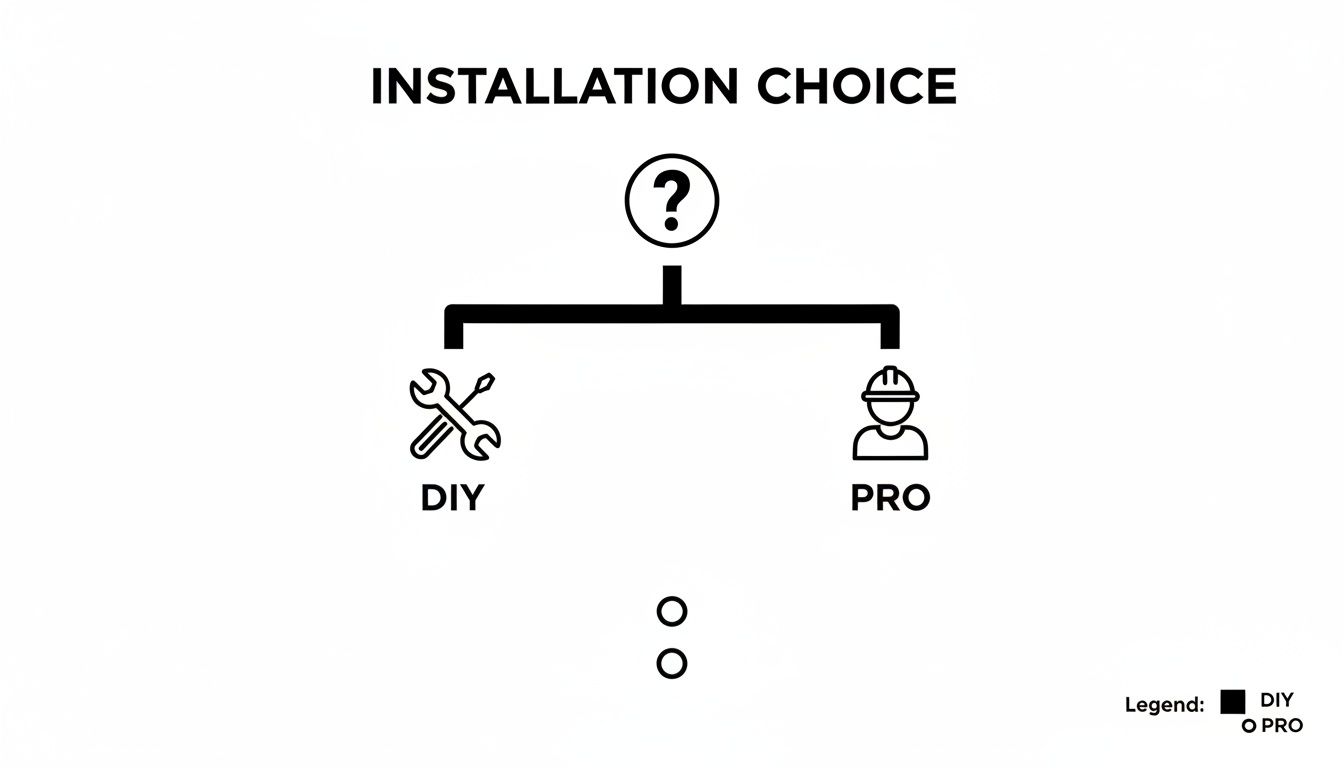
Whether you go the DIY route or hire a pro often depends on the specific flooring material and your own experience and comfort level.
If you're hiring out, here’s what you need to ask to ensure you're working with a true expert:
- Are you fully licensed and insured to work in Georgia?
- Can you provide a portfolio or share some recent, local references?
- Does your quote clearly itemize subfloor prep, old flooring removal, and disposal?
- What is your estimated timeline for this project, from start to finish?
- What kind of warranties do you provide for your installation work?
- How do you manage dust and protect the rest of my home during the install?
- Who will be my single point of contact if I have questions during the project?
Running through this final checklist will put you in the driver's seat. You'll be able to move forward as an informed, prepared homeowner, ready to choose the perfect flooring and the right team to make it happen.
Ready to see your options up close and get an expert opinion? The team at Flacks Flooring is here to guide you through every choice, from picking the right material to a flawless professional installation. We’ll make sure you find the perfect floor for your Cumming, GA, home. Schedule your free in-home consultation today and let our 30 years of experience work for you. Visit us online to get started.