
When you’re picking out the best underlayment for a hardwood floor, the decision really hinges on two things: what your subfloor is made of and what you need the underlayment to do. If you're working with a concrete slab, a moisture barrier isn't just a good idea—it's non-negotiable. For a second-story bedroom, on the other hand, your top priority is probably going to be sound reduction, which points you toward materials like dense felt or rubber.
Why Your Underlayment Choice Defines Your Hardwood Floor's Future
People spend a lot of time choosing the perfect wood species and finish, but the underlayment is arguably the most critical decision you'll make for the long-term health of your floors. This layer is completely hidden, but it’s the single most important factor in preventing costly repairs, stopping those annoying squeaks from developing, and making sure your beautiful new floors feel and perform great for years to come.
A Foundation for Longevity and Performance
Think of underlayment as the foundation for your floor. A house needs a solid base, and your hardwood is no different—it needs a stable, protective layer beneath it. This is especially true here in North Georgia, where our climate adds its own challenges.
A quality underlayment does several key jobs:
- Manages Humidity: It creates a vital barrier against moisture vapor that rises from subfloors, a common headache in Georgia's humid climate that can cause boards to cup and warp.
- Reduces Noise: For homes in Johns Creek or Milton with multiple levels, the right underlayment makes a world of difference in dampening the sound of footsteps, creating a much quieter home.
- Smooths Imperfections: It helps compensate for minor bumps and dips in both wood and concrete subfloors, giving the hardwood planks the flat, stable surface they need.
A well-chosen underlayment doesn't just support your floor; it actively protects it. By managing moisture, sound, and subfloor flaws, it ensures the beauty you see on the surface is built to last.
The Real-World Impact on Your Investment
The value of getting this right becomes crystal clear in practice. Take a family in Milton upgrading a 2,000 sq ft living space. The right underlayment bridges small gaps in the subfloor, eliminating voids that can account for 15% of hardwood failures down the road.
Products with a built-in vapor barrier can block up to 99% of subfloor moisture, which can easily extend the life of your floor by 10-15 years. That's a huge return that also boosts your home's resale value in a competitive market like Forsyth County.
Understanding this long-term impact is a key part of any successful project. For a broader perspective on home upgrades, it's helpful to learn how to plan your home renovation so that every decision contributes to lasting quality. Here at Flacks Flooring, our 30+ years of experience have taught us one thing for sure: making a smart underlayment choice from the start is the key to avoiding future headaches and loving your hardwood floors for a lifetime.
Decoding Underlayment Performance Metrics That Matter
Picking the right underlayment for your hardwood floors is about more than just the material. To really get it right, you need to understand the language of performance. These metrics aren't just technical jargon on a product label; they're the details that dictate how your floor feels, sounds, and holds up in your home.
Think of it like buying a car. You wouldn't just look at the paint job, right? You’d check the horsepower, gas mileage, and safety ratings. Underlayment specs tell you exactly how it’s going to perform day in and day out.
Moisture and Vapor Control
Here in Georgia, with our humidity, moisture is public enemy number one for hardwood floors. Water vapor is always trying to rise up from the ground, especially through concrete slabs. If that vapor hits the underside of your hardwood, it can cause the boards to swell, cup, or even grow mold.
A quality underlayment with a built-in vapor barrier is your first and best line of defense. This is non-negotiable if you're installing over concrete or in a basement. The "perm rating" on these products tells you how good they are at blocking moisture—the lower the number, the better. Skipping this step is just asking for a catastrophic floor failure down the road.
“Hidden vapor from concrete is the silent killer for many hardwood installations. A proper vapor barrier isn't just a recommendation; it's essential insurance against future damage and costly repairs.”
Before you even think about installation, you absolutely must test your subfloor. A little bit of prep work now can save you a massive headache later. You can learn how to test concrete for moisture the right way, which is a small step that prevents huge problems.
Sound Reduction Ratings: IIC and STC
Ever lived in an apartment below someone with hardwood floors? Then you know all about impact noise—the clomping of footsteps, dropped objects, and furniture sliding around. This is where sound ratings are crucial, especially for condos, townhomes, or any second-story room in a Forsyth County home.
You'll see two key ratings on underlayment packaging:
- Impact Insulation Class (IIC): This tells you how well the underlayment muffles impact sounds like footsteps. The higher the IIC number, the quieter it will be for the people below you.
- Sound Transmission Class (STC): This measures how well the material blocks airborne noise, like voices or music, from traveling between floors. Again, a higher STC rating is better.
For multi-level living, you should be looking for an IIC rating of 50 or higher. Some of the better acoustic underlayments can reduce impact noise by as much as 25 decibels, which makes a huge difference in the feel of a home.
Thermal Insulation and R-Value
An underlayment’s thermal resistance is measured by its R-value. People often overlook this, but it’s a big deal for both comfort and energy efficiency. It's especially important for any room that sits above an unheated space, like a garage, crawlspace, or basement.
Simply put, a higher R-value means better insulation. The underlayment acts as a thermal break, stopping the cold from creeping up through the subfloor. This keeps your hardwood feeling warmer underfoot in the winter and can even help trim your heating bills.
For instance, a good cork or dense felt underlayment will have a much better R-value than a basic thin foam sheet. If you're finishing a basement in your Cumming home or putting new floors in a bedroom over the garage, paying attention to the R-value will make that room feel a whole lot more comfortable all year long.
Comparing Hardwood Underlayment Materials for Your Home
Now we get to the heart of it—matching the right underlayment to your home. Once you know what you’re trying to solve for (noise, moisture, cold floors), you can start comparing the most common materials side-by-side. Forget about a one-size-fits-all "best" option; the perfect choice for your hardwood floor depends entirely on your specific house, your subfloor, and what you want to achieve.
Let's move past the generic pros and cons and look at how materials like foam, cork, rubber, and felt actually perform in the real world. This will help you see exactly why one might be a slam dunk for a quiet upstairs bedroom, while another is the only sensible choice for a basement renovation over a concrete slab.
This simple flowchart is a great starting point. It helps you visualize the decision-making process based on what you’re working with and what you need.
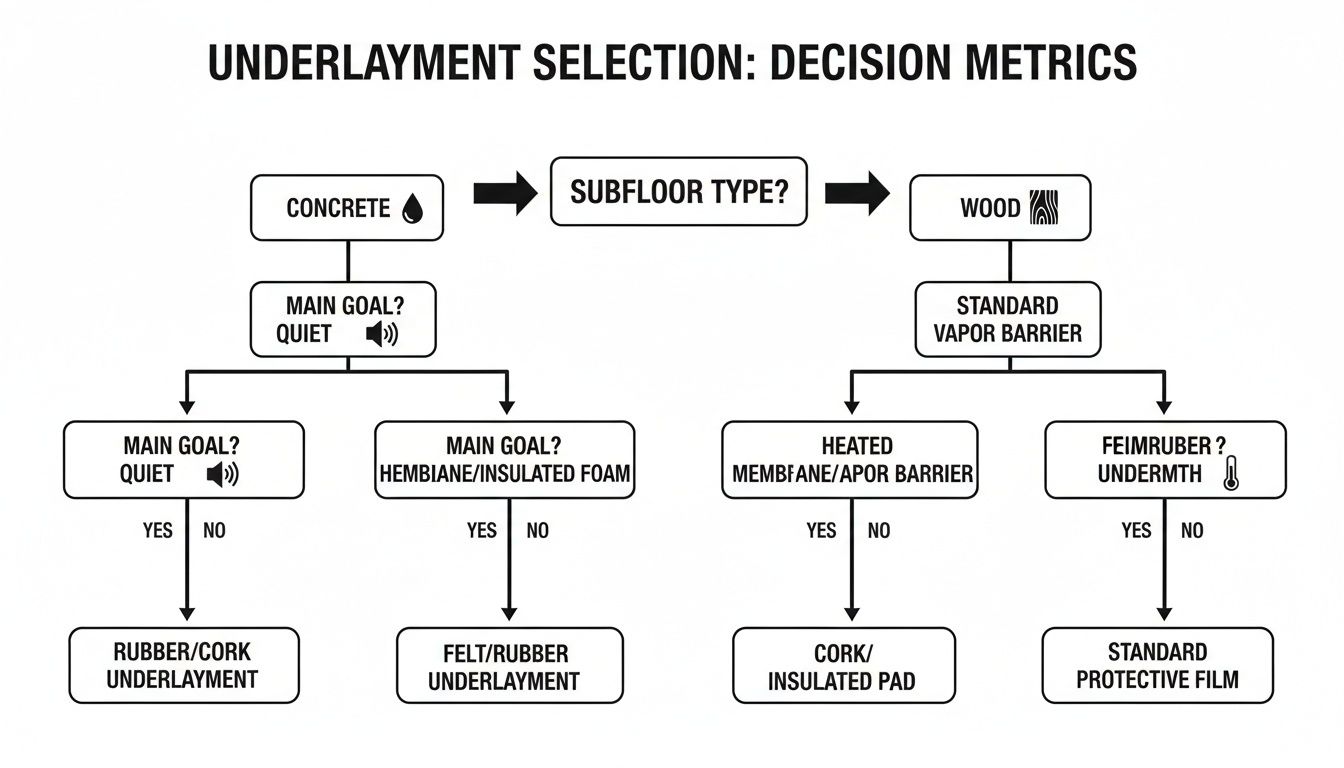
As you can see, the first fork in the road is always your subfloor. From there, your priority—be it acoustics, insulation, or something else—guides the rest of the way.
Foam Underlayment: The Versatile Standard
If you've looked into underlayment at all, you've seen foam. It's one of the most common and wallet-friendly options out there, usually made from polyethylene or polypropylene. For floating engineered hardwood floors, it’s often the default choice, providing a bit of cushioning and smoothing over minor bumps in the subfloor.
But it’s important to know that not all foam is created equal. The most basic sheets are dirt cheap but don’t do much for sound or warmth. On the other hand, you have advanced 3-in-1 underlayments. These products integrate a vapor barrier and have self-sealing adhesive strips, creating a fantastic all-in-one solution, especially for installations over concrete.
A 3-in-1 foam is the perfect fit for a homeowner on a budget who is installing a floating engineered hardwood floor over a concrete slab on the ground floor or in a finished basement.
Cork Underlayment: The Natural Insulator
For a natural, sustainable option, it’s hard to beat cork. Harvested from the bark of cork oak trees, its unique honeycomb-like structure is full of tiny air pockets. This makes it an incredible thermal and acoustic insulator. If your main goal is to make a room feel cozier underfoot and deaden sound, cork should be at the top of your list.
Cork is also naturally antimicrobial and resists mold and mildew—a huge plus here in Georgia's humid climate. It's surprisingly dense, too, giving your floor firm support that protects the locking systems while still absorbing sound vibrations effectively.
Cork is, hands down, the best choice for thermal insulation. It creates a thermal break that stops the chill from a concrete subfloor from seeping through, making basement rooms and bonus rooms over the garage feel worlds more comfortable.
Rubber Underlayment: The Soundproofing Champion
When quieting a space is your absolute number one priority, rubber is the undisputed king. Made from recycled tires, this stuff is incredibly dense and heavy, which allows it to absorb and block sound waves far more effectively than any other material. You’ll really notice the difference in reducing impact noise, like footsteps, which is a game-changer for multi-story homes and condos.
Rubber also happens to be extremely resistant to moisture, making it a great two-for-one solution. With the global underlayments market expected to hit USD 39.42 billion by 2032, you can bet that high-performance, moisture-resistant materials like rubber are a big reason why—especially in renovation-heavy areas like Forsyth County. You can dive deeper into these trends in this detailed industry report.
For a second-story bedroom, a home office, or any room in a condo, dense rubber underlayment is the best investment you can make for a truly quiet and peaceful home.
Felt Underlayment: The Dense and Durable Classic
Don't overlook recycled felt. This is another fantastic option, prized for its density and long-term durability. It delivers impressive sound absorption and solid thermal insulation. Since it’s made from recycled fibers, it’s also an eco-conscious choice. Felt provides a firm, stable foundation that works well for both floating and traditional nail-down hardwood floors.
Its dense composition is great at soaking up sound, and it has a high crush resistance. That means it won’t get squashed down over time, even under heavy furniture, ensuring your floor feels solid and supported for decades.
Hardwood Underlayment Performance Comparison
To pull it all together, this table gives you a quick snapshot of how each material performs across the key metrics that matter most to homeowners around here.
| Material Type | Primary Benefit | Best For Subfloor | Sound Reduction | Moisture Protection | Average Cost |
|---|---|---|---|---|---|
| Foam | Cost-Effective & Versatile | Wood or Concrete | Fair | Good (with barrier) | $0.25 – $0.75/sq ft |
| Cork | Thermal Insulation | Wood or Concrete | Good | Fair | $0.50 – $1.00/sq ft |
| Rubber | Superior Soundproofing | Wood or Concrete | Excellent | Excellent | $0.75 – $1.50/sq ft |
| Felt | Sound Dampening & Firmness | Wood | Very Good | Fair | $0.60 – $1.20/sq ft |
This comparison really highlights the trade-offs between cost and performance. While basic foam is the easy choice for your budget, spending a bit more on cork, rubber, or felt can bring significant upgrades in comfort and quietness—benefits you’ll appreciate every single day. Ultimately, the best underlayment for your hardwood floor is the one that solves your home's unique challenges.
Real-World Scenarios for North Georgia Homeowners
Choosing the right underlayment for your hardwood floor stops being theoretical the moment you start looking at your own home. What works perfectly for a new build in Milton might be the wrong choice entirely for a basement finishing project over in Cumming.
Let's walk through a few common situations we see all the time with North Georgia homeowners. Seeing how these materials solve real-world problems will help you pick the right one for your space with total confidence.
Scenario 1: The Finished Basement in Johns Creek
A finished basement is a fantastic addition to any home, but it brings one huge challenge to the table: concrete subfloors. Concrete is naturally porous and wicks moisture from the ground, which is public enemy number one for any hardwood floor. Your absolute top priority here is moisture control.
- The Subfloor: Poured concrete slab, below ground level.
- The Challenge: Constant moisture vapor from the ground and a cold, unforgiving surface.
- The Goal: Create a bulletproof moisture barrier and add a layer of thermal insulation for comfort.
For this job, a 3-in-1 foam underlayment is a smart, budget-friendly solution. The built-in vapor barrier is non-negotiable for protecting your wood, and the foam itself provides a nice thermal break to cut the chill you feel from the concrete.
If you have a bit more room in your budget, upgrading to a dense rubber underlayment is an even better move. Not only does it offer incredible moisture resistance, but it also provides world-class sound dampening—a huge plus if that basement will be a home theater or a playroom for the kids.
Scenario 2: Soundproofing a Second-Story Bedroom in Milton
In any two-story home, noise traveling between floors is a common complaint. The sound of footsteps, a dropped toy, or even just someone walking across an upstairs bedroom can easily disrupt the peace and quiet downstairs. Your main goal here is purely acoustic.
- The Subfloor: Standard plywood or OSB.
- The Challenge: Impact noise (like footsteps) traveling straight through the floor to the living area below.
- The Goal: Absorb as much sound as possible to make the whole house feel quieter and more peaceful.
This is exactly where a high-density rubber underlayment proves its worth. Its sheer weight and density are second to none when it comes to absorbing the vibrations from footfalls. Investing in quality rubber can cut impact noise by 20-25 decibels, a massive reduction that you can genuinely hear and feel.
A strong runner-up is a thick, recycled felt underlayment. While it's not quite on the same level as rubber, its dense, fibrous structure is fantastic for deadening sound. It also gives the floor a very firm, solid feel underfoot that many people really appreciate.
Scenario 3: Renovating an Older Home in Cumming
Older homes around Forsyth County are full of charm, but that charm often comes with subfloors that are far from perfect. You're likely to find minor unevenness, small dips, or boards that have settled over the decades. The underlayment here has to pull double duty, correcting for those imperfections while adding modern comfort.
- The Subfloor: Older wood planks that may be slightly uneven.
- The Challenge: Minor subfloor flaws and poor insulation, which can make rooms feel drafty.
- The Goal: Smooth out the subfloor for a flat, stable installation and add a much-needed layer of warmth.
For older homes with imperfect subfloors, the underlayment's role shifts from a simple barrier to a foundational corrector. It must provide stability and bridge minor gaps to ensure the new hardwood lays flat and performs beautifully for years to come.
In this situation, cork underlayment is the perfect fit. Its natural ability to compress allows it to absorb minor subfloor variations, creating a stable and solid base without feeling mushy. Cork is also a fantastic thermal insulator (it has a high R-value), so it will add a noticeable layer of warmth and make the entire room feel cozier. If you're looking for a floor that pairs well with these conditions, our guide to the best engineered hardwood can help you match the right foundation with the right flooring.
By picturing your own home in these scenarios, you can start to zero in on what you truly need. Whether you're fighting moisture in the basement, quieting a noisy second floor, or adding comfort to an older home, there’s an underlayment designed to solve the unique challenges of your North Georgia project.
A Flawless Finish Starts With What's Underneath
Even the absolute best underlayment can't save a bad installation. You're making a significant investment in your hardwood floors, and that deserves more than just a good product—it requires an expert touch to actually work as intended. Think of this less as a DIY manual and more as an owner's guide to recognizing quality work, so you can ask the right questions and know what to look for.
Believe it or not, protecting your hardwood begins long before the first roll of underlayment is even brought into the room. It all starts with the subfloor. That's the real foundation of your entire flooring system. Trying to install a floor on a subfloor that's uneven, dirty, or holding moisture is a non-starter.
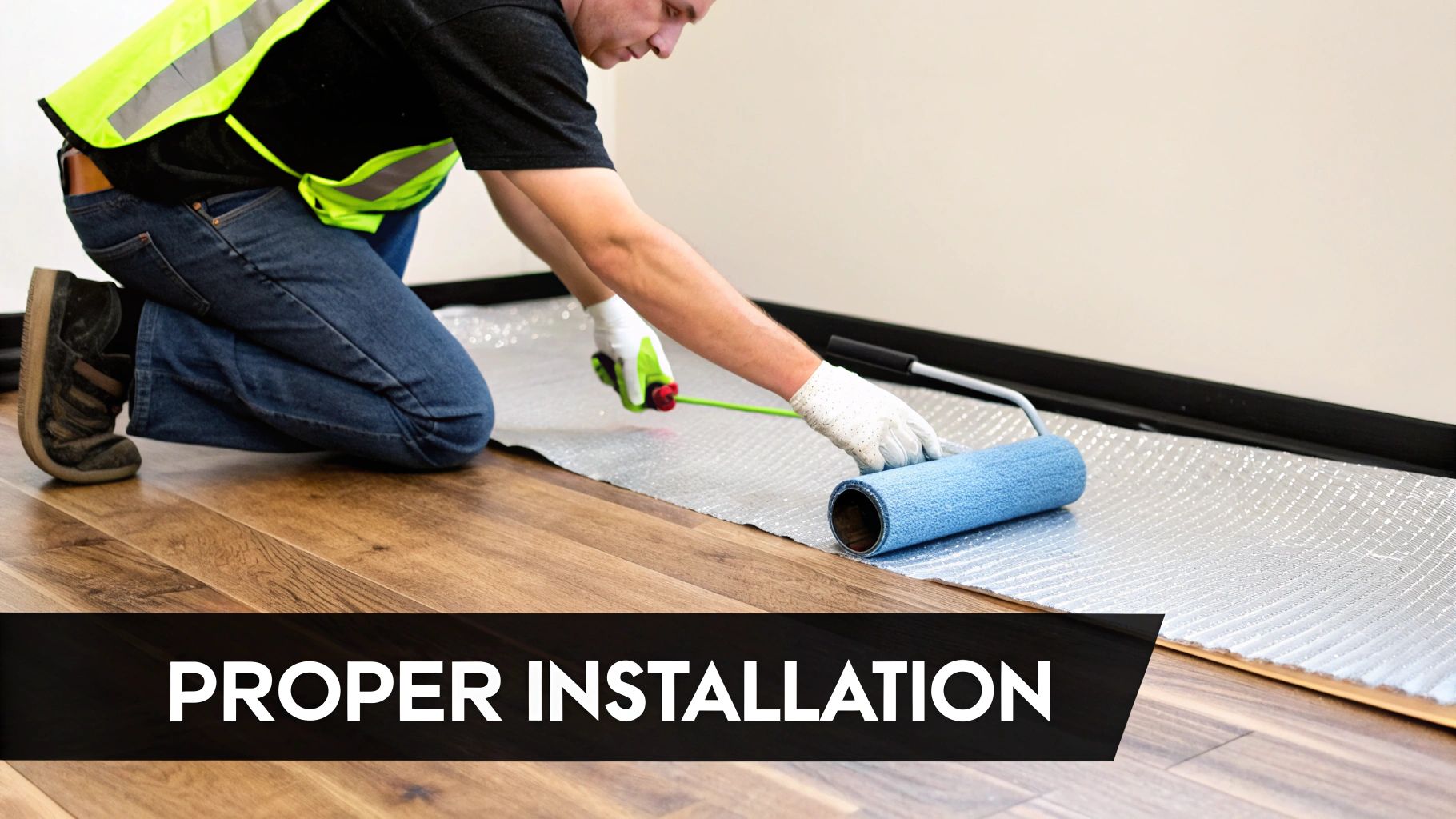
This foundational work isn't just a suggestion; it's non-negotiable. In our experience, skipping proper subfloor prep is the number one reason floors fail, leading to everything from annoying squeaks to floors that buckle and warp.
Getting the Subfloor Ready for Prime Time
Proper subfloor preparation is, without a doubt, the most critical part of the entire job. Before anything else happens, the subfloor absolutely must be clean, flat, and dry. This means a crew should be thoroughly sweeping and vacuuming to get rid of every last bit of dust and debris that could create a high spot or mess with adhesion.
Next, it’s all about flatness. The industry standard is that the subfloor can’t vary by more than 3/16 of an inch over a 10-foot span. Any high spots have to be sanded down, and every little dip or low spot needs to be filled with a professional-grade leveling compound.
Finally, moisture testing is a must, especially over concrete slabs. It’s a step we never skip. For a deeper dive into this critical process, we've put together a guide on hardwood floor installation on concrete. Trust me, ignoring what's going on in your subfloor is just asking for trouble down the road.
Why Seam Sealing Is a Big Deal
When you’re using an underlayment with a built-in vapor barrier, the way the seams are handled is everything. It's the difference between an effective moisture shield and a useless sheet of plastic. The entire point is to create one continuous, unbroken barrier that moisture can't possibly sneak through.
To do that right, every single seam between the rolls has to be meticulously sealed with a tape approved by the manufacturer. This isn't just a "nice to have"—it's the only way the vapor barrier can do its job. A pro installer will take their time here, ensuring a perfect, airtight seal along every inch.
An unsealed seam in a vapor barrier is like a hole in the bottom of a boat. It might not sink right away, but it completely defeats the purpose and leaves your beautiful hardwood vulnerable to long-term moisture damage.
Common Pitfalls to Watch Out For
Beyond the big two—subfloor prep and seam sealing—a few other common mistakes can completely undermine your underlayment. Knowing what they are helps you spot quality work from a mile away.
- Wrong Thickness: Using an underlayment that’s too thick for your specific hardwood is a classic mistake. It creates a "spongy" or soft feeling when you walk on it, which puts a ton of stress on the tongue-and-groove joints. This leads to squeaks, gaps, and eventually, a failing floor. Always stick to the flooring manufacturer’s specs.
- Overlapping Seams: This one’s simple: underlayment seams should butt up against each other snugly. They should never overlap. Overlapping creates a ridge that telegraphs right through to the finished floor, creating an uneven surface you can see and feel.
- Forgetting Expansion Gaps: Wood is a natural material; it expands and contracts with humidity changes. A 3/8" to 1/2" expansion gap must be left around the entire perimeter of the room. This space gives the floor room to breathe without buckling under pressure.
Driven by renovation booms in areas like Georgia's Forsyth County, the global floor underlayment market is set to grow steadily. With the market projected to expand from USD 1,449.9 million in 2025 and continue at a 3.6% CAGR through 2033, homeowners are increasingly seeing the value of premium materials. They are recognizing that products like cork underlayment, which offer superior sound insulation and comfort, are worth the investment when paired with a quality installation.
Answering Your Top Underlayment Questions
Once you’ve waded through all the material options and performance factors, you’re often left with a few lingering questions. It’s completely normal. Think of this as the final check-in, where we tackle those common "what ifs" that pop up right before you pull the trigger.
We hear these questions all the time from our clients across Cumming and Johns Creek, so let's clear them up and give you the confidence to move forward.
Do I Always Need Underlayment for Hardwood Floors?
In almost every single case, the answer is yes. While you might find some engineered hardwood products with a pre-attached pad, the overwhelming majority of floors—both solid and engineered—need a separate underlayment. It’s your first line of defense against moisture, a critical sound dampener, and it helps smooth out the minor imperfections you’ll find in any subfloor.
For traditional nail-down jobs, builders used to just use rosin paper to stop squeaks. But today, especially over a concrete slab or with any floating floor, a quality underlayment with an integrated vapor barrier is non-negotiable. Skipping it is a surefire way to void your flooring’s warranty and invite serious headaches like cupping, gapping, or even mold.
Think of underlayment as an insurance policy for your flooring investment. It’s a small upfront cost that prevents huge, expensive problems down the line.
Can I Use Carpet Padding Under My Hardwood?
Let me be direct: absolutely not. Carpet padding is engineered to be soft and squishy to give carpet that comfortable feel underfoot. That is the exact opposite of what a rigid material like hardwood needs. Your wood floor requires a firm, dense foundation to stay stable.
When you put a soft, spongy layer underneath, the floor has too much give. Every step causes the planks to flex, putting enormous stress on their tongue-and-groove joints. Before you know it, that constant movement will break the locking system, leading to squeaky spots, noticeable gaps, and a floor that has essentially failed. Always stick to underlayment specifically made for hardwood.
How Does Underlayment Thickness Affect My Floor?
Thickness is a balancing act, and it’s one of the most critical factors for your floor's long-term health. This is one area where "more" is definitely not "better."
- Too Thick: If the underlayment is too thick, your floor will feel bouncy and unstable. That excessive flex puts constant strain on the joints, causing them to weaken and eventually fail.
- Too Thin: On the flip side, an underlayment that’s too thin won't offer enough sound insulation or do a good job of smoothing over small dips and bumps in the subfloor, which defeats its purpose.
The golden rule is to follow the flooring manufacturer’s specifications. For most floating installations, they’ll recommend something in the 2mm to 3mm range. Getting the thickness just right ensures your floor feels solid, performs well, and has the support it needs to last for decades.
Navigating these decisions is what we do every day. If you're ready to find the perfect foundation for your new hardwood floors, the team at Flacks Flooring is here to provide expert guidance tailored to your home's unique needs. Contact us today to schedule your consultation.