
Choosing the best underlayment for hardwood floors isn't a one-size-fits-all situation. The right choice really comes down to your subfloor, the specific hardwood you're installing, and what you’re trying to achieve—be it serious moisture protection or just dampening some noise. For a concrete subfloor, you absolutely need an underlayment with a built-in vapor barrier. For a traditional nail-down solid hardwood installation over plywood, felt is often the go-to choice for pros.
The Unseen Hero of Your Hardwood Floors
While you’ll get all the compliments on the beautiful grain and finish of your new hardwood, it's the thin layer of underlayment beneath that’s quietly doing all the hard work. Think of it as the unsung hero, the essential foundation protecting your entire flooring investment. Cutting corners here by skipping it or grabbing the wrong type is a classic mistake that almost always leads to headaches and expensive repairs later.
To understand why it's so important, you have to see underlayment for what it is: not just a simple sheet of foam, but an engineered material designed to prevent problems before they even start. A quality underlayment is your first line of defense against the most common things that can go wrong with a hardwood floor.
Core Functions of Hardwood Underlayment
The right product really serves three critical functions, and each one plays a huge part in how your floors look, feel, and last over time.
- Moisture Protection: This is probably the most crucial job, especially here in Georgia with our humidity. Underlayment acts as a shield, stopping moisture vapor from wicking up from the subfloor—especially concrete—and wrecking your wood. Without it, you’re looking at cupping, warping, and even mold.
- Sound Absorption: Hardwood floors can be noisy, turning simple footsteps or a dropped toy into loud thuds. Underlayment helps absorb that impact sound, making your home significantly quieter and more serene. You’ll really notice the difference in a two-story house or a condo.
- Comfort and Stability: It adds a slight cushion underfoot that makes the floor more comfortable to stand on and reduces fatigue. It also bridges minor imperfections in the subfloor, giving the hardwood planks a perfectly flat and stable surface to lie on, which is key for a tight installation.
"Underlayment acts as both shock absorber and shield. It protects against sound transmission, subfloor imperfections, and environmental changes that can affect wood stability."
Getting the underlayment right is just as vital as the other important factors when choosing the best flooring for your living room. It's a decision that protects your investment and genuinely improves how your home feels.
Why Your Subfloor Material Matters Most
Before you even look at underlayment options, you have to know what your subfloor is made of. This is the single most important factor. What works for a plywood subfloor is completely wrong for a concrete slab.
| Subfloor Type | Primary Challenge | Recommended Underlayment Focus |
|---|---|---|
| Concrete Slab | High moisture transmission from the ground. | Vapor Barrier is Non-Negotiable. Must have a 6-mil poly film or integrated barrier. |
| Plywood/OSB | Lower moisture risk, potential for squeaks. | Firmness and Vapor Control. Felt for nail-down; foam/cork for floating floors. |
Comparing the Top Hardwood Underlayment Materials
Choosing the right underlayment for your hardwood floors isn't just about checking a box; it's about understanding how different materials perform in the real world. While you'll find plenty of options out there, four materials really dominate the landscape: foam, felt, cork, and rubber. Each has its own strengths and is designed for specific situations, from a straightforward floating floor installation to a high-end living space where soundproofing is critical.
Getting this choice right is fundamental to protecting your flooring investment. The underlayment you select has a direct impact on everything from how the floor feels underfoot and how much noise travels between rooms to the long-term health of the wood itself.
The image below shows the three main jobs every underlayment is designed to do.
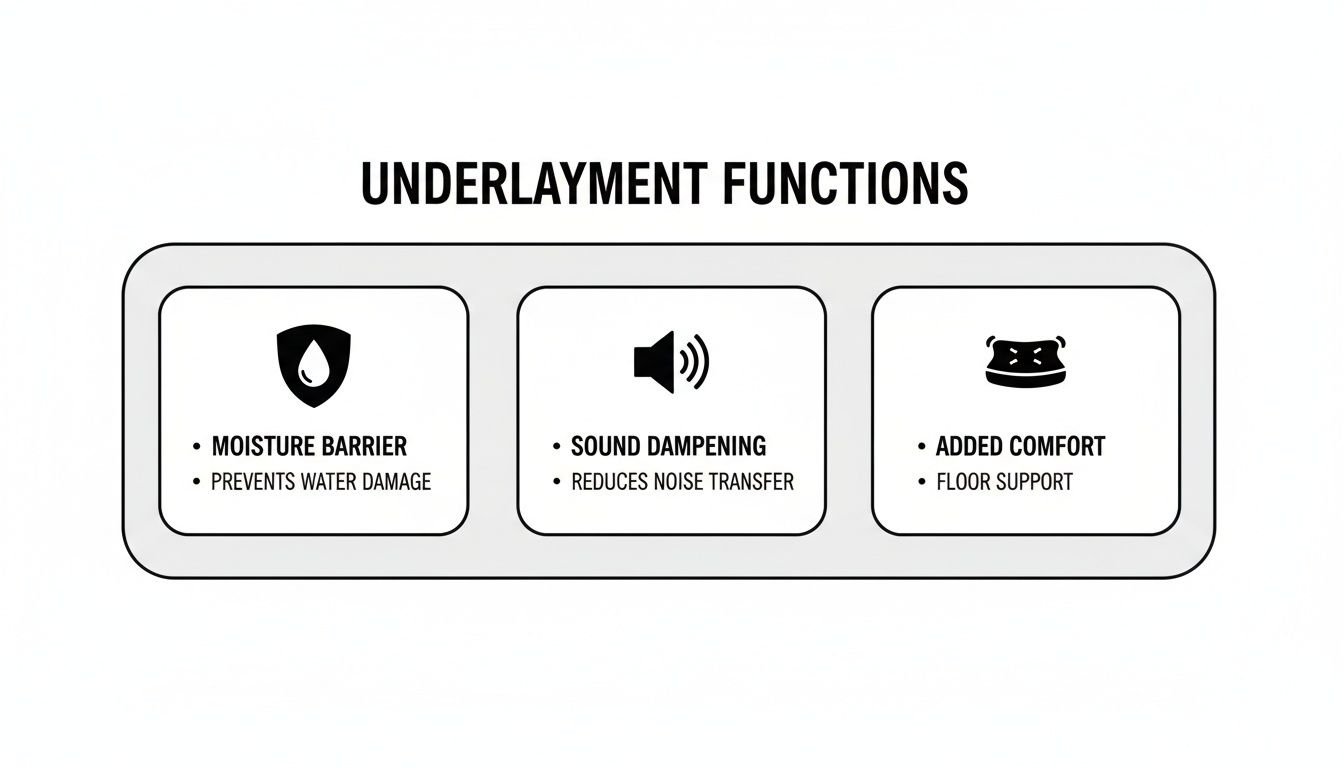
This visual is a great breakdown of how underlayment provides essential moisture protection, sound dampening, and comfort—the true foundation of a great hardwood floor installation.
Foam Underlayment: The Go-To for Floating Floors
Foam is easily the most common and budget-friendly underlayment you'll come across, and it's almost always used for floating engineered hardwood floors. Its main purpose is to give just enough cushion to let the floor "float" over the subfloor, smoothing out minor bumps and getting rid of that hollow sound.
Most foam rolls come with a built-in vapor barrier, which is a thin plastic film that stops moisture from seeping up from below. This is a huge plus for installations over concrete slabs, a common subfloor in many Forsyth County homes. Just keep in mind that standard foam provides very little in the way of serious sound insulation compared to denser, heavier materials.
Best Scenario For Foam:
- Engineered hardwood that will be installed using a floating method.
- Budget-conscious projects where you just need basic moisture protection and a little cushioning.
- Ground floor or basement installations over concrete, as long as it has a quality vapor barrier attached.
Felt Underlayment: The Professional's Choice for Nail-Down Hardwood
Ask any seasoned flooring pro what they prefer for a nail-down solid hardwood job, and you'll probably hear "felt." Made from recycled fibers, this underlayment is incredibly dense and stands up to compression, which is non-negotiable for this type of installation. If you use a soft, squishy underlayment, the boards will have too much give, causing the nails to loosen over time and leading to those infamous squeaks.
While it offers fantastic durability and decent sound dampening, standard felt is not a moisture barrier. For jobs over a potentially damp space like a crawl space, you’ll often see it paired with a separate layer of rosin paper to slow down moisture vapor.
Felt’s density provides a rock-solid foundation for nail-down floors that softer materials just can't deliver. It supports the boards firmly, preventing the tiny movements that cause squeaks and put long-term stress on the joints.
This material also "breathes," which allows small amounts of moisture vapor to escape—a benefit when installed over traditional wood subfloors. Its real strength is creating a firm, stable base that gives you that classic, solid feel of traditional hardwood.
Cork Underlayment: The Eco-Friendly Acoustic Solution
In recent years, cork has become a premium, eco-friendly option that truly shines in both thermal and acoustic insulation. It's a renewable resource harvested from the bark of cork oak trees, and its performance is impressive. The natural cellular structure of cork is a master at absorbing sound vibrations, making it one of the best underlayments for hardwood floors when noise control is a major concern.
A good cork underlayment can dramatically cut down on impact noise, like footsteps, which makes it perfect for second-story rooms, condos, and home offices. It also adds a noticeable amount of thermal insulation, helping your floors feel warmer, especially over a chilly basement or concrete slab.
Key Advantages of Cork:
- Superior sound dampening, making it ideal for multi-level homes.
- Natural thermal insulation properties, which boost comfort and can even help with energy bills.
- Hypoallergenic and antimicrobial, meaning it naturally resists mold and mildew.
Just be aware that while cork is moisture-resistant, it isn't waterproof. If you're installing it directly over concrete, you absolutely must put down a separate 6-mil polyethylene vapor barrier first to give your hardwood complete protection.
Rubber Underlayment: The Ultimate in High-Performance Flooring
When you need the absolute best in durability and sound isolation, rubber underlayment is the top-of-the-line solution. It's the densest material available and offers the highest level of sound absorption you can get. This makes it the go-to choice for luxury homes, home theaters, music studios, or condos with strict sound transmission codes.
Rubber is incredibly tough and won't break down or compress over time, even under the weight of heavy furniture or in high-traffic areas. This ensures your hardwood floor stays perfectly stable and supported for decades. The sheer density also gives the floor an exceptionally solid and grounded feel when you walk on it.
This level of performance does come with a higher price tag, but the results often speak for themselves. The global floor underlayment market, valued at around $1.5 billion in the mid-2020s, continues to grow because homeowners in places like Cumming, Johns Creek, and Milton understand that underlayment is an investment. This growth has led to innovations like better R-values for warmth and decibel reduction ratings that often show 15–25 dB improvements. Spending an extra $0.50–$2.00 per square foot on a premium underlayment now can save you from costly repairs down the road and even boost your home's resale value. You can find more details on this growing industry at OpenPR's market analysis.
Underlayment Performance Comparison Guide
To make the decision easier, this table breaks down how each material stacks up based on the most important performance factors. Evaluate your project needs against these metrics to find the perfect match.
| Underlayment Type | Best For | Sound Reduction | Moisture Protection | Typical Cost/Sq. Ft. | Ideal Installation Method |
|---|---|---|---|---|---|
| Foam | Floating engineered floors on a budget | Low | Good (with VB) | $0.25 – $0.60 | Floating |
| Felt | Nail-down solid hardwood for maximum stability | Moderate | Low (permeable) | $0.40 – $0.75 | Nail-Down |
| Cork | Sound/thermal insulation on upper levels | High | Moderate (resists) | $0.70 – $1.50 | Floating, Glue-Down |
| Rubber | Ultimate soundproofing and high-traffic durability | Highest | High (impermeable) | $1.00 – $3.00+ | Floating, Glue-Down |
Ultimately, the goal is to select an underlayment that not only fits your budget but also provides the specific protection and performance features your new hardwood floor needs to last a lifetime.
Matching Underlayment to Your Hardwood Type
When it comes to your new floors, here's the golden rule: the hardwood always picks the underlayment, never the other way around. This isn't just a technical detail; it's the foundation of a long-lasting installation. Solid and engineered hardwoods are built differently and installed using completely different methods, which means their support needs are worlds apart.
One type needs a firm, unyielding base. The other thrives on a bit of cushioned flexibility. Getting this pairing wrong is one of the most common—and costly—mistakes I see. An incompatible underlayment can cause everything from annoying squeaks to a complete floor failure down the road. Let's break down why these two popular hardwood options demand such different foundations.
Underlayment for Solid Hardwood Installations
Think about traditional solid hardwood. It’s almost always nailed or stapled directly into a wooden subfloor. For this kind of installation, the best underlayment for hardwood floors is thin, dense, and won't compress. Its job is to act as a moisture-retarding layer and a slight buffer, not to add a cushy feel underfoot.
Putting a soft, spongy foam underlayment beneath a nail-down floor is a recipe for disaster. Every time you walk across the floor, that slight vertical squish will slowly work the nails or staples loose from the subfloor. Before you know it, you've got a symphony of creaks, squeaks, and boards that just don't feel solid anymore.
That's why flooring pros stick to one of two main options for nail-down jobs:
- Felt Underlayment: This is the industry go-to. Made from recycled fibers, felt is incredibly dense and resists being squashed flat. It creates that rock-solid base needed to keep planks and fasteners locked in place, and it offers a bit of sound dampening as a bonus.
- Rosin or Vapor Paper: This is your basic, no-frills option. It's mainly there to keep the hardwood from rubbing directly against the subfloor, which helps minimize dust and potential squeaks. It provides very little moisture resistance but gets the job done on a budget.
Don't forget that the wood itself matters. Different species have their own unique stability characteristics. A good guide to hardwood species can show you how woods like oak or hickory react to their environment, which really drives home why a stable foundation is so non-negotiable.
Supporting Engineered Hardwood Floors
Engineered hardwood, particularly when installed as a "floating" floor, plays by a completely different set of rules. Since the planks aren't nailed down, they rely on the underlayment to provide cushion, support their click-lock joints, and absorb sound.
This is where materials like foam, cork, and rubber really shine. They help smooth out minor imperfections in the subfloor, add a comfortable spring to your step, and dramatically cut down on footstep noise. That slight give they provide is crucial for a floating system, allowing the entire floor to expand and contract as one big sheet when the humidity changes.
The market has heavily shifted in this direction. In fact, engineered wood now accounts for about 75% of the wood flooring market. These modern, prefinished floors are typically floated or glued down, and the manufacturer will specify exactly which underlayments are compatible. For instance, floating floors call for options like polyethylene foam, cork, or special rubber, which can run anywhere from $0.30 to $2.00 per sq ft. As you can see from trends covered by industry sources like FCNews, getting this match right is critical for avoiding callbacks and keeping your warranty intact.
The flooring dictates the underlayment, not the other way around. A nail-down installation needs firmness to prevent fastener failure, while a floating floor needs cushion to support its locking system and enhance comfort.
Understanding this fundamental difference is the absolute key to a successful installation. If you try to force the wrong underlayment on a hardwood floor, you’re building an unstable system that's destined to have problems. By matching the underlayment to the wood and the installation method, you're ensuring your floors will perform exactly as designed for years to come.
Solving for Moisture and Sound Control
When it comes to choosing the best underlayment for hardwood floors, we're really talking about tackling two big enemies: moisture and noise. These aren't just minor details—they're the factors that will decide whether your beautiful new floors last for decades or start causing problems in just a few years. Getting these two things right is how you protect your investment and keep your home quiet and comfortable.
The first step is realizing that not all protective layers are the same. A simple moisture barrier is designed to slow down water vapor, and that's often good enough over a standard wood subfloor. But a vapor retarder is in a completely different league. It’s engineered to block significant moisture, making it an absolute must for installations over concrete slabs, which we see all the time in Georgia homes.

Mastering Moisture Protection
Moisture is, without a doubt, the number one killer of hardwood floors. A concrete slab that looks and feels perfectly dry can still release enough water vapor to make your new planks cup, warp, or even grow mold underneath. This is exactly why professionals never, ever skip pre-installation moisture testing. We use meters to get hard data on the moisture levels in both the subfloor and the wood itself, which tells us precisely what kind of protection is needed.
For tricky areas like basements, you have to think about the entire flooring system. In these below-grade spaces, it's critical to look at the best flooring options for basements to ensure every single layer can handle the unique environment. Putting engineered hardwood down there demands a serious strategy, usually involving a high-performance underlayment with a sealed, built-in vapor barrier. If you're thinking about a project like this, our guide on using engineered hardwood in a basement gives very specific advice for getting a successful, long-lasting result.
Never assume a subfloor is dry enough just because it looks or feels that way. Sub-surface moisture is invisible, and only proper testing can reveal the true conditions your hardwood will face.
Decoding Sound Control Ratings
After moisture, effective sound control is what really separates a decent installation from a truly great one. You’ll see a lot of vague claims like "quiets floors," but that doesn't tell you much. To really understand what you're buying, you need to look at the technical specs.
There are two key ratings you need to know:
- IIC (Impact Insulation Class): This number tells you how well the underlayment muffles impact sounds—think footsteps, dropped toys, or scooting chairs. A higher IIC rating is better, and it's especially important for second-story rooms or condos.
- STC (Sound Transmission Class): This rating measures how effectively the underlayment blocks airborne noise, like voices or music, from passing through the floor to the room below.
These numbers give you real, concrete information. For example, a quality cork or rubber underlayment can cut impact noise by around 15–25 dB, which is a very noticeable difference. At the same time, spending an extra $1.00–$1.50 per sq ft on a high-performance underlayment can eliminate noise complaints and prevent thousands of dollars in moisture-related repairs down the road. By understanding these ratings, you can pick an underlayment that you know will deliver the peace, quiet, and protection you're paying for.
Your Decision Checklist for the Right Underlayment
Choosing the right underlayment can feel like you're getting lost in the weeds, but it gets a lot easier when you know the right questions to ask. Think of this checklist as a simple framework to walk you through the decision. It’s designed to help you have a productive conversation with your flooring pro and make sure no stone is left unturned for your project.

When you work through these points one by one, you'll feel confident that you’re picking an underlayment that’s a perfect match for your home, your new floors, and what you expect them to do.
Question 1: What Is My Subfloor Material?
Everything starts here. Your subfloor material sets the ground rules for what you need.
- Concrete Slab: Moisture protection is your absolute top priority. You must choose an underlayment with a built-in vapor retarder or put down a separate 6-mil polyethylene film first. This isn't optional—it's what stops your beautiful new wood from cupping and warping down the line.
- Plywood or OSB: The moisture risk isn't as high, but a vapor-retarding underlayment is still a smart move, especially over a crawl space or with our humid Georgia climate. Here, the focus also includes making sure the underlayment is right for how you plan to install the floor.
Question 2: What Type of Hardwood Am I Installing?
The way your hardwood planks are made directly impacts the kind of support they need from underneath.
- Solid Hardwood: This classic flooring is almost always nailed down. That means it needs a thin, firm, and dense underlayment like felt that won’t compress over time. If you use something soft and squishy, the fasteners will eventually loosen, and you'll be dealing with annoying squeaks.
- Engineered Hardwood: This is the flexible option—it can be floated, glued, or stapled. Floating floors are the most common, and they pair perfectly with a cushioned underlayment like foam, cork, or rubber. This type of underlayment supports the click-lock mechanism, makes the floor more comfortable, and does a great job absorbing sound.
The rule is simple: the flooring dictates the underlayment. Solid hardwood demands firmness and stability, while engineered hardwood often benefits from cushion and flexibility. Mismatching them is a recipe for long-term flooring failure.
Question 3: What Are My Primary Performance Goals?
Once you've covered the basics, think about what else you want from your floor. Pinpointing your top priority helps you zero in on the best possible option.
- Ultimate Sound Reduction: If you want to quiet the sound of footsteps in a two-story home, it’s worth investing in premium materials like cork or rubber. Their dense structure is excellent at dampening sound, something you can verify with a high IIC rating.
- Maximum Moisture Proofing: For a basement project or any installation over concrete, you need a bulletproof vapor seal. Look for underlayments that have a robust, integrated vapor barrier and specify that the seams should be taped.
- Enhanced Comfort and Warmth: To take the chill off a floor, especially one over a cold basement, a cork underlayment is a fantastic choice. It provides really good thermal insulation, making the floor feel warmer and more pleasant to walk on.
- Budget-Focused Project: Need a solid, no-frills solution for a floating engineered floor? A standard foam underlayment with an attached vapor barrier strikes a great balance, giving you reliable performance without breaking the bank.
Answering these questions turns a confusing choice into a clear path forward and helps you have an informed discussion. Of course, for tricky situations, nothing beats a final expert opinion. A thorough evaluation during the professional floor installation process can catch unique subfloor issues that might call for a more specialized solution, guaranteeing a perfect foundation for your beautiful new floors.
Common Questions About Hardwood Underlayment
After digging into the details, you probably still have a few questions about picking the best underlayment for your hardwood floors. Let's run through some of the most common things we hear from homeowners right here in Cumming and Forsyth County. These are the quick, clear answers you need to get your project across the finish line with confidence.
Do I Really Need Underlayment for Hardwood Floors?
In almost every scenario, yes. Think of it as non-negotiable. For any floating floor installation, underlayment is mandatory. It provides the cushioning, stability, and crucial support for the floor's locking system—without it, the floor simply can't work as designed.
When it comes to traditional nail-down solid hardwood, you’ll need a vapor-retarding layer like felt or rosin paper. This simple layer is critical for blocking moisture creeping up from the subfloor and it also stops the wood-on-wood contact that eventually leads to annoying squeaks.
And if your floor is going over a concrete slab? A moisture-blocking underlayment is absolutely essential. Trying to skip this step is a recipe for disaster. It won't just void your warranty; it invites mold and practically guarantees your beautiful new floor will warp or cup down the road.
Can I Just Use the Same Underlayment for Any Hardwood?
That’s a common misconception, and getting this wrong can ruin a flooring project. Solid hardwood that's nailed or stapled down needs a thin, firm underlayment that won’t compress. If you put something soft and squishy underneath, you introduce vertical movement that loosens the fasteners over time, leading to squeaky, unstable boards.
Engineered hardwood, on the other hand, is a different story, especially when it's installed as a floating floor. It pairs perfectly with cushioned options like foam, cork, or rubber. These materials make the floor more comfortable to walk on, absorb footstep noise, and give the flooring system the slight flexibility it needs.
One of the biggest mistakes we see is assuming one underlayment fits all. Solid hardwood demands a firm foundation to hold fasteners tight, while floating engineered floors need a resilient cushion to perform properly. They are not interchangeable.
What’s the Best Underlayment to Make My Floors Quieter?
If noise reduction is your main goal, cork and rubber are the champions, hands down. They are fantastic at deadening impact sounds, like the sound of footsteps traveling to the floor below. Both materials are naturally dense and have incredible acoustic properties that absorb vibrations far better than basic foam.
This is measured with an IIC (Impact Insulation Class) rating, and both cork and rubber consistently earn top scores. If you’re trying to create a quieter home, spending a bit more on a quality cork or rubber underlayment delivers a real, noticeable difference. That makes them a perfect fit for second-story rooms, condos, home offices, or anywhere else sound transmission is a concern.
How Does Georgia's Humidity Affect My Underlayment Choice?
Here in Georgia, with our humid climate, moisture control isn't just a nice-to-have feature—it's your number one priority. All that moisture in the air can cause hardwood to expand, cup, gap, or even buckle if it’s not properly protected.
For any project over a concrete slab or in a basement, you absolutely must use an underlayment with a built-in, high-performance vapor barrier. This layer is specifically designed to stop moisture vapor from the ground from reaching your wood, which is a constant battle in our region.
Even if you have a wood subfloor over a crawl space, a good vapor-retarding underlayment is a smart investment. It helps smooth out the effects of those seasonal humidity swings, keeping your floors stable and looking great for years. Honestly, choosing the right moisture protection is the single most important decision you'll make for the long-term health of your hardwood floors in the Southeast.
Ready to find the perfect foundation for your new hardwood floors? The experts at Flacks Flooring have over 30 years of experience helping homeowners in Cumming, Johns Creek, and Milton make the right choice. Visit our showroom or schedule an in-home consultation today!