
When it comes to picking the best wood flooring, the first big question is always the same: do you go with classic, solid hardwood, or the more modern engineered hardwood? For homeowners around Cumming and Forsyth County, this isn't just about looks. It's about finding a floor that can handle Georgia's humidity and your family's lifestyle.
Solid wood gives you that timeless, authentic feel and can be refinished again and again over a lifetime. Engineered wood, on the other hand, offers incredible stability, making it a smarter choice for areas where moisture might be a concern. Your decision really hinges on where the flooring is going, the specific conditions in your home, and what you expect from it in the long run.
Navigating Your Wood Flooring Options
Choosing new wood floors is a big deal. It’s a major investment that affects the look, feel, and even the value of your home. If you live in Johns Creek, Milton, or anywhere around here, you know our climate can be tough on wood. That's why the choice has to be about more than just color and grain.
This guide is here to walk you through it, step by step. We'll break down what really matters when comparing wood flooring types, so you can make a choice you'll be happy with for years to come. Think of this as your practical roadmap to a beautiful, durable floor.
Key Decision Factors for Wood Flooring
Before we get into the weeds, let's start with a quick, high-level look. This table cuts right to the chase, comparing the fundamental differences between solid and engineered wood. It’s a great starting point for figuring out which path is right for you.
| Factor | Solid Hardwood | Engineered Hardwood |
|---|---|---|
| Moisture Stability | Susceptible to humidity; not for basements | Excellent stability; suitable for all levels |
| Refinishing Potential | Can be sanded multiple times (4-5) | Can be sanded 1-3 times, depending on veneer |
| Installation Versatility | Typically nail-down installation | Can be nailed, glued, or floated |
| Initial Cost | Generally higher material cost | Often more budget-friendly upfront |
Seeing the options side-by-side makes it clear: there’s no single "best" choice, only the best choice for your specific situation. Now, let’s explore these differences in more detail.
Solid vs. Engineered Wood: A Detailed Comparison
When you're looking at hardwood, your first major decision is almost always solid versus engineered. On the surface, they can look identical—both give you that authentic, beautiful wood top layer. But it’s what’s underneath that makes all the difference, especially with the humidity we get here in Cumming, Georgia.
Think of solid hardwood as the classic, traditional choice. Every single plank is milled from one solid piece of wood. This gives it incredible longevity; you can sand and refinish it over and over again for generations. The catch? That single-piece construction also means it expands and contracts noticeably with changes in humidity and temperature.
Engineered hardwood, on the other hand, is built for stability. It has a top layer of real hardwood—the part you see and walk on—but it's bonded to a core made of multiple layers of high-quality plywood stacked in different directions. This cross-grain construction is the secret to its strength, making it far more resistant to the moisture swings common in our local climate. You can learn more in our detailed guide on what engineered hardwood flooring is.
Installation Flexibility and Location
The most practical difference between the two really comes down to one question: where is it going?
Because it’s so sensitive to moisture, solid hardwood is a no-go for basements or any below-grade space. It's best kept to the main and upper levels of a home.
This is where engineered flooring really pulls ahead. Its stable core means you can install it just about anywhere—on any level of your home, even directly over concrete subfloors in a finished basement. You don't have to worry nearly as much about the planks warping or cupping. That flexibility makes it a fantastic choice if you want a seamless look throughout your entire house.
This little decision tree can help simplify the choice based on your project's location.
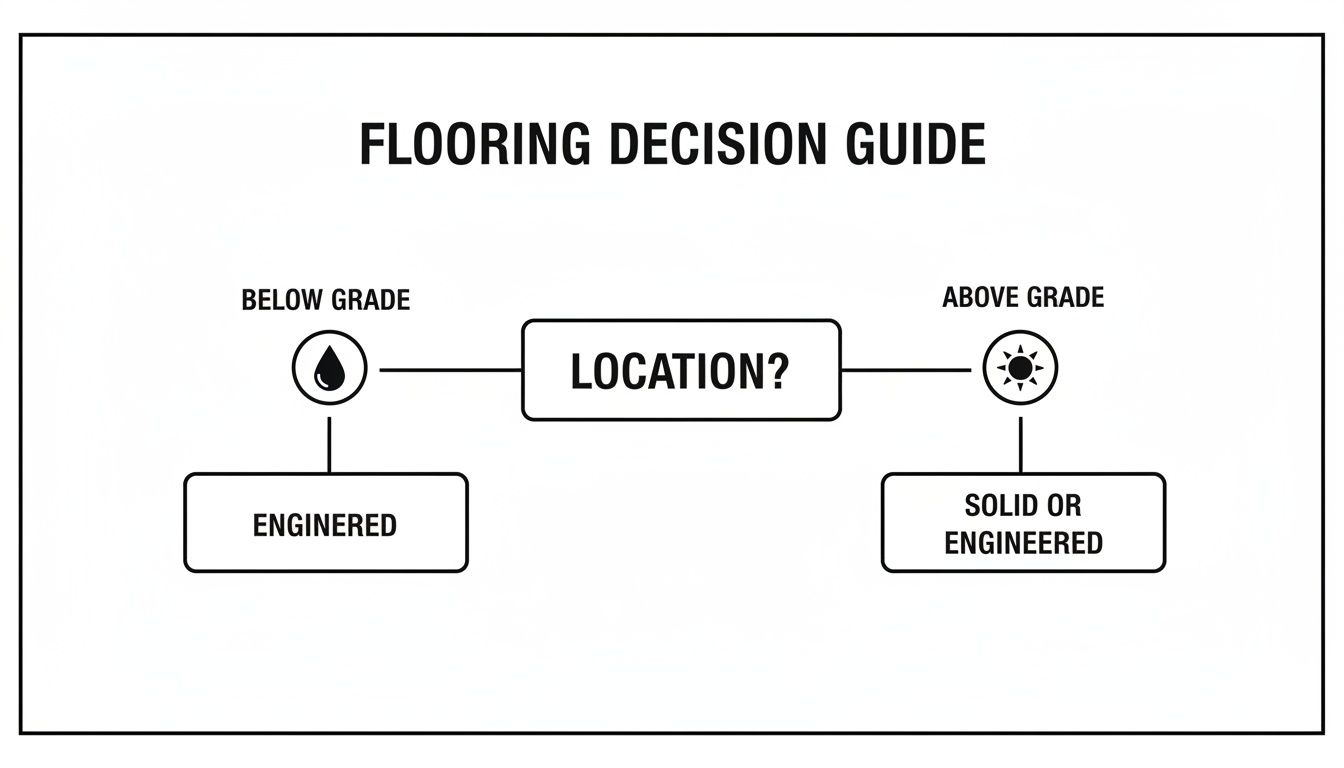
As you can see, both are great options for floors above ground level. But once you go below grade, engineered wood is really the only safe bet.
Durability and Long-Term Value
When we talk about durability, the conversation gets a bit more interesting. The wood species on top is what determines how well your floor resists dents and scratches, and that’s true for both types. An engineered Hickory floor is just as tough as a solid Hickory floor.
The real difference lies in their potential lifespan and how many times you can refinish them.
- Solid Hardwood: This is the marathon runner. You can typically sand and refinish it 4-5 times. With the right care, a solid hardwood floor can easily last over 100 years.
- Engineered Hardwood: Its refinishing potential depends entirely on the thickness of that top wood layer. Most can be sanded 1-3 times, giving high-quality options an impressive lifespan of 40-80 years.
For many homeowners here in Forsyth County, the structural stability of engineered flooring offers better practical value over the long haul. Avoiding costly, moisture-related repairs often outweighs the ability to refinish the floor a few extra times.
There's a reason the market is shifting. Engineered wood is seeing huge growth precisely because it’s so adaptable to different climates and is more resource-efficient. Beyond that, the investment pays off. Studies have shown that homes with quality hardwood or engineered wood floors tend to sell 5-10% faster and can fetch 3-5% higher prices.
Choosing the Right Wood Species for Your Home
Picking a wood species is a lot like choosing the personality for your floor. It sets the tone for everything—from the hardness and grain pattern to how the color will deepen and mature over the years. The trick is to match the wood's natural character with your home's traffic flow and your personal style.
For most folks here in the Forsyth County area, the conversation usually starts with a handful of time-tested favorites. Each one brings something different to the table, offering a unique mix of durability and visual appeal that works in just about any room.
The Classics: Oak and Hickory
Oak is the quintessential American hardwood, and for good reason. Whether you choose Red or White Oak, you get a beautiful, prominent grain that does a fantastic job of hiding everyday scratches and scuffs. It hits a sweet spot on the hardness scale with a Janka rating around 1290-1360, making it tough enough for an active family but not so hard that it's difficult to work with.
If you need something even more rugged, look no further than Hickory. With a Janka rating that often tops 1820, it’s one of the toughest domestic hardwoods you can find. Hickory isn't shy, either. Its grain is bold, and you’ll see dramatic color variations from creamy whites to dark browns, sometimes all in the same plank. This creates a visually stunning, rustic floor that can handle just about anything you throw at it—heavy foot traffic, kids, pets, you name it.
The wood's hardness is a critical factor for longevity. A softer wood like Walnut can deliver an incredible look of luxury, but a much harder species like Hickory is the smarter choice for a busy entryway or kitchen where dents and dings are just part of life.
The Elegance of Maple and Walnut
For those who lean toward a cleaner, more modern aesthetic, Maple is a fantastic choice. It features a very fine, subtle grain and minimal color variation, which gives you a smooth, uniform look. Don't let its clean appearance fool you, though; with a Janka score around 1450, it’s plenty durable. Its naturally light, bright tones are also great for making a space feel bigger and more open.
But if you’re looking to make a statement, nothing compares to Walnut. It’s known for its deep, chocolatey-brown hues and complex, swirling grain that instantly adds a layer of sophistication to a room. Walnut is a softer wood, however, with a Janka rating of about 1010. That means it’s more prone to scratches and dents, making it a better fit for low-traffic areas like a bedroom or a formal living room where its beauty can truly shine.
Sometimes you just need to see it for yourself. Exploring a visual guide to hardwood species can really help you picture how these different grains and colors will look in a real home. Every wood tells a story, and understanding their unique traits is the key to picking the one that’s a perfect match for your life.
How Georgia's Climate Impacts Your Flooring Choice
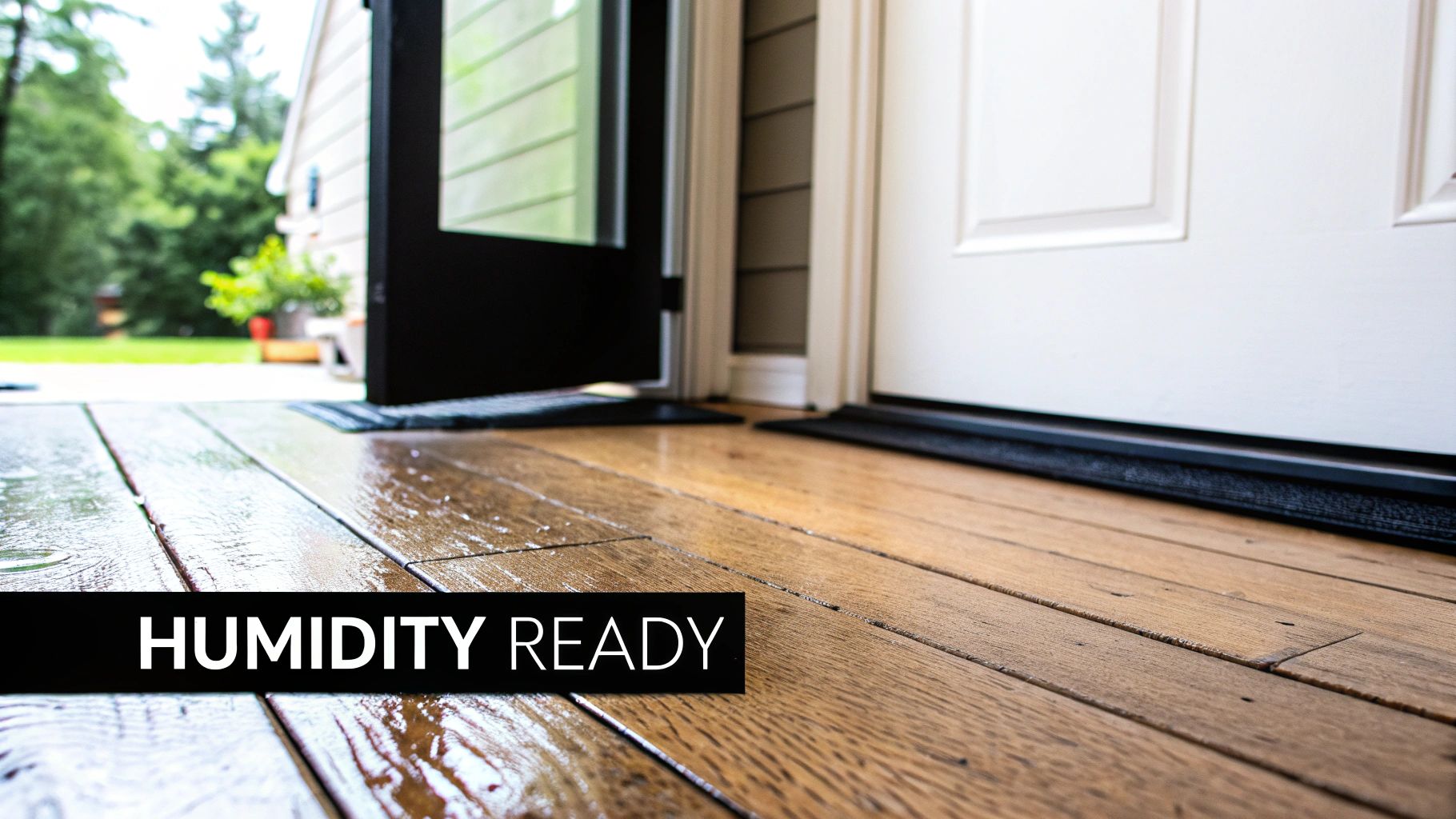
Anyone who's lived through a Georgia summer knows what we're dealing with: humidity. That persistent moisture in the air is a huge factor when you’re choosing the best wood flooring for your home in Cumming, Johns Creek, or Milton. Wood is a natural material, and just like a sponge, it absorbs ambient moisture and expands, then contracts when the air dries out.
This constant back-and-forth movement is what causes some of the most common flooring headaches. Over time, you might see cupping (where the edges of the planks raise up), warping, or annoying gaps opening up between the boards. That's why understanding your home’s environment is every bit as important as picking a species or a finish you love.
Engineered Wood: The Stability Champion
Solid hardwood is classic, no doubt about it. But its single-plank construction makes it much more reactive to the expansion and contraction cycles driven by our local humidity. This is where engineered hardwood really shines for Georgia homeowners.
Engineered planks are built in layers, with the wood grains running in different directions. This cross-ply construction gives it incredible dimensional stability, making it far less likely to swell or shrink with the changing seasons. That stability makes it a fantastic choice for any level of your home, even moisture-prone basements. It just holds its ground better, which means fewer gaps and a longer, healthier life for your floors.
It’s no surprise the market is shifting this way; engineered wood is projected to see major growth because it's so well-suited to climates like ours. It also costs 20-30% less to produce while giving you the same authentic look as solid wood. If you're curious about the bigger picture, you can find more on flooring market trends on platforms like maximizemarketresearch.com.
Essential Steps for a Lasting Installation
Picking the right wood is only half the battle. To ensure your floors last for decades in Georgia, the installation process has to be done right. These steps are your home's best defense against our climate.
- Proper Acclimation: Your new wood flooring needs to get used to its new home before it's nailed down. We leave the planks in your house for several days so they can adjust to your home's unique temperature and humidity. This simple step prevents a world of problems down the road.
- Vapor Barrier: This is non-negotiable, especially over a concrete slab or a crawl space. A quality vapor barrier acts as a shield, stopping ground moisture from wicking up into your beautiful new floors.
- HVAC Management: Your HVAC system is your floor's best friend. Running the air conditioning consistently during those muggy summer months does more than keep you cool—it pulls excess moisture from the air, protecting your investment from seasonal swelling.
By prioritizing acclimation and moisture barriers, a professional installer ensures your floor is set up for success from day one. Skipping these steps is a gamble against nature—one that rarely pays off in the long run.
Finishes and Plank Widths: The Details That Define Your Floor
Once you've settled on a wood species, the next two choices—finish and plank width—are what truly bring your floor to life. These aren't just minor details; they dictate the final look, feel, and even the long-term durability of your investment. Getting them right is key to creating a floor you'll love for years.
Pre-Finished vs. Site-Finished: Convenience Meets Customization
You'll face an immediate fork in the road here: do you want your floors finished on-site or pre-finished at the factory?
A site-finished floor means raw wood is installed, then sanded and sealed right in your home. This gives you ultimate control over the exact stain and a perfectly seamless surface. The trade-off? It's a messy, disruptive process that involves dust and strong fumes, and it takes a lot longer.
This is why most homeowners today lean toward pre-finished flooring. The planks arrive ready to install, coated with an incredibly tough, factory-applied finish. These coatings are cured with UV light, creating a surface that’s far more durable than anything that can be applied in a home. The result is a faster, cleaner installation and a floor that stands up better to the daily grind.
Finish Sheen: Finding the Right Level of Shine
The sheen of your finish does more than just protect the wood; it sets the entire mood of the room. A high-gloss finish bounces light everywhere, creating a formal, almost mirror-like surface. While it can brighten up a space, the downside is that it acts like a spotlight for every single scratch, piece of dust, or bit of pet fur.
That's why low-gloss or matte finishes have become the go-to choice for modern homes. They absorb light, which cleverly hides minor scuffs and daily wear. This makes them a lifesaver in high-traffic areas or any home with kids and pets. You get a sophisticated, soft look that feels both elegant and livable.
A low-gloss finish celebrates the wood's natural character instead of hiding it under a plastic-like shine. It’s a practical, stylish choice that feels right at home in the relaxed, modern spaces we see all over Forsyth County.
Plank Width: How to Shape Your Space
The width of your floorboards has a massive impact on the visual scale of a room. Traditional, narrow planks—usually 2-3 inches wide—create a classic, linear pattern. While timeless, this look can sometimes feel a bit busy, especially in a large, open-concept space.
For a more contemporary and open feel, go wider. Planks in the 5-7 inch range have been a dominant trend since 2020, and for good reason. They create fewer seams, making rooms feel larger, more unified, and less cluttered.
Combine those wider planks with a waterproof engineered hardwood—a product category seeing 15% growth in popularity each year—and you have a floor that’s both stunning and practical. It’s the perfect combination for a busy family home or a high-value rental property. You can explore more about what's driving the market with these hardwood flooring market trends.
Why Professional Installation is Non-Negotiable
You can spend weeks picking out the perfect wood flooring, but the real test of its beauty and longevity comes down to one thing: the installation. A flawless installation is what transforms a pile of planks into a stunning, seamless part of your home—one that will perform beautifully for decades to come.
Tackling the job yourself might seem like a smart way to cut costs, but it's a gamble that rarely pays off. We've seen it all. Simple mistakes like not preparing the subfloor correctly, leaving the wrong size expansion gaps, or messing up the plank layout can lead to permanent damage. Think buckling, ugly gaps, and floors that squeak with every step. These aren't just cosmetic issues; they can completely void your manufacturer's warranty.
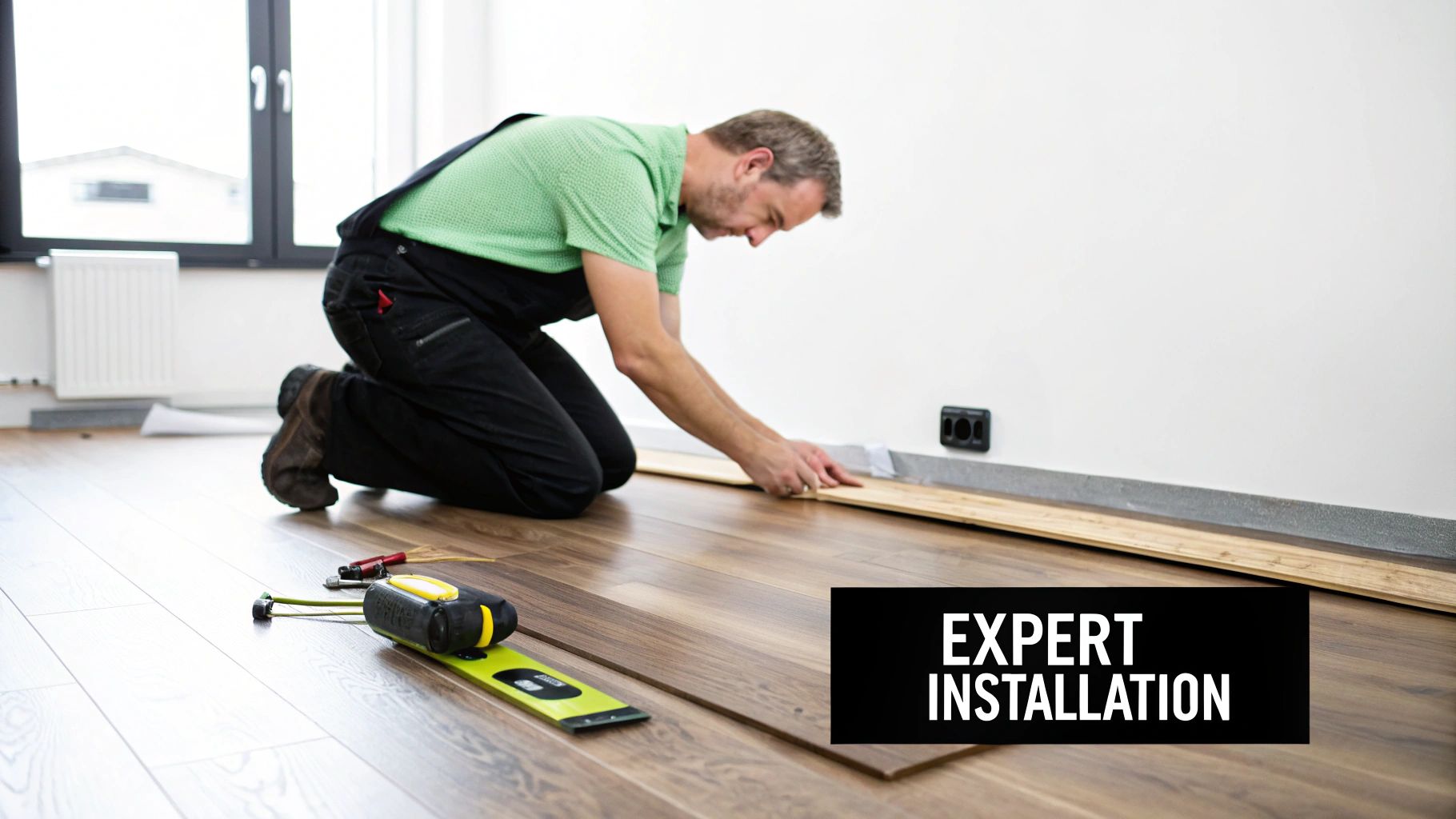
With over 30 years of experience here in the Cumming area, our entire process is built around precision and foresight. It always starts with an in-home consultation. We need to see your space, check the subfloor, and understand the unique conditions of your home—from humidity levels to sunlight exposure—before we even think about laying the first board.
From Our First Meeting To The Final Walk-Through
Our time-tested approach means we handle every single detail the right way, preventing problems before they ever have a chance to start. We carefully map out the timeline to minimize the disruption to your daily life, but we never rush crucial steps like letting the wood acclimate properly to your home's environment.
This commitment to true craftsmanship is what separates a professional job from an amateur one. Our installers know how different wood species react to our Georgia climate and adjust their techniques accordingly. For a deeper dive into the technical side, check out this complete guide to professional hardwood floor installation.
A professional installer doesn't just lay down planks; they build a foundation for your home's future. The peace of mind that comes from knowing the job is done right—backed by years of local experience—is the most valuable part of the investment.
Ultimately, working with a seasoned team makes the entire project seamless and stress-free. You can learn more about how our crews manage every phase of a professional floor installation, from the initial measurements to the final meticulous walk-through, ensuring a result you'll love for a lifetime.
Common Questions We Hear About Wood Flooring
It’s completely normal to have a few lingering questions, even after you’ve done your homework. Choosing the right wood floor is a big deal, and you want to get it right. Here are some straightforward answers to the questions we get asked most often by homeowners just like you.
How Long Will My New Wood Floors Last?
The lifespan of your floor really comes down to two things: the type of wood you choose and how you care for it.
A high-quality engineered hardwood floor can easily give you 40 to 80 years of service. Its longevity is tied directly to the thickness of its real wood veneer, which dictates whether it can be refinished down the road. If you're looking for something that lasts a lifetime (and then some), solid hardwood is the undisputed champion, often lasting over 100 years because it can be sanded down and refinished multiple times.
Can I Put Hardwood Flooring in My Kitchen?
Absolutely, but you have to be smart about it. Traditional solid hardwood in a kitchen is a bit of a gamble because of the constant potential for spills and moisture.
This is where modern flooring technology shines. Waterproof engineered hardwood is a fantastic solution for kitchens. It’s built to withstand the rigors of daily life, with a protective finish that guards against splashes and spills, so you can have the timeless look of wood without the constant worry.
Is Wood Flooring a Good Idea if I Have Pets?
Yes, wood floors and pets can get along just fine! The trick is choosing a wood species that can handle the occasional scratch from claws and paws. Look for woods with a high Janka hardness rating, like Hickory or Oak, as they are naturally more resilient.
Here's a pro tip: Always go for a low-gloss or matte finish. High-gloss floors are beautiful, but they act like a magnifying glass for every little scratch and piece of pet hair. A matte finish, on the other hand, is much more forgiving and does an incredible job of hiding minor wear and tear.
How Do I Keep My Hardwood Floors Looking New?
Good maintenance is the key to a long-lasting floor, and it’s easier than most people think. A simple, consistent routine makes all the difference.
- Sweep Often: Use a soft-bristle broom or dust mop every day or two. This gets rid of the fine grit and dirt that can act like sandpaper on your floor's finish.
- Vacuum Correctly: Once or twice a week, vacuum using a hard floor setting or an attachment that doesn't have a spinning beater bar, which can cause scratches.
- Clean Smart: Only use a pH-neutral cleaner specifically made for hardwood. Stay away from homemade solutions like water and vinegar, soap-based products, or steam cleaners—they can dull or damage the finish over time.
Stick to these simple habits, and you'll protect your investment and keep it looking beautiful for decades.
Ready to find the perfect wood flooring for your home in Cumming, GA? The experts at Flacks Flooring are here to help you navigate every choice with confidence. Schedule your free in-home consultation today by visiting us at https://flacksflooring.com and let's bring your vision to life.