
You’re probably standing in your kitchen right now, looking at old floors that have taken one spill too many, and wondering which replacement won’t become your next regret. That’s the question in Cumming, Johns Creek, Milton, and the rest of North Metro Atlanta. Not what looks good in a showroom for five minutes, but what still works after years of cooking, kids, pets, grocery traffic, and wet shoes coming in from the deck.
Kitchen flooring has to do more than match your cabinets. It has to survive real life. If you’re shopping for durable kitchen flooring, or comparing hardwood flooring installation, luxury vinyl plank flooring, tile flooring, or even affordable flooring options near you, the smart move is to judge every option by long-term performance first and style second.
Choosing Your Kitchen Floor The Heart of Your Atlanta Home
I’ve seen the same scene for decades. A homeowner in Forsyth County starts with a simple idea: “Let’s update the kitchen.” Then the samples hit the counter. Wood-look tile. Waterproof LVP. Engineered hardwood. Laminate. Suddenly the easiest room to picture becomes the hardest room to decide on.
That hesitation makes sense. The kitchen floor is the hardest-working surface in the house. It takes chair movement, dropped utensils, dog nails, standing water by the sink, and constant foot traffic. A bad choice doesn’t just look tired fast. It becomes annoying every single day.
A lot of homeowners also make the mistake of choosing the kitchen floor in isolation. That usually backfires. The floor has to work with cabinet color, traffic flow, pantry access, and how your family uses the room. If you’re still sorting out layout and workflow, this piece on designing a functional kitchen is worth your time because flooring decisions make more sense once the room itself makes sense.
What I tell neighbors in North Metro Atlanta
If you live in Alpharetta, Cumming, Roswell, or Woodstock, your kitchen floor needs to handle three things well:
- Moisture exposure: Sink splash, dishwasher leaks, pet bowls, and tracked-in rain.
- Daily abrasion: Dirt and grit act like sandpaper, especially near exterior doors.
- Long-term value: You want a floor you can live on, not one you’re planning to replace again too soon.
For rooms that see regular water exposure, many homeowners start by reviewing flooring for kitchens and bathrooms so they can narrow the field to products that make sense before they get distracted by color alone.
You don’t need the trendiest floor. You need the one that fits how your kitchen gets used on a Tuesday night.
In this market, I’m opinionated about kitchen floors because I’ve seen too many rushed decisions. The right floor should look right, feel right, clean easily, and still earn its keep years from now. That’s the standard.
Decoding Durability What Really Matters for Your Floor
Durability in a kitchen is not one thing. It is four separate tests. Can the floor resist scratches. Can it handle dents. Can it take daily moisture without swelling or staining. Will it still look respectable after years of foot traffic, mop buckets, chair movement, and tracked-in grit from a Forsyth County driveway.

A showroom sample won’t answer those questions by itself. The right way to judge a floor is to match the product to how your kitchen gets used in North Metro Atlanta. A Johns Creek home with one cook and no pets can get away with more than a Cumming household where the kitchen is the path from the garage to the backyard.
Scratch and dent resistance
Many homeowners get distracted by looks and overlook the core issue. Surface wear matters, but so does the material under the surface.
With luxury vinyl plank flooring and rigid core construction, I check the wear layer first, then I look at the core. A thicker wear layer helps with scuffs and finish wear. A stronger core helps the floor resist dents from dropped cans, chair legs, and a heavy refrigerator rolling back into place. If you have large dogs, kids who treat barstools like gym equipment, or a kitchen table that gets dragged instead of lifted, that core matters.
Porcelain tile wins on scratch resistance. It is hard to beat. Hardwood can still be a good long-term floor, but it shows life faster. Some homeowners accept that because they want warmth and a more natural look. If that sounds like you, read this guide on hardwood flooring for kitchens with the right expectations. Wood can age well, but it is never the low-maintenance option in a busy kitchen.
Water resistance versus waterproof
These terms get used loosely, and that leads to expensive mistakes.
Waterproof means the flooring material itself will not swell from normal kitchen water exposure. Water-resistant means it can handle some moisture if you clean it up fast. That is a big difference in our area, where summer humidity is high, rain gets tracked in, and many kitchens connect directly to a patio, deck, or garage entry.
The weak point is often not the plank or tile face. It is the seams, the edges, and the installation details around cabinets, dishwashers, and exterior doors. A good product installed poorly still fails.
Wear over time
One dropped pan proves very little. Repetition is the true test.
Kitchen floors in Cumming, Johns Creek, and the rest of North Fulton take the same abuse in the same lanes every day. The sink run. The refrigerator run. The path from the island to the back door. Add Georgia red clay, fine grit, chair movement, and afternoon sun, and you start to see which floors hold their appearance and which ones age in a hurry.
That is why I tell homeowners to stop asking only, “Will it survive?” Ask, “How will it look after five years of normal family use?”
Practical rule: If your kitchen is a spill zone, pet zone, and backyard shortcut, put moisture protection first, wear resistance second, and appearance third.
Why total cost matters more than sticker price
The cheapest floor on installation day is often the expensive floor ten years later.
Analysts cited by Tasting Table’s comparison of kitchen flooring costs and lifespan note that tile often lasts much longer than vinyl, while vinyl usually costs less up front. That trade-off is real. In higher-value North Metro Atlanta homes, especially where resale matters, a longer-lasting floor can make better financial sense if you plan to stay put.
My advice is simple. Judge durability by replacement cycle, repair risk, and how forgiving the floor will be in your specific kitchen. Sticker price is only one piece of the job.
The Top Contenders for Durable Kitchen Flooring in 2026
A family in Cumming comes in from the backyard after a summer storm. Wet shoes hit the floor. The dog cuts through the kitchen. Somebody drops an ice dispenser tray at the fridge. That single minute tells you more about kitchen flooring than a showroom sample ever will.
For North Metro Atlanta homes, I narrow the serious options to four materials. Porcelain tile, rigid core LVP, engineered hardwood, and laminate. The first three deserve the bulk of your attention. Laminate has a place, but it is usually a value play, not a long-haul solution.
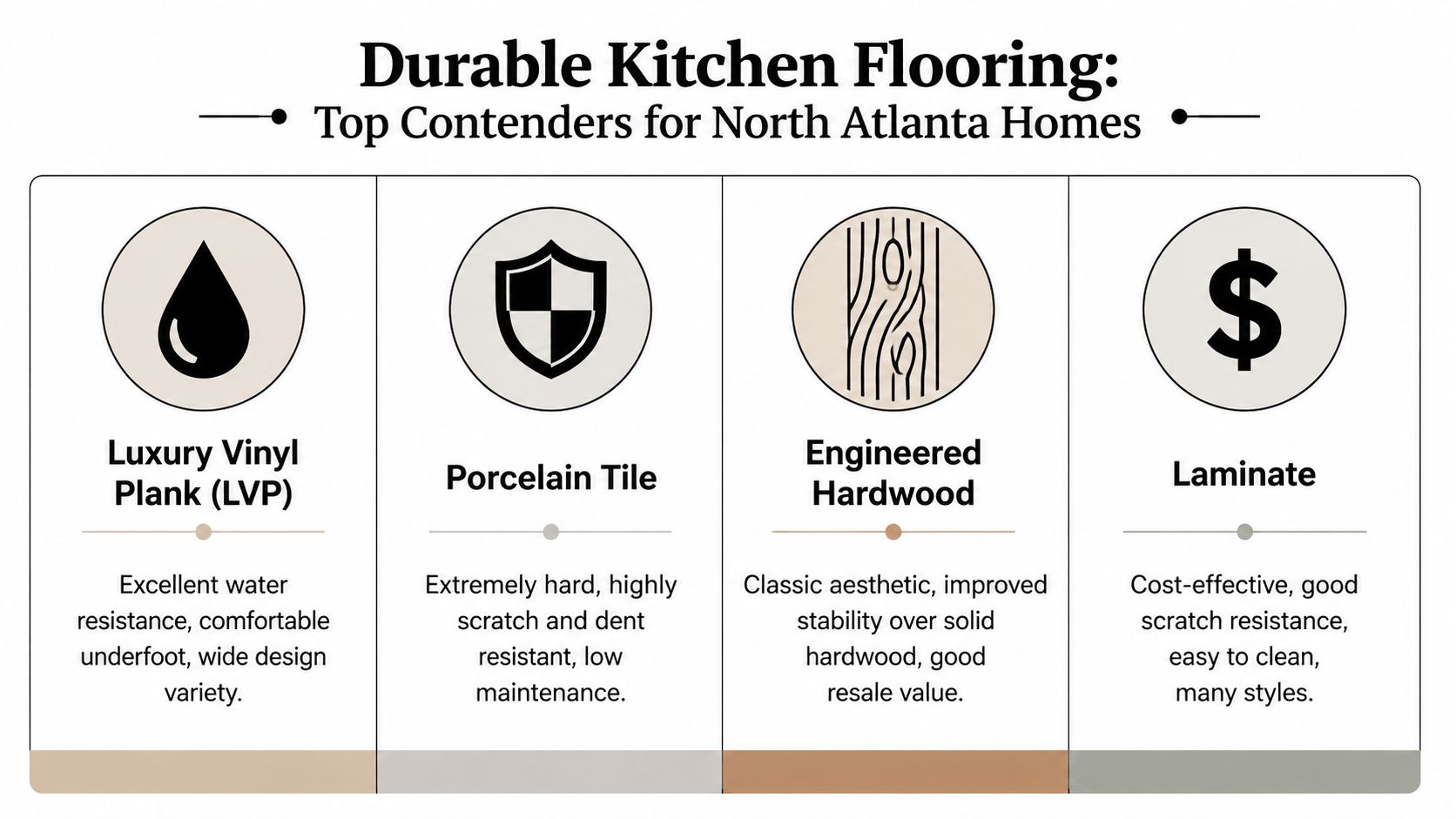
Durable Kitchen Flooring At-a-Glance Comparison
| Material | Avg. Lifespan | Waterproof? | Scratch Resistance | Avg. Installed Cost/Sq.Ft. |
|---|---|---|---|---|
| Luxury Vinyl Plank | 15-25 years | Yes | High | $3-7 |
| Porcelain Tile | 20-50 years | Yes | Very high | $8-15 |
| Engineered Hardwood | 15-25 years | No | Moderate | Qualitative only |
| Laminate | Qualitative only | No | Moderate to good | Qualitative only |
Luxury Vinyl Plank
Rigid core LVP earns its spot because it handles the mess that wrecks other floors. In Forsyth County kitchens that open to patios, garages, mudrooms, and breakfast areas, that matters every single day.
Good LVP gives you strong water protection, solid scratch resistance, easier upkeep than grout, and a softer feel underfoot than tile. It also works well in busy homes with kids, dogs, and constant traffic from the backyard to the sink. If you want a practical floor that does not demand much from you, LVP is hard to beat.
The weak point is perception. Even good LVP does not carry the same visual weight as tile or real wood in higher-end homes in Johns Creek, Milton, or Alpharetta. It can look sharp. It just does not always feel as permanent.
Buy carefully. Wear layer, core construction, and board quality matter more than brand marketing. If you are sorting through options, this guide on what luxury vinyl plank flooring is helps explain the difference between basic vinyl and the rigid core products that belong in a kitchen.
Porcelain and ceramic tile
If you want the toughest floor in the group, pick porcelain tile and be done with it.
Porcelain stands up to water, scratches, chair movement, pet nails, and grit tracked in from red clay driveways better than anything else on this list. US Granite Marble’s kitchen flooring guide notes porcelain’s very low water absorption, which is one reason it performs so well around spills and routine kitchen moisture. Fine Homebuilding’s kitchen and bath flooring guide also points out that well-installed porcelain and glazed ceramic tile can last for decades.
That is the upside. The downside is just as real.
Tile is harder on your feet. Dropped dishes usually shatter. Grout lines need attention. And if the installer ignores subfloor prep or lippage control, you will feel that mistake for as long as the floor stays in the house. In older homes around North Fulton, I pay very close attention to floor flatness before tile goes down.
Choose porcelain over standard ceramic if your budget allows it. In a hard-used kitchen, the upgrade is usually worth it.
Where tile makes the most sense
- Busy family kitchens with heavy daily traffic
- Pet-heavy homes
- Homes where owners plan to stay put
- Higher-value remodels where resale and permanence matter
Texture matters too. A polished tile may look clean on a sample board, but a kitchen needs enough grip to stay safe when the floor is wet.
For North Metro Atlanta homeowners who want the least drama over the next 15 to 20 years, porcelain is usually the safest bet.
Engineered and sealed hardwood
Hardwood still has a strong case in the kitchen. It brings warmth, character, and continuity that vinyl and tile cannot fully copy. In open-concept homes, that visual flow can matter as much as raw durability.
Statista’s kitchen floor upgrade data shows hardwood remains a common choice in kitchen remodels, which matches what I see in Johns Creek and Milton homes where the kitchen blends into the main living space. If the rest of the first floor is wood, breaking that line with tile or vinyl can make the kitchen feel disconnected.
Still, hardwood asks more from the homeowner. Spills need quick cleanup. Standing water is a problem. Large dogs, chair scraping, and repeated wet traffic will wear it faster than tile or LVP. That does not make it a bad choice. It makes it a choice for homeowners who care enough about the look to accept the trade-off.
A useful outside perspective is this guide to hardwood flooring for kitchens, which does a good job framing where wood belongs and where it doesn’t.
Choose engineered or sealed hardwood if:
- You want the kitchen to match adjacent wood floors
- You care more about warmth and appearance than maximum water resistance
- Your household cleans up spills quickly
- You are remodeling for long-term livability and resale presentation
In North Metro Atlanta, I prefer engineered hardwood over site-finished solid wood for kitchens. It handles seasonal indoor humidity swings better and gives you a little more stability.
Laminate
Laminate is the fourth-place contender.
It can offer decent scratch resistance, a broad range of looks, and a lower entry cost than tile or better wood products. For a light-use kitchen, a rental update, or a shorter-term ownership plan, it can make financial sense.
Its weakness is moisture. Once water gets into the joints or core, the floor can swell and telegraph damage fast. In a real kitchen, especially one that serves as the back door shortcut, that risk is hard to ignore. I do not recommend laminate for households that are rough on floors or slow to clean up spills.
My recommendation by homeowner type
Here is the practical ranking for 2026.
- Busy family kitchen in Cumming or Forsyth County: Choose porcelain tile first, rigid core LVP second.
- Open-plan home in Johns Creek, Milton, or Alpharetta: Choose engineered hardwood if matching adjacent spaces matters more than waterproofing.
- Budget-focused remodel or lower-priority kitchen update: Choose laminate only if moisture risk is low and expectations are realistic.
- Pet-heavy home with constant traffic: Choose porcelain tile.
- Homeowner who wants easy upkeep without a cold, hard floor: Choose rigid core LVP.
My opinion is simple. Buy for the way your kitchen gets used, not for the way it looks on a sample board under showroom lights.
Budgeting for Your New Kitchen Floor in Metro Atlanta
A kitchen floor budget can go sideways fast in North Metro Atlanta. You pick a sample that looks right in the store, hear a square-foot price that sounds manageable, and then the actual costs show up. Floor prep, demo, trim work, appliance moves, and disposal are what push a project over budget in homes across Cumming, Johns Creek, and Forsyth County.
Start with the full job cost. That is the number that matters.
What belongs in a real flooring quote
A real kitchen flooring quote covers the whole replacement, not just the material. If a bid looks much lower than the others, there is usually a reason, and it is rarely in your favor.
Your quote should spell out:
- Material quality: Good, better, and best products within the same category do not wear the same way.
- Installation labor: Porcelain tile, gluedown products, floating LVP, and engineered hardwood each demand different tools and skill.
- Subfloor prep: Leveling, patching, moisture checks, and repair work often decide how long the new floor lasts.
- Removal and disposal: Old vinyl, cracked tile, thinset, and debris do not disappear on their own.
- Transitions and trim: These small pieces affect safety, appliance clearance, and the finished look.
Cheap flooring quotes usually hide expensive problems.
In older kitchens around Roswell, Marietta, and parts of East Cobb, I see uneven subfloors all the time. In newer Forsyth County homes, the issue is often builder-grade materials and rushed original installation. Different house, same lesson. If the prep work gets shortchanged, the floor starts showing it early.
Spend based on years of use
The smartest budget is built around service life. If you plan to stay in the home for years, paying more for a floor that holds up under muddy shoes, dropped pans, dog nails, and heavy traffic is the better value.
Porcelain tile usually costs more up front, but it earns that price in a hard-use kitchen. Rigid core LVP often lands in a more comfortable middle range and works well for families who want durability without the hardness of tile. Engineered hardwood costs more than many people expect once you include prep, installation, and finish details, so buy it for the look and resale fit, not because you think it will outlast tile or quality vinyl in a wet kitchen.
That is the difference between a smart budget and a cheap one.
Where to put your money first
If you need to make cuts, make them in the right places. Here is the order I recommend:
- Subfloor condition
- Material that fits your household
- Installer experience
- Design upgrades and premium visuals
That order protects long-term value in Metro Atlanta homes. A floor that looks high-end but fails early hurts you twice. You pay for the upgrade, then pay again to fix or replace it.
Before you commit to a product, get an all-in quote tied to the actual work in your kitchen. A clear professional floor installation process helps you see where the money goes and where cutting corners will cost you later. If financing helps you buy the right floor once, that can be the smarter move than settling for a cheaper option that wears out before the rest of your kitchen does.
The Professional Installation Process From Start to Finish
Saturday morning in Cumming. The old refrigerator is pulled out, the dishwasher is sitting in the breakfast room, and half the kitchen is exposed. This is the point where a durable floor is either built to last or set up to fail.

The consultation and measuring stage
A good installation starts in your house, with your light, your layout, and your traffic patterns. A kitchen in Johns Creek with open sightlines into the family room needs a different transition plan than a tighter Forsyth County kitchen with a mudroom entry and two dogs tracking in red clay.
This visit should answer practical questions before materials are ordered. Will the new floor raise appliance heights. Will the dishwasher slide back in after the finished floor is installed. Are there soft spots near the sink, old tile that should come out, or slope issues that will telegraph through a floating floor. Those details matter more than the sample board.
If you want to see what a proper professional floor installation process should include, start there. You should know exactly who is measuring, who is prepping, what is included, and what could trigger added work.
The subfloor work that decides how long the floor lasts
Homeowners in North Metro Atlanta often focus on the wear layer, the tile body, or the finish color. Installers focus on the surface underneath, because that is where jobs go wrong.
Wood-framed homes in this area can have minor movement. Humidity swings from our sticky summers to heated winter interiors can expose weak prep fast. If the subfloor has low spots, bounce, water damage, or poorly patched sections, the finished floor will show it. Tile can crack. LVP can feel hollow or fail at the locks. Engineered hardwood can develop movement and noise that should not be there.
Porcelain, vinyl, laminate, and engineered wood all need different prep standards. The product instructions are not suggestions. They are the installation rules that protect your warranty.
Installation day and final walkthrough
A professional crew follows a clear sequence and does not rush the early steps.
- Site protection: Cabinets, adjacent rooms, and traffic paths are covered before demolition or material movement starts.
- Removal and cleanup: Old flooring, adhesive, or underlayment comes out cleanly so the crew can see the actual condition of the subfloor.
- Subfloor prep: Leveling, patching, fastening, moisture checks, and underlayment work are handled before the new floor is laid.
- Layout planning: Plank direction, tile centering, doorway transitions, and edge cuts are planned for the full kitchen, not improvised row by row.
- Material installation: Expansion gaps, mortar coverage, trowel choice, roll-out, fastening, and cure times all have to match the flooring type.
- Walkthrough: You inspect transitions, trim, appliance clearance, and finish details, then get care instructions that fit your floor.
Good installers solve problems before you see them.
That final walkthrough should also cover cleanup and first-week care. Tile owners should ask when grout is ready for routine cleaning and can bookmark this guide on how to clean tile floors for later. LVP and wood owners should ask when appliances can go back, what pads to use under furniture, and which cleaners will not damage the finish.
Flacks Flooring offers all-inclusive pricing that includes installation and site preparation. That matters because stripped-down quotes often leave out the very work that makes a kitchen floor hold up in a busy Metro Atlanta home.
Protecting Your Investment Long-Term Maintenance Tips
A durable kitchen floor still needs the right care. Most floors don’t fail because the product was bad. They fail because the homeowner cleaned them the wrong way, ignored small issues, or let moisture sit where it shouldn’t.
What to do for each flooring type
The maintenance plan should match the material, not a generic bottle from the grocery store.
- Porcelain or ceramic tile: Sweep grit often, especially near exterior doors. Wipe spills promptly so grout lines don’t become the weak point. If you want a solid general refresher on how to clean tile floors, that guide covers practical basics homeowners can follow.
- LVP flooring: Use a manufacturer-approved cleaner and avoid harsh scrub tools. Don’t use a steam mop. Heat and moisture together can create problems at seams or wear down the finish faster.
- Engineered hardwood: Clean with products made for sealed wood floors. Don’t flood the surface with water, and don’t let pet bowls or sink splash sit for long periods.
- Laminate: Keep water exposure brief and controlled. Laminate usually looks better longer when homeowners use only lightly damp cleaning methods.
The habits that matter most
This part is simple, but it works:
- Use felt pads: Chairs do more damage than is often realized.
- Control grit: Door mats help keep abrasive dirt from grinding into the finish.
- Wipe spills fast: The faster you act, the fewer problems you’ll have.
- Follow product instructions: Not internet myths, not neighbor advice, and not whatever cleaner happens to be under the sink.
The best maintenance routine is boring. Regular sweeping, quick spill cleanup, and the right cleaner beat “deep cleaning” heroics every time.
If you spend money on durable kitchen flooring, protect it with habits that match the product. That’s how you get the long life you paid for.
Your Durable Kitchen Flooring Checklist
A kitchen floor in Cumming or Johns Creek has to survive real life. Wet shoes from summer storms, red clay grit tracked in from the yard, chair legs scraping at the island, and a dishwasher leak that never happens at a convenient time. Use this checklist to rule out the wrong options before you spend a dollar on material.
Ask yourself these before you buy
- What beats up this kitchen most? Large dogs, kids, rolling stools, dropped pans, heavy cooking, and water around the sink all push you toward different floors.
- What matters more in this house: toughness, comfort, or appearance? Pick the priority first. If you try to get every benefit from one product, you usually end up disappointed.
- How much water sits on the floor in a normal week? If the honest answer is "more than it should," cut moisture-sensitive products from the list early.
- How slick can this floor safely be? In busy family kitchens, especially with older homeowners or young kids, slip resistance deserves as much attention as color and pattern.
- How long are you staying in the home? In Forsyth County, a floor that holds up and looks appropriate for the price point of the house usually pays back better than a cheap floor you replace too soon.
- Does the new floor need to run into nearby rooms cleanly? Height changes, awkward transitions, and mismatched finishes can make a full kitchen remodel look patched together.
- What does the subfloor look like right now? A durable surface installed over a weak or uneven base is still a bad floor.
My final filter
For North Metro Atlanta kitchens, I’d narrow the field fast.
Choose porcelain tile if you want the longest-wearing surface and you can live with a harder feel underfoot. Choose rigid core LVP if your house is active, you want strong water resistance, and you need an easier installation path in many remodels. Keep engineered hardwood on the list only if matching nearby living spaces matters and your household is disciplined enough to protect it from routine kitchen abuse.
One more rule. Never approve a floor from a showroom sample alone. Take samples home, set them next to your cabinets and counters, and look at them in morning light, afternoon light, and with the kitchen lights on. That step saves North Atlanta homeowners from a lot of expensive second-guessing.
Frequently Asked Questions About Kitchen Flooring
What’s the best scratch-resistant flooring for large dogs?
For most homes, porcelain tile is the strongest answer. It’s harder than the usual alternatives and handles claw traffic well. If you want something softer underfoot, rigid core LVP is usually the runner-up because it resists scuffs better than many homeowners expect and handles pet water bowls without stress.
Can new kitchen flooring go over old tile?
Sometimes yes, sometimes no. It depends on whether the existing tile is bonded well, how flat the surface is, and whether the added height creates issues at appliances, doorways, or adjacent rooms. A shortcut here can create a bigger replacement later. I’d rather remove a bad base than build a new problem on top of it.
How long does a kitchen floor replacement usually take?
It depends on the material and the amount of prep. A straightforward floating floor job moves faster than a tile install that needs subfloor correction and curing time. The size of the kitchen matters less than the condition of what’s underneath. If an installer gives you a timeline without talking about prep, that timeline isn’t worth much.
Is hardwood a bad idea for kitchens in North Atlanta?
Not automatically. It’s a selective choice, not a universal one. In a lower-chaos household that wants a warm, continuous main-floor look, engineered and well-sealed hardwood can work beautifully. In a kitchen with constant spills, pet traffic, and kids cutting through from the yard, I’d steer you toward tile or waterproof LVP first.
What does factory-direct pricing actually mean for my wallet?
It usually means the seller is trying to reduce middle-layer markups. That can help, but don’t get stuck on the phrase. The smarter question is whether the quote includes material, prep, installation, and cleanup. A lower product price doesn’t help much if the labor and prep numbers turn into surprises later.
Is laminate good enough for a kitchen remodel?
It can be, if your priorities are budget and appearance and your kitchen doesn’t see constant moisture. I wouldn’t choose it over porcelain or rigid core LVP for a busy family kitchen, but it still has a place in lighter-use homes, rentals, and shorter-term updates.
What should I bring to a flooring consultation?
Photos of the kitchen, cabinet and countertop samples if you have them, measurements if available, and a clear list of your essential requirements. If you know you need waterproof flooring, say it upfront. If your main concern is dogs, say that too. Good decisions come faster when your priorities are clear.
If you’re weighing hardwood or waterproof flooring for your kitchen, Flacks Flooring is a practical place to start. You can compare materials, talk through installation versus replacement, and get guidance based on how your kitchen is used in Cumming, Forsyth County, Johns Creek, or Milton.