
If you're standing in your living room in Cumming or Johns Creek, looking at worn carpet, dated tile, or scratched builder-grade hardwood, you're probably trying to solve more than one problem at once. You want the house to feel better. You want something durable enough for real life. And you don't want to spend good money on a floor that looks great for six months and then starts showing every season change, pet nail, and furniture move.
That’s where european white oak flooring keeps coming up in serious renovation conversations. Homeowners compare it against LVP flooring for waterproof practicality, laminate flooring for budget control, tile flooring for moisture resistance, and carpet installation for comfort in bedrooms. Yet many people still circle back to European white oak because it does something those other categories don’t do in the same way. It gives a home a grounded, high-end look while still delivering long-term performance when it’s specified and installed correctly.
In North Metro Atlanta, that last part matters. A floor in Forsyth County doesn’t live in a showroom. It lives through humid summers, HVAC swings, muddy shoes, dogs running in from the yard, and the daily traffic that comes with family life. European white oak can handle that environment well, but only if you understand what you’re buying, how it should be installed, and where it makes sense compared with other flooring options.
An Introduction to Timeless Flooring
A lot of flooring decisions start the same way. A homeowner plans a kitchen update, then notices the old flooring makes the whole main level feel disconnected. Or a family in Milton replaces carpet upstairs and starts thinking about carrying one surface through the hallway, office, and primary bedroom. Real estate agents in Cumming run into it too. One dated floor can drag down the feel of an otherwise well-kept home.
European white oak tends to enter the conversation when someone wants a floor that feels calm, clean, and established instead of trendy. It works in modern homes, but it doesn’t depend on a modern style. It also works in classic interiors, renovated ranch homes, and newer open plans in Alpharetta or Roswell where people want wide planks and a lighter palette without the floor looking flat or artificial.
What makes it appealing is the balance. It has the visual depth people want from real hardwood flooring installation, but it can also fit renovation goals that often send buyers toward waterproof flooring or scratch-resistant flooring. It won’t replace every category. If a basement needs a hard waterproof surface, tile flooring or LVP flooring may still be the better answer. If a bedroom needs softness and sound control, carpet installation still has a place. But on the main level of a home where appearance, durability, and resale all matter, european white oak flooring is often the option that ties everything together.
A good floor doesn’t just match the paint color. It changes how the whole house feels when you walk in.
That’s why this material shows up so often in floor replacement projects across Cumming, Johns Creek, Canton, and North Fulton. People aren’t just buying wood. They’re choosing the surface that sets the tone for the home every single day.
What Makes European White Oak a Unique Choice
A lot of homeowners around Cumming first react to European white oak the same way. They walk into a house, notice the floor feels lighter and calmer than traditional oak, then realize it still has enough grain and texture to keep the room from feeling plain.

Part of that comes down to the species itself. European white oak usually refers to oak from Europe, often Quercus robur or closely related species, and the visual difference is noticeable once you put it beside many domestic options. The grain tends to show more natural movement, more visible ray fleck, and a wider mix of pattern from board to board.
Grain and character
That fuller look is one reason it works so well in wider planks. On a big open floor plan in Johns Creek or Alpharetta, wide boards need enough variation to keep the room from looking washed out. European white oak usually does that better than flatter, more uniform species.
Milling also plays a role. Many European white oak products are cut in ways that preserve a broader mix of grain, including straight sections, cathedrals, and flecking in the same board. For homeowners, that matters less as a sawmill detail and more as a day-to-day benefit. The floor has character before stain ever enters the conversation.
Color and grade
Its color range is another reason it stands apart. European white oak sits comfortably between pale and warm, which gives homeowners more flexibility with paint, cabinetry, and trim. In North Metro Atlanta homes, that range works especially well when people want a lighter floor but do not want the space to feel cold or overly gray.
Grade matters too. A lot of European white oak sold in the U.S. includes knots, mineral streaks, and other natural variation that would be minimized in a cleaner domestic select floor. Some homeowners love that. Others expect every board to look nearly identical and are surprised when the delivered cartons show more contrast.
That is a buying decision, not a defect.
For homeowners comparing species side by side, this guide to hardwood species helps clarify how grain pattern, color, and variation affect the finished look in a real room.
Why that matters in real homes
In practice, European white oak gives you a refined floor that still feels lived-in. That balance is useful in active households because natural variation tends to hide small dents, dust, and everyday wear better than a floor with a very uniform face.
It also gives installers and finish crews more room to tailor the final result. A matte finish, a light wire-brush texture, or a natural-toned stain usually pairs well with this wood because the grain already carries the visual interest. The floor does not need heavy color to look finished.
For homes in Cumming, Milton, and surrounding areas, that combination is hard to ignore. European white oak gives a house a custom look without forcing everything else in the room to be perfect.
Durability and Performance in Georgia’s Climate
If a floor can’t handle Georgia humidity, none of the style talk matters. Homeowners need to separate solid european white oak flooring from engineered european white oak flooring, because the construction changes performance in a major way.
Hardness and everyday wear
European white oak has a Janka hardness rating of 1,360 lbf, which is higher than red oak at 1,290 lbf and on par with American white oak, according to Elmwood Reclaimed Timber’s European oak flooring specifications. In plain terms, that means it holds up well under normal residential traffic.
For a homeowner, the Janka number matters less as a bragging point and more as a practical indicator. In kitchens, hallways, and entry areas, harder wood resists dents and wear better than softer species. It still isn’t damage-proof. A dropped cast iron pan can mark almost any wood floor. But for daily traffic, kids, chairs, and pets, European white oak is a dependable performer.
Why engineered matters in Forsyth County
In this climate, I’d rather have an engineered European white oak on many projects than a wide solid plank. The reason is movement. Wood expands and contracts with moisture. Georgia gives it plenty of moisture.
Engineered European white oak reduces expansion and contraction by up to 50% to 70% compared with solid wood because of its multi-ply construction, according to Elemental Hardwoods’ engineered white oak product guidance. That same source notes width change at 1.5% to 2.5% at 0% to 12% EMC, compared with 5% to 8% for solid oak.
That’s the difference between a floor that stays flatter through seasonal swings and one that fights the house.
For homeowners searching for best engineered hardwood, this is the category worth slowing down for. The surface may look similar across samples, but the core construction is what determines whether the floor behaves well over time.
What works and what doesn’t
Here’s the practical version.
| Situation | Usually works better | Why |
|---|---|---|
| Main-level living areas over stable subfloor | Engineered European white oak | Better dimensional stability |
| Wide-plank look in open plan homes | Engineered European white oak | Handles seasonal changes more predictably |
| Moisture-prone rooms where you still want real wood feel | Engineered European white oak with proper prep | More forgiving than solid wood |
| Basements or spaces needing fully waterproof flooring | LVP or tile | Real wood still has moisture limits |
Practical rule: If you want wide-plank real wood in North Metro Atlanta, engineered construction usually gives you a better chance at a quiet, stable floor over the long haul.
The trade-off
There is a trade-off, and homeowners should hear it plainly. If you want maximum refinishing potential over many decades, solid hardwood still has advantages. But many engineered European white oak floors use a 3 mm to 4 mm wear layer, and some can be professionally refinished multiple times before reaching the core, as described in the Elmwood specification page linked above.
For many families, that’s the smarter balance. You get real hardwood, a stable platform, and a floor that better matches the climate realities in Cumming, Johns Creek, and surrounding areas.
Designing Your Space with Finishes Grades and Styles
A sample board can look perfect under bright showroom lighting and still feel wrong once it sits next to your kitchen cabinets, brick fireplace, and the softer natural light you get in a North Metro Atlanta home. That is why finish, grade, and plank style need to be chosen in the room, not just from a display rack.
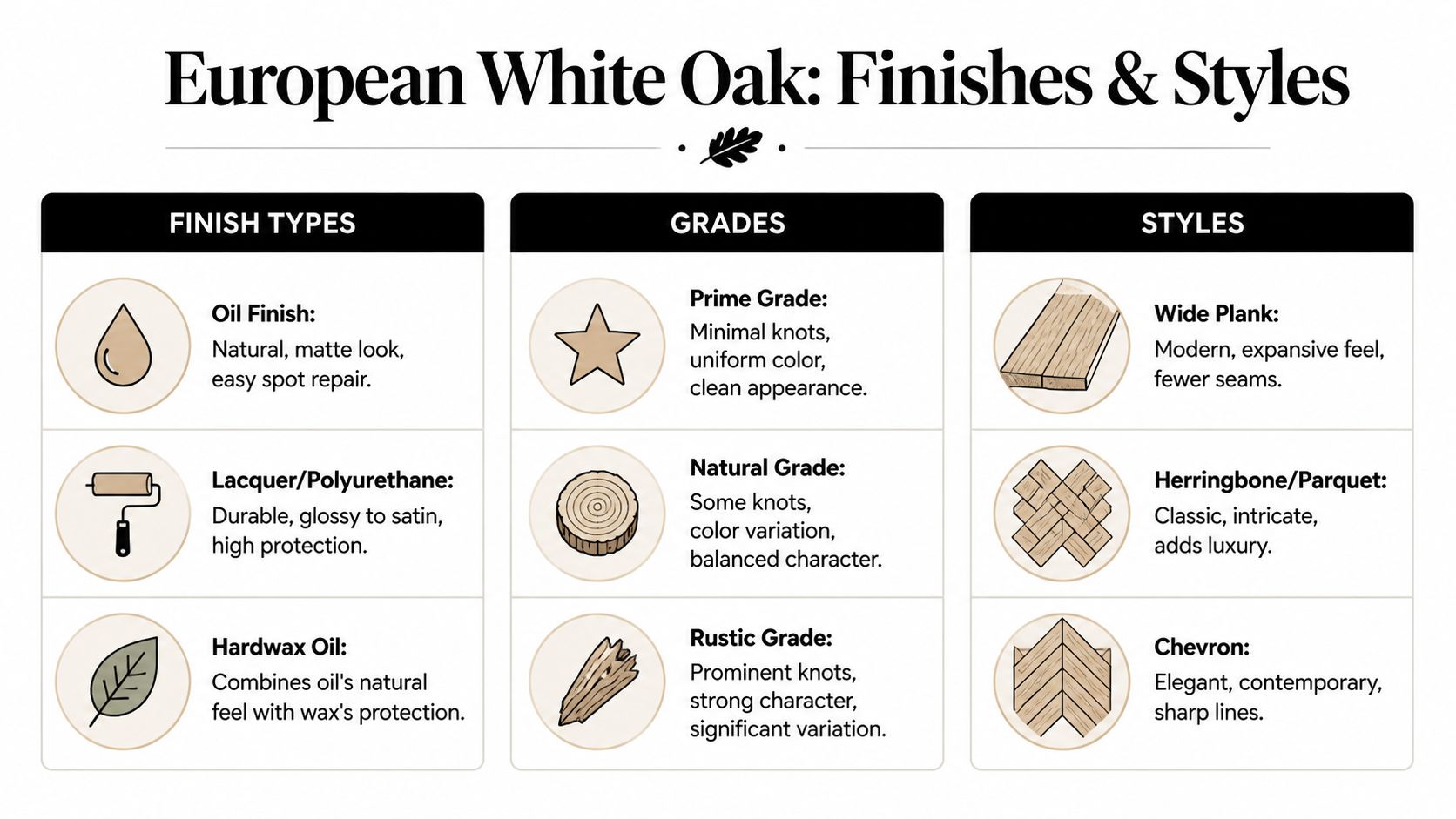
Start with the finish
Finish sets the tone of the floor, but it also affects how the floor lives day to day.
Matte UV-cured urethane is a practical fit for busy homes in Cumming, Johns Creek, and nearby areas. It keeps glare down, hides fine dust better than a shinier floor, and usually asks less of the homeowner over time. In open floor plans with lots of sunlight, that lower sheen often looks more natural and less flashy.
Oil finishes and hardwax oil looks create a softer, more natural surface. They can be excellent in the right house, especially if the owner likes a floor that develops character instead of staying uniform. The trade-off is upkeep. Spot repairs are often easier, but routine care matters more, and that is not every household’s preference.
That choice should match your habits, not just your Pinterest board.
Then choose the grade
Grade has a bigger effect on the room than many homeowners expect because it controls how much variation you see from board to board.
- Prime or select looks work well in cleaner, more refined interiors where you want the floor to stay visually quiet.
- Natural grades give you some knots, grain movement, and color shift without making the room feel busy.
- Rustic grades show more character and can add warmth, especially in larger homes where a perfectly uniform floor can feel flat.
In practice, many homeowners around North Metro Atlanta land in that natural middle ground. They want a real-wood look with personality, but they do not want every knot and mineral streak competing with cabinets, furniture, and trim details.
Width and texture shape the room
Wider planks usually make a space feel calmer because there are fewer visual breaks across the floor. That is one reason European white oak is so often chosen for open living areas and larger primary suites. In Georgia homes, though, wide-plank style should be paired with the right product specification and installation plan so the floor looks clean and stays that way.
Texture changes the read of the floor just as much.
A wire-brushed surface tends to hide small scratches, everyday dust, and the wear patterns that come with kids, dogs, and active households. It also gives the floor a more relaxed look. A smooth finish feels sharper and more formal, but it usually shows surface marks faster, especially in strong afternoon light.
The floor needs to look right during normal life, not just on a fresh sample board.
A quick style match
| Interior style | Usually fits best |
|---|---|
| Modern minimalist | Light tone, matte finish, cleaner grade |
| Modern farmhouse | Natural or rustic grade, wire-brushed texture |
| Traditional luxury | Medium to rich tone, longer planks, cleaner visual flow |
| Old-world or European-inspired | More character, smoked or reactive-tone look, parquet or herringbone accents |
One last practical point. Large samples beat small ones every time. A single plank can make a color look simple and neutral, but once that floor covers a full room, the undertones become much more obvious. I always recommend viewing the product against your paint, cabinetry, and fixed features before making the final call.
Budgeting for European White Oak Flooring
A homeowner in Cumming will often narrow the style down first, then hit the essential question fast. What will it cost to do it right? With european white oak flooring, the honest answer depends less on the name of the wood and more on the product format, the condition of the house, and how much prep the job needs before the first plank goes down.

The biggest budgeting mistake I see in North Metro Atlanta is comparing square-foot material prices without accounting for humidity-related prep. In this part of Georgia, a floor that looks affordable on the sample board can turn into a more expensive project once subfloor flatness, moisture readings, trim work, and stair details are priced accurately.
What drives the final number
Material matters, but it is only one line item. The full price usually changes based on a handful of job-specific factors:
- Plank specification. Wider boards, thicker wear layers, premium finishes, and cleaner grades usually cost more.
- Old floor removal. Carpet tear-out is usually straightforward. Tile demo, glued-down wood removal, and disposal take more labor.
- Subfloor preparation. Leveling low spots, correcting squeaks, patching damaged areas, and addressing moisture conditions can add meaningful cost.
- Installation method. Glue-down, nail-down, and floating systems each come with different labor time and material requirements.
- Trim and transitions. Stair noses, flush vents, reducers, base adjustment, and custom thresholds are often left out of low quotes.
Some homes also need furniture moving, appliance disconnects, or phased installation so the family can stay in the house during the work. Those details affect labor just as much as the flooring itself.
Cost versus long-term value
European white oak is usually not the budget option. For a quick rental turn or a short-term cosmetic update, laminate or some LVP products may fit the goal better. For bathrooms, laundry rooms, or other wet areas, tile is often the better use of money.
Homeowners in Cumming, Johns Creek, and nearby areas usually choose European white oak for a different reason. They want a floor that feels more natural underfoot, fits a higher-end interior, and still makes sense years from now. If the plan is to stay in the home and live on the floor every day, that long view matters more than chasing the lowest initial number.
Maintenance planning belongs in the budget too. A floor with the right finish and care routine is easier to keep looking good, and a simple guide to maintaining hardwood floors helps homeowners understand the upkeep before they buy.
How to get a quote that means something
A useful quote should read like a scope of work, not just a product allowance. Ask for clear answers on:
- Subfloor prep, including whether leveling, patching, or moisture-related work is included
- Demo and haul-away, so removal and disposal do not show up later as extras
- Trim details, including transitions, shoe molding, base work, vents, and stair parts
- Layout and waste allowance, especially for wide planks, patterned installs, or rooms with a lot of cuts
- Scheduling, because acclimation, prep, and finish details can affect start dates and occupancy
A low quote can look good until the omissions start showing up as change orders.
The better approach is simple. Compare complete proposals, ask what conditions could raise the price, and make sure the installer has accounted for the conditions of a humid Georgia home.
Installation and Long-Term Care
A lot of problems blamed on wood are really installation problems. That’s especially true in humid parts of Georgia, where people hear “engineered” and assume the floor can go straight from the carton to the house without much planning.
That assumption causes trouble.

Acclimation is not optional
A detailed account of white oak flooring issues in humid conditions points to problems on lower levels even with engineered products and recommends 7 to 14 days of pre-installation acclimation at site humidity, along with subfloor moisture testing below 12%, as described in this discussion of white oak floor problems.
That advice lines up with what careful installers already know. The wood has to get used to the house it will live in. Not the warehouse. Not the delivery truck. The house.
The checklist I’d want any homeowner to ask about
Before hardwood flooring installation starts, the installer should be able to speak clearly about the basics.
- Room conditions. The HVAC should be running and the home should be close to normal living conditions.
- Subfloor moisture. The crew should test it, not guess.
- Slab prep. Over concrete, vapor management matters.
- Flatness. Even a good plank floor will telegraph subfloor problems.
- Installation method. Glue-down can feel more solid in some applications. Floating can work well in others. The right answer depends on the product and site conditions.
If an installer shrugs off acclimation or moisture testing, that’s not confidence. That’s a warning sign.
Lower-level rooms need extra caution
Main levels and upper floors usually present fewer moisture surprises than lower levels. In basements or slab-on-grade areas, homeowners need to be realistic. Even when a product is designed for better stability, wood is still wood. If a room has chronic moisture issues, fully waterproof flooring may be the better answer.
That doesn’t mean european white oak flooring can’t work on a lower level. It means the site has to be right, and the prep has to be disciplined.
Care that actually protects the floor
Daily care doesn’t need to be complicated.
| Habit | Why it helps |
|---|---|
| Dry mop or vacuum with a hard-floor setting | Removes grit that acts like sandpaper |
| Clean spills promptly | Limits moisture sitting on seams |
| Use felt pads under chairs and furniture | Reduces surface scratching |
| Keep entry mats at doors | Cuts down on dirt and moisture transfer |
For long-term upkeep, the finish matters. Some floors need only periodic recoating when the wear is in the finish layer. Others may eventually need sanding and refinishing. The right maintenance approach depends on the specific finish and wear pattern, which is why practical guidance like these hardwood floor maintenance tips is worth reviewing before the floor goes in.
A well-installed floor rewards simple habits. A poorly installed floor punishes even careful owners.
Choosing a Supplier and Installer in North Metro Atlanta
The best european white oak flooring product can still disappoint if the supplier oversells it or the installer treats it like a generic floor replacement. In Cumming, Johns Creek, Milton, and the surrounding North Metro Atlanta area, homeowners should look for a company that knows hardwood, understands local humidity, and is willing to talk openly about trade-offs.
What to ask before you buy
Ask direct questions. Good flooring professionals won’t dodge them.
- Where is this material sourced from? If a supplier talks about sustainability, ask for documentation.
- Can you explain the grade clearly? “Rustic,” “natural,” and “select” can look very different from one line to another.
- What prep is included in the quote? You want to know whether moisture testing and subfloor correction are built in.
- Which install method do you recommend for my house, and why? The answer should reflect your actual conditions.
- What happens if site conditions aren’t ready on installation day? Serious installers have a process for that.
Supply chain and traceability matter
This is one area many homeowners skip, especially when they’re focused on color and width. But if you’re paying for imported hardwood, you should ask how the supplier verifies what they’re selling.
Questions around FSC/PEFC compliance, chain-of-custody documentation, and quality variation in non-select grades come up often, and guidance from EuropeanCo’s overview of European white oak flooring benefits specifically recommends requesting chain-of-custody documents from verified mills.
That matters for two reasons. First, it helps you vet sustainability claims. Second, it gives you a better read on consistency. A supplier who can explain the mill source, grading expectations, and finishing process is usually easier to trust than one who only sells off the sample board.
Signs you’re talking to the right team
A reliable local flooring company usually does a few things well:
- They insist on an in-home visit because room conditions, subfloor type, and lighting all affect the recommendation.
- They show full-size samples or larger boards, not just tiny swatches.
- They compare categories fairly. Sometimes hardwood is right. Sometimes waterproof flooring, tile, carpet, or LVP is the better fit.
- They give all-inclusive pricing with fewer mystery costs.
- They don’t promise perfection. They explain how wood behaves and what maintenance really looks like.
That kind of guidance is what separates a helpful flooring partner from a showroom that just moves boxes.
If you're comparing european white oak flooring with hardwood, LVP, carpet, or other floor replacement options in Cumming, Johns Creek, Milton, or the surrounding North Metro Atlanta area, Flacks Flooring is a solid place to start. Their team brings decades of experience, offers in-home consultations, and helps homeowners sort through the details that matter, including style, installation method, site preparation, and long-term value.