
When you're picking out new laminate flooring, most of the focus is on the color, the texture, and the style. But there's a hidden layer underneath that plays a massive role in how your new floor feels, sounds, and lasts. That layer is the floor padding, or underlayment.
It's not just an optional extra; think of it as a non-negotiable part of the whole system. Getting it right directly affects your floor's comfort, lifespan, and day-to-day performance.
The Unsung Hero Beneath Your Laminate Floors
Imagine buying a top-of-the-line mattress but putting it on a flimsy, uneven frame. It wouldn't feel right, and it certainly wouldn't last. The same logic applies to your flooring. The right floor padding for laminate is the solid foundation that supports the floor's locking system, keeping the planks from shifting, separating, or flexing under pressure.
But this invisible layer does a lot more than just provide support. It's a real workhorse. It smooths out minor imperfections in your subfloor, creating that perfectly flat surface needed for a professional-looking installation. It also acts as a thermal break to keep your floors from feeling so chilly on a cold morning and, just as importantly, absorbs sound to quiet down that "click-clack" noise that can sometimes come with floating floors.
It's no surprise that homeowners are putting more thought and money into durable, beautiful flooring. The residential market is actually projected to make up 60.32% of the global flooring market share by 2026, fueled by a boom in home renovations. For homeowners right here in Cumming and Johns Creek, this just confirms that laminate is a fantastic, well-supported choice that manufacturers are constantly improving. You can dig into more of these flooring trends and detailed market insights from Fortune Business Insights.
Choosing the right padding is just as important as choosing the laminate itself. The question isn't if you need it, but rather which one is best for your specific home and subfloor.
Making an informed choice here is how you protect your investment. The right underlayment is what turns a good floor into a great one by boosting its comfort, durability, and acoustic properties. To get a better feel for how the planks themselves are made and why this foundation is so critical, you might want to read our guide on what is laminate flooring?. Understanding the whole system helps you see why every layer matters.
Decoding Padding Materials: Foam, Cork, Felt, And More
Picking the right underlayment for your new laminate floor is a lot like choosing the right tires for your car. They might all look similar at a glance, but some are built for a quiet, comfortable ride, while others are designed for rugged performance. Let's break down the common materials—foam, cork, and felt—to see what makes each one tick.
Foam is the go-to, all-around player in the underlayment game. It's affordable, incredibly easy to work with, and gives you a great mix of cushioning and support for most homes. Think of it as the dependable choice for everyday spaces like bedrooms, living rooms, and hallways, especially when you're installing over a standard wood subfloor.
Cork: The Natural Sound Dampener
Is the sound of footsteps echoing through your home a major pet peeve? If so, cork is your new best friend. This natural material is remarkably dense, which gives it a unique ability to absorb sound and vibrations far better than basic foam. It’s an absolute game-changer for second-story rooms, condos, or any area where you want to keep noise from traveling to the floor below.
Beyond just quieting things down, cork's density also makes it a fantastic thermal insulator, helping your floors feel noticeably warmer underfoot. It’s definitely a premium choice, but for the peace, quiet, and comfort it brings, many homeowners find it’s an investment that pays off every single day.
Felt: The Dense Insulator
When you're after top-tier comfort and serious insulation, felt underlayment is the way to go. Typically made from recycled fibers, felt padding is exceptionally dense. This not only creates a solid, luxurious feel under your feet but also does a phenomenal job of absorbing sound.
Where felt really shines, though, is its insulating power. It creates a robust thermal barrier that stops the cold from creeping up from below, making it the perfect partner for installations over chilly concrete subfloors in basements. While it's one of the pricier options, nothing beats felt for adding warmth and a high-end feel to your flooring project.
Combination Padding: The All-In-One Solution
To simplify installation and guarantee you've got all your bases covered, many people now turn to combination underlayments. These clever products merge a foam or felt pad with a vapor barrier that’s already attached, giving you a single, all-in-one solution. This is especially handy for any installation over a concrete subfloor.
This integrated design means you don't have to wrestle with laying a separate, giant plastic sheet first. It saves a step and, more importantly, reduces the chance of leaving gaps in your moisture protection. It’s a smart and efficient choice, especially for basements or homes built on a slab foundation. The principles are similar for other floor types, but you can see how things change in our guide on the best underlay for wood flooring.
This quick-reference guide will help you choose the best underlayment material based on your specific needs, from soundproofing to moisture protection.
Comparing Laminate Floor Padding Materials
| Material Type | Key Benefit | Best For | Consideration |
|---|---|---|---|
| Standard Foam | Affordability & Ease of Use | Most residential projects over wood subfloors. | Basic sound and thermal insulation. |
| Cork | Superior Sound Dampening | Second-story rooms, condos, and apartments. | A premium option; higher cost. |
| Felt | Excellent Thermal Insulation | Installations over cold concrete, like basements. | Often the most expensive choice. |
| Combination | Convenience & Moisture Barrier | Concrete subfloors; speeds up installation. | Ensures no gaps in vapor protection. |
As you can see, the "best" material really comes down to your subfloor, your budget, and what you're trying to achieve with your new floor.
The flowchart below gives you a simple, visual way to walk through the decision-making process, starting with the most important question: what kind of subfloor are you working with?
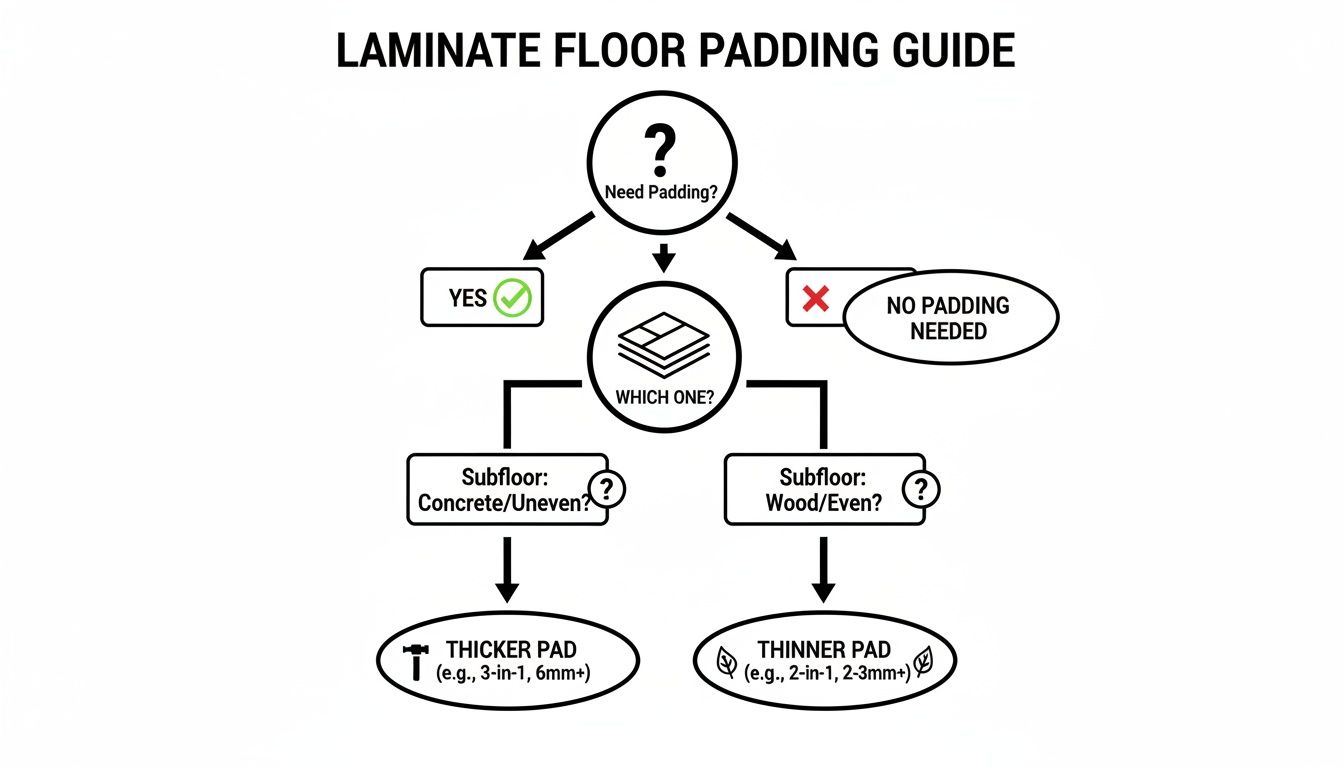
As the guide shows, identifying your subfloor is always step one. It's the factor that determines whether a built-in vapor barrier is a non-negotiable requirement or just a nice feature to have.
Finding the Right Underlayment Thickness
When you're picking out padding for your new laminate floor, it's natural to think that thicker equals better. More cushion, more luxury, right? It's a common assumption, but with laminate flooring, that line of thinking can actually cause some serious headaches down the road.
The real goal isn't to create a plush, pillowy surface. It's all about providing the right amount of stable support for the floating floor that sits on top.
Think of it like the foundation of a house. You don't want it to be soft and spongy; you need it to be firm and stable to support the structure above. Overly thick or soft padding allows for too much give, or "flex," every time you take a step. This constant up-and-down movement puts a huge amount of stress on the locking systems that hold the laminate planks together.
Eventually, that stress can cause the joints to weaken, separate, or even break. You'll end up with frustrating gaps between your planks and a floor that feels bouncy and unstable underfoot.
The Goldilocks Zone for Laminate Padding
So, if thicker isn't the answer, what is? For almost every residential laminate installation, the sweet spot for underlayment thickness is between 2mm and 3mm. This is the industry-wide "Goldilocks zone" that provides all the benefits you need without compromising the floor's structural integrity.
Padding in the 2mm to 3mm range delivers:
- Just Enough Cushion: It absorbs some impact and gives a comfortable feel without being overly soft.
- Subfloor Smoothing: It's perfect for evening out minor imperfections and tiny bumps in your subfloor.
- Solid Joint Support: It's dense and firm enough to create a stable base that protects the floor's locking system from stress.
A word of caution: most flooring manufacturers have very strict rules about underlayment. Installing a padding thicker than 3mm will often void your laminate warranty completely. If the plank joints start to fail, you'll be on your own. Always read the manufacturer's installation guide first.
Factors That Influence Your Choice
While that 2-3mm rule is your best guide, the thickness of your laminate planks can play a small role. A thicker, more robust laminate plank (think 10-12mm) has more inherent rigidity, so it can often handle a denser 3mm underlayment without any issues.
On the other hand, thinner laminate planks (in the 6-8mm range) are more flexible and more vulnerable to the stress caused by a soft sub-layer. If you're working with thinner flooring, sticking with a firm 2mm padding is your safest bet for a solid, long-lasting installation.
When in doubt, your laminate's installation manual is the ultimate authority. It will tell you exactly what the manufacturer requires to keep your floor stable and your warranty intact.
More Than Just a Cushion: Sound, Moisture, and Warmth
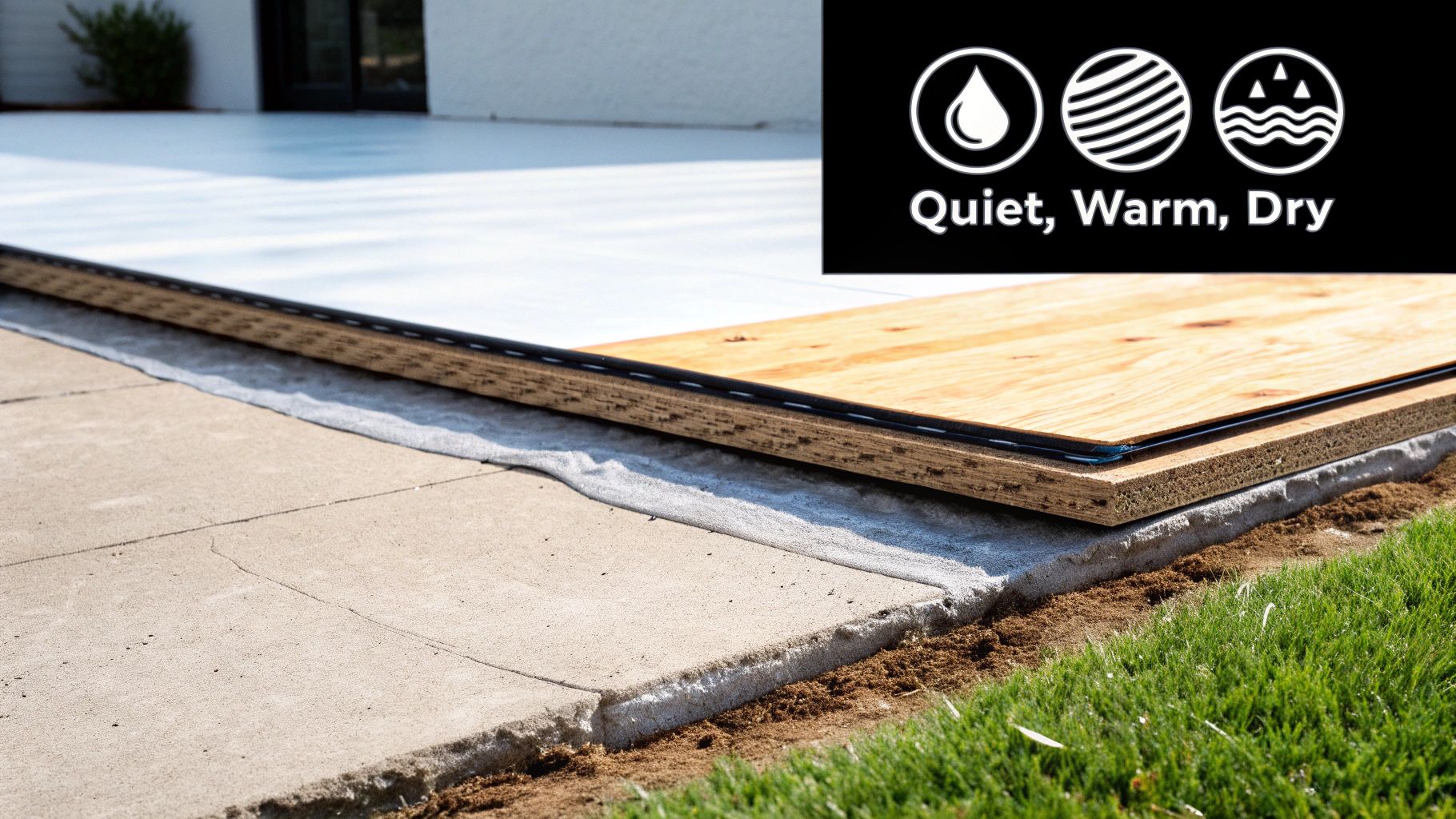
A quality floor padding for laminate does so much more than just sit under your planks. It’s actively working to improve your home's entire environment. Think of it as an investment in comfort, peace and quiet, and the long-term health of your floor. It tackles three big challenges all at once: noise, moisture, and temperature.
Ever noticed how an empty room with a hard floor has a sharp echo? Toss a thick rug down, and the sound is immediately softer. Underlayment works on the exact same principle. It creates a critical buffer between the hard laminate and the subfloor, absorbing sound and getting rid of that hollow "click-clack" noise when you walk.
Quieting Your Home: Understanding Sound Ratings
When you’re looking at underlayment options, you'll run into two acronyms: IIC and STC. They might sound technical, but the idea behind them is pretty straightforward.
- IIC (Impact Insulation Class): This number tells you how well the padding deadens impact noises—think footsteps, dropped toys, or scooting chairs. A higher IIC rating means better sound absorption, which is a must-have for second-story rooms, condos, or apartments.
- STC (Sound Transmission Class): This one measures how well the material blocks airborne sounds, like voices, TVs, or music, from passing through the floor to the room below.
Simply put, high ratings for both mean a much quieter, more serene home.
To put it in perspective, a bare concrete slab might have an IIC rating of around 28. By adding a quality underlayment and laminate flooring, you can easily boost that to 50 or higher. That’s a huge, noticeable difference in noise for anyone on the floor below.
Staying Warm and Cozy with Thermal Insulation
We’ve all experienced it: stepping onto a floor over a cold basement or concrete slab and feeling that chill go right through your socks. A good underlayment acts as a thermal barrier, working just like the insulation in your walls. This ability to resist heat flow is measured by its R-value—the higher the R-value, the better the insulation.
This thermal break keeps your floor’s surface from getting so cold, making it feel much more comfortable underfoot. It can even help with your energy bills by preventing heat from escaping through the floor. The same logic applies when choosing padding for other floors, a topic we dive into in our guide to the best underlayment for hardwood floors.
The Non-Negotiable: Your Floor’s Defense Against Moisture
This last point is arguably the most important, especially for homes here in Georgia. Concrete subfloors are porous. Even if they look and feel bone-dry, they are constantly releasing a small amount of moisture vapor. If that vapor gets trapped under your laminate flooring, it can cause the planks to warp, swell, and even lead to mold and mildew.
This is where a vapor barrier (sometimes called a moisture barrier) becomes absolutely essential. It’s your floor’s only real defense. Many underlayments designed for concrete subfloors already have a vapor barrier built-in, usually a thin sheet of plastic film. Don't skip this. Even if you buy laminate with a pre-attached pad, you still need to roll out a separate 6-mil vapor barrier over concrete to be fully protected.
Laying It Down Right: Installation Tips & Common Mistakes
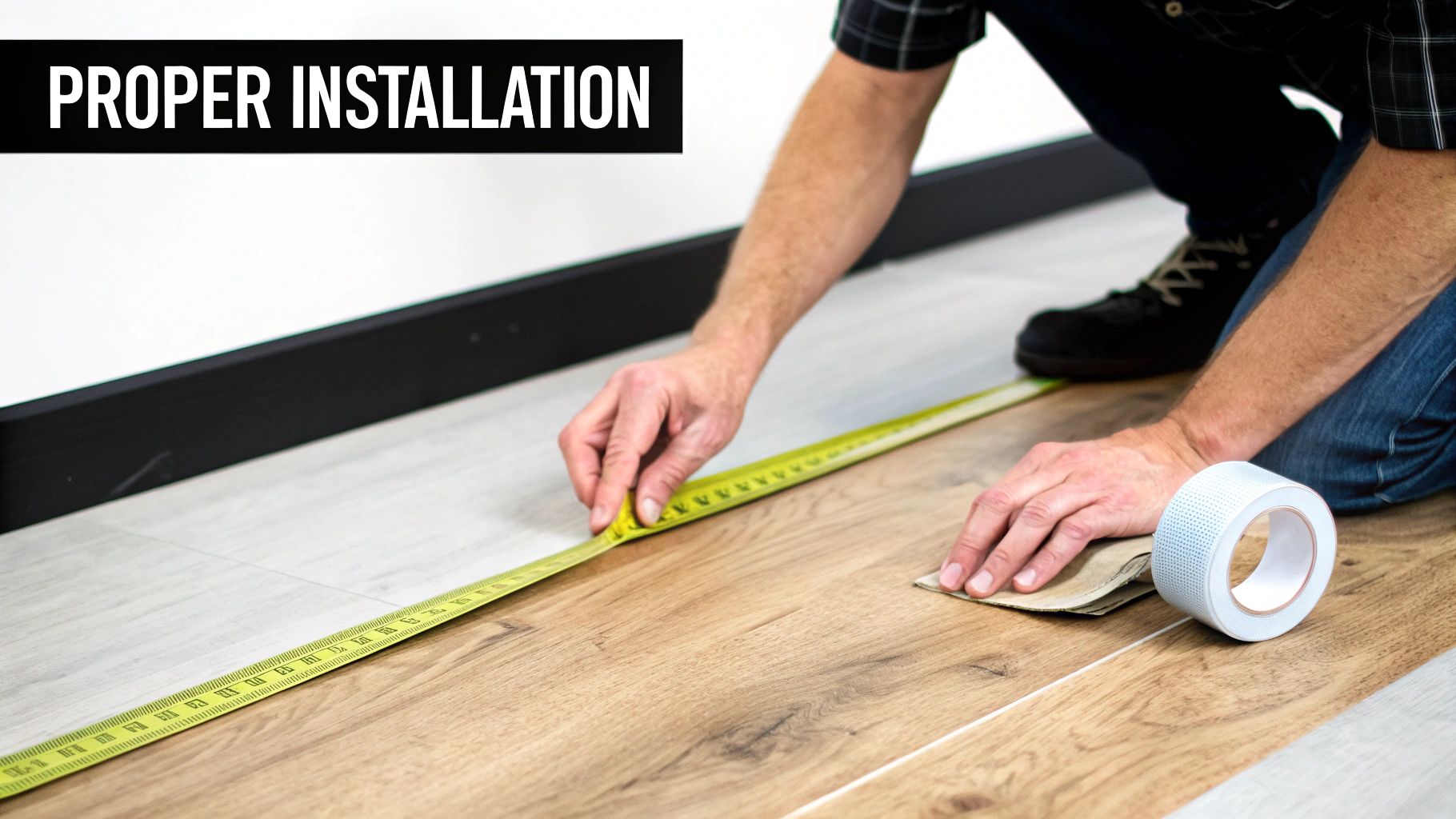
You’ve done the research and picked out the perfect floor padding for laminate. Great! But the job isn't done yet. The best underlayment in the world won't do you any good if it's installed improperly. Getting the installation right is just as crucial as the materials you chose, ensuring you have a seamless, stable foundation for your beautiful new floor.
Success actually starts before you even think about unrolling the padding. The subfloor has to be perfectly clean, completely dry, and impressively flat. I mean it—take the time to sweep and vacuum every last bit of dust and debris. Any tiny pebble or grain of sand left behind will feel like a boulder under your new floor, creating annoying bumps or a crunching sound with every step.
Start with a Flawless Subfloor
Before you lay down a single inch of padding, give your subfloor a serious inspection. Grab a long level and check for any high or low spots across the entire room. For most laminate floors, the rule of thumb is that the subfloor needs to be flat within 3/16 of an inch over a 10-foot span.
Don't be tempted to skip fixing these imperfections. It’s a non-negotiable first step.
- Tackling High Spots: On a wood subfloor, you might need to sand down some bumps. For concrete, grinding down high areas is the way to go.
- Fixing Low Spots: Dips and valleys are best filled with a self-leveling compound. This stuff is almost magical—it pours out and creates a perfectly smooth, even surface on its own.
Putting in this prep work is what allows your laminate planks to lock together securely and lay flat without any weird flexing or stress on the joints. Rushing this part is just asking for a squeaky, uneven floor a few months down the road.
Rolling Out and Sealing the Underlayment
With a prepped subfloor, you're ready for the padding. Start by unrolling your first row along the longest wall. If you're on a concrete slab, make sure the vapor barrier film is facing down. The most important technique here is to butt the edges of each row together snugly.
Never, ever overlap the seams of your underlayment. When you overlap the padding, you create a high ridge. This bump will stop the laminate planks from laying flat and can even cause their locking systems to break over time.
To join the seams, you need to use the right tape. This isn't a job for standard duct tape. Use a high-quality tape that the underlayment manufacturer specifically recommends. Proper underlayment tape is designed to create a waterproof seal, which is critical for keeping your moisture barrier intact and effective.
Here are the biggest mistakes we see homeowners make time and time again:
- Forgetting the Vapor Barrier on Concrete: This is the cardinal sin of laminate installation. Your concrete might feel bone dry, but it's always releasing moisture vapor. If your padding doesn't have a barrier built-in, you must put down a 6-mil polyethylene vapor barrier first.
- Overlapping the Seams: As I mentioned, this creates an uneven surface that will totally compromise the stability and feel of your new floor.
- Skipping Subfloor Prep: Tossing expensive padding over a dirty or uneven subfloor is a waste of money. It will lead to a noisy, unstable, and deeply disappointing result.
By steering clear of these common pitfalls, you can be confident your floor padding will do its job perfectly, protecting your investment and giving you a floor you'll love for years to come.
Making the Right Choice for Your Home
All this information can feel like a lot to take in, I get it. But choosing the right floor padding for laminate really just boils down to answering a few key questions about your specific project.
Once you think through your home's unique needs, the options start to narrow down pretty quickly. You'll be able to make a confident choice that protects your new floors for years to come. The whole idea is to match the padding's strengths to your room's biggest challenges.
Let's walk through a few common scenarios:
For a Second-Floor Bedroom: What's the biggest concern here? Usually, it's noise. You don't want footsteps echoing through the ceiling below. In this case, a cork or high-density felt underlayment with a solid IIC rating is going to be your best friend.
For a Basement Installation: Down here, moisture is public enemy number one. You absolutely need a combination underlayment that has a vapor barrier built right in. If not, you'll have to lay down a separate 6-mil poly film first. No exceptions. Felt is often a great pick for basements because it adds a nice touch of warmth, too.
For a Living Room on a Budget: For a standard living space sitting on top of a wood subfloor, you don't need to go overboard. A quality 2mm foam underlayment gives you all the essential support and comfort you need without stretching the budget.
Balancing Priorities and Making a Smart Decision
Think about what really matters most to you. Are you trying to quiet down a noisy, high-traffic hallway? Or is your main goal making a chilly basement feel a little cozier? When you prioritize your main goal, the decision gets a whole lot clearer.
It's easy to want to skimp on the padding, but remember this: it's a small part of your total project cost, yet it has a massive impact on how your floor performs and feels every single day.
The perfect floor padding is the one you never have to think about again. It works silently behind the scenes, protecting your floors, quieting your home, and adding a touch of comfort underfoot every single day.
To make sure you're picking the best possible foundation for your floor, a comprehensive guide on how to choose laminate flooring can be a huge help. Armed with that knowledge, homeowners here in Cumming and Milton can feel empowered to make a choice that delivers lasting performance.
Your Laminate Padding Questions, Answered
Even after doing all the research, a few nagging questions can still pop up when you're about to pull the trigger on floor padding for laminate. Let's tackle some of the most common ones we hear from homeowners, so you can move forward with total confidence.
Can I Just Reuse My Old Carpet Padding Under the New Laminate?
I get this question all the time, and the answer is a hard no. It might seem like a clever way to save a few bucks, but it's one of the most destructive mistakes you can make with a new laminate floor.
Carpet padding is way too thick and squishy. That softness works against the laminate's click-lock system, preventing the planks from engaging securely. The result? Your floor will feel bouncy, the joints will flex and eventually break, and you'll have gaps opening up everywhere. You've got to use an underlayment specifically made for laminate flooring to get the firm support it needs and keep your warranty intact.
My Laminate Has Padding Attached. Do I Still Need a Vapor Barrier?
This is a great question, and the answer comes down to what's underneath your floor. If you're installing over a concrete slab or in a basement, you absolutely still need a separate 6-mil polyethylene vapor barrier.
Think of it this way: the attached pad is for comfort and sound, not for stopping persistent moisture from wicking up through concrete. That separate plastic sheet is non-negotiable for preventing your beautiful new floor from warping, swelling, or growing mold.
Now, if you're working with a plywood or OSB subfloor on an upper level of your home, the attached padding is usually all you need.
What's the Single Most Important Feature to Look for in Underlayment?
Honestly, there isn't one "most important" feature for everyone. The best feature is the one that directly solves the biggest problem in the room you're working on.
It really depends on your specific situation:
- Installing over concrete? Moisture protection is your number one priority, period.
- Putting it in a second-floor bedroom or condo? Sound absorption is king. You'll want to look for high IIC and STC ratings to keep the peace.
- Finishing a chilly basement? Thermal insulation will make the biggest difference. A higher R-value will help the room feel warmer and more comfortable.
Figure out your main goal for the space first. That will immediately narrow down your options and point you toward the perfect underlayment for the job.
Navigating all these details can feel a bit overwhelming, but you don't have to figure it out alone. Here at Flacks Flooring, we're all about giving straightforward, honest advice to our neighbors in Cumming, Johns Creek, and Milton. No pressure, no hard sells—just expert guidance to help you get it right. Swing by our showroom or schedule an in-home consultation and we'll help you build the perfect foundation for your new floor.