
You notice it when the light hits the floor sideways. One board looks a little high. Then you walk across the room in socks and feel it underfoot. In Cumming, Johns Creek, Milton, and the rest of North Metro Atlanta, that’s often the first sign that moisture has gotten into hardwood.
I’ve seen this after dishwasher leaks, slow refrigerator line drips, wet dog bowls that sit in the same spot too long, and summer humidity that pushes a marginal installation past its limit. The floor may still look mostly fine from standing height, but wood doesn’t warp without a reason. If it’s moving, moisture is involved.
The good news is that not every warped floor needs to be torn out. Some boards can settle back with controlled drying. Some isolated areas can be repaired cleanly. Some floors are telling you it’s time to stop fighting the space and choose a better material for the room. The hard part is knowing which situation you’re in before a small problem turns into a much larger one.
Your Guide to Fixing Warped Hardwood Floors in North Georgia
A lot of homeowners have the same first reaction. They hope the floor will flatten out on its own if they run the ceiling fan and wait a few days. That delay is where repairable damage becomes replacement territory.
For hardwood hit by water, the first 24 to 48 hours matter most. PuroClean’s wood floor guidance notes that homeowners need to act within that window to help prevent irreversible damage. Standing water needs to come off the floor right away, and the area needs to be dried thoroughly.
That’s especially true in Forsyth County. Our climate doesn’t give you much margin for error. A wet floor in a dry mountain climate behaves differently than a wet floor in a Georgia summer where the air already wants to hold moisture. In homes around Alpharetta, Cumming, and along the North Fulton line, I’ve seen mild cupping stay mild when the response was fast. I’ve also seen the same type of leak turn into buckling because someone let it sit over a weekend.
What most homeowners are dealing with
Usually it starts one of three ways:
- A leak from above like an ice maker line, dishwasher, sink supply, or washing machine
- Humidity stress where the floor absorbs moisture from the air over time
- Moisture from below coming through a subfloor, slab, crawl space, or basement area
Practical rule: If you can feel the floor change shape, don’t wait for it to “air out” naturally. Start drying the space and find the moisture source first.
A warped floor isn’t just a cosmetic problem. It’s a clue. The board shape tells you where the moisture came from, how long it’s likely been there, and whether you’re looking at a controlled repair, a sanding issue, or a board replacement job.
What works and what usually doesn’t
What works is simple, but it has to be done in the right order:
- Stop the moisture source
- Remove visible water
- Dry the room and floor evenly
- Wait before sanding or refinishing
- Assess whether the wood stabilized
What doesn’t work is panic sanding, over-wetting the board, or trying to nail down a floor that’s still moving from moisture imbalance.
If you’re searching for how to fix warped wood floor problems in Woodstock, Acworth, Roswell, Marietta, or anywhere near Cumming, the effective answer depends on severity. Minor warping can sometimes be handled with patience and the right tools. Major movement needs a flooring pro who knows how to remove boards, correct the cause, and blend the repair so it doesn’t look patched.
Understanding Why Your Wood Floor is Warped
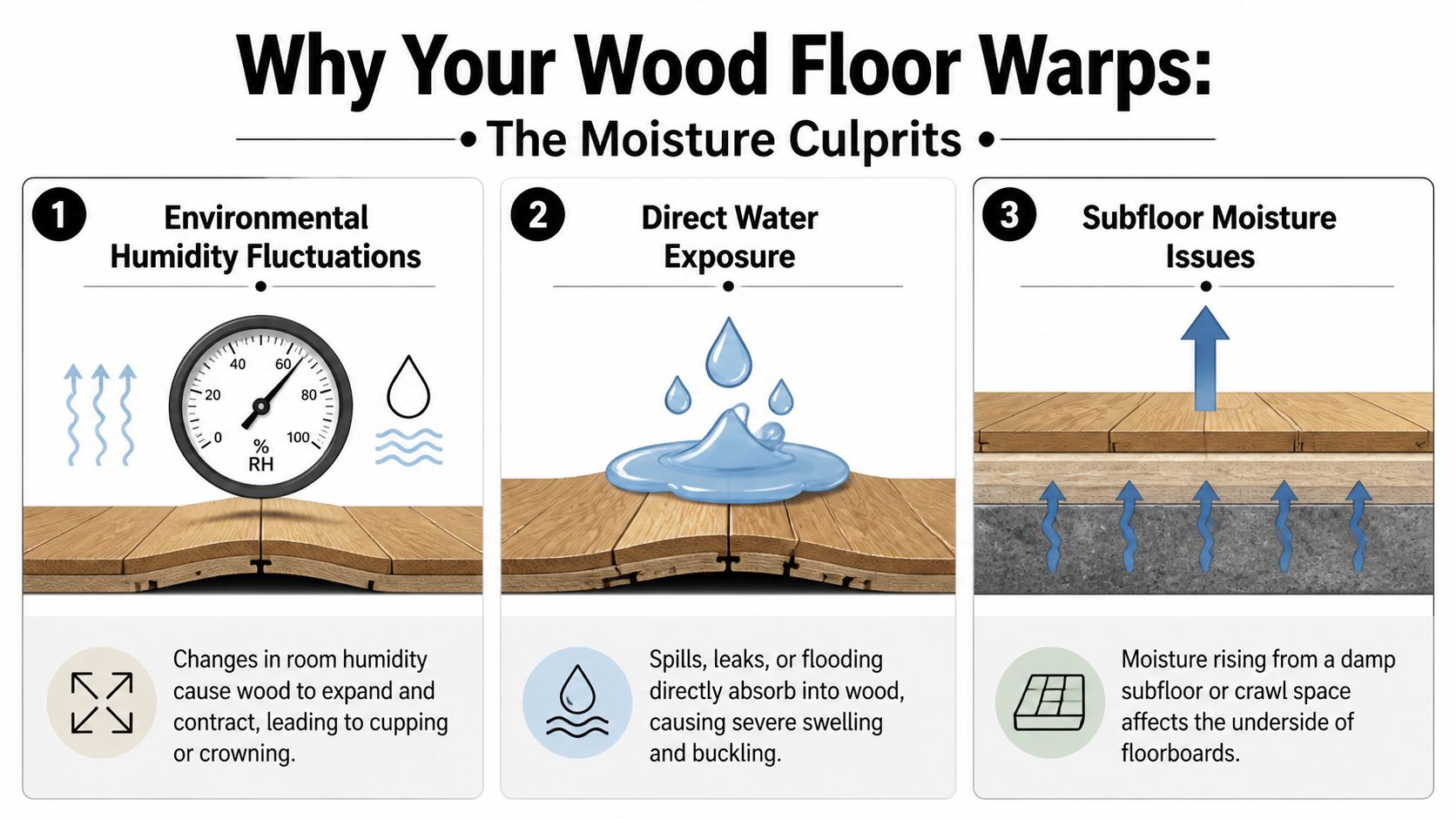
There’s one point that clears up most confusion fast. Excess moisture is the cause of warped hardwood floors. This flooring video reference identifies moisture as the single definitive cause, whether it comes from leaks, ambient humidity, or subfloor issues. It also notes that prevention and repair center on keeping indoor humidity in the 30 to 50% range.
That matters in North Georgia because our homes cycle through muggy summers, rainy spells, and indoor heating seasons. Wood responds to all of it.
The three warping patterns homeowners usually see
A warped floor doesn’t always look the same. The shape gives you clues.
| Warping type | What it looks like | What it usually suggests |
|---|---|---|
| Cupping | Board edges sit higher than the center | Moisture is affecting the underside more than the top |
| Crowning | Board center rises above the edges | The top dried differently than the bottom, or the floor was corrected too soon |
| Buckling | Boards lift up from the subfloor | A more serious moisture problem, often from a major water event or deep moisture below |
Cupping is the one I see most often
Cupping is common in homes with crawl space humidity, slab moisture, slow plumbing leaks, or seasonal indoor humidity swings. The board edges curl upward because the underside takes on more moisture than the face.
In practical terms, this is the “maybe salvageable” version if it’s caught early and the moisture source is corrected. It still needs attention. Homeowners often mistake cupping for a finish problem and start thinking about sanding. That can backfire if the boards are still carrying moisture.
Crowning is often a correction problem
Crowning is the opposite shape. The middle of the board sits higher than the edges. That can happen when the top side dries out faster while moisture still lingers underneath, or when someone sands a cupped floor before it has stabilized.
Experience matters. A floor can look ready for cosmetic repair when it isn’t. If you flatten the surface too soon, the board keeps moving and the finished result gets worse, not better.
A wood floor rarely needs a “harder push.” It usually needs the moisture problem solved first.
Buckling means stop guessing
Buckling is the severe version. Boards can lift away from the subfloor, push against each other, or create obvious ridges and movement underfoot. That usually points to prolonged exposure, substantial water intrusion, or a problem below the hardwood itself.
If the moisture came from a basement or lower level water event, homeowners should also review broader cleanup steps. EZ Plumbing's basement flood tips are useful because they focus on the immediate actions that help limit secondary damage before flooring repairs even begin.
For a closer look at one severe form of movement, this guide on what causes hardwood floors to buckle is worth reading. Buckling isn’t a cosmetic nuisance. It’s usually a sign that the floor system has been pushed past what it can absorb without mechanical repair.
The usual moisture culprits in North Metro homes
In this area, I tell homeowners to investigate these first:
- Kitchen appliance lines around refrigerators and dishwashers
- Window condensation that repeatedly wets the same boards
- Pet water stations in one fixed spot
- Basement and slab moisture in below-grade or lower-level rooms
- Improper cleaning where too much water gets used on hardwood
- High indoor humidity during Georgia summers
- Tight installation with not enough room for expansion
If you miss the source, the repair won’t last. That’s true whether you’re dealing with hardwood flooring in Cumming, a floor replacement project in Roswell, or trying to decide between hardwood and waterproof flooring in Johns Creek.
How to Address Minor Warping Yourself
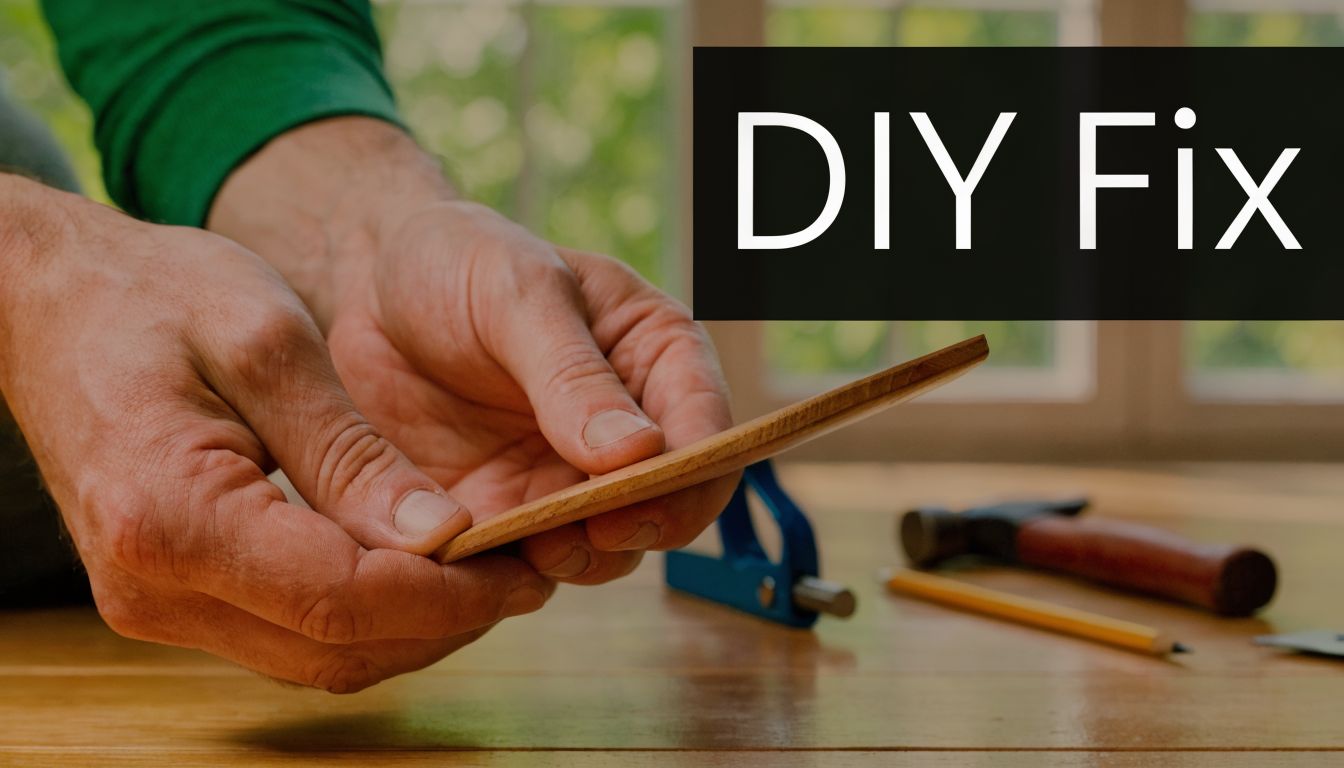
If the damage is small, the movement is slight, and you caught it early, a DIY repair can work. For minor warping, European Flooring’s repair method describes moisture re-equilibration and weighted compression with a 70 to 85% success rate for superficial damage when used quickly. The same source says the method can preserve original boards and save over 60% compared to full replacement.
That doesn’t mean every homeowner should try it. It means there’s a narrow lane where careful DIY makes sense.
Start with the moisture source
Before you touch the board, find out why it moved.
If a dishwasher line dripped into the same run of flooring, fix that first. If the room feels heavy and damp, check humidity. If the boards near an exterior wall are affected, inspect windows, door thresholds, and anything that can let water in. A moisture meter helps because guessing wastes time.
What you’re trying to avoid is this common mistake: flattening a board while the environment is still wet. The board may look better for a short time, then move again.
Gather the right tools
For minor repairs, I like homeowners to work with actual flooring tools, not improvised shortcuts.
- Moisture meter for checking wood and surrounding conditions
- Dehumidifier for pulling moisture out of the room
- Plastic sheeting to isolate a small repair area if needed
- Distilled water for controlled reconditioning of a board surface
- Sandbags or other even weights for compression
- Painter’s tape to protect finish boundaries
- 120-grit sandpaper for final feathering if the board stabilizes
- Matching stain and polyurethane if the finish needs touch-up
The drying step comes before the pressing step
If there’s standing moisture in the room, dry the room first. Remove rugs, clear furniture, and run the dehumidifier continuously. Keep airflow moving, but don’t blast hot air directly onto one isolated board. Uneven drying causes its own problems.
For slight cupping over a limited area, some homeowners have success creating a small tent with plastic sheeting and using a dehumidifier to draw moisture out over several days. The goal is steady drying, not a rush job.
Field note: Wood usually responds better to controlled, even drying than to aggressive heat.
How weighted compression works
This is the part many people rush.
The weighted compression method is for a small, isolated board or a very limited area with superficial movement. The process described in the source above involves carefully wetting the affected board with distilled water, covering it with plastic sheeting, and applying 50 to 100 lbs/sq ft of even weight for 3 to 7 days while monitoring it daily in order to avoid over-drying cracks and reversal problems from over-wetting.
That sounds backward at first, but the idea is controlled re-equilibration, not soaking the floor. You’re trying to help the fibers relax while the pressure encourages the board back toward shape.
Here’s the practical sequence:
Confirm the source is fixed
Don’t press a board back into shape while moisture is still entering the area.Clean the surface
Remove dirt and grit so you don’t grind debris into the finish.Apply moisture carefully
Use distilled water sparingly on the affected board only.Cover and weight evenly
Plastic sheeting goes over the board, then distributed weight across the repair zone.Check it every day
You’re watching for progress, finish issues, or signs you’re making it worse.Stabilize before finishing
If the board settles but feels loose or squeaks, secure it before cosmetic work.
When a minor repair is worth trying
DIY makes the most sense when:
- The damage is isolated to a small area
- The movement is slight
- You know the moisture source
- The boards are otherwise solid
- You’re comfortable waiting and monitoring the repair
It does not make sense when boards are lifting, multiple rows are involved, or you’re dealing with a wet subfloor.
What homeowners get wrong
The biggest failures I see come from impatience.
Some sand too early. Others over-wet the board because they think more moisture will make it easier to flatten. Some skip humidity control after the repair and the floor moves again with the next weather swing. Even a good board correction won’t hold if the room stays damp.
If you’re trying this in a Cumming or Milton home during a humid stretch, be realistic. Minor warping can respond well, but only when the space itself is under control.
Calling a Pro for Major Floor Repair or Replacement
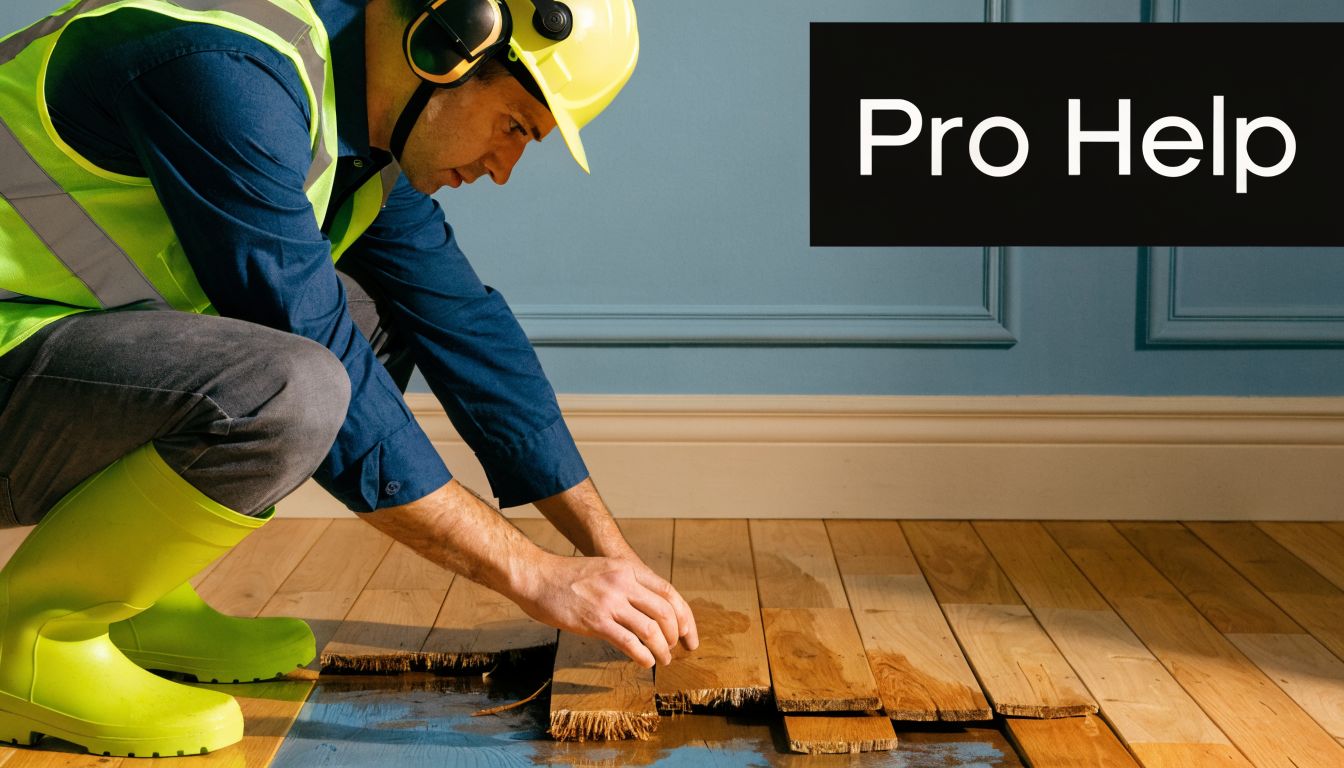
There’s a point where DIY stops being practical and starts increasing the chance of a bad outcome. If the floor is lifting, the damage runs across several boards, or the moisture source isn’t fully identified, it’s time to bring in a flooring professional.
For severe warping or buckling that affects multiple boards or shows more than 1/4-inch deviation, Bruce Flooring’s repair guidance says the fix is surgical board replacement by certified installers. The same source notes that professional repair can restore levelness and may enhance sale value by 2 to 5% for Forsyth County real estate situations where floor condition affects presentation.
The clear signs DIY is over
If I walked into a house in Canton, Woodstock, or Cumming and saw any of these, I wouldn’t tell the homeowner to keep experimenting:
- Multiple boards are affected together
- Boards are lifting or separating from the subfloor
- The floor feels soft, hollow, or unstable
- The damage sits near a slab, basement, or known moisture-prone area
- You can’t confidently say where the water came from
- The finish is broken and the wood underneath is moving
At that point, you’re not just fixing shape. You’re dealing with structural attachment, moisture balance, material matching, and finish blending.
What professional board replacement actually involves
Homeowners often picture “replacing a few boards” as a simple cut-out and drop-in task. On real hardwood, it’s more precise than that.
A proper repair usually includes:
| Repair stage | What the installer is doing |
|---|---|
| Assessment | Checking the extent of damage and whether the subfloor is part of the problem |
| Extraction | Removing damaged boards without scarring surrounding material |
| Acclimation | Letting replacement boards stabilize to the room before installation |
| Lacing in | Weaving or fitting new boards into the existing field so the repair reads naturally |
| Blending | Sanding, staining, and finishing so the patched area doesn’t stand out |
The trade-off is straightforward. A good pro costs more than a DIY attempt, but a failed DIY on severe damage usually creates a harder and uglier repair later.
When replacement makes more sense than repair
Sometimes the right answer isn’t hardwood repair at all. If the room has a history of moisture issues, the household has large dogs, or the area is a basement, laundry zone, or busy kitchen, replacement can be the smarter long-term move.
That’s where people start comparing materials:
- New hardwood flooring installation if the room is dry, stable, and you want a classic surface
- Luxury vinyl plank flooring if waterproof performance matters more
- Laminate flooring if you want a budget-conscious hard surface for low-moisture spaces
- Tile flooring for entryways, mudrooms, baths, or areas that take repeated water exposure
If you’re weighing repair against replacement after a leak, a useful next read is water-damaged floor repair options. It helps frame the practical decision homeowners face after the immediate emergency is over.
The right repair should solve the cause, restore the floor, and avoid making the next moisture event more expensive.
Why in-home evaluation matters
Photos help, but they don’t tell the whole story. A board that looks mildly raised in a picture can feel loose underfoot. A stain line near a wall can point to a window leak, a plumbing issue, or slab migration. Matching existing hardwood also depends on species, width, thickness, finish age, and sun fade.
That’s why homeowners searching for flooring near me, hardwood flooring installation in Cumming, or floor repair in Alpharetta should think in terms of diagnosis first. The best flooring pro isn’t the one who rushes to sell a new floor. It’s the one who can tell you what can be saved, what can’t, and what material fits the room going forward.
Protecting Your Investment and Choosing New Flooring
A repaired floor is only a win if it stays stable. In North Georgia, the long-term lesson is simple. Control moisture, or the floor will keep telling you about it.
That matters whether you’re keeping solid hardwood, moving to engineered material, or replacing a problem area with waterproof flooring.
How to keep hardwood stable in Georgia homes
The first layer of prevention is environmental control. If your house swings from damp to dry, wood reacts. In homes around Cumming, Johns Creek, and Milton, that usually means summer humidity management and keeping an eye on trouble spots around kitchens, exterior doors, and lower levels.
These habits help:
- Run dehumidifiers in rooms that stay damp or muggy
- Clean spills quickly instead of letting moisture sit at seams
- Check appliance lines behind refrigerators, dishwashers, and washers
- Use mats carefully at doors and pet areas so water doesn’t linger underneath
- Avoid wet mopping traditional hardwood
- Watch windows and thresholds during storm season
If you like the look of real wood but want better dimensional stability, engineered hardwood flooring is often worth a serious look. It gives homeowners a wood surface with a construction that can make more sense in rooms where seasonal movement is a concern.
Choosing flooring by room, not just by style
A lot of replacement mistakes happen because people shop by appearance first and use conditions second. That’s backwards.
Here’s the way I’d think about common rooms in North Metro Atlanta homes:
| Room or condition | Flooring direction that usually makes sense |
|---|---|
| Main living areas | Hardwood or engineered hardwood if the house is moisture-stable |
| Basements | Waterproof flooring, often LVP, because moisture risk is ongoing |
| Kitchens | Depends on lifestyle, but waterproof surfaces deserve a hard look |
| Homes with pets | Scratch-resistant and easy-clean surfaces matter more than tradition |
| Busy rentals or resale prep | Durable, affordable flooring options often win on practicality |
Why LVP gets considered so often
Luxury vinyl plank has become the fallback recommendation in a lot of homes for one reason. It solves problems hardwood doesn’t like.
For families in Roswell, Marietta, and Alpharetta dealing with dogs, kids, muddy entries, or basement moisture, LVP flooring offers a combination of waterproof performance, scratch resistance, and easier maintenance. It also works well for homeowners who want a wood look without the same sensitivity to spills and humidity.
That doesn’t mean it’s better everywhere. It means it’s often better in the rooms where hardwood keeps getting asked to do the wrong job.
What to weigh when deciding on replacement
I’d sort the decision into four buckets:
Performance
If the room sees moisture, pick a floor that tolerates moisture. If the room sees heavy foot traffic, pick a floor that handles wear.
Appearance
Some homeowners want authentic wood grain variation. Others care more about a clean, modern look that fits farmhouse, classic, or contemporary interiors.
Budget
The right flooring choice depends on where you want to spend and where you don’t. Some rooms justify premium hardwood. Others call for an affordable flooring option that still looks sharp and wears well.
Household reality
Dogs, kids, rental turnover, basement dampness, and fast renovation timelines all matter more than showroom impressions.
A good flooring decision matches the room you actually live in, not the room you wish you had.
That’s the biggest shift I’ve seen in recent years. People searching for best flooring for pets, waterproof flooring for basements, or scratch-resistant flooring for dogs aren’t shopping for trends. They’re trying to stop recurring problems.
Common Flooring Questions from Cumming Homeowners
Homeowners usually ask warped-floor questions for about five minutes. Then the conversation gets bigger. They want to know whether they should repair or replace, whether hardwood is still worth it, and what material makes sense for the next decade of real life.
Is hardwood always worth repairing
No. If the damage is isolated and the rest of the floor is stable, repair often makes sense. If the room has a repeated moisture history, repair may only be buying time.
That’s where room use matters. A formal dining room and a basement playroom shouldn’t be judged by the same flooring standard. In some homes, preserving hardwood is absolutely the right move. In others, switching to waterproof flooring avoids a repeat problem.
What’s the best flooring for pets and heavy traffic
For many households, that’s where LVP flooring enters the conversation. It’s popular because it handles busy traffic, claws, bowls, and everyday cleanup well. If you want a harder surface underfoot but need practicality, LVP is often a strong fit.
Hardwood can still work in pet-friendly homes, but owners need to accept more maintenance and faster visible wear. Tile also performs well in high-traffic areas, especially entries and mudrooms, though it feels very different underfoot than wood-look flooring.
What about laminate flooring
Laminate can be a good option when you want an affordable hard surface and the room doesn’t have recurring moisture issues. It’s often considered for secondary living spaces, bedrooms, and budget-conscious updates.
I’d be more cautious with laminate in true moisture-prone zones. For those areas, waterproof flooring generally gives homeowners more peace of mind.
Is waterproof flooring the best option for basements
In most North Georgia basements, waterproof flooring deserves serious consideration. Even when there isn’t active flooding, below-grade spaces deal with humidity and moisture variability that can punish traditional hardwood.
For kitchen-specific thinking, Domicile Construction's insights on flooring offer a practical breakdown of how people choose materials based on spill risk, maintenance, and daily use. The same kind of logic applies in basements. Pick the floor for the conditions, not just the visual.
Should I choose tile, laminate, LVP, or carpet for certain areas
It depends on how the room is used.
- Tile flooring works well in wet entries, bathrooms, and laundry areas.
- LVP flooring fits homes that want waterproof performance with a wood look.
- Laminate flooring can be a solid value play in drier rooms.
- Carpet installation still makes sense in bedrooms, bonus rooms, and spaces where softness and sound control matter.
A lot of homeowners trying to compare everything at once get stuck. It helps to decide what matters most in that room: water resistance, comfort, scratch resistance, appearance, or budget.
What’s the difference between installation and replacement searches
When people search hardwood flooring installation, they’re usually planning a new floor in a room that’s ready for it. When they search floor replacement, they’re usually reacting to a problem, worn material, or a renovation where the existing floor has to go.
That difference matters because replacement often includes more than the visible surface. There may be removal, prep, subfloor correction, transition work, or material changes to suit the space better than the old floor did.
Are in-home consultations worth it
Yes, especially when moisture, transitions, or whole-house consistency are part of the project. A showroom sample can’t tell you how your lighting, wall color, subfloor condition, and adjacent rooms will affect the result.
An in-home consultation also helps homeowners compare styles in context. Modern, farmhouse, and classic looks all read differently once they’re in your actual house. That’s true whether you’re shopping for affordable flooring in Acworth, hardwood in Alpharetta, carpet installation in Marietta, or waterproof flooring in Cumming.
What do real estate agents and sellers usually care about most
Three things. Clean appearance, durable material, and a flooring choice that fits the market for the home.
For some listings, that means repairing existing hardwood because buyers expect it. For others, it means replacing damaged flooring with a practical, attractive product that photographs well and doesn’t raise concerns during showings. Flooring has a big effect on perceived maintenance, even when buyers can’t name exactly why a house feels better.
What should I do first if I’ve just discovered a warped wood floor
Don’t start shopping for stain colors. Don’t rent a sander. Don’t assume the board shape tells the whole story.
Do this instead:
- Find and stop the moisture source
- Dry the area thoroughly
- Assess whether the damage is minor or severe
- Decide whether the room still deserves hardwood
- Get professional eyes on it if there’s any doubt
That sequence saves more floors than any shortcut ever will.
If you’re dealing with warped hardwood, weighing floor repair against replacement, or comparing hardwood, carpet, laminate, and waterproof flooring in Cumming or the surrounding North Metro Atlanta area, Flacks Flooring is a strong place to start. Their team offers in-home consultations, practical guidance, and help choosing flooring that fits your home, your budget, and the way your family lives.