
That new carpet smell. It’s one of those things—some people don't mind it, but for most of us, it’s a scent we want gone, fast. It’s caused by something called Volatile Organic Compounds (VOCs) being released from the carpet’s backing and fibers. It's a process known as off-gassing.
The good news? It's completely temporary. With the right approach—think good ventilation, a bit of cleaning, and a few simple tricks—you can clear the air and start enjoying your new floors without that lingering chemical odor.
So, What Exactly Is That "New Carpet Smell"?
When you walk into a room with freshly laid carpet, that distinct smell you notice comes directly from the manufacturing process. It's not the fuzzy fibers themselves, but primarily the synthetic latex backing used to hold everything together. As this backing material cures and settles into its new environment, it releases various compounds into the air.
The main culprit behind that specific, almost plastic-like scent is a VOC known as 4-phenylcyclohexene (4-PCH). Now, the word "chemical" can sound a bit scary, but let's put it in context. These VOCs are present in very low concentrations and are also found in countless everyday items, from the paint on your walls to your new sofa.
Understanding Off-Gassing
Off-gassing is just the technical term for what happens when those compounds, which are solid or liquid in the carpet materials, turn into a gas and are released into your home's air. This process kicks into high gear the moment the carpet is unrolled and installed. Because it's happening in a closed-off room, the scent concentrates and becomes much more noticeable than it was in a spacious, airy warehouse.
A few key things to remember about off-gassing:
- It doesn't last forever. The smell is at its worst right at the beginning and will fade significantly on its own.
- Fresh air is your best friend. Getting air circulating is the single most effective way to dilute the VOCs and get them out of your house.
- Carpets today are much safer. If you're worried about things like formaldehyde, you can rest easy. It hasn't been used in U.S. carpet manufacturing for decades.
How Long Until the Smell Is Gone?
For most homeowners here in Forsyth County, the timeline is actually pretty quick. The new carpet smell, which is mostly from that 4-PCH in the latex binders, usually peaks within the first 24 to 72 hours.
Did you know that with good ventilation, the odor can dissipate by as much as 90% in just a day or two? That's a huge relief for families in Milton and Cumming who are focused on creating healthy living spaces. In fact, studies show that these specific VOCs are among the lowest contributors to indoor air quality issues and have no established links to negative health effects. You can learn more about the safety of modern carpets and set your mind at ease.
Key Takeaway: That new carpet smell is a normal, short-lived part of the installation. Once you understand it’s just VOCs from the backing and that it clears out quickly with airflow, you can confidently move on to the practical steps to freshen up your home.
Immediate Actions for Fresh Air
That brand-new carpet smell hits you the moment you walk in. While it's a sign of a fresh start for your floors, you don't have to just live with it. A few proactive steps right away can make a world of difference, speeding up the off-gassing process and getting your home's air back to normal much faster.
The goal is simple: get those Volatile Organic Compounds (VOCs) out of the room, not just swirling around in it.
Master the Art of Ventilation
Your most powerful tool is good old-fashioned ventilation. Stale air is the enemy, and fresh air is your best friend in this fight.
But just cracking a single window open won't cut it. You need to create a cross-breeze by opening windows on opposite sides of the room or your home. This creates a natural wind tunnel that literally pushes the VOC-filled air out while pulling fresh air in.
For those of us in Cumming or Johns Creek, this is perfect on a nice spring or fall day. But when the Georgia heat or humidity is too much, you can supercharge your ventilation with fans.
- Create a push-pull system. Put a box fan in one window facing out to push the stale air outside.
- Keep the air moving. Flip on your ceiling fans to prevent the air from becoming stagnant and concentrated.
- Use your HVAC system. Switch your thermostat to the "fan only" setting. This circulates air through your entire house using the system's powerful fan, diluting the smell without running up your cooling or heating bill.
This whole process—from the initial strong smell to its eventual disappearance—is something we see all the time.
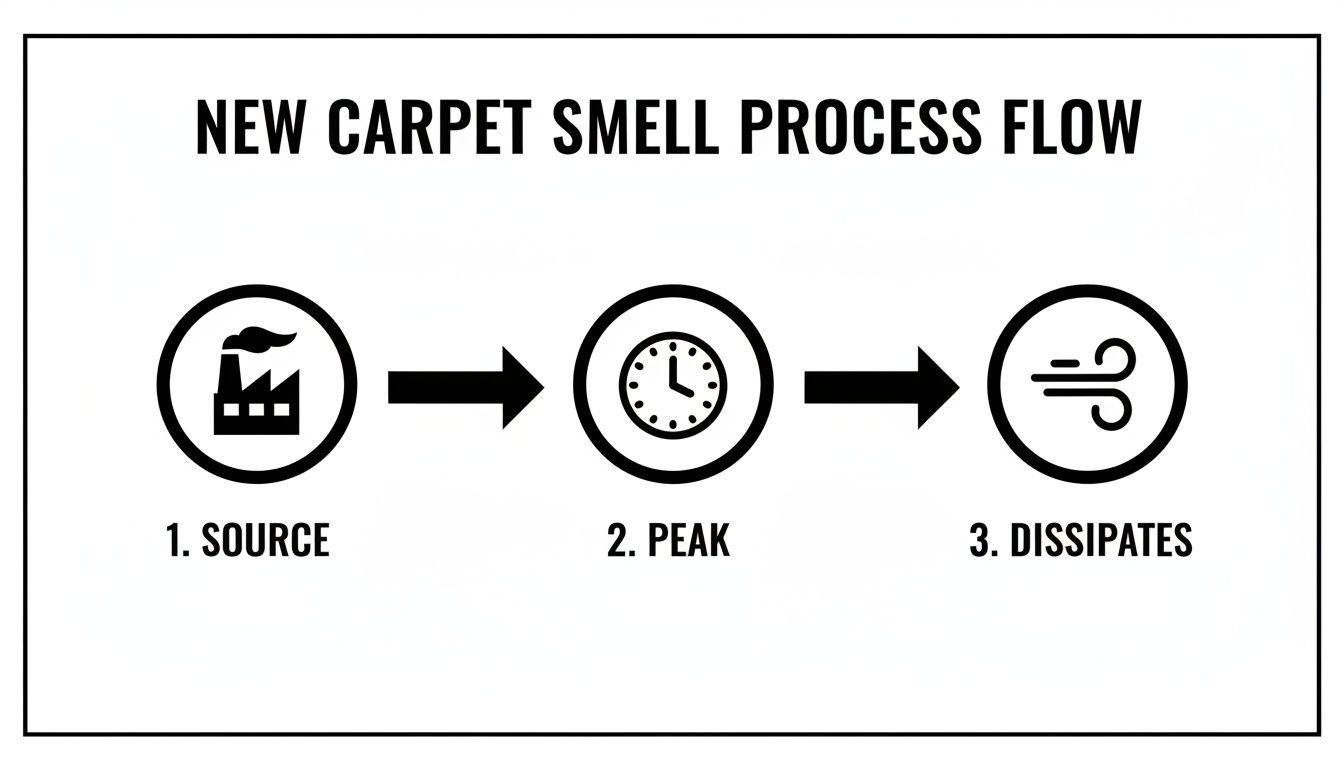
As you can see, the smell is strongest right at the beginning. The key is to take action to shorten that timeline and get to the "dissipates" phase as quickly as possible.
The Critical Role of Daily Vacuuming
Ventilation takes care of the VOCs floating in the air, but what about the source? Your new carpet is covered in tiny, loose fibers and dust from manufacturing and installation. Think of these particles as tiny sponges, soaking up and holding onto that distinct new carpet smell.
That's why you need to vacuum every single day for the first week. It’s not just about tidiness; you're physically removing the source of the odor. With every pass, your vacuum sucks up those loose, smell-trapping fibers, which means there's less material left to release VOCs into the air.
A Pro Tip for Forsyth County Homes: If your vacuum is equipped with a HEPA filter, now is the time to use it. A High-Efficiency Particulate Air (HEPA) filter is a game-changer because it traps microscopic particles. This ensures the odor-carrying dust is gone for good, not just stirred up and blown back into your room.
By combining these two strategies—aggressive ventilation and consistent vacuuming—you're fighting the smell on two fronts. You’re clearing the air and removing the source simultaneously. These aren't temporary fixes; they are steps to permanently improve air quality in your home using carpet.
Your mission for the first few days is simple: maximum airflow and maximum particle removal. Stick with it, and you’ll notice a huge difference within the first 24 to 48 hours. You'll be able to enjoy the comfort of your new floors without the distracting smell. You’re not just waiting it out—you’re actively showing that smell the door.
Step 3: Put Natural Deodorizers to Work
After you’ve aired out the room and given it a good vacuuming, you might still catch a whiff of that distinct “new carpet” smell. This is completely normal. If you're hesitant to use commercial sprays and prefer a more natural approach, your kitchen pantry probably holds the solution.
These common household items don't just cover up smells; they actively absorb the compounds causing them. It’s a budget-friendly and safe way to clear the air, especially for families in places like Johns Creek and Milton who are conscious about what they bring into their homes.
The Baking Soda Method
There's a reason baking soda is the go-to for so many household odors—it just works. Its natural properties neutralize the acidic VOCs that are off-gassing from your new carpet. But to get it right, you can't be stingy.
Grab a couple of large boxes and sprinkle a generous, even layer over the entire carpet. Think of it like a light dusting of snow. Use a soft brush to gently work the powder down into the fibers so it can get to the source of the smell.
The real secret here is time. You need to let the baking soda sit for at least 24 hours. If the smell is particularly strong, leaving it for up to 48 hours is even better. This gives it enough time to truly absorb those VOCs.
Once the time is up, vacuum thoroughly. You'll likely need to pass over the area multiple times from different angles to get all the fine powder out. A vacuum with a good HEPA filter is your best friend for this job, as it will trap the tiny particles and the odors they've absorbed.
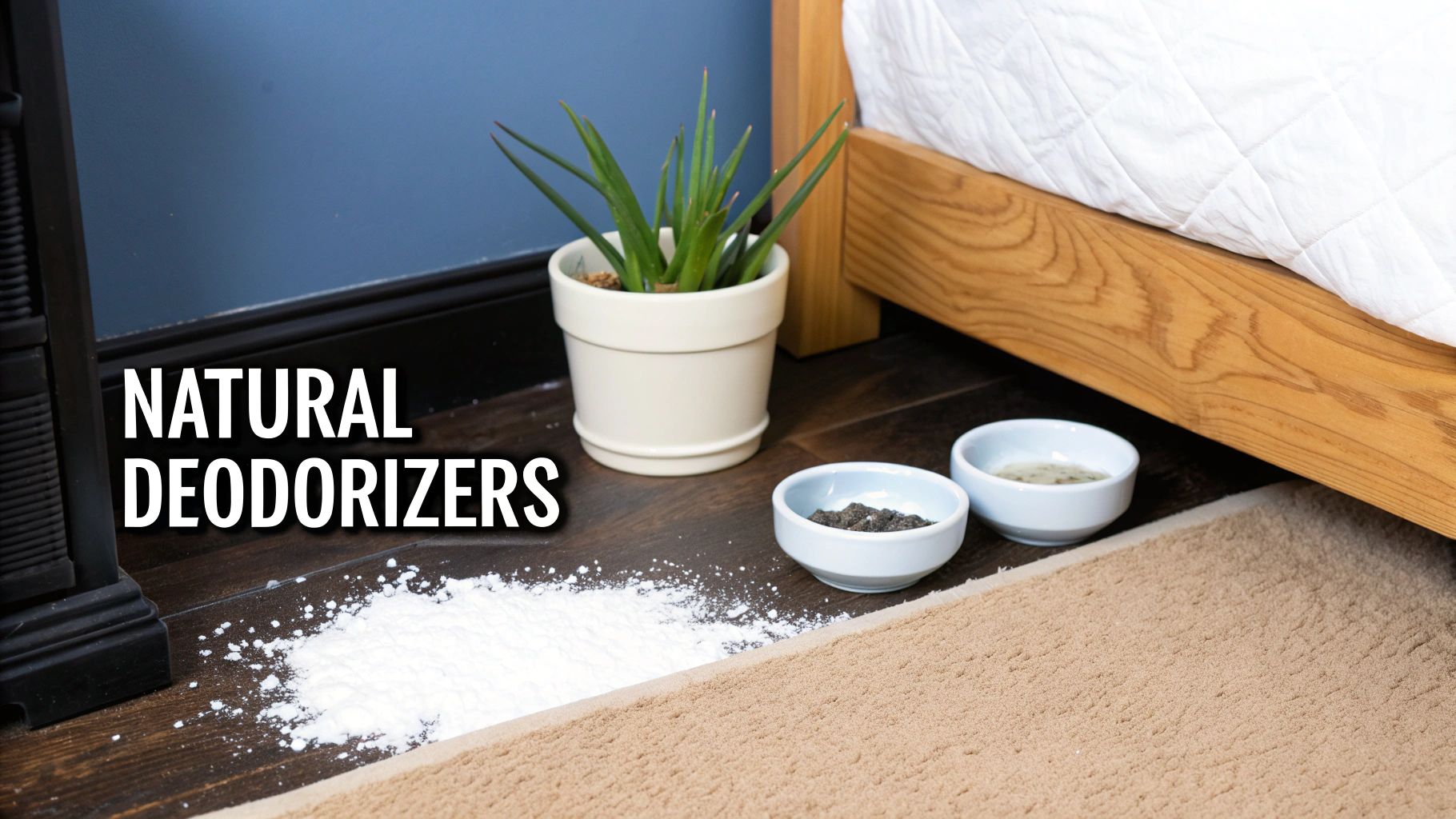
A Quick Comparison of Your Go-To Options
While baking soda is fantastic for direct application on the carpet, other natural products work wonders on the air in the room. Here’s a quick rundown of what works best and when.
Natural Deodorizer Effectiveness Comparison
| Method | How It Works | Best For | Pro Tip |
|---|---|---|---|
| Baking Soda | Directly absorbs and neutralizes acidic VOCs within the carpet fibers. | Treating the entire carpet surface for widespread, embedded odors. | Apply a thick layer and brush it in. Let it sit for a full day or two. |
| White Vinegar | Neutralizes airborne odor molecules. | Tackling lingering smells in the air after ventilating the room. | Place small, shallow bowls in the corners of the room. The vinegar smell will vanish as it evaporates, taking other odors with it. |
| Activated Charcoal | Porous surface traps and filters VOCs and impurities from the air. | Passive, continuous air purification for several days or weeks. | Use breathable bags or bowls and place them near air vents or in corners for maximum effect. |
| Houseplants | Absorb airborne toxins and release clean oxygen through natural processes. | Long-term, continuous improvement of indoor air quality. | Choose low-maintenance air-purifiers like Snake Plants or Spider Plants. |
Using a combination of these—like baking soda on the carpet and a few bowls of vinegar in the corners—can speed up the process significantly.
More Natural Odor Absorbers for the Air
Baking soda is a direct-contact solution, but what about the VOCs floating in the air? That's where a few other household staples come in. These are passive methods, meaning you can set them up and let them do their job.
- Bowls of White Vinegar: Don't worry, your house won't smell like a salad. Pour some plain white vinegar into a few small bowls and scatter them around the room. As the vinegar evaporates, it neutralizes odors in the air. The vinegar scent itself disappears once you remove the bowls.
- Activated Charcoal: This stuff is a powerhouse absorber. You can find it in small pouches or as loose briquettes. Just place them in a few bowls around the room, and they will quietly filter the air, trapping VOCs and other impurities.
For a deeper dive into green cleaning, you can find more great tips in our guide to natural floor cleaning solutions.
Let Houseplants Lend a Hand
Never underestimate the power of a few good houseplants. While they won't fix a strong smell in a single day, they are fantastic for improving your home's long-term air quality.
Plants like Snake Plants, Spider Plants, and Peace Lilies are well-known for their air-purifying abilities. Think of them as living, breathing air filters that work around the clock to remove common indoor pollutants. They're a beautiful and functional addition that will keep your air fresh long after that new carpet smell is gone.
Advanced Tools for Stubborn Odors
You’ve aired out the house, vacuumed like a pro, and tried every natural trick in the book, but that faint chemical smell still hangs around. When the basics aren't quite cutting it, it's time to bring in the heavy hitters.
Sometimes, a persistent new carpet odor needs more than a passive approach. It needs to be actively stripped from the air and pulled from the carpet fibers. This is especially true for rooms in your Johns Creek or Milton home that don't get great cross-breeze, or for anyone who’s extra sensitive to scents.
Luckily, you don't have to just wait it out. A couple of modern tools can tackle these stubborn odors head-on, not just masking the smell but eliminating the source.
Put an Air Purifier to Work
One of the most effective weapons against lingering VOCs is a high-quality air purifier. But here’s the key: not just any model will do the job. To really neutralize that new carpet smell, you need a unit with a specific two-stage filter system designed for both particles and gases.
Here’s a quick breakdown of how it works:
- HEPA Filter: A High-Efficiency Particulate Air (HEPA) filter is brilliant at trapping tiny physical things—dust, pollen, and even the loose carpet fibers that carry those odor-causing chemicals.
- Activated Carbon Filter: This is your secret weapon for smells. Activated carbon has a porous surface that adsorbs gaseous pollutants like the VOCs causing that new carpet smell. Think of it as a super-sponge for odors, trapping them on a molecular level.
For the best results, stick the air purifier in the middle of the room and let it run on high for a few hours each day, particularly during that first week. It works best if you keep the doors and windows closed while it's running, letting it cycle through all the air in the room without interruption.
Air purifiers with both activated carbon and HEPA filters can make a huge difference with new carpet VOCs. Studies show they’re great at trapping gases like formaldehyde and benzene, which are key to getting rid of that chemical odor in just 1-6 weeks. This is a huge win for Cumming homeowners renovating to sell—it speeds up the off-gassing that can otherwise linger for months.
The Power of a Professional Steam Clean
You probably think of steam cleaning for old, dirty carpets, but it can be a game-changer for brand-new ones, too. A professional hot water extraction, done soon after installation, is a fantastic way to wash away the residual chemicals left over from manufacturing.
The process shoots high-pressure hot water and a mild cleaning solution deep into the carpet fibers, and then a powerful vacuum sucks it all right back out. This isn't just a surface clean; it physically flushes out the VOCs at their source. It's like giving your carpet its first real bath, which dramatically speeds up the off-gassing process.
For those really stubborn smells or for a whole-home approach to air quality, you could even look into dedicated tools like air purification systems.
Scheduling a professional steam clean is a smart move, especially for households with kids, pets, or anyone with allergies or asthma. It gives you peace of mind that the air is clean right from the get-go. While it's a cleaning method, its biggest immediate benefit is getting rid of that odor. For tips on keeping it clean down the road, check out our guide on how to clean a dirty carpet.
By combining a good air purifier with a strategic professional clean, you can knock out even the most stubborn new carpet smell and start enjoying your beautiful new floors.
When to Call in the Pros for Carpet Cleaning
You've aired out the rooms, sprinkled baking soda like a pro, and vacuumed until you can't vacuum anymore. So why does that new carpet smell still hang in the air? Sometimes, despite all your hard work, that stubborn chemical odor just doesn't want to leave.
When the smell persists, or if you simply want the most effective solution from the get-go, it’s time to call a professional. This isn’t throwing in the towel; it's bringing in the heavy artillery to ensure your home's air is as fresh and healthy as possible.
A professional cleaning is a different beast altogether. It goes way beyond surface-level fixes to physically remove the chemical residues that are embedded deep within the carpet fibers and backing. For families here in Cumming with young kids or anyone dealing with allergies, it’s the ultimate step for total peace of mind.
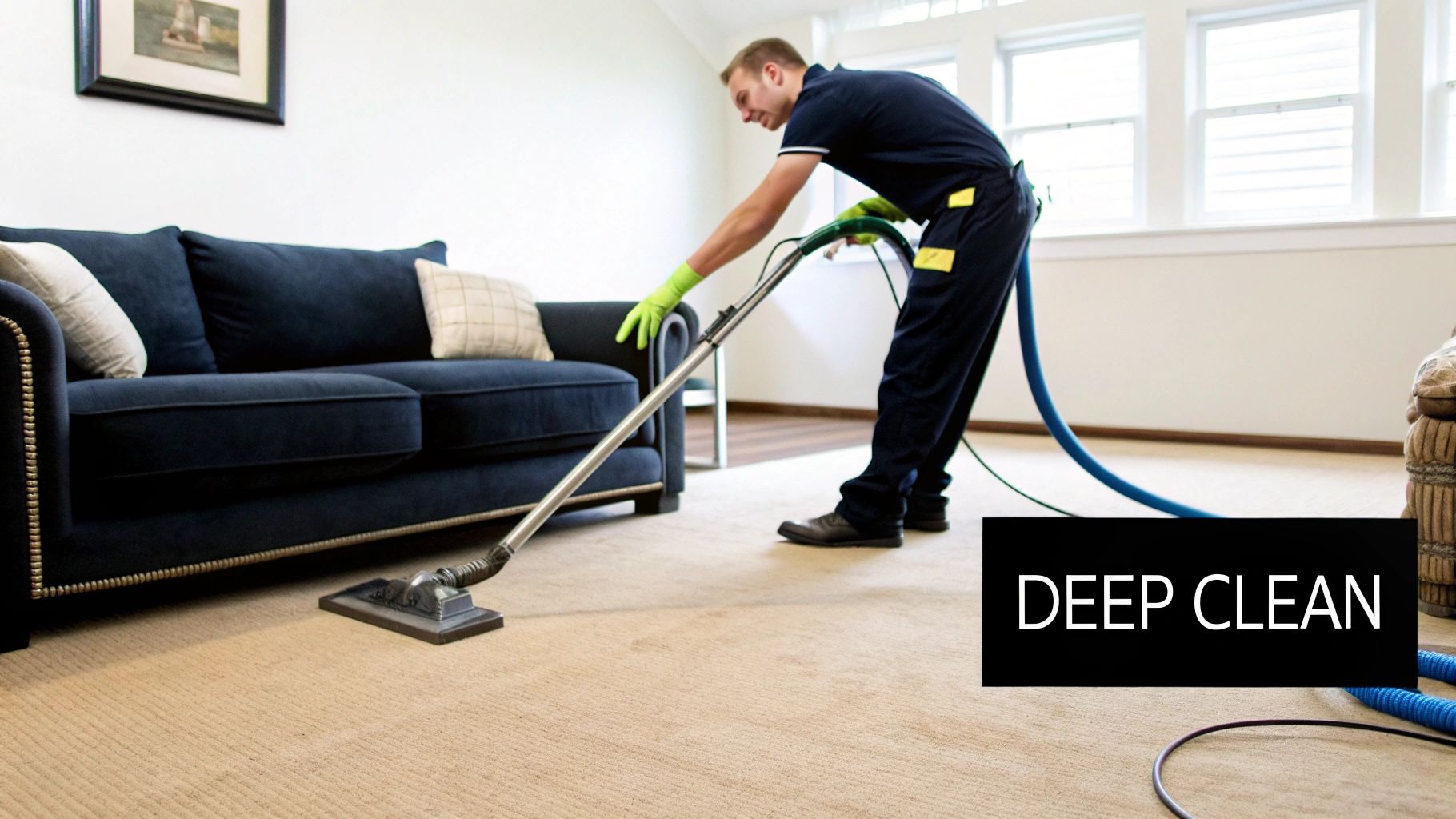
The Power of Hot Water Extraction
In the world of professional carpet cleaning, hot water extraction (often called steam cleaning) is the undisputed champion. It's so effective because it doesn't just mask odors—it gets to the very root of the problem, flushing out the VOCs from the base of the carpet.
Here's a look at how it works:
- Deep-Down Clean: A technician uses high-powered equipment to spray a mixture of extremely hot water and a specialized cleaning solution deep into the carpet fibers. The combination of heat and pressure is fantastic at breaking down and loosening the sticky chemical residues causing that "new" smell.
- Total Removal: Right after spraying, a powerful vacuum sucks everything back up—the water, the cleaning solution, dirt, and most importantly, the dissolved VOCs. It's like a deep rinse cycle that pulls the unwanted chemicals completely out of your home.
This is the key difference. DIY methods often just absorb or cover up odors. Hot water extraction physically removes the source.
Creating a Healthier Home
The payoff of a professional clean right after installation goes well beyond just getting rid of a smell. It’s about creating a genuinely healthier environment, which I know is a huge priority for families across Forsyth County and Johns Creek.
The numbers are pretty staggering. A proper hot water extraction can slash dust mite allergens by 91%, cat allergens by 95%, and dog allergens by 97%. This is a game-changer for real estate agents prepping a home for sale or contractors finishing a build-out in Milton.
But it doesn't stop there. Studies show a dramatic drop in airborne dust (52%), total VOCs (49%), bacteria (40%), and even fungi (61%) after just one deep clean. You can dive deeper into the health benefits of professional carpet cleaning to see the full impact.
Expert Tip: I always recommend scheduling a professional cleaning within the first week or two after your carpet is installed. This lets you hit the off-gassing process right at its peak, giving you immediate relief from the smell and a cleaner start.
Is It the Right Move for You?
Hiring a professional isn't just a last resort for stubborn odors. It's a smart, proactive move for anyone who wants to ensure their brand-new carpet is as clean and fresh as it looks.
You should seriously consider it if:
- The new carpet smell is still strong after a week of airing it out.
- Someone in your home has allergies, asthma, or is sensitive to chemicals.
- You have young children or pets who live on the floor.
- You simply want the fastest, most thorough way to remove VOCs.
By investing in a professional hot water extraction, you’re doing more than just solving a smell problem. You're taking a concrete step to improve your home’s air quality and making sure your new carpet is a source of comfort from day one.
Common Questions About That New Carpet Smell
Even after you've done everything right, it's normal to have a few questions about that distinct new carpet smell. Every home here in Cumming is a bit different, and what works for one family might need a little adjustment for another. Let's dig into some of the most common questions we hear from homeowners, so you can feel confident and breathe easy.
Getting the right answers separates worrying about a lingering smell from knowing you're on the fast track to a fresh, clean home.
How Long Does the New Carpet Smell Actually Last?
This is the big one, isn't it? While there’s no universal timeline, the most potent odor from Volatile Organic Compounds (VOCs) usually hits its peak within the first 24 to 72 hours after installation.
With good, steady ventilation—we're talking open windows and running fans—you should notice a huge difference in just a couple of days. For most carpets, the scent will be almost gone after a week. However, if you have a particularly sensitive nose or the room has limited airflow, a faint odor might hang around for a few weeks as the last traces of VOCs make their way out.
Is This Smell Harmful to My Kids or Pets?
A totally valid and important question for any family in Forsyth County. The good news is that modern carpets made in the U.S. are manufactured to be incredibly safe. The levels of VOCs they release are very low and aren't considered a significant health risk for most people.
That said, some people and pets are more sensitive than others. Keep these points in mind:
- For sensitive family members: Anyone with asthma, allergies, or chemical sensitivities might notice temporary irritation, like a headache or a stuffy nose.
- For kids and pets: They spend much more time down on the floor and have smaller bodies, so it’s always smart to be a little extra cautious. Try to keep them out of the newly carpeted room for the first 48-72 hours while you're airing it out aggressively.
By following the ventilation and cleaning steps we’ve covered, you’re creating a safe and healthy space for everyone in your home.
Does the Carpet Pad Make a Difference in the Smell?
Yes, it absolutely can. The carpet pad, or underlayment, has its own manufacturing process and can release its own set of VOCs. The two main players are rebond pad (made from recycled foam) and rubber pad.
Both are safe, but some lower-quality rebond pads can have a stronger initial smell because of the binders used to glue the foam pieces together. If you know you're sensitive to smells, it's worth investing in a higher-quality, low-VOC carpet pad. It can make a real difference in the overall scent level in your home right from day one.
Expert Tip: Your carpet is only half the story. Always ask your flooring specialist about low-VOC padding options. Tackling potential odors at the source is the best strategy.
I've Tried Everything, and I Can Still Smell It. What Now?
Okay, so a week or two has passed. You’ve aired the place out, vacuumed with baking soda, and the smell is still sticking around. Don't panic. Sometimes, a super-dense carpet or a room with tricky airflow just needs a stronger hand. This is when it's time to call in the pros for a hot water extraction cleaning.
This deep cleaning process essentially power-washes your carpet, flushing out any residual manufacturing chemicals that simple vacuuming can't touch. It’s the most effective final step for a stubborn odor. For a wider look at dealing with all sorts of lingering smells, this comprehensive guide to removing carpet odours is a great resource.
Should I Hold Off on Moving My Furniture Back In?
If you can, yes. It's a good idea to wait. When you move heavy furniture back in right away, you can trap VOCs under big pieces like beds, dressers, and entertainment centers. This creates little pockets where the smell can linger for much longer simply because fresh air can't get in to clear it out.
Give the room at least 24 to 48 hours of solid, open-air ventilation before putting everything back. If you’re pressed for time, at least try to leave a few inches of space between the furniture and the walls. That small gap can do wonders for encouraging airflow around the room's perimeter, helping the off-gassing process finish up more quickly and evenly.
At Flacks Flooring, we believe your new floors should bring you joy, not a headache. If you're planning a flooring project in Cumming, Johns Creek, or Milton and have questions about low-VOC options, our team is here to guide you to the perfect, healthiest choice for your home. Visit our showroom or learn more at https://flacksflooring.com.