
Meta Title: Laminate Floor Transition in Cumming, GA
Meta Description: Laminate floor transition advice for Cumming, GA homes. Handle humidity, tile, carpet, and doorways right. Visit our Cumming showroom today.
Suggested URL Slug: /laminate-floor-transition-cumming-ga
If you just finished a laminate floor in Cumming, GA and now the doorway looks unfinished, you are not alone. The planks look sharp across the room, but where laminate meets tile, carpet, hardwood, or another laminate run, that last detail decides whether the job feels complete or starts giving you trouble once Georgia humidity kicks in.
Around Forsyth County, that trouble shows up fast. A gap at the bathroom door, a lip into the kitchen tile, a loose strip near the mudroom, or swelling pressure after a stretch of damp weather. In active family homes near Lake Lanier, in HOA communities, and in newer North Atlanta open-concept homes, the right laminate floor transition is not trim for trim’s sake. It is what protects the edge, preserves movement, and keeps the floor safe under daily traffic.
If you are searching for a flooring store near me or trying to sort out a remodel in Cumming, Johns Creek, Milton, Alpharetta, Suwanee, Buford, Sugar Hill, Dawsonville, Canton, or Woodstock, visit our Cumming showroom or schedule a free flooring consultation. Good transition work is one of those details that looks small on day one and matters a lot three seasons later.
Your Guide to Flawless Laminate Flooring Transitions in Cumming
The common scenario is simple. New laminate is down in the family room, the old tile stays in the kitchen, and now there is an awkward break between the two. Sometimes the surfaces are close in height. Sometimes one side sits noticeably higher. Either way, leaving it unfinished is a starting point for avoidable problems.
A proper transition gives that edge a finished look, but more, it gives the floor room to move. That matters in Cumming homes because North Georgia weather does not stay steady. Humid summers, wet winter shoes, spring pollen, tracked-in red clay, and everyday traffic from kids and pets all work on flooring joints.
What homeowners in Cumming usually need
Most laminate transition questions fall into a few real-life situations:
- Doorway to doorway laminate runs: Two rooms have laminate and need a clean bridge that still allows floating-floor movement.
- Laminate to kitchen tile: Common in Forsyth County remodels where homeowners keep durable tile in wet areas.
- Laminate to bedroom carpet: Still common in older homes in Cumming, Johns Creek, and Milton.
- Laminate at exterior doors or fireplaces: The flooring ends and needs a firm finished edge.
The mistake I see most often is choosing a strip by appearance alone. Homeowners match color and ignore height, gap requirements, subfloor type, or where moisture collects. That is how a nice-looking remodel turns into a call-back.
Pro tip: The right transition is chosen by floor height, movement needs, and traffic pattern first. Color match comes after that.
Why this detail changes the whole job
Transitions do three practical jobs:
- They protect exposed laminate edges
- They manage movement where different surfaces meet
- They reduce the chance of a toe-catching lip in busy walkways
That matters in North Atlanta homes with open layouts, especially where one flooring type flows into another near kitchens, laundry areas, garage entries, and back doors. In a lake home near Lanier, it matters even more because damp traffic and seasonal indoor humidity swings put extra stress on those seams.
Homeowners, real estate agents, builders, and designers all notice the same thing. A laminate floor can be installed well and still look unfinished if the transition is wrong. The fix is usually straightforward, but it needs to be selected with the room, the subfloor, and the local climate in mind.
Why a Proper Transition Matters for Your Forsyth County Home
A transition strip is one of the smallest pieces in a flooring job. It also carries a lot of responsibility. In Forsyth County homes, it has to deal with movement, moisture, and traffic at the exact point where floors are most vulnerable.

Georgia humidity is the first reason this matters. In regions like Georgia, proper laminate floor transitions reduce 45% of buckling risks in HDF laminate flooring when connecting to tile surfaces, because they accommodate the expansion gaps floating floors need (Flacks Flooring transition guidance). That is not a technical footnote. It is the difference between a floor that settles in and a floor that starts pushing against itself.
Humidity, movement, and local wear
Laminate needs room to expand and contract. In Cumming and the rest of North Georgia, that is not optional. Summer moisture rises, HVAC cycles shift, and floors respond. If a transition locks the floor too tightly, especially at a doorway or tile edge, the pressure has to go somewhere.
Usually, it shows up as:
- Peaking at plank joints
- Edge lift near tile
- Buckling across longer runs
- Loose or cracked trim at the doorway
Lake Lanier homes and homes with large window walls see this more often because indoor conditions can swing harder from season to season. The same goes for older homes in Milton or Johns Creek with mixed flooring and additions that were built at different times.
Daily family traffic makes bad transitions fail faster
Climate is only half the story. Family life finishes the job.
Red clay from a driveway, muddy traffic after rain, spring pollen grit, dog nails, rolling backpacks, grocery carts, and wet winter shoes all hit transition points first. A weak or badly chosen strip starts rocking, loosening, or wearing on the edge. Once that happens, the exposed laminate edge is easier to chip.
A transition also affects safety. If the height change is not handled properly, it creates an obvious trip point in a doorway. That is why profile choice matters just as much as color.
For homes dealing with uneven floor heights, this guide to transition strips for uneven floors is a useful next step.
Key takeaway: In Forsyth County, a transition is not decorative trim. It is part of the floor system.
Where the wrong choice shows up fast
Some spots in Cumming homes are less forgiving than others:
| Area | What usually goes wrong | Better approach |
|---|---|---|
| Kitchen to family room | Tile and laminate pinch against each other | Use a profile designed for differing materials and movement |
| Hallway doorways | Long floating runs build pressure | Break the run correctly at the doorway |
| Garage entry or mudroom | Moisture and grit wear the edge | Use a durable edge profile and keep the gap correct |
| Carpeted bedrooms | Unsupported edge flexes under traffic | Use a transition meant to finish laminate cleanly against soft flooring |
If the goal is durability in an active Forsyth County home, transition selection should happen before the install starts, not after the planks are already down.
Choosing the Right Laminate Transition in Cumming
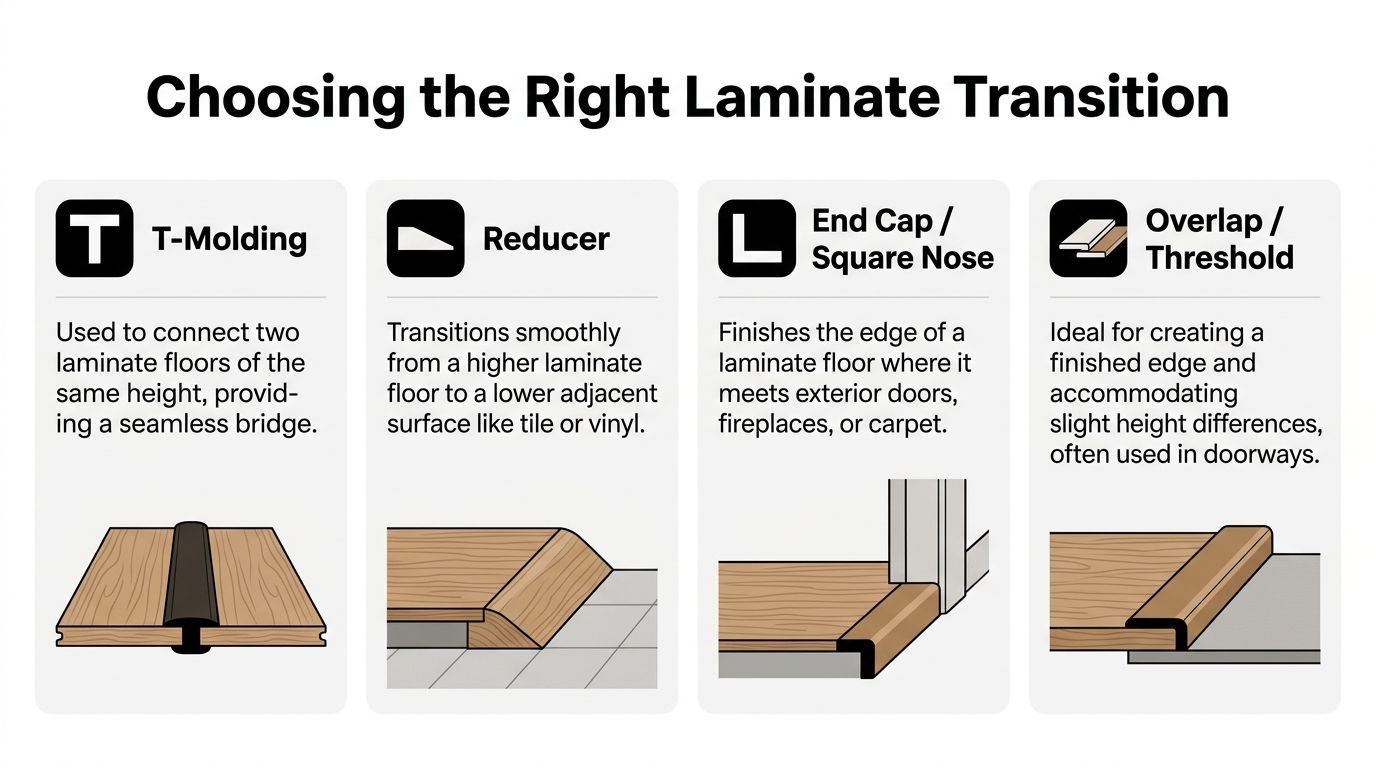
The right profile depends on what the laminate is meeting. Same height is one situation. Lower vinyl is another. Carpet, exterior doors, fireplaces, and slightly uneven subfloors each call for a different answer.
T-molding for room-to-room laminate in Cumming
A T-molding is the standard choice when laminate meets laminate at the same height. This is common in Cumming and Suwanee homes with open-concept layouts where one laminate run ends at a doorway and another starts in the next room.
It gives you a centered bridge over the gap while still allowing the floor to float. For same-height room transitions, this is usually the cleanest look and the most dependable setup if the spacing is correct.
This type works well in:
- Hallways between bedrooms
- Office to hallway transitions
- Open-plan homes where one run breaks at a doorway
- Builder-grade homes in Forsyth County that are being updated room by room
Reducers for laminate to lower surfaces
A reducer handles a height change from laminate down to a lower floor. This is a common remodel condition in Canton, Buford, and older Cumming homes where laminate is replacing carpet but existing vinyl or tile stays in the next room.
Homeowners often guess wrong. They see a modest drop and try to force a flat profile where a sloped one is needed. The result feels awkward underfoot and looks unfinished from the side.
Overlap reducers are especially useful when laminate meets a lower surface like vinyl. For a successful install, leave a 1-inch expansion gap, and in high-humidity areas like Forsyth County, neglecting that gap causes 35% of overhang failures (overlap reducer installation guidance).
End caps and square nose pieces
An end cap or square nose finishes laminate where it stops without meeting another floating floor at the same height. You see this near sliding doors, fireplaces, and some hearth edges, as well as at certain carpet terminations.
These are important in North Georgia homes with exterior entries because the edge often sits where moisture and dirt come in. A properly fitted end profile keeps the floor edge from looking abrupt and gives the installation a stronger stopping point.
Overlap thresholds for mixed conditions
An overlap or threshold profile helps when conditions are not perfectly neat. Maybe the subfloor is slightly off. Maybe one room was remodeled years earlier. Maybe you are connecting laminate to carpet in an older Dawsonville or Woodstock home where the floor heights are close, but not exact.
That profile can be practical, but it has to be chosen carefully. Too bulky, and it becomes a trip point. Too light-duty, and it starts flexing under traffic.
For homeowners comparing options, this page on transition pieces for laminate flooring lays out common profile choices and where each one makes sense.
Local rule of thumb: If the doorway gets wet shoes, pet traffic, or constant back-and-forth use, choose durability first and visual subtlety second.
Quick decision guide for Cumming homes
| Flooring condition | Usually the right pick |
|---|---|
| Laminate to laminate, same height | T-molding |
| Laminate down to vinyl or lower tile edge | Reducer |
| Laminate ending at door, fireplace, or fixed edge | End cap or square nose |
| Slightly inconsistent height or mixed doorway condition | Overlap or threshold profile |
Color matters too, especially for resale. In Johns Creek, Milton, and Alpharetta homes where homeowners want a cohesive remodel, a matched transition keeps the flooring from looking chopped up room to room. The best result usually blends with the laminate rather than drawing attention to the joint.
A Cumming Pro's Guide to Installing Laminate Transitions
The install itself is not complicated on paper. What makes it go right or wrong is precision. Doorways expose every small mistake. If the cut is off, the gap is wrong, or the track is fastened the wrong way, the transition becomes the failure point.

Start with the subfloor and the doorway
Before any transition goes in, the area has to be cleaned and checked. Around Cumming, that often means two common situations:
- Concrete slab in newer construction
- Plywood subfloor in older homes and remodels
On either one, you want the transition area free of dust, tile chips, thinset ridges, and loose debris. Red clay dust around doorways is more common than people think, especially during active remodels. If it stays under the track, the strip may never sit tight.
You also want to undercut door jambs properly. That gives the flooring and trim a cleaner finish and avoids the patched-around look.
If underlayment is part of the laminate system, it needs to be right before the transition step. This guide to padding for laminate floor installation helps homeowners understand what belongs under the floor and what does not.
Installing a T-molding the right way
For laminate-to-laminate doorways, accuracy matters. Use a T-molding with a 1-1/8 inch gap for the track, center the track, and secure it to the subfloor, not the flooring, so the laminate can keep floating. That method has a success rate exceeding 95% when the spacing is maintained (laminate doorway transition method).
A clean install usually follows this sequence:
Lay both laminate runs first
Stop at the doorway with the required opening for the transition system.Measure the opening carefully
Measure more than once. Older homes in Forsyth County are not always perfectly square.Cut the track and molding to fit
A miter saw with a fine-tooth blade works well for laminate-faced profiles. A hacksaw is often better for metal track.Fasten the track to the subfloor
Never pin the floating floor in place with screws through the laminate.Press or tap the molding in from one end
A rubber mallet helps seat the piece evenly without beating up the surface.
Pro tip: Do not glue a floating-floor transition just because it feels faster. If the profile is meant for a track system, use the track system.
Reducers and mixed-surface installs
Reducers take a little more judgment because the goal is not just to cover a gap. It is to create a smooth change in height that feels natural underfoot.
Pay attention to these points:
- Dry-fit first: Make sure the reducer lands where both surfaces are supported.
- Check door swing: The piece can look perfect and still interfere with clearance.
- Match the right profile to the drop: Too flat and the edge catches. Too steep and it looks forced.
- Use the intended fastening method: Track systems and adhesive systems are not interchangeable just because both seem workable.
In busy family homes, a reducer near the kitchen, mudroom, or laundry entry takes a lot of abuse. That is where proper seating matters.
The mistakes that cause callbacks
Most transition failures come from a short list of avoidable errors:
- Wrong profile for the height difference
- Insufficient expansion space
- Fastening through the laminate instead of the subfloor
- Forcing a full-length snap-in all at once
- Ignoring a crooked jamb or uneven substrate
- Choosing a flimsy strip for a heavy-traffic doorway
DIY can work well on a straightforward doorway. If the floor heights are inconsistent, the doorway is out of square, or the laminate meets tile at a busy traffic zone, professional installation usually saves time and frustration.
One practical option homeowners ask about is whether the transition pieces are available through the same local source as the flooring. In many cases, yes. Flacks Flooring carries flooring categories and related trim options in its Cumming showroom, which helps when you want the transition to coordinate with the floor instead of approximating it after the fact.
Why Choose Flacks Flooring for Your Cumming Project
A lot of transition problems start before installation day. The wrong profile gets ordered. The laminate and adjacent floor heights are not checked together. The subfloor condition is guessed at. Then the trim gets treated like an afterthought.
That is where a local flooring team matters.
Flacks Flooring has served Cumming, Forsyth County, and North Atlanta for over 30 years. That local experience matters because homes here are not all built the same. A new construction house in Sugar Hill, a lake home near Lanier, a builder-grade subdivision remodel in Cumming, and an older Milton or Johns Creek home with mixed flooring each present different transition challenges.
Local knowledge changes the recommendation
National blogs usually stop at basic definitions. Local installers have to deal with conditions specific to the area:
- Georgia humidity and seasonal expansion
- Tracked-in red clay at exterior doors
- Wet winter shoes in entry areas
- Spring pollen grit that acts like fine abrasive dust
- Active family traffic from kids, pets, and guests
- HOA and new construction community expectations for clean finished work
That is why product advice in a showroom matters. A homeowner might come in asking for a T-molding because the two floors “look close enough,” but the right answer may be a reducer or end cap once the heights and location are reviewed.
Better fit, better finish, fewer regrets
Big-box stores can sell trim. They usually cannot tell you much about how that trim will behave in a Forsyth County doorway over time.
A local flooring store can help sort out:
- Which profile fits the flooring combination
- Whether the doorway needs a track system or another method
- How to handle transitions in slab homes versus plywood subfloors
- What will hold up better in high-traffic family spaces
- How to keep the finished look consistent across a remodel
If you are searching for flooring near me in Cumming, the practical advantage is simple. You can bring in photos, ask specific questions, compare flooring and trim in person, and get guidance from people who work on North Georgia homes every day.
Frequently Asked Questions About Laminate Transitions
Q: Do I need a transition strip between two laminate rooms in Cumming?
A: Often, yes. In many Cumming homes, especially with floating laminate, a doorway transition helps manage seasonal movement and gives the run a controlled break. That is especially useful in North Georgia where humidity shifts from season to season.
Q: What transition works best from laminate to tile in a Forsyth County kitchen?
A: It depends on the height difference and the tile edge. In many Forsyth County remodels, a reducer or another profile designed for differing surfaces is the right choice. Kitchens also see more moisture, muddy traffic, and hard use than a standard bedroom doorway.
Q: Can you match a laminate floor transition to my existing floor?
A: Often, yes, or at least get very close. In the Cumming showroom, homeowners usually compare the floor sample and trim side by side. That helps avoid ordering a piece that is technically similar but looks off once it is installed in natural light.
Q: Are laminate transitions important in homes with kids and pets?
A: Yes. Busy homes in Cumming, Milton, and Johns Creek put more stress on doorway edges than lightly used rooms. A properly selected transition helps protect the laminate edge and creates a smoother path through the room.
Q: What if my floors are slightly uneven?
A: Slight unevenness is common, especially in older Forsyth County homes and some remodels around Dawsonville and Buford. That usually means you need a profile designed to handle a height difference rather than forcing a flat strip where it does not belong.
Q: Can I install a laminate floor transition myself?
A: Sometimes. A simple doorway with a standard profile is often manageable for a careful DIY homeowner. If the doorway is out of square, the subfloor is uneven, or the laminate meets tile or carpet at an awkward height, professional installation usually gives a cleaner result.
Q: What about transitions at exterior doors or lake homes near Lanier?
A: Those areas need extra attention. Exterior doors and lake homes often deal with more moisture, tracked dirt, and changing indoor conditions. The edge profile has to finish the floor cleanly and hold up to heavier wear from daily entry traffic.
Q: How do I know which transition to buy before I visit a flooring store near me?
A: Take clear photos of the doorway, measure the opening, and note which flooring types are meeting. In Cumming, bringing those details into the showroom makes it much easier to recommend the right profile for your home instead of guessing from memory.
If your laminate floor transition is the last thing holding up the job, bring it to people who know Cumming homes. Visit Flacks Flooring in Cumming, GA, stop by the showroom, or schedule a free flooring consultation. We can help you sort out the right transition for tile, carpet, hardwood, vinyl, or room-to-room laminate so the finished floor looks right and holds up in Forsyth County conditions. Call today or get a flooring estimate before humidity damage, loose edges, or doorway wear turn a small detail into a bigger repair.
Internal link suggestions:
- /hardwood-flooring-cumming-ga
- /waterproof-flooring-cumming-ga
- /laminate-flooring-cumming-ga
- /flooring-installation-cumming-ga
- /transition-strips-for-uneven-floors/
- /transition-pieces-for-laminate-flooring/
- /padding-for-laminate-floor-installation/
Schema recommendations:
- LocalBusiness
- Service
- FAQPage