
You’re probably doing what most North Metro Atlanta homeowners do. You typed laminate flooring stores near me, clicked a few listings, saw a bunch of pretty room photos, and still didn’t get a straight answer about what floor fits your house, your dogs, your budget, and our Georgia humidity.
That’s the main problem. Most flooring pages show product. They don’t give advice.
After decades around flooring jobs in Cumming, Johns Creek, Milton, and the rest of this part of Georgia, I can tell you this much. The right store matters almost as much as the right floor. A good store helps you avoid a bad product fit, a weak installation plan, and the hidden add-ons that turn a “deal” into a headache.
Choosing the Best Floor for Your North Atlanta Home
You buy flooring once, then live with the bill, the noise, the scratches, and the maintenance for years. That is why the best floor for a North Atlanta home is not the one with the prettiest sample board. It is the one that fits your rooms, your traffic, and your long-term cost.
A cheap floor with expensive add-ons is still an expensive floor. I see that mistake all the time with big box pricing. The plank looks affordable, then the quote gets loaded up with underlayment, trim, delivery, tear-out, floor prep, and installation changes after the sale. A good local flooring company gives you the complete cost up front and helps you choose a product that will not cost you more in repairs or replacement three years from now.
Start with how the room lives
North Georgia houses have their own set of problems. We get humid summers, wet shoes, red clay, dog traffic, and plenty of homes with subfloor issues or minor slab moisture that never show up in a showroom display. A floor that works great in a dry upstairs bedroom may be the wrong pick for a basement rec room or a busy kitchen in Cumming.
Start with the room, then the product.
If you want a quick primer on construction and performance, read what laminate flooring is and how it’s built. Then compare laminate, LVP, and hardwood based on ownership cost, not just sticker price.
Flooring comparison for North Georgia homes
| Feature | Laminate Flooring | Luxury Vinyl Plank (LVP) | Hardwood Flooring |
|---|---|---|---|
| Best fit | Busy main-level living areas, bedrooms, and family spaces where you want a wood look without hardwood cost | Kitchens, baths, basements, laundry areas, and any room with real moisture exposure | Main living areas and higher-end homes where appearance, resale, and long service life matter |
| Water handling | Better than older laminate, but still a dry-area choice in my book | Strongest choice for moisture-prone rooms | Handles normal living fine, but does not forgive standing water or humidity abuse |
| Scratch resistance | Very good for kids, dogs, chairs, and daily traffic | Good, though wear layers vary a lot by product | Depends on species, finish, and how much abuse the room gets |
| Feel underfoot | Firmer and more solid than many shoppers expect | Slightly softer in some installations | Natural feel that still sets the standard |
| Repair and life cycle | Usually replaced, not refinished | Usually replaced, not refinished | Can be refinished in many cases, which changes the long-term math |
| Total cost of ownership | Strong value if installed right in the right rooms | Strong utility value where water risk would shorten other floors’ lives | Higher upfront cost, but often worth it in homes you plan to keep |
My rule: Use LVP where water is a real threat, laminate where you want durability and a better-looking hard surface at a sane price, and hardwood where the house justifies the investment.
My honest take on each option
Laminate flooring is the best fit for a lot of North Atlanta families, especially on dry main floors. Today’s better laminates look sharper than entry-level vinyl, resist wear well, and hold up nicely against pets and daily traffic. The catch is simple. They still need the right room and proper prep under them. Skip either one and the savings disappear fast.
LVP flooring earns its keep in wet or messy areas. If you have a mudroom, a basement entry, a kitchen that sees constant spills, or dogs coming in from the yard, LVP usually gives you fewer headaches over time. It may not have the same crisp surface realism as a good laminate, but it handles moisture better, and that matters in this part of Georgia.
Hardwood flooring still wins for character and resale appeal. In Milton, Alpharetta, Roswell, and many older homes with a more traditional look, real wood often makes the most sense if the budget allows for it. You pay more up front, but if you plan to stay put and maintain it well, hardwood can be the better long-term value.
The right answer is rarely the lowest shelf price. The right answer is the floor that fits the room, comes with honest installation guidance, and is quoted as a full job instead of a pile of surprise charges.
Evaluating Laminate Flooring Stores Near You
A flooring store isn’t just a place that stocks planks. It’s where you find out whether the person across from you knows flooring, or just knows how to point at a display board.

What a good store does in the first conversation
A good salesperson asks about your house. They ask whether this is for a basement, a main floor, a rental, stairs, pets, kids, or a home going on the market.
A weak store starts with color and price only.
If you’re comparing local options, this guide to local flooring companies near you is a useful starting point because the true difference between stores is rarely the sample wall. It’s whether they can connect the product to your actual installation conditions.
The technical detail that matters more than most shoppers realize
For laminate, AC rating matters. A lot.
Laminate performance is determined by its Abrasion Class rating, and for high-traffic homes in Cumming and Forsyth County, AC4 or AC5 with HDF cores is the standard I’d look for. Those products can withstand over 10,000 abrasion cycles without visible wear, and thicker planks in the 8-12mm range help with sound absorption and handling uneven subfloors, according to this laminate specification guide.
That’s not showroom trivia. That’s the difference between “still looks good years later” and “I wish we’d spent a little more.”
Use this store checklist
- Ask about AC rating first: If the staff can’t explain AC4 vs AC5 in plain language, keep shopping.
- Check plank thickness: Thicker laminate generally handles subfloor imperfections better and feels more solid.
- Look for HDF core details: Especially if you’re shopping waterproof laminate lines.
- Review larger samples: Tiny swatches hide pattern repeat, sheen, and edge profile.
- Pay attention to questions they ask you: Good stores want to know how you live, not just what color you like.
- Listen for installation knowledge: If they never mention subfloor prep, transitions, or moisture conditions, that’s a problem.
A laminate floor usually doesn’t fail because the photo looked bad in the showroom. It fails because somebody sold the wrong spec for the house.
What the showroom should tell you
You want a showroom where you can compare oak looks, wide planks, matte finishes, smooth vs embossed textures, and waterproof laminate next to LVP. You also want a team that will tell you when laminate is not the right answer.
That honesty saves money.
Decoding Flooring Costs in Forsyth County
You walk into a big box store, see a laminate floor advertised at a bargain price, and think you’ve found the deal. Then the full quote shows up. Delivery, tear-out, floor prep, transitions, trim, and installation all get added after the fact. That cheap floor suddenly is not cheap.
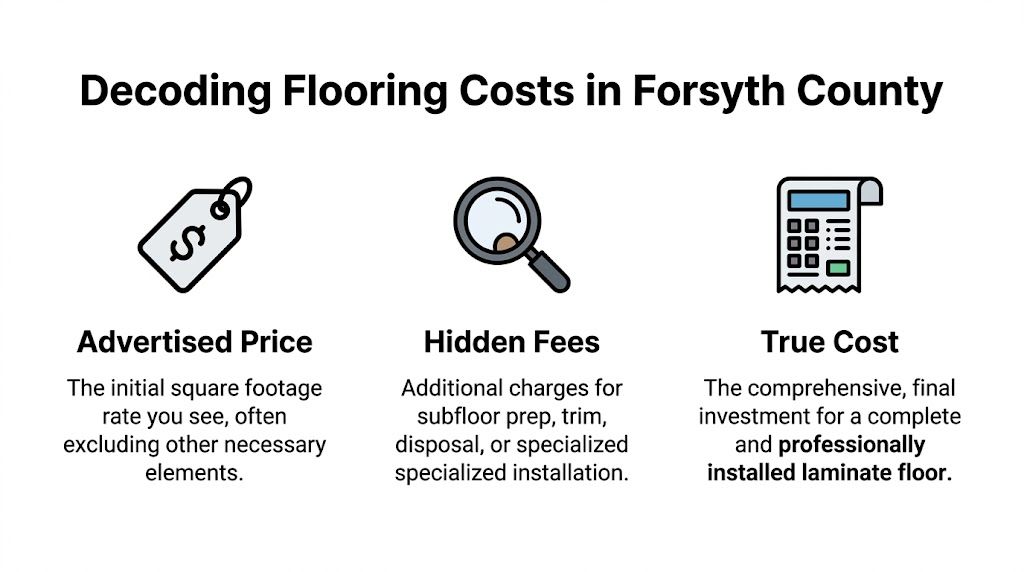
The cheap quote trap
Forsyth County homeowners get tripped up on the same thing over and over. They compare material prices instead of finished-job prices.
That is the wrong number to chase in North Georgia, where humidity swings, uneven subfloors, and busy family traffic can expose a bad install fast. A low shelf price means very little if the floor needs extra prep or the installer cuts corners to hit a number.
Even Floor & Decor’s laminate flooring selection page shows how much attention retail flooring gets at the product level. What it does not solve for you is total cost of ownership. That is where local, full-service dealers usually earn their keep. They measure properly, inspect the subfloor, spell out the extras, and give you one number you can budget around.
What gets left out of the first quote
A lot of first quotes assume a perfect room. Very few houses in Cumming, Johns Creek, Alpharetta, or Dawsonville are perfect once the old floor comes up.
Here’s where the bill usually grows:
- Old flooring removal: Carpet, pad, tack strip, glued-down material, or broken laminate still has to come out.
- Subfloor repair and leveling: This matters more than the laminate brand. If the base is off, the floor will sound hollow, flex, or fail at the joints.
- Moisture-related prep: North Georgia humidity and slab conditions can create problems if nobody checks them first.
- Trim and transitions: Reducers, T-molds, stair noses, quarter round, and baseboard adjustments are part of a finished job.
- Furniture moving and haul-away: Some stores include it. Some dump it in your lap on install day.
- Underlayment and installation details: The right pad and the right install method affect noise, feel, and long-term wear.
None of that is optional if you want the floor to last.
Compare quotes the right way
Ask for the total installed price for a completed room. Then make each store show its work.
Use these questions:
- What is included in this number, line by line?
- Does this quote include tear-out, prep, delivery, and installation?
- Who is responsible for measuring, and who is performing the install?
- How do you handle subfloor problems if you find them?
- What warranty covers the product, the labor, and any callback issues?
A useful reality check is this breakdown of carpet vs laminate flooring costs. It pushes you to compare full project costs, not just the number printed on a sign.
The number that actually matters
The only price that matters is the final installed cost for a finished floor that performs well in your house.
I’ll take a clear, all-in quote over a bargain teaser every time. You should too. Piecemeal pricing looks cheaper at the front end and often costs more once the extras start stacking up. A local store that handles measuring, product selection, prep, installation, and warranty service under one roof gives you better control of the cost, and usually fewer headaches later.
That is long-term value. Not the lowest square-foot price.
How to Prepare for an In-Home Consultation
You find a laminate you like in the store, then it lands in your house and suddenly the color looks off, the room feels chopped up, and the quote starts growing once the actual conditions show up. That is exactly why the in-home consultation matters. It is where a good flooring company earns its keep and where bad pricing habits get exposed.

A proper visit should answer two questions. What will work in this house, and what will this project really cost by the time the job is finished? In North Georgia, those answers depend on more than the sample board. Humidity swings, tracked-in grit from driveways and patios, active dogs, and basement or slab conditions all change what makes sense.
What to have ready before they arrive
Get your priorities straight before anyone rings the doorbell. If you do that, you will get better advice and a cleaner quote.
- List the rooms in order of importance: Main level, stairs, bedrooms, basement, office, rental space. Start with the rooms that take the most abuse.
- Write down how the house lives: Kids, big dogs, wet shoes, aging parents, rolling chairs, heavy furniture, backyard traffic. Real use matters more than showroom talk.
- Pull a few photos you like: Cabinets, paint, countertops, and existing floors nearby all affect the right choice. A loose sample never tells the whole story.
- Point out every problem with the current floor: Noise, scratches, soft spots, uneven areas, stains, door clearance issues, moisture worries. Those details save time and prevent bad recommendations.
Clear the room enough for measuring and inspection. If there is a crawl space access, basement room below, or known trouble spot, mention it up front.
Questions worth asking
Do not spend the whole visit talking about color names and plank width. Ask the questions that expose whether the store is giving you real guidance or just trying to close a sale.
- If this were your house in Cumming, what would you install here and why?
- What part of this room gives you concern?
- How will this floor handle our traffic, pets, and cleaning routine?
- What parts of the job could add cost after the quote, and how do you handle that?
- Who is responsible if the floor sounds hollow, shifts, or has a callback issue later?
- How will this product look against the floors, trim, and light in the next room?
Those answers tell you a lot. A good local team will talk plainly, point to trouble spots, and explain the trade-offs without dancing around them.
Why local experience matters in North Georgia
North Georgia homes have patterns. Summer humidity, red clay, lake traffic, basement dampness, and busy garage entries all show up on floors over time. A store with real local installation experience usually catches those issues fast because they have seen them hundreds of times before.
That matters for total cost of ownership. A local company that measures in person, helps you choose the right product for the room, and owns the install process usually saves you money the boring way. Fewer change orders. Fewer callbacks. Fewer expensive surprises after the boxes are delivered.
Big box pricing often looks simple until you start adding the missing pieces and sorting out who is responsible for what. An in-home consultation should clear that up. If the person in your house cannot explain the product fit, the likely problem areas, and the full path from selection to finished floor, keep shopping.
Flooring Advice for Every Role
You walk into a flooring store with your own agenda. A homeowner wants a floor that holds up. An agent wants a listing to show clean and sell fast. A contractor wants the job to stay on schedule. If the store gives every one of those people the same answer, that store is not paying attention.
For homeowners
Buy for the way you live, not for the sample board.
If you have kids, dogs, muddy shoes, or a kitchen that gets hard daily use, put wear, cleanup, and noise control ahead of trend. In North Georgia, that choice affects what you spend over the next ten years, not just what you pay this month. A cheaper product with weak installation support can cost more once you add repairs, replacement boards, trim fixes, and callback headaches.
For real estate agents
Pick floors that make the house look brighter, cleaner, and easier to maintain. That is what helps a showing.
You do not need the fanciest floor in the room. You need a finish that photographs well, installs without drama, and does not raise buyer questions about scratches, stains, or obvious patchwork. For listing prep, dependable mid-range laminate often gives better return than overspending on a product the next owner may replace anyway.
For interior designers
Samples lie all the time.
A floor that looks great under showroom lights can turn flat, pink, or too busy once it sits next to the client’s cabinets, wall color, and natural light. Bring the full room story. Trim, paint, counters, upholstery, and adjoining floors all matter. So do transition details, because a sharp design falls apart fast when the install crew uses the wrong reducer or leaves sloppy gaps.
For contractors
You need straight answers on timing, material lead times, floor prep, and who owns problems if the subfloor is not ready.
That is where local service earns its keep. Flacks Flooring is one Cumming option that handles product selection, in-home measurement, installation, and pricing in one process. That matters because pieced-out jobs are where budgets drift. One crew blames another, the schedule slips, and the client calls you.
For renters
Keep it practical.
If the lease does not allow permanent changes, focus on reversible options and skip any plan that risks your deposit. A decent store should tell you that up front and steer you away from products or installation methods that do not make sense for a rental.
Good flooring advice depends on the job the floor needs to do, who is paying for it, and how long it needs to last. That is the difference between buying a floor and buying a problem.
Flooring FAQs for Cumming and North Fulton Homes
Is laminate a good choice for Georgia humidity
Yes, if the product is chosen well and installed correctly. Humidity by itself doesn’t rule laminate out. Trouble starts when people ignore moisture conditions, skip prep, or use the wrong floor in a room that sees regular water exposure.
For kitchens, basements, and entry points, I want the conversation to include waterproof options and realistic room use.
Is laminate better than hardwood for dogs
For many dog owners, laminate is the easier practical choice. It’s often the smarter move when scratch resistance and lower maintenance matter more than the long-term refinishing potential of real wood.
That doesn’t make hardwood wrong. It just means you need to be honest about your household.
What should I bring to the store
Bring room photos, basic measurements if you have them, and a few inspiration pictures. Also bring a list of what bothers you about your current floors. Noise, scratches, stains, cold feel, slippery finish, and cleaning frustration all help narrow the right product.
Should I shop by color first or performance first
Performance first. Always.
Once you narrow the floor type and specification, then pick the look you want. It’s a lot easier to find a good color inside the right product category than to force the wrong product because you liked the sample.
Are big-box flooring quotes usually complete
Sometimes. Often they aren’t complete enough for a real apples-to-apples comparison.
That’s why you need every quote broken out clearly. Prep, removal, labor, trim, and transitions shouldn’t be a surprise later.
What’s the biggest mistake people make with laminate
Buying on appearance alone.
The second biggest mistake is ignoring installation conditions. A floor can be good on paper and still be a bad fit for the room if the subfloor, moisture level, or traffic demands aren’t addressed.
How do I know a store actually knows flooring
Ask technical and practical questions together. Ask what AC rating they recommend. Ask how they handle uneven subfloors. Ask what they’d put in a basement versus a main living area. Ask what they’d avoid in your house.
If the answers are vague, keep looking.
If you want straight advice instead of showroom fluff, talk with Flacks Flooring. They’re a Cumming-based flooring store serving homeowners and project partners who want clear product guidance, in-home consultations, and all-inclusive pricing that covers installation and site preparation.