
When you type "local flooring companies near me" into a search bar, you're not just looking for a service. You're searching for a partner, someone you can trust to handle a significant investment in your home. From my experience, the best choice is almost always a dedicated local expert who brings true craftsmanship and community accountability to the table. They offer a depth of knowledge that big-box stores just can't replicate.
Why a Local Flooring Pro Is Your Best Bet
Deciding between a national chain and a local installer is a major fork in the road for your flooring project. While the big retailers certainly offer convenience, local flooring companies deliver a personal touch, specific regional expertise, and direct accountability that almost always leads to a better result and a smoother process.
Deep Roots in the Community
Local contractors have a reputation to protect right in your neighborhood. A bad review or a subpar job hits their business much harder than it would a massive corporation. This simple fact provides a powerful incentive for them to deliver fantastic work and build great relationships with their clients. They aren't just putting down a floor; they're building their reputation one project at a time. You can often see this commitment by checking out their service area and local involvement.
This dedication is especially important in today's market. With the U.S. flooring industry valued at $22.28 billion and growing, the demand for quality work is huge. Consider that 75% of U.S. homes were built before the year 2000—that's a lot of floors needing an update. This makes finding a trustworthy local pro more critical than ever.
A local installer’s name is on the line with every project. They live in the areas they work, making them uniquely invested in your satisfaction and the quality of their craftsmanship.
Unmatched Regional Expertise
Here’s something else to think about: a local expert understands your environment. They know how regional conditions, like the distinct humidity levels we see in Georgia, will affect different flooring materials like hardwood or luxury vinyl.
This insight allows them to recommend products that are genuinely suited to perform well in your home for years to come, helping you avoid headaches like warping or gapping. That kind of specialized, on-the-ground knowledge is a massive advantage when you're investing in your home.
Let's break down the core differences between your two main options.
Local Pro vs. Big Box Store: A Quick Comparison
The choice often comes down to weighing the pros and cons of personalized service versus mass-market convenience. Here's a straightforward look at what you can expect from each.
| Feature | Local Flooring Company | Big Box Store |
|---|---|---|
| Expertise | Specialized knowledge of local climate & home styles. | General knowledge; often a one-size-fits-all approach. |
| Accountability | Direct contact with the owner/installer. Reputation is local. | Subcontracted labor; accountability can be diffused. |
| Installation | In-house, experienced crews who are part of the team. | Often uses third-party installers with varying skill levels. |
| Flexibility | More adaptable to custom requests and project changes. | Standardized processes with less room for customization. |
| Customer Service | Personalized, relationship-focused support. | Call centers and corporate customer service departments. |
Ultimately, while a big box store might seem easier upfront, the long-term value, quality, and peace of mind you get from a dedicated local expert are hard to overstate. You're not just a number on a work order; you're a neighbor.
Building Your Shortlist of the Best Local Installers

Now that you know why hiring local is the way to go, it's time to actually find these companies. A quick Google search is a decent starting point, but the real gems are often found a little deeper than the top-sponsored ads.
Your first move should be to tap into your local network. Jump into your neighborhood Facebook group or a community forum like Nextdoor and ask for recommendations. You'll get honest, unfiltered opinions from neighbors who have been in your exact shoes.
These are the same principles I'd recommend when finding home renovation experts near you; the goal is always to connect with proven, trusted pros in your area.
Think Beyond a Basic Search
Don't stop with online searches and forums. Some of the best leads come from other professionals who see this kind of work every day.
- Ask a Real Estate Agent: Agents know exactly which contractors deliver quality work that helps sell homes. They have a vested interest in recommending people who won't let them down.
- Talk to Other Contractors: If you have a painter or plumber you trust, ask them who they recommend for flooring. Good pros tend to know other good pros.
- Check Industry Associations: Look up organizations like the National Wood Flooring Association (NWFA). They keep lists of certified installers who have committed to a higher standard of training and professionalism.
Aim for a list of three to five solid contenders. Any more than that, and you'll get bogged down with quotes and follow-ups. This number is the sweet spot for making a confident, well-researched decision.
How to Actually Read Online Reviews
Once you have a few names, it's time for some digital detective work. We all rely on reviews—in fact, over 90% of people read them before making a purchase, and a massive 76% trust them as much as a personal recommendation. This step is critical.
Don't just look at the star rating. You need to read between the lines.
Look for patterns in what people are saying. Do multiple reviews mention that the crew was clean, punctual, and great at communicating? Those are huge green flags.
Most importantly, pay attention to how a company handles a bad review. Do they ignore it? Or do they respond professionally and try to make things right? A thoughtful response to criticism often tells you more about a company's integrity than a dozen five-star reviews.
The Essential Vetting Process for Any Contractor
Once you've narrowed your list down to a few top contenders, it's time to roll up your sleeves and do some real homework. This is where you separate the true professionals from the rest. Moving beyond a company's sales pitch and digging into their credentials is the single best way to protect your investment and ensure you’ll love the final result.
Verify Licenses and Insurance (The Non-Negotiable Step)
First things first: ask for proof of license and insurance. Don't just take their word for it. Any legitimate contractor will have no problem providing you with a copy of their general liability insurance and worker's compensation policies.
This isn't just a formality; it's a massive financial safeguard for you. Job-site accidents can happen, and in residential construction, liability claims can average over $75,000. If the contractor you hire is uninsured, that financial responsibility could land squarely on your shoulders.
Talk to Their Past Clients
Next, ask for references—and actually call them. A confident, quality contractor will be happy to connect you with recent clients. But don't just ask, "Were you happy with the job?" You need to dig deeper to get the full story.
Here are a few questions I always recommend asking:
- "How did the crew handle unexpected issues or changes?" This tells you everything about their problem-solving skills and flexibility.
- "Did the final bill match the initial quote?" This is a great way to gauge their honesty and transparency with pricing.
- "Was the project completed on the agreed-upon timeline?" This speaks volumes about their reliability and project management.
Hearing firsthand accounts is invaluable. You can see how our own team stacks up by checking out what our clients have to say about their experiences right here: https://flacksflooring.com/flacks-team-reviews/
A contractor’s portfolio shows you what they can do, but their references tell you what they actually do. Pay close attention to how they talk about communication, cleanliness, and professionalism.
Get a Close Look at Their Workmanship
Finally, it's time to examine their work. Ask to see a portfolio or photos of recently completed projects. Knowing what to look for is key. The same principles for vetting apply whether you're hiring a flooring installer or learning how to choose a reputable carpet cleaning company.
Pay attention to the small stuff. Look for clean, tight seams where planks or tiles meet. Check for precise, clean cuts around tricky areas like doorframes and cabinets. See how they handled transitions between different flooring types. These little details are what separate an amateur from a true craftsman.
How to Read and Compare Flooring Quotes
You’ve done the legwork and have a few estimates from different flooring companies. Now comes the tricky part: figuring out which one is actually the best deal. It's rarely as simple as just picking the lowest number.
Comparing flooring quotes can feel like comparing apples and oranges if you don't know what to look for. A professional, trustworthy quote should be completely transparent, spelling everything out so there are no nasty surprises when the final bill arrives. The goal is to see beyond the bottom-line price and understand the real cost of the entire project.
Deconstructing the Estimate Line by Line
A solid quote from any reputable local flooring company will be itemized. This means they break down the total cost into individual parts, which is exactly what you want. This is where you’ll spot the crucial differences between one bid and another.
Here’s what you should be looking for on each estimate:
- Materials: Does it list the specific flooring brand, style, and color? (e.g., "Shaw Floorte Pro, color 'Valore Plus'"). It should also show the total square footage needed and the price per square foot.
- Labor and Installation: This is the cost for the actual installers' time and skill. Some companies charge a flat project fee, while others price it per square foot. If you want to dive deeper into what affects this, our guide on hardwood flooring installation costs is a great resource.
- Subfloor Preparation: This is a big one. If your subfloor isn't perfectly flat and stable, the new floor will fail. This line item might include costs for leveling compounds, plywood, or repairs.
- Removal and Disposal: Who is tearing out the old carpet or tile, and how are they getting rid of it? This should be its own line item.
- Additional Materials: Don't forget the little things that add up, like underlayment, transition pieces for doorways, new baseboards, or specialized adhesives.
Taking the time to check for these details is how you make a smart, informed decision.
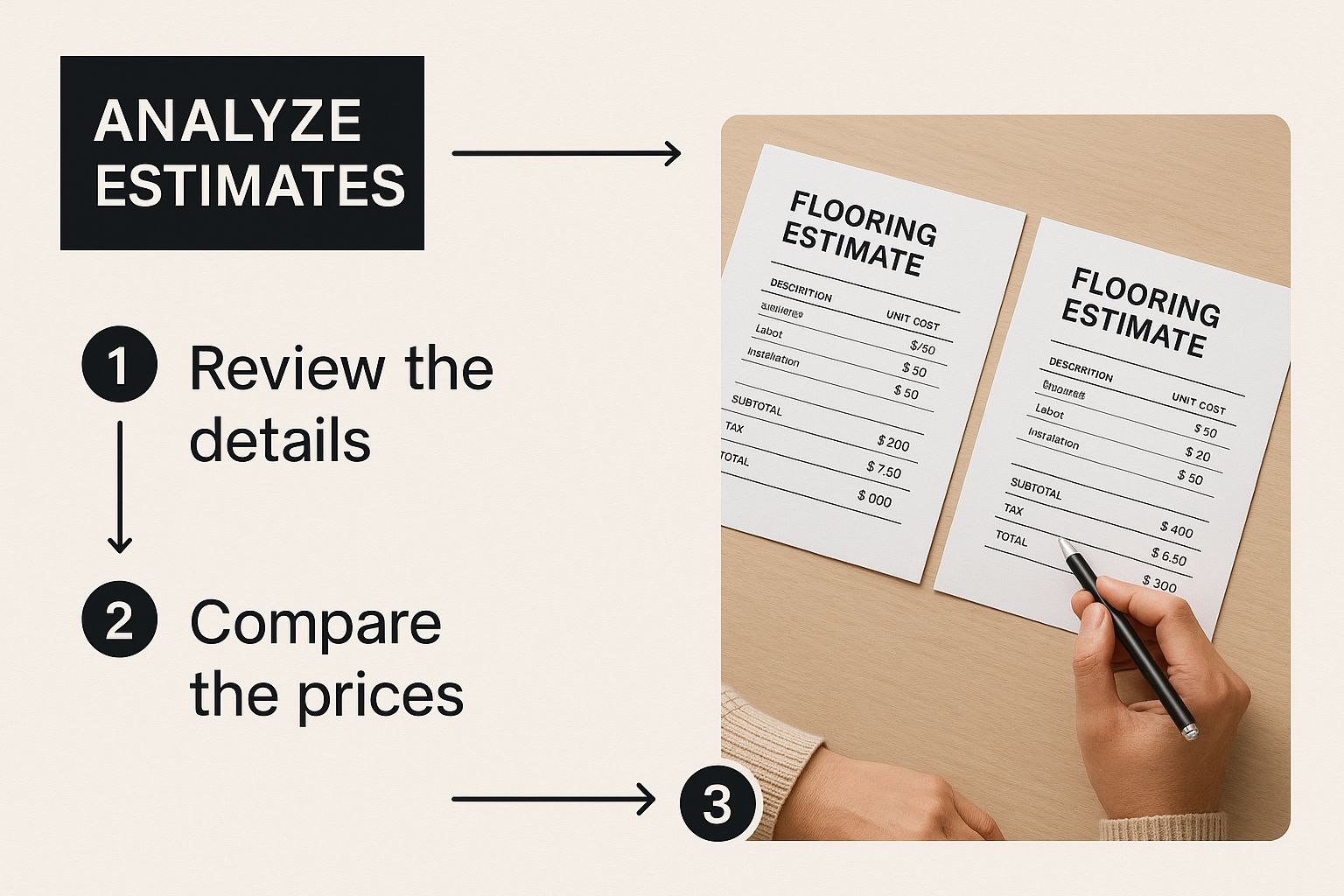
As you can see, a detailed quote brings clarity and confidence, while a vague one just opens the door to potential problems.
Spotting Red Flags in a Quote
If a quote feels too simple or is just a single number on a piece of paper, be wary. A surprisingly low bid that lumps everything into one "total cost" is often a classic setup for unexpected charges later on.
In fact, 35% of all disputes between homeowners and contractors stem from fuzzy details about the project's scope and budget. Vague estimates are a huge part of that problem. For more on avoiding these common pitfalls, check out the excellent homeowner resources from NARI.
Key Takeaway: A quote that doesn’t specifically mention things like moving furniture, subfloor prep, or old flooring disposal isn’t a good deal—it’s just a bill with hidden costs waiting to happen. The best contractors lay all the cards on the table from the very beginning.
You've done the hard work of vetting companies and comparing quotes, and you probably have a favorite in mind. Before you pop the champagne, there’s one last crucial step: the final check-in.
This is more than just a formality. It's your chance to have a frank conversation, iron out the final details, and confirm the project timeline. Use this call to ask any last-minute questions and, just as importantly, gauge their responsiveness one last time. Think of it as a final gut check.
A truly professional contractor will welcome this conversation. It shows you're a serious, detail-oriented client, and it helps them ensure everything is perfectly aligned before they start. Once you get that final sense of confidence, it's time to look at the paperwork.
Decoding the Contract: Your Project's Blueprint
Don't just skim the contract—it’s the most important document in this entire process. A vague or incomplete agreement is a massive red flag.
In fact, construction law experts report that contracts lacking specific details are a factor in over 60% of all residential construction lawsuits. A solid contract is your best protection against misunderstandings and disputes.
Think of the contract as the definitive roadmap for your flooring project. It should leave nothing to chance. Before your pen ever touches the paper, make sure it clearly spells out these key items:
- A Detailed Scope of Work: This needs to be more than "install new floor." It should break down every single task, from demolishing and disposing of the old flooring to installing baseboards and handling the final cleanup. There should be zero ambiguity.
- Specific Material Specifications: The contract must list the exact materials being used. "Hardwood" isn't good enough. It needs to specify the brand, product line, color, plank width, and finish—for example, "Mohawk UltraWood, Coastal Allure Oak, 7.5" width."
- A Clear Project Timeline: Look for a concrete start date and an estimated completion date. While unforeseen issues can happen, having this in writing creates accountability and sets clear expectations for how long your home will be a work zone.
- A Transparent Payment Schedule: This section should clearly outline how much is due and when. A typical structure might be a deposit to secure the job, a second payment when materials arrive on-site, and the final balance only after the project is 100% complete and you’ve signed off on it.
- All Warranty Information: You need two types of warranties detailed in writing: the manufacturer's warranty covering the flooring material itself and the installer's labor warranty, which covers the quality of the workmanship. Understand the terms and duration for both.
Got Questions About Hiring a Flooring Pro?
Even with a solid game plan, a few questions always seem to pop up before you sign on the dotted line. Let's tackle some of the most common ones I hear from homeowners, so you can feel completely confident in your choice.
Should I Buy the Flooring Myself or Through My Installer?
This is the classic "buy direct or go through the pro" dilemma, and honestly, there's no one-size-fits-all answer.
Going through your installer is usually the path of least resistance. They often have access to trade discounts, handle all the logistics of ordering and delivery, and—most importantly—they're on the hook if the wrong materials or damaged boxes show up. It just simplifies things.
On the other hand, buying the flooring yourself can open up a wider world of options or let you jump on a great retail sale. If you go this route, communication is absolutely key. Have a chat with your installer before you buy anything. Make sure they're okay with installing customer-provided materials and understand that you'll be responsible for getting the right amount of product to the job site on time.
What’s a Fair Deposit for a Flooring Project?
You can typically expect a deposit to be somewhere between 10% and 33% of the total job cost. I'd raise a red flag for any company demanding 50% or more upfront. That can sometimes be a sign of a cash flow problem, which you don't want to get caught up in.
The best payment schedules are tied to progress. A common setup looks something like this: an initial deposit to get on the schedule, another payment when materials are delivered to your home, and the final balance once the job is done and you're happy with the result. It's also a good idea to quickly check your state's laws, as some have legal limits on how much a contractor can ask for as a deposit.
A fair deposit protects both you and the contractor. It secures your spot on their schedule and covers initial material costs without putting you at significant financial risk before the work even begins.
How Long Should an Installation Warranty Last?
When you work with one of the best local flooring companies near me, you should get two separate warranties.
First, there's the manufacturer's warranty. This covers the actual flooring product against defects and can range from 10 years to a lifetime, depending on the material.
The second one, which is just as critical, is the installation or workmanship warranty provided by the contractor. A pro who takes pride in their work will always stand behind it, usually offering a warranty for at least one year. This is your protection against installation-related problems, like seams that start to pull apart or boards that begin to lift. Insist on getting this in writing in your contract.
Ready to get answers for your specific project? The team at Flacks Flooring is here to help you navigate every step, from material selection to flawless installation. Explore our services and schedule your consultation today!