
Core Difference: Water Resistance
When it comes down to performance, water is the deciding factor. Luxury vinyl plank (LVP) uses a 100% waterproof vinyl core, so even standing moisture won’t cause warping or swelling. In contrast, laminate relies on a wood-fiber core that’s only water-resistant, meaning extended exposure can lead to permanent damage.
Key Insight: LVP’s vinyl composite repels water entirely, while laminate’s high-density fiberboard can swell and crack if it stays wet too long.
Making The Best Flooring Choice For Your Home
Homeowners in Cumming, Forsyth County, Johns Creek, and Milton often face the same question: LVP or laminate? Both deliver the warmth and texture of hardwood without the hefty price tag, but each shines in different scenarios. Your final decision should reflect the room’s humidity levels, foot traffic, and your long-term plans.
Consider these real-world use cases:
- Kitchens, bathrooms, basements and laundry rooms demand waterproof LVP.
- Bedrooms, living areas and home offices can comfortably host budget-friendly laminate.
- High-traffic hallways and entryways benefit from LVP’s superior dent and scratch resistance.
- Laminate works well in controlled environments where spills are rare.
Quick Comparison LVP vs Laminate at a Glance
Before diving deeper, here’s a side-by-side snapshot of the most critical characteristics.
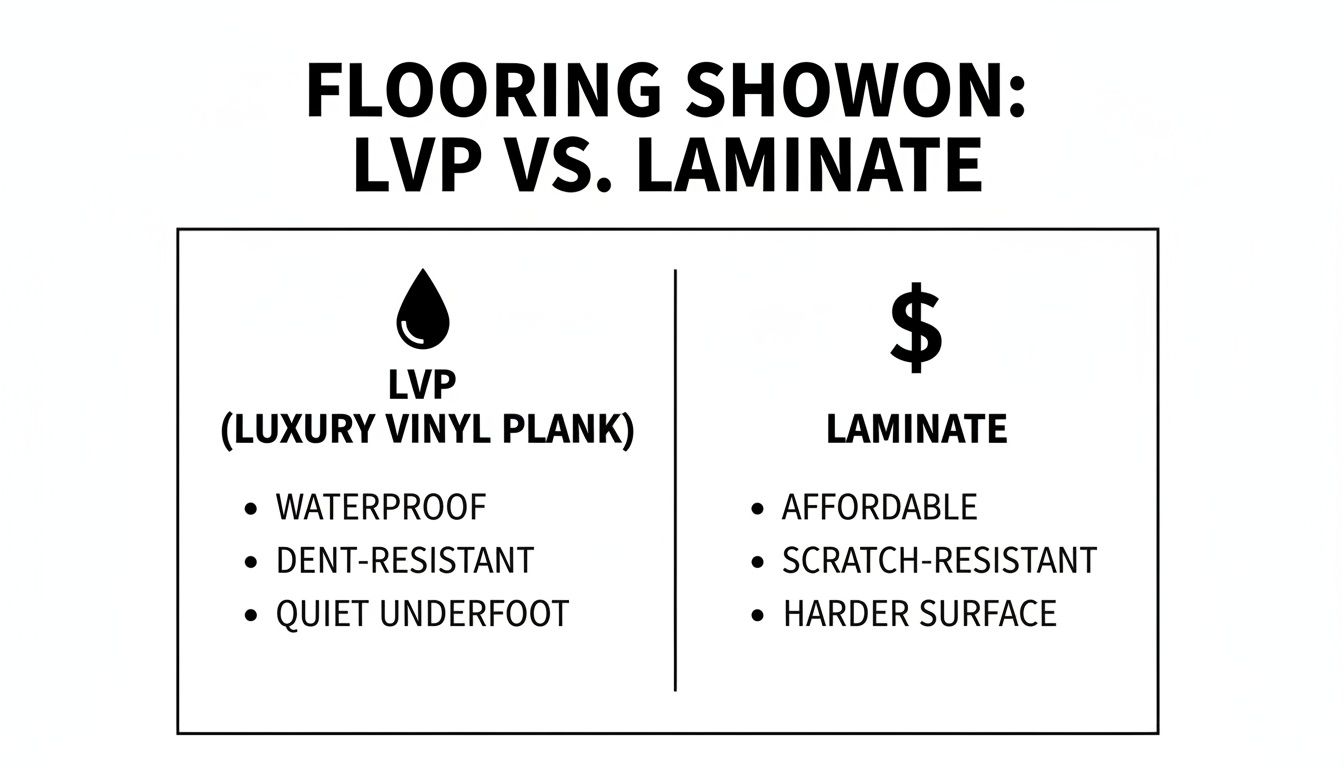
Quick Comparison LVP vs Laminate at a Glance
| Feature | Luxury Vinyl Plank (LVP) | Laminate Flooring |
|---|---|---|
| Core Material | Solid vinyl composite (100% waterproof) | High-density fiberboard (HDF) with wood composites |
| Water Resistance | Waterproof. Can be submerged without damage. | Water-resistant. Resists spills but will swell if soaked |
| Best For | Kitchens, bathrooms, basements, laundry rooms | Bedrooms, living rooms, home offices |
| Durability | Highly resistant to scratches, dents and stains | Excellent scratch resistance but can dent under heavy impact |
| Installation | Click-lock or glue-down; very DIY-friendly | Click-lock floating floor; DIY-friendly |
| Cost | $2.50 – $7.00 per square foot | $1.50 – $5.00 per square foot |
| Feel Underfoot | Softer, quieter with better sound absorption | Firmer, can sound hollow without underlayment |
Use this snapshot as a quick reference to match each product’s strengths with your home’s unique demands.
What’s Really Inside? A Look at Core Materials
To get to the heart of the luxury vinyl plank vs. laminate debate, you have to look past the surface. They might look similar at a glance, but what they're made of is completely different. This isn't just a technical detail—it's the single most important factor determining how they'll perform in your home, especially with Georgia's notorious humidity. It’s why one is a rockstar in a damp basement and the other belongs in a dry, upstairs bedroom.
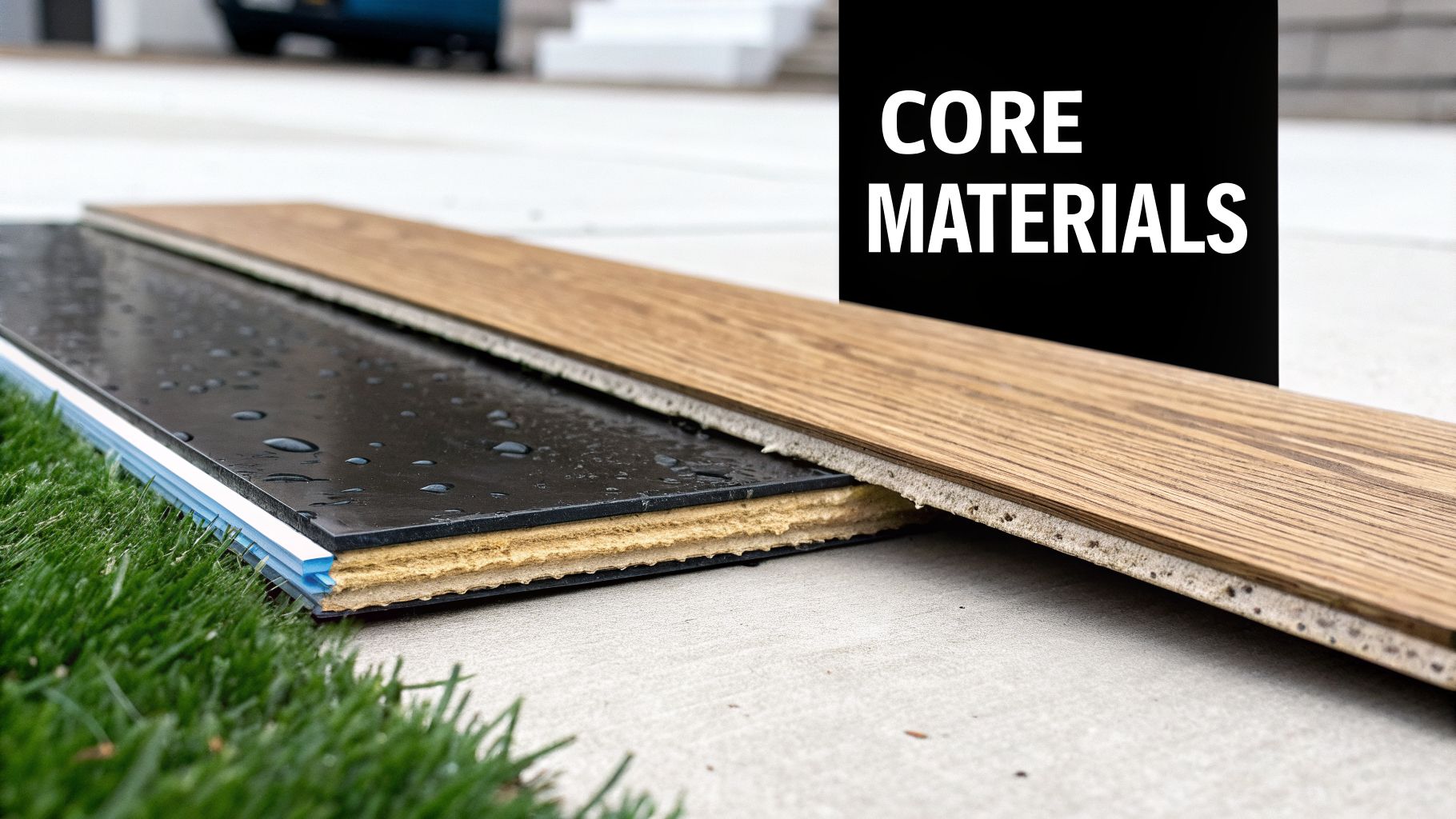
Getting this right from the start is the key to investing in a floor that actually fits your life and home.
The Makings of Luxury Vinyl Plank
Luxury Vinyl Plank (LVP) is a marvel of modern engineering, built entirely from synthetic materials—mostly polyvinyl chloride (PVC). Its multi-layered design is all about one thing: creating a floor that's tough, stable, and completely immune to water.
The real magic is in its core. LVP typically features a solid vinyl composite core (SVC) or a stone polymer composite (SPC) core. Think of it as a dense, solid plank of plastic and minerals. There are no wood fibers or organic materials anywhere in it, which means there's nothing for moisture to soak into.
Because of this, LVP is genuinely 100% waterproof. You could leave it at the bottom of a pool, pull it out, dry it off, and it would be perfectly fine. No swelling, no warping, no delaminating. This makes it the clear winner for any room where spills, splashes, or moisture are a fact of life—from kitchens and bathrooms in Johns Creek to basements in Cumming.
Key Takeaway: LVP's core is its superpower. Since it’s made entirely of vinyl and minerals, water simply has no effect on its structural integrity, providing unparalleled peace of mind in moisture-prone spaces.
The Makings of Laminate Flooring
Laminate, on the other hand, is built around a core made from wood byproducts. It's constructed from several layers fused together with intense heat and pressure, but at its heart, it’s still an organic material.
That core is almost always a high-density fiberboard (HDF). To make it, manufacturers take leftover hardwood and softwood, break it down into fine wood fibers, mix it with wax and resin, and press it all together.
This creates an incredibly hard and durable board, but it doesn't change the fact that it's made of wood. When you really dig into what laminate flooring is made of, you’ll see its wood-based nature is its Achilles' heel. If water gets past the top wear layer and finds its way to the HDF core, those wood fibers act like a sponge and swell up.
Here’s the problem: that damage is permanent. Once the HDF swells, it never goes back to its original size or shape. You're left with bubbled, peeling, or buckled planks that can't be fixed. This is why even "water-resistant" laminate comes with strict warnings about how quickly you need to clean up spills.
A Side-by-Side Core Breakdown
When you look at the materials up close, the performance differences become crystal clear.
- LVP Core: A solid, non-porous vinyl composite. It physically can’t absorb water, making it a truly waterproof flooring solution.
- Laminate Core: Compressed wood fibers. Even though it's dense, it’s still porous and will soak up water, causing irreversible structural damage.
This single distinction is everything for homeowners in Forsyth County and Milton, where our humid summers put floors to the test. LVP stays completely stable no matter the moisture in the air, but laminate needs a carefully controlled environment to avoid damage from ambient humidity and everyday accidents. When it comes to the luxury vinyl plank vs. laminate showdown, this core difference is what matters most.
A Head-to-Head Durability Analysis
When you're picking new floors, you're not just buying a pretty surface; you're making an investment in how your home performs every single day. How will it stand up to dropped toys, a dog's excited scrambling, or the constant foot traffic of a busy family? This is where the real-world differences between luxury vinyl plank and laminate flooring really start to show.
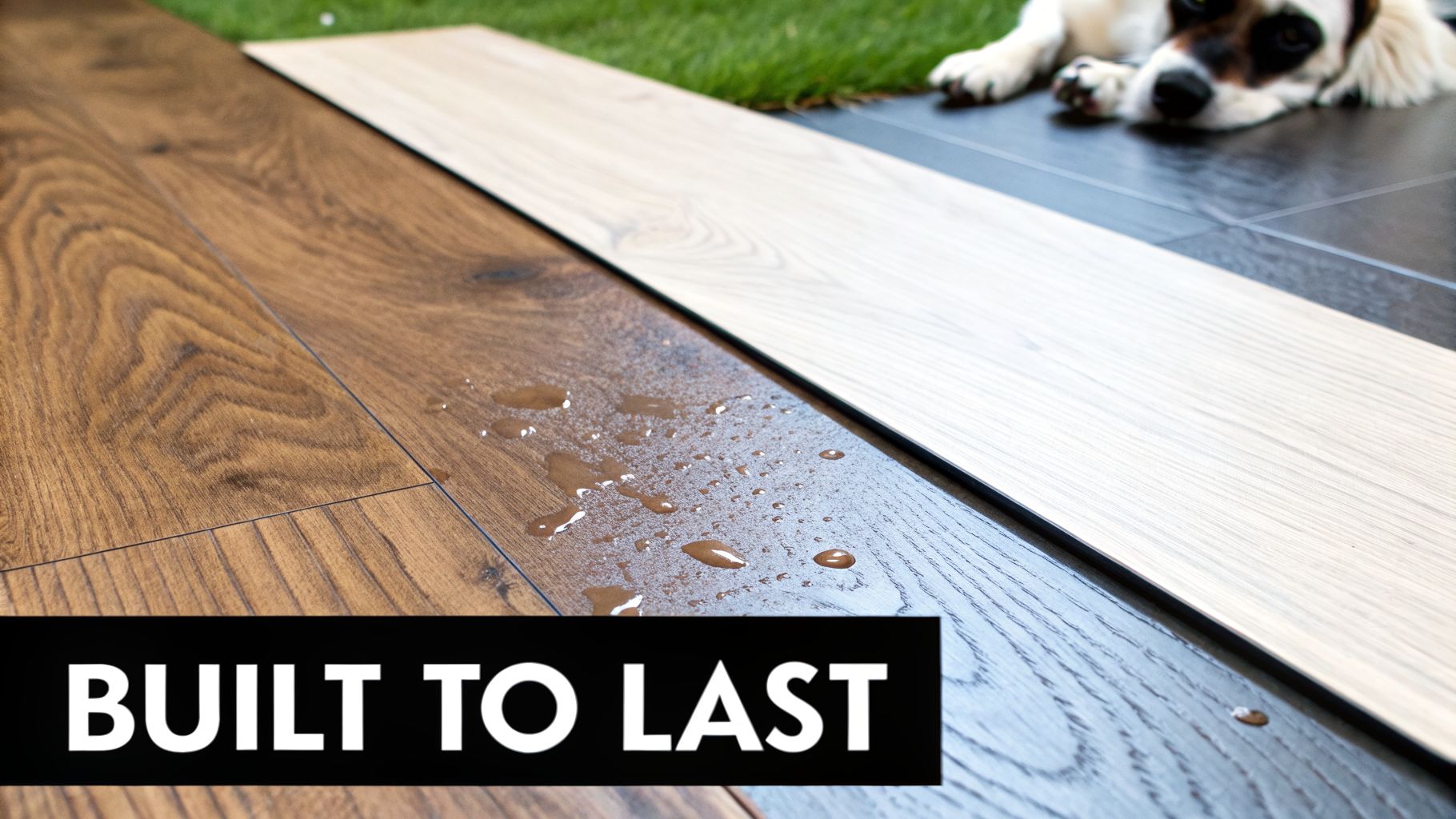
While both are built to be tough, their core materials mean they handle life's challenges very differently. For homeowners here in North Georgia, understanding these distinctions is key, because our lifestyle and climate have a huge say in a floor's lifespan.
Scratch and Scuff Resistance
A floor's first line of defense is its top layer. Both LVP and laminate pack some impressive technology here, but they achieve their toughness in different ways.
Laminate is famous for its incredibly hard aluminum oxide topcoat. This surface is a beast when it comes to resisting fine, surface-level scratches, making it a solid choice for homes with pets whose claws can do a number on softer floors. It also holds up well against dragged furniture and the daily grind of an active household.
LVP, on the other hand, relies on a thick, clear polyurethane wear layer. The real measure of its strength is the thickness, which is measured in mils (that's one-thousandth of an inch). A quality LVP with a wear layer of 20 mil or higher offers incredible protection that easily rivals laminate, especially when it comes to deeper gouges and scuffs.
Key Differentiator: Laminate’s surface is harder, making it excellent at preventing fine scratches. LVP’s wear layer is more resilient against deeper gouges and won't chip, which gives it an edge in overall impact resistance.
Impact and Dent Resistance
So, what happens when someone drops a heavy pan in the kitchen? This is another scenario where the core construction of each floor tells a different story.
Since laminate’s HDF core is essentially compressed wood fibers, it’s extremely rigid. That rigidity provides stability, but a sharp, heavy impact can cause a dent or even a chip. And once that top layer is broken, the core underneath is exposed to potential moisture and further damage.
LVP is different. Its flexible vinyl core is much more forgiving and tends to absorb the force of an impact rather than denting or cracking. This makes it a smarter, more resilient choice for kitchens, playrooms, or any spot where accidental drops are just a part of life.
Comfort and Sound Absorption Underfoot
How a floor feels and sounds can totally change the atmosphere of your home. This is an often-overlooked detail in the luxury vinyl plank vs. laminate debate, and it's where you'll notice a clear difference.
LVP’s vinyl makeup gives it a softer, more flexible feel under your feet. It also has natural sound-dampening qualities, which means you get a quieter, more solid sound when you walk on it. That's a huge plus for second-story rooms or any home where you want to minimize noise traveling between floors.
Laminate, with its rigid core, feels harder and can create a hollow, clacking sound, especially if it’s installed without a high-quality underlayment. While a good underlayment definitely helps, LVP is simply quieter right out of the box.
We see this preference shift in the market data, where LVP’s real-world performance is winning over homeowners and builders. Globally, LVT commanded a 64.7% revenue share in the vinyl flooring market in 2024, a trend driven by its multi-layered construction that provides up to 20x the scratch resistance of some other flooring types. This makes it a perfect fit for high-traffic homes in growing areas like Forsyth County.
Meanwhile, while laminate still holds a 63.61% market share within its own category, its overall slice of the U.S. flooring market slipped to 4.8% in 2024, down from 5.6% a decade ago. It’s steadily losing ground to LVP, especially in new construction. You can dig into more flooring market trends on Grand View Research.
Performance in North Georgia's Climate
For those of us in Cumming and Milton, Georgia's humidity isn't just a talking point—it's a real factor for our homes. Temperature and moisture swings cause building materials to expand and contract, and flooring is no exception.
LVP’s vinyl core is completely stable and totally unfazed by humidity. It won't swell, warp, or cup because of moisture in the air, ensuring a tight, gap-free floor all year long.
Laminate's wood-based core, however, is a different story. It can absorb ambient moisture, and in our humid summers, that can cause it to expand. If it's not installed with the right amount of expansion space around the perimeter, you risk seeing the planks buckle or warp. This makes proper climate control far more important for keeping a laminate floor looking its best.
Design and Realism: Which Floor Looks More Authentic?
When it comes down to it, how a floor looks is often what seals the deal. Years ago, both luxury vinyl and laminate had a reputation for looking, well, fake. They had a plastic-like sheen you could spot a mile away. But that’s ancient history. Today, manufacturing has gotten so good that both are stunningly realistic mimics of real wood and stone.
The race between LVP and laminate to look the most like real hardwood has been a game-changer for homeowners. Both now rely on high-definition 3D printing for their image layers, capturing the subtle graining, knots, and color tones that make wood so beautiful. This is the secret sauce that gives each plank its distinct personality.
The Tech That Makes It Look Real
A pretty picture is one thing, but the real magic is a process called Embossing in Register (EIR). This is where the floor's surface texture is precisely aligned with the printed image underneath. You don't just see a knot in the wood grain—you can actually feel its slight dip and texture under your fingertips. It creates a tactile experience that used to be the exclusive domain of genuine hardwood.
Since both high-quality LVP and laminate use EIR, the visual gap between them has all but disappeared. A premium laminate floor can look every bit as convincing as a top-of-the-line LVP, so your choice often hinges on the subtle details.
Key Insight: The game-changer is Embossing in Register (EIR) technology, used in both LVP and laminate to create hyper-realistic textures that match the visual grain. This means you can get a truly authentic look from either one, so the deciding factor might be something else, like pattern repetition or image clarity.
The Case for Laminate's Visuals
Laminate’s construction gives it a secret weapon for visual clarity. Its rigid high-density fiberboard (HDF) core is perfectly flat and unyielding, so when the photographic layer is bonded to it, the image comes out incredibly crisp. It’s like printing a photo on heavy cardstock versus a more flexible paper—the details just pop.
This often translates to exceptionally sharp and well-defined wood grain patterns that can truly fool the eye. For a designer in Johns Creek aiming for the most precise, high-definition wood aesthetic in a space without moisture concerns, a top-tier laminate could have a slight visual advantage.
Where LVP Shines
Luxury vinyl plank fights back with a huge advantage of its own: pattern variation. The way LVP is made allows manufacturers to create a much larger number of unique plank images in a single box. This is a critical detail for achieving a natural-looking installation.
- Fewer Repeats: With more unique planks, the odds of seeing two identical boards next to each other plummet. That’s one of the biggest giveaways of a manufactured floor.
- Organic Look: Real wood is random; no two pieces are ever identical. LVP is simply better at capturing this authentic, imperfect look.
- Deeper Textures: The vinyl material itself can be embossed with a wider variety of textures, from a light wire-brushed feel to deep, hand-scraped grooves.
You can see the incredible range of styles for yourself by checking out some of the best luxury vinyl flooring brands.
This knack for avoiding a cookie-cutter, repetitive appearance is why LVP often feels more genuinely upscale across large, open rooms. For anyone in Forsyth County or Milton planning a big project, this variety helps ensure the floor looks bespoke, not mass-produced. The choice really comes down to what you value more: the sharpest possible image (laminate) or the most natural, random pattern (LVP).
Breaking Down the True Cost and Long-Term Value
When you’re weighing luxury vinyl plank against laminate, the price on the box is just the first chapter of a much longer story. To get a real sense of value, you have to look at the total cost of ownership—that means factoring in installation, how the floor holds up over time, and what it does for your home's resale value, especially here in the competitive North Georgia market.
That budget-friendly laminate might look great at first, but its weakness against water is a real risk. Think about it: one bad plumbing leak or even a big spill left overnight in your Cumming home could mean tearing the whole floor out. Suddenly, that "affordable" choice becomes a very expensive, unexpected problem.
Analyzing Upfront and Installation Costs
On the surface, laminate usually has a lower price tag, running anywhere from $1.50 to $5.00 per square foot for the material itself. LVP starts a bit higher, typically between $2.50 and $7.00 per square foot. Both often feature a click-lock system, which makes them popular choices for DIY projects.
Going the DIY route can definitely save you some money. If you're thinking about tackling it yourself, understanding how to install peel and stick flooring can give you a good idea of the basics. If you hire a pro, expect to add another $2.00 to $5.00 per square foot for labor. We dive deeper into these numbers in our guide on the cost to install vinyl flooring.
Key Takeaway: While laminate materials are often cheaper upfront, the total project cost can end up being surprisingly close to LVP once you factor in professional installation. The real difference in value shows up years down the road.
Lifetime Value and Return on Investment
This is where LVP really pulls ahead. A quality LVP floor can easily last 15-25 years, while most laminate floors are ready for replacement after 10-15 years. That longer lifespan means you aren’t paying for a second flooring project a decade from now, which is a huge long-term saving.
Because LVP is 100% waterproof, you’re also sidestepping the risk of costly repairs from moisture damage—a very real concern in our humid Georgia climate. This resilience is a big reason why the market is shifting so dramatically. The global luxury vinyl market was valued at over USD 26.53 billion in 2024 and is projected to skyrocket to USD 93.78 billion by 2037. That growth rate is more than double what's expected for laminate.
This isn’t just a fad; it’s driven by what homeowners actually want: floors that can handle real life with kids, pets, and spills. Today, vinyl holds a commanding 34.2% of the entire U.S. flooring market share.
At the end of the day, choosing LVP is more than just a purchase; it's an investment in your home. For homeowners in places like Forsyth County and Johns Creek, a durable, beautiful floor is a major selling point that delivers a real return. It’s about peace of mind and lasting value.
Making the Right Choice for Every Room in Your Home
You've done the homework—you’ve looked at the materials, compared the durability specs, and crunched the numbers. Now for the fun part: putting that knowledge to work and making a decision you’ll love for years. Choosing between luxury vinyl plank and laminate isn't about finding one "winner." It's about picking the right floor for the right room and the right lifestyle.
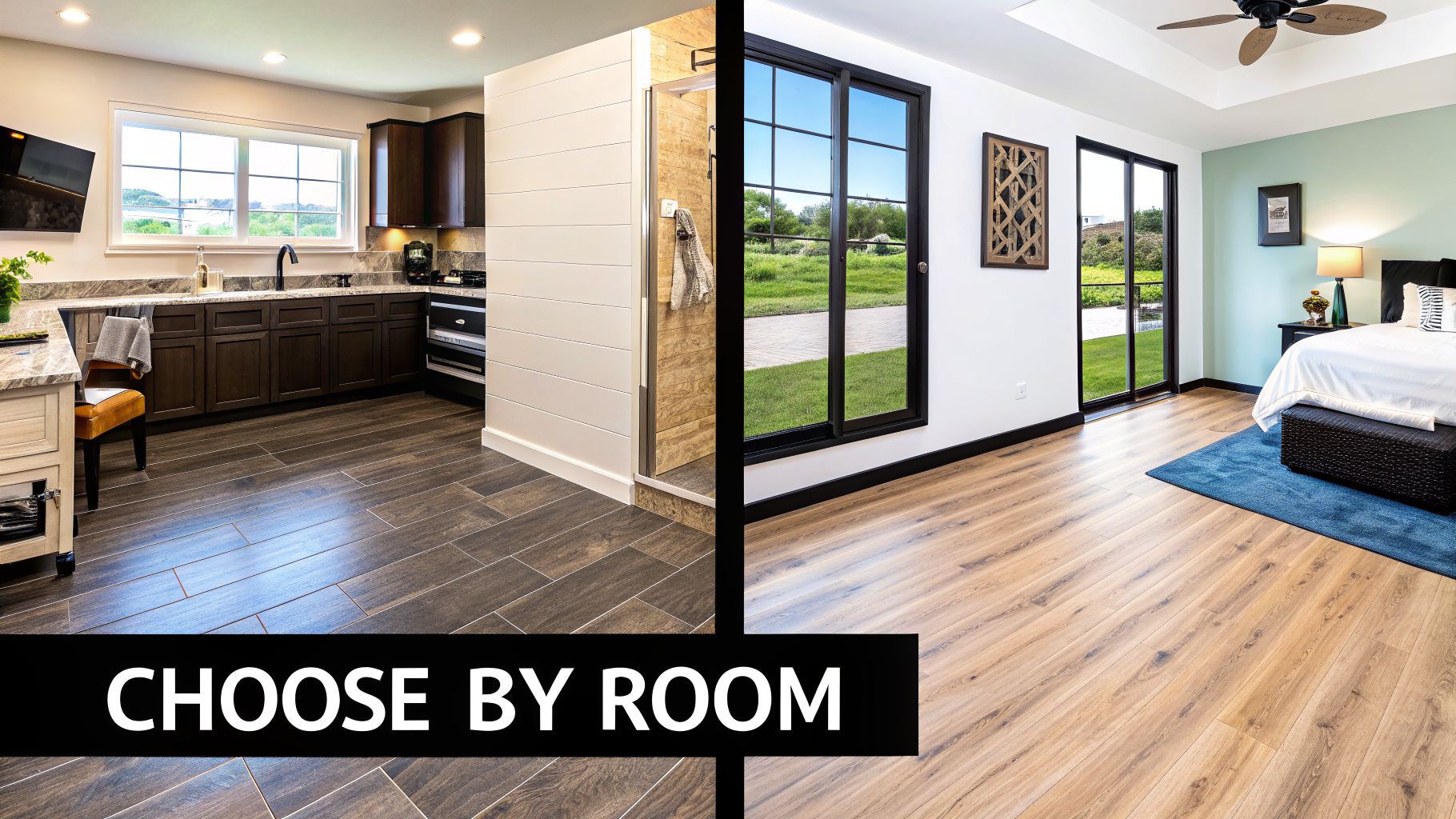
This is a totally situational decision. The perfect floor for a quiet home office would be a disaster in a chaotic family kitchen with spilled drinks and wet paws. When you match the flooring's strengths to the room's unique demands, your investment truly pays off.
The Clear Winner for High-Moisture Zones
For some spots in your home, the choice is pretty much made for you. If a room sees water, humidity, or frequent spills, you need a floor that can handle it without a second thought.
- Kitchens and Bathrooms: Think about the splashes from the sink, spills from cooking, and steam from the shower. These areas are tough on floors, and LVP's 100% waterproof core offers complete protection and peace of mind.
- Basements and Laundry Rooms: Whether dealing with the natural humidity in a Georgia basement or a potential leak from the washing machine, LVP is the only reliable option here. Its synthetic construction means it simply won't swell, buckle, or fall apart when wet.
When it comes to any space that’s below ground or prone to moisture, the luxury vinyl plank vs. laminate debate isn't much of a debate at all. LVP isn't just a better choice; it's the only one that truly stands up to water long-term.
Ideal Scenarios for Laminate Flooring
Don't count laminate out, though. It's still a fantastic and budget-friendly choice for the dry, climate-controlled parts of your house. Its incredible scratch resistance and sharp, realistic look make it a perfect fit where moisture isn't a daily concern.
Laminate really shines in places like:
- Bedrooms and Home Offices: These are typically low-moisture, lower-traffic areas where laminate's durability and affordability are a perfect match.
- Formal Living and Dining Rooms: Its tough surface holds up beautifully against furniture legs and daily life, all while providing a timeless, polished appearance.
Before you pull the trigger, it's always a good idea to explore different room styles to see how each flooring type might complement your vision. Matching the floor to your overall aesthetic is just as important as matching it to the room's function.
Guidance for Professionals and Property Owners
The right flooring has a real impact on property value and client happiness, which makes this a critical decision for industry pros.
- For Real Estate Agents: In markets like Johns Creek and Milton, recommending LVP for kitchens and bathrooms is a huge selling point. Buyers today love its modern look and the "worry-free" waterproof guarantee.
- For Contractors: LVP is a go-to for new construction and remodels because it's so forgiving to install and incredibly resilient. Fewer callbacks over moisture problems lead to happier clients and a stronger reputation.
In the end, the best choice comes from understanding exactly what you need. By putting LVP in wet zones and using laminate's great value in dry areas, homeowners all over Forsyth County can design a home that's beautiful, practical, and built to last.
LVP vs. Laminate: Answering Your Final Questions
Even after comparing the specs, you probably still have a few lingering questions. That's completely normal. Choosing the right floor is a big decision, and these practical, real-world concerns are often what tip the scales.
Here are the most common questions we get from homeowners in Cumming, Johns Creek, and our neighboring communities. Let's get you the answers you need to feel great about your choice.
Can I Install LVP or Laminate Over an Existing Floor?
Most of the time, yes you can! Both LVP and laminate are engineered to be "floating floors," which means they can often go right over old, hard surfaces like tile, sheet vinyl, or even hardwood. This approach can save you a ton of time, money, and mess on demolition.
But there's a catch. The existing floor has to be level, clean, and structurally sound. If you try to install LVP or laminate over an uneven surface, the locking systems between the planks will be stressed. Over time, they can fail, leading to unsightly gaps and separation. And definitely don't try to install new flooring over soft surfaces like carpet—it creates a spongy, unstable base that will void just about every warranty out there.
Which Flooring Is Better for Homes with Pets and Children?
For a busy house filled with kids and pets, Luxury Vinyl Plank (LVP) is almost always the winner. Its entire construction is built to withstand the beautiful chaos of family life.
A high-quality LVP has a tough wear layer that stands up remarkably well to scratches from dog claws and dragged toys. But the real game-changer is that LVP is 100% waterproof. Spills, muddy paw prints, and pet accidents are just part of life, and with LVP, they’re not a catastrophe. Liquids can’t seep in and cause the planks to swell, warp, or stain, even if you don't get to them right away.
While today's laminate floors have come a long way with scratch resistance, their wood-based core is still their Achilles' heel when it comes to moisture. If liquid gets between the seams, it can cause permanent damage. For true peace of mind, LVP is the safer bet for families.
Does a Professional Installation Affect My Flooring Warranty?
Yes, one hundred percent. This is a huge point that homeowners sometimes miss. Flooring manufacturers have very specific installation guidelines, and following them to the letter is a non-negotiable condition of their warranties.
These instructions cover everything from subfloor prep and moisture readings to leaving the right-sized expansion gap around the edges of the room. If a DIY installation cuts corners or misses a step, you could unknowingly void your entire warranty. That means if a manufacturing defect shows up down the road, you'll be on your own.
Hiring a certified professional installer is the single best way to protect your investment. You’re not just paying for labor; you’re paying for the guarantee that the job is done right, your floor will perform as it should, and your warranty will be rock-solid.
At Flacks Flooring, we help homeowners in Cumming and Forsyth County navigate these decisions every day. If you're ready to find the perfect waterproof or hardwood flooring solution for your home, visit our showroom or schedule an in-home consultation. Explore your options with experts you can trust at https://flacksflooring.com.