
Most flooring advice stops at “maple is hard, so it's durable.” That's incomplete advice, especially for a North Georgia home with dogs, children, rolling kitchen chairs, and bright natural light. Maple hardwood flooring resists dents exceptionally well, but its pale color and fine grain can make scratches easier to see. The right question isn't whether maple can take abuse. It's whether you'll be satisfied with how that abuse looks over time.
That distinction matters in Cumming, Johns Creek, Milton, Alpharetta, and throughout Forsyth County. Maple can deliver a clean, modern floor with strong structural performance, but it demands better moisture control and more deliberate maintenance than many homeowners expect. If your priority is dent resistance and a light, uniform design, maple deserves serious consideration. If you want a floor that hides every mark from pets and daily traffic, luxury vinyl plank, textured oak, laminate, or tile flooring may be the more practical choice.
The Reality of Maple Hardwood Flooring in Busy Homes
Harder wood doesn't automatically stay looking new longer. Hardness primarily addresses denting, such as the impact from dropped cookware, furniture legs, or concentrated pressure. Scratches are a different problem. Dog claws, grit dragged in from an entryway, and rolling office chairs can mark the finish without denting the wood.

Maple's pale tone and tight, fine grain create its signature appearance. Boards often look clean and consistent, which works beautifully with modern cabinetry, white walls, farmhouse interiors, and classic trim. The same visual uniformity can also make a dark scratch or scuff stand out more than it would on a busier, more open-grained floor.
Read your household honestly
A quiet formal room and a combined kitchen, breakfast area, and family room have very different flooring demands. Before choosing maple, consider where traffic enters, where pets turn sharply, and where chairs move repeatedly across the surface.
- Dogs and active pets: Maple can resist claw-related dents, but surface marks may remain visually obvious.
- Rolling chairs: Home offices need protective mats or chair types that won't concentrate wear in one area.
- Entryways: Grit acts like abrasive material. Without a quality mat and regular vacuuming, it can scratch the finish.
- Children: Maple handles ordinary household impacts well, but toys, furniture movement, and tracked-in debris still affect the surface.
Practical rule: Choose maple for its clean appearance only if you're prepared to protect that appearance.
Maple's history supports its reputation for demanding environments. The first patent for an interlocking or end-matched maple flooring system appeared in 1891, and the Maple Flooring Manufacturers Association was founded in 1897 to standardize grading and dimensions, according to the documented history of maple wood flooring. That consistency helped maple become a dependable choice for gyms, schools, and other high-traffic spaces.
For a homeowner searching for scratch-resistant flooring for dogs or the best flooring for high-traffic areas, the honest answer is conditional. Maple is structurally tough, but it isn't visually forgiving. If you want a bright floor and accept visible signs of living, it can be a strong long-term material. If low-maintenance appearance matters more than dent resistance, compare it with waterproof LVP, textured hardwood, laminate flooring, or tile before committing.
Understanding Janka Hardness and Moisture Movement
The Janka rating gives maple a meaningful advantage in busy rooms. Hard maple measures about 1,450 lbf, meaning it takes approximately that amount of force to press a steel ball into the wood. The rating is about 12% higher than Northern Red Oak, so maple generally offers stronger resistance to dents from concentrated impacts, as documented by the Maple Flooring Manufacturers Association's physical properties information.
That makes maple a sensible candidate for entry halls, dining areas, and main living spaces where furniture and foot traffic create repeated pressure. It doesn't make the floor immune to damage, and it doesn't measure finish quality, scratch concealment, color change, or moisture performance.
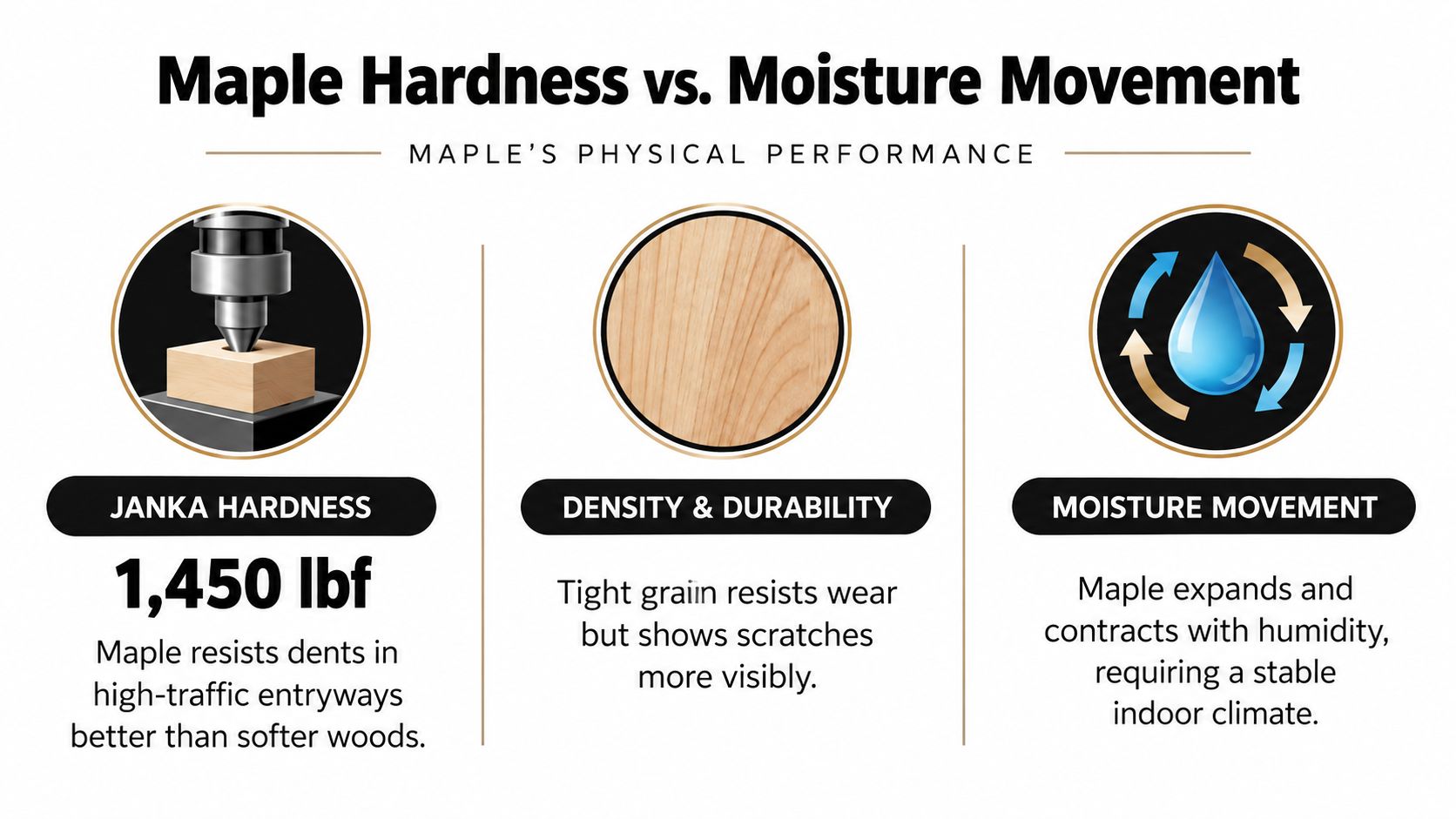
Hardness protects against one type of wear
Think of a heavy table leg versus a dog claw. The table leg applies concentrated downward pressure, where maple's hardness helps. A claw or grit particle can drag across the finish, creating a visible line rather than a deep depression.
That's why dent resistance and scratch visibility must be evaluated separately. A light, tight-grained floor may show a scratch clearly even when the wood beneath the finish remains sound. Your installer should discuss finish selection, sheen, board variation, and protective habits instead of promising that maple will remain flawless.
Moisture movement deserves equal attention
Hard maple has a dimensional stability factor of about 4.8% radial shrinkage and 9.9% tangential shrinkage, according to species specifications for maple flooring. Those figures describe how the material moves as its moisture content changes. In a North Georgia home, that matters because warm, humid summers and drier heating seasons can create opposing conditions inside the same house.
If the wood goes down before the home and subfloor are ready, seasonal movement can contribute to gaps, cupping, or edge movement. Professional hardwood flooring installation should include moisture testing of the flooring and subfloor, an assessment of the concrete or wood substrate, and an acclimation plan appropriate to the product.
Control the room before installing the boards
Maple flooring should be installed only after wet construction has settled and the home's indoor conditions are suitable. A contractor should explain how they'll verify moisture, what preparation the subfloor needs, and how they'll address a basement or slab installation.
For a broader comparison of wood species, grain, color, and performance, review this guide to hardwood species. The best species isn't selected from a sample board alone. It's matched to the home's traffic, structure, climate, and maintenance expectations.
Choosing Between Solid and Engineered Maple Options
Solid and engineered maple can both be excellent products, but they solve different installation problems. Solid maple is milled from one piece of wood and offers a substantial wear layer that can be sanded and refinished over its service life. Engineered maple uses a real maple surface over a layered core, giving the plank greater resistance to movement across changing moisture conditions.
Solid maple fits the right structure
Solid maple is most comfortable on a properly prepared wood subfloor above grade. It's a strong choice for main-level living areas when the home has suitable framing, controlled indoor conditions, and enough floor height for the installation.
Its long-term advantage is refinishing potential. A solid floor can often be renewed more than once, depending on the wear layer, prior sanding, profile, and the skill of the refinisher. That doesn't mean every solid product is automatically superior. A poorly prepared subfloor or moisture problem can damage solid boards just as effectively as any other wood product.
Engineered maple handles complicated conditions better
Engineered construction is usually the more practical option over a concrete slab, in many basement installations, and in rooms where seasonal movement creates extra risk. The cross-layered core helps distribute movement, although it doesn't eliminate the need for moisture testing or a proper moisture mitigation plan.
Engineered maple also deserves attention in kitchens. The product must be approved for the specific installation, and the installer should follow the manufacturer's requirements for temperature, moisture, adhesive, and expansion. A compatible product installed incorrectly is still a failed installation.
Installer question: “What does this subfloor require before maple can be installed, and what readings will you document?”
Plank width also affects planning. Wider boards create fewer seams and a more contemporary look, but they place greater demands on subfloor preparation and environmental control. Narrower boards can provide a more traditional appearance and may be easier to manage in certain conditions.
Read the practical comparison in engineered hardwood versus solid hardwood before choosing a construction type. For a basement or slab home in Metro Atlanta, I'd generally start with engineered maple unless the site assessment clearly supports another approach. For a stable wood subfloor and a long-term refinishing plan, solid maple remains a compelling option.
Project Costs and Installation Timelines
Maple's material price is only one part of the budget. Removal, subfloor repairs, leveling, moisture barriers, adhesive or fasteners, transitions, baseboards, stairs, waste, furniture handling, and finish choices can all affect the installed total. Get those items identified before comparing bids.
Published installed hardwood ranges fall between $9 and $25 per square foot. Another breakdown places solid hardwood at $11 to $25 per square foot installed and engineered hardwood at $9 to $20 per square foot installed. HomeGuide's hardwood flooring cost information provides useful planning ranges, not a guaranteed proposal for a North Georgia home.
Maple hardwood flooring budget ranges
| Product Type | Cost Per Square Foot Installed | Best Application |
|---|---|---|
| Solid hardwood | $11 to $25 | Stable wood subfloors and homeowners planning future refinishing |
| Engineered hardwood | $9 to $20 | Concrete slabs, many basements, kitchens, and variable moisture conditions |
The site determines the final price more than the species label. A damaged or uneven subfloor can add more labor than choosing maple instead of another hardwood. Wide planks, room-to-room transitions, stairs, demolition, and furniture movement can raise the total as well.
Ask for a written scope that separates preparation from installation. That makes a low bid easier to evaluate and exposes missing moisture-control work before the project begins.
Build the schedule around acclimation
Hardwood generally requires more planning than carpet or laminate because the boards need time to adjust to the home before fastening or gluing. A flooring timeline guide estimates one to two days for carpet or laminate, two to four days for hardwood, and three to five days or more for tile in typical single-room replacement scenarios. Maple acclimation adds time before active installation starts. Use this hardwood installation timeline guide to compare the stages.
A separate cost guide reports a standard hardwood installation benchmark of roughly $6 to $12 per square foot, with higher-end wood and larger spaces reaching $13 to $25 per square foot. It places a 250-square-foot room at about $1,800 to $6,300 and a 1,200-square-foot area at about $8,500 to $31,500. See Angi's hardwood flooring cost guide for those published figures.
Do not schedule around the shortest labor estimate. Confirm when the material arrives, how long acclimation requires, what preparation comes first, and when the room can handle normal use. A realistic schedule protects the finish and gives the installer time to address moisture conditions properly.
Maintenance Routines and Long-Term Refinishing
Maple rewards disciplined housekeeping. The goal isn't to keep people from using the room. It's to remove the grit, moisture, and friction that turn ordinary traffic into visible wear on a light surface.
Vacuum or sweep regularly with equipment designed for hard floors. A soft-bristle attachment removes abrasive particles without dragging a beater bar across the finish. Clean spills promptly, and use a slightly damp cleaning method rather than soaking the boards. Standing moisture has no place on a wood floor.
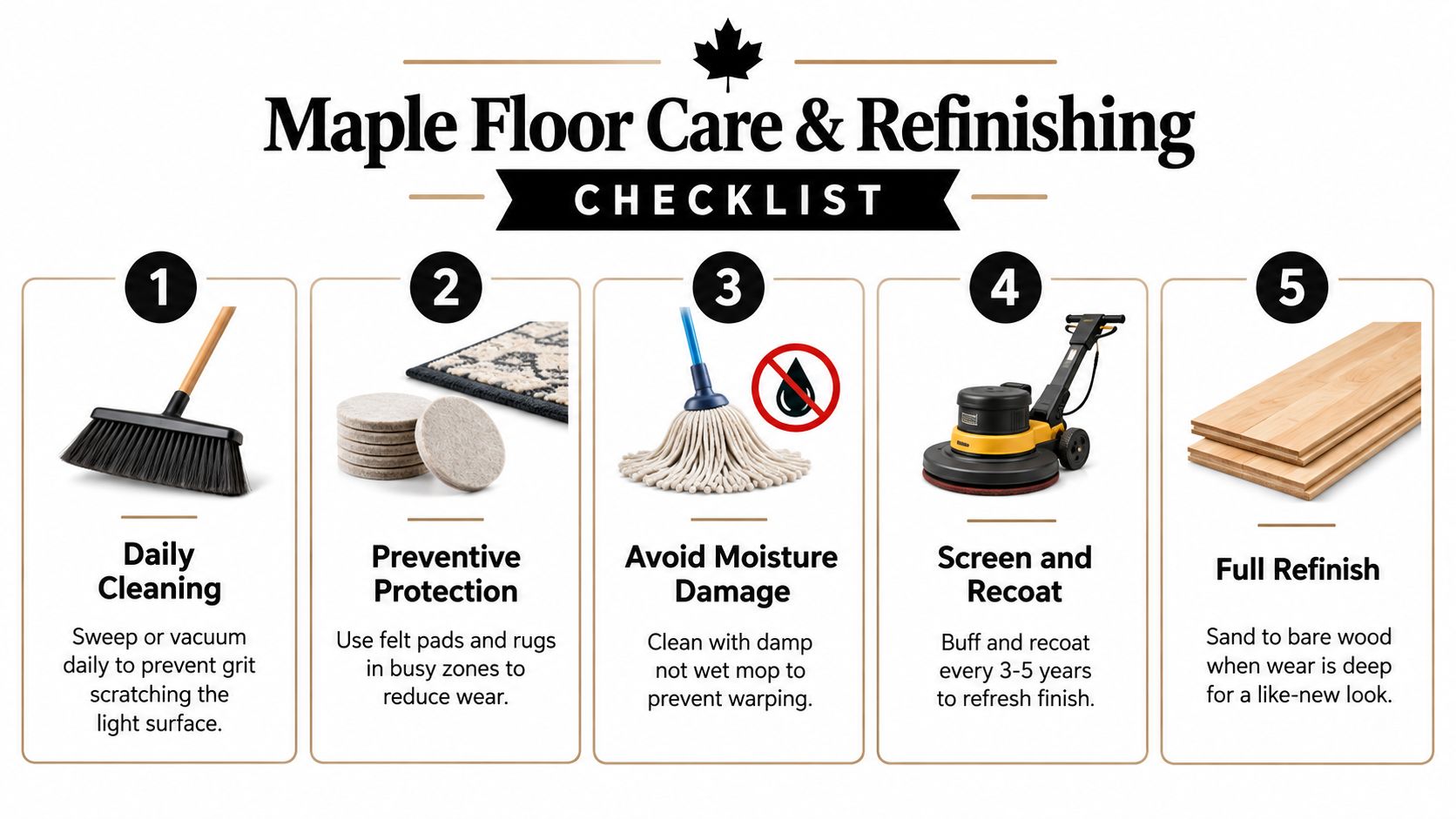
Prevent the scratches you'll notice first
Use felt pads under furniture and replace them when they collect grit. Put durable mats at exterior doors, but avoid rubber-backed products unless the manufacturer confirms they're suitable for the finish. Lift furniture instead of dragging it, and use a proper chair mat in a home office.
Pet owners should keep claws trimmed and watch the areas where dogs launch, turn, and wait near doors. These habits matter more on maple because the floor's light tone can reveal surface marks quickly.
Match cleaning to the finish
Factory-finished maple often provides a consistent initial surface and can be a practical choice for active homes. Site-finished floors offer more control over sheen and color, but the sanding, staining, and coating process requires experienced preparation. Maple's tight grain can absorb stain unevenly if the contractor doesn't prepare the surface correctly, so don't treat staining as a casual add-on.
A screen and recoat can refresh a worn finish when the wood itself isn't damaged. The exact timing depends on traffic, finish condition, and the maintenance system, so avoid adopting a fixed calendar without an inspection. Deep wear that reaches the wood calls for sanding and refinishing, while localized damage may be better addressed through flooring repair.
The important distinction is whether the problem is in the finish, the board, or the subfloor. A flooring professional should identify the cause before recommending replacement. That protects your budget and keeps a repairable floor from being discarded unnecessarily.
Style Pairings and Vetting Your Installation Team
Maple's design strength is its restraint. The light color and fine grain create a calm base for modern, farmhouse, and classic rooms, but the surrounding materials determine whether the result feels warm, stark, rustic, or refined.
In a modern Alpharetta or Milton interior, maple pairs well with flat-panel cabinetry, matte black hardware, simple stone, and restrained wall color. Farmhouse rooms can use painted cabinets, woven textures, natural wood furniture, and aged metal to keep the pale floor from feeling sterile. Classic interiors benefit from traditional trim, richer furniture, and carefully selected area rugs that add contrast without hiding the floor.
Don't choose from a showroom board under artificial lighting alone. A maple sample can look cooler near a north-facing window, warmer under incandescent fixtures, and different beside your actual cabinets. In-home consultations also reveal transitions, stairs, subfloor changes, moisture risks, and the practical route from the delivery door to the installation area.

Ask questions that expose installation quality
A low estimate can hide preparation work. Ask every contractor:
- Moisture testing: Which readings will you take in the flooring and subfloor?
- Acclimation: Where will the material acclimate, and how will you decide it's ready?
- Subfloor preparation: How will you address uneven areas, squeaks, contamination, or slab moisture?
- Construction choice: Why does solid or engineered maple fit this specific room?
- Finish protection: What cleaning products, mats, pads, and chair protection does the finish require?
- Repair policy: How will you handle damaged boards, transitions, or installation-related movement?
- Warranty terms: What does the warranty cover, and what homeowner conditions could void it?
- Written scope: Are demolition, disposal, trim, transitions, furniture handling, and site preparation included?
For homeowners comparing flooring near me in Cumming, Woodstock, Acworth, Canton, Roswell, Marietta, Johns Creek, or North Fulton, location alone isn't a qualification. Look for a team that evaluates the home rather than selling a product from a sample wall.
Flacks Flooring is one local option that provides hardwood, carpet, and waterproof flooring selections, along with showroom guidance and in-home consultations. Whether you compare that service with another installer, insist on the same standard of site-specific evaluation.
Making the Final Decision for Your Home
Maple makes sense when three priorities line up. You want a bright, clean floor. You value strong resistance to dents. You're willing to manage moisture, grit, furniture friction, and the visible scratches that come with an active household.
It's a particularly good fit for a homeowner in Cumming, Johns Creek, or Milton who wants a modern interior and understands that a lived-in floor won't remain visually untouched. Maple's domestic supply position also supports its long-term practicality. The American Hardwood Export Council reports 953.7 million cubic meters of hard maple growing stock, representing 6.6% of total U.S. hardwood growing stock, with growth exceeding harvest and net volume continuing to increase, as shown in its American hard maple resource information.
Use this decision test
Choose maple if:
- Your main concern is denting: You want a hard domestic species for furniture impacts and concentrated traffic.
- Your style is light and disciplined: You like pale, fine-grained flooring and can accept visible surface marks.
- Your home can support the installation: Moisture testing, acclimation, and indoor climate control are part of the plan.
- You're planning long-term ownership: You're evaluating construction, finish, maintenance, and refinishing together.
Look elsewhere if your priority is maximum visual forgiveness. A more varied oak, a textured or wire-brushed hardwood, waterproof LVP, laminate flooring, or tile flooring may better suit a household where pets, mud, spills, and frequent furniture movement are unavoidable. For carpet installation, reserve carpet for rooms where softness, warmth, and noise control matter more than hard-surface cleanup.
The best flooring decision isn't the one with the hardest material or the lowest initial quote. It's the one that fits your structure, traffic, appearance expectations, maintenance habits, and full installation budget. Maple is a strong choice, but only when you choose it with open eyes.
If you're comparing maple hardwood flooring with LVP, laminate, carpet, or other affordable flooring options, visit Flacks Flooring to review materials and schedule an in-home consultation. Ask for a site-specific recommendation that accounts for moisture, pets, traffic, style, installation timing, and the specific requirements of your North Georgia home.