
You’re probably looking at a handful of floor samples right now and having the same reaction most homeowners do. The light ones feel safe but a little flat. The dark ones look dramatic but seem like they’ll show every speck of dust, every dog nail mark, and every footprint after a rainy Georgia afternoon.
That’s usually where medium wood floors win people over.
They sit in the middle for good reason. They bring warmth without making a room feel heavy. They feel finished and substantial without turning everyday life into a maintenance project. In North Atlanta homes, that balance matters. A floor has to work with sunlight, humidity, pets, busy kitchens, open plans, and resale expectations, not just look good on a sample board.
Medium tones also fit the mix of homes you see across this area. They make sense in a historic Roswell renovation, a family home in Cumming, a polished Johns Creek resale, or a newer Alpharetta interior that leans clean and modern. The right floor doesn’t just match a paint color. It supports how the home lives.
Why Medium Wood Floors Are Atlanta's Timeless Choice
A lot of flooring decisions start with a visual reaction. Someone falls in love with a dark espresso board in the showroom, or they pick a pale natural floor because it feels current. Then the practical questions start. How will it look in afternoon sun? Will it fight the cabinets? Is it going to show every scratch from the dog?
That’s where medium wood floors earn their place.
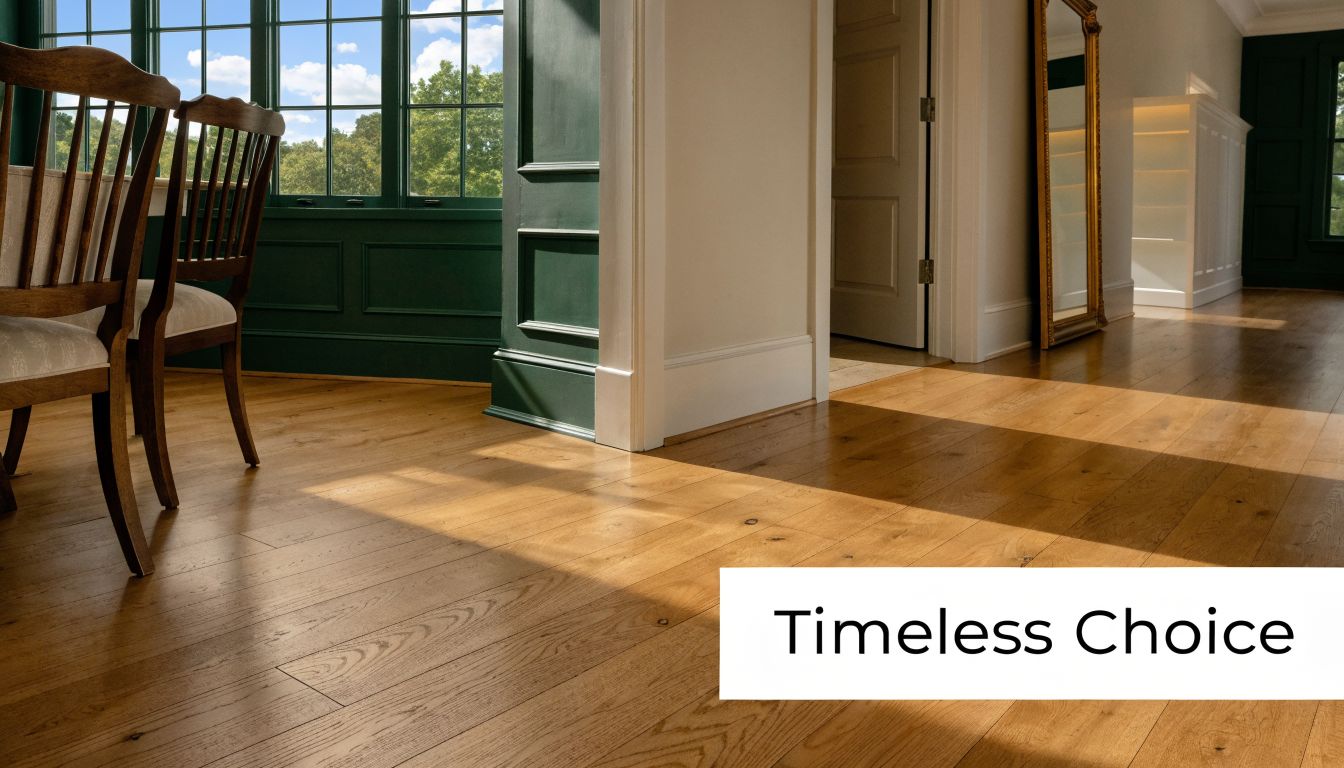
They fit the way Atlanta homes actually live
In Metro Atlanta, homes don’t all follow one style. You’ll see painted brick ranches, traditional two-stories, farmhouse-inspired updates, and sleek newer builds in the same drive. Medium tones bridge those styles better than most flooring choices.
They also work with the realities of local light. Georgia sun can make a pale floor look washed out in one room and make a dark floor look almost black in another. A medium tone usually lands in a more forgiving place. It still shows grain. It still adds warmth. It just doesn’t swing too hard.
Practical rule: If you want a floor you’re still happy with after furniture changes, paint updates, and daily traffic, mid-tone wood is usually the safest long-term choice.
They support resale without looking generic
Timeless doesn’t mean boring. It means the floor gives the next buyer fewer reasons to hesitate.
For homeowners in competitive areas like Cumming and Milton, that matters. The 2022 Remodeling Impact Report cites a 147% return on investment for new wood floors, which is why mid-tone hardwood often makes sense as both a design choice and a property decision, as noted by Elmwood Reclaimed Timber’s summary of the Remodeling Impact Report.
That doesn’t mean every wood floor is equal. Tone, construction, board width, finish, and installation all affect whether a floor feels premium or like a rushed update. But medium wood floors start from a strong position because they appeal to more people than flooring at either extreme.
If you want the broader value case for wood in general, this guide to the benefits of hardwood flooring is a good companion read.
They solve the light-versus-dark debate
Most homeowners aren’t really asking, “What’s the trend?” They’re asking a better question.
Which floor will still look right when the kids run through the house, the dog slides around the corner, the dining chairs get moved daily, and the sunlight shifts across the room all year?
Medium wood floors answer that question well. They’re warm without being too red, rich without being too dark, and polished without being fussy. That’s why they keep showing up in homes that feel settled, comfortable, and finished.
What Exactly Are Medium Tone Wood Floors
“Medium” sounds precise until you start shopping. Then you realize it covers a wide range.
One homeowner means honey oak. Another means a soft walnut brown. Someone else wants a floor that reads warm but not orange, brown but not muddy, classic but not overly rustic. All of those can fall under medium wood floors.
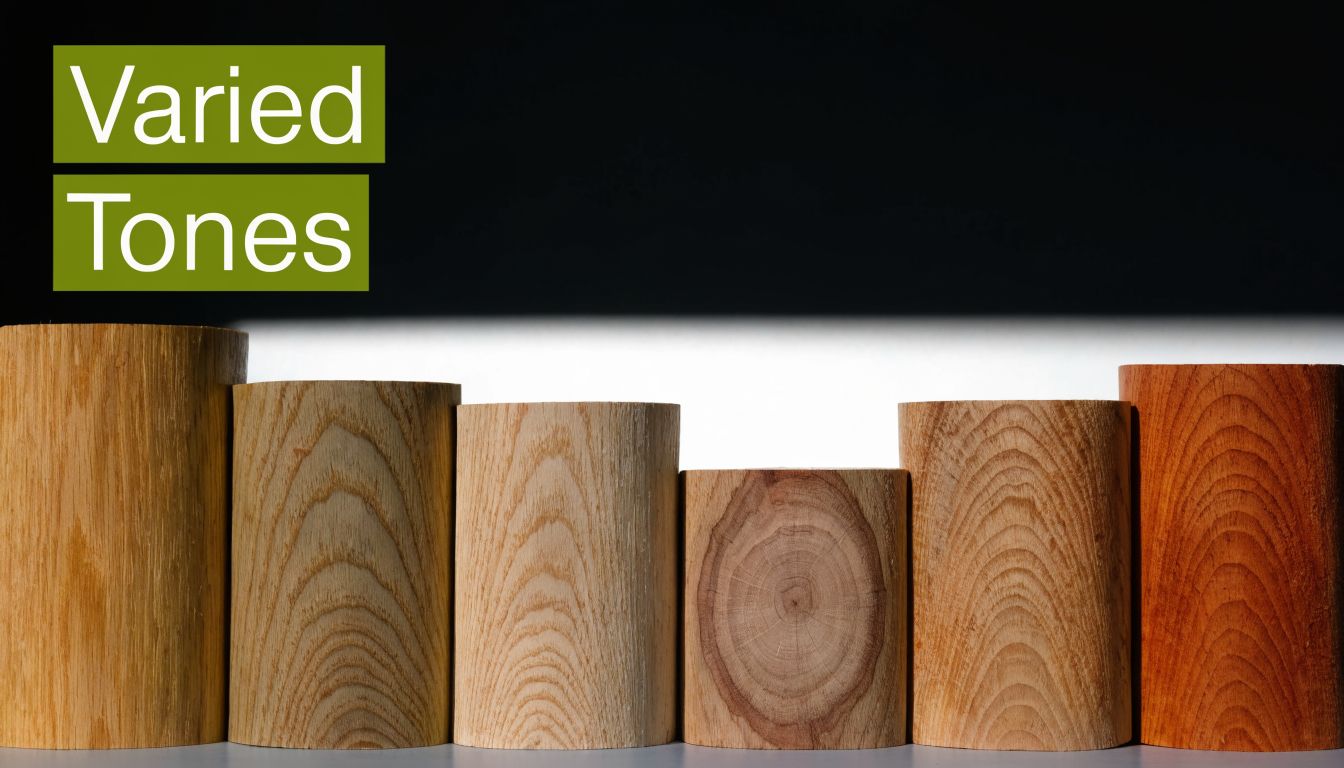
Think in undertones, not just darkness
The easiest way to understand medium tones is to think of them like coffee or honey. They sit between very pale blonde wood and deep espresso finishes, but they can still lean in different directions.
A medium floor might have:
- Golden undertones that feel sunny and traditional
- Caramel notes that read warm and welcoming
- Soft brown character that feels grounded and neutral
- Taupe influence that works well with cooler wall colors
- Red-brown depth that suits older homes with classic trim
That range is why two medium floors can look completely different in the same room.
Natural color versus stain color
Some medium wood floors get their look from the species itself. Others get there through stain, smoking, or finish tone.
Here’s the practical difference:
| Approach | What it tends to do | Best for |
|---|---|---|
| Natural species color | Shows more authentic grain variation and a less “coated” look | Homeowners who want a quieter, more organic floor |
| Stained medium tone | Gives more control over warmth, depth, and consistency | Matching cabinets, trim, or an existing design plan |
| Finished engineered surface | Delivers a repeatable color across planks and often a more predictable sample-to-install result | Renovations where visual consistency matters |
If you like the floor because of its grain, don’t let the stain bury it. If you like the floor because of its color, make sure the species and finish support that color in your lighting.
A sample under showroom lights can look balanced. The same board in a south-facing room can turn much warmer by late afternoon.
What medium is not
It helps to define the edges.
Light floors usually read natural, blonde, pale beige, or airy. They can make a room feel bigger, but they often create a sharper contrast with daily dirt and scuffing.
Dark floors usually read deep brown, coffee, ebony, or nearly black. They bring drama, but they ask more of the homeowner from a maintenance standpoint.
Medium wood floors land between those extremes. They usually show enough depth to feel substantial and enough lightness to stay flexible with paint, cabinetry, and furniture.
Why the category matters during a consultation
Homeowners often say, “I want something not too dark.” That’s a start, but it’s not enough to choose the right floor.
A better description sounds like this:
- I want a medium tone with less red in it
- I want something warmer than natural oak but not heavy
- I want a medium brown that still shows grain
- I want a mid-tone floor that works with white cabinets and doesn’t feel yellow
That level of clarity saves time and usually leads to better decisions. It moves the conversation from vague preference to a floor that fits the home.
How to Select Your Ideal Medium Wood Floor
Choosing the right medium wood floor comes down to four decisions. Get these right and the floor tends to perform well for years. Miss one, and even a beautiful product can become a daily irritation.
Start with species and household wear
Species changes both the look and the behavior of the floor.
Oak is often the baseline because it takes stain well and works in almost any style. Hickory brings more movement and contrast. Walnut offers a richer, softer visual that many people love in quieter spaces.
For busy homes, surface character matters as much as color. A floor with visible grain and natural variation tends to disguise daily life better than one that looks very smooth and uniform.
One useful benchmark comes from engineered Northern Oak. The technical spec lists a Janka hardness of 1360 and describes it as a medium durability option suited to daily traffic, which is why many homeowners land there for living areas, hallways, and family spaces, according to this engineered floor technical spec sheet.
What tends to work best by lifestyle
- Kids and pets: Oak and hickory style visuals usually age more gracefully than very sleek, uniform looks.
- Formal rooms: Walnut tones can be beautiful, especially where traffic is lower.
- Whole-home continuity: Mid-tone oak remains the easiest path when you need one floor to connect multiple spaces.
In Georgia, construction matters as much as color
A medium tone can be perfect visually and still be the wrong choice structurally if the construction doesn’t fit the house.
Engineered hardwood often makes more sense than solid wood in North Atlanta. Engineered medium wood floors offer expansion under 0.2% in relative humidity ranging from 10-75%, which helps reduce gapping and cupping in humid conditions. That matters in Forsyth County, where moisture swings can be hard on flooring. The same technical guidance notes that solid wood movement can contribute to up to 30% of flooring failures in high-moisture areas. That’s why engineered construction is often the more forgiving option for local homes, based on the same technical specification.
The practical takeaway is simple. If you want wood in a home that sees seasonal humidity changes, engineered construction is often the safer play.
A few signs engineered may be the better fit
- Wide-open floor plans: More continuous surface area means movement control becomes more important.
- Homes with varying HVAC performance: Uneven indoor conditions can expose weak flooring choices.
- Main-level remodels over existing subfloors: Engineered wood usually gives you more flexibility.
Width changes the personality of the room
Board width is one of the most overlooked choices in a flooring project. It changes the scale of the room and the style message of the floor.
Historically, wood flooring started with narrow functional strips. In the early 1900s, common widths were 2 1/4 inches and 1 1/2 inches, and engineered wood later emerged with a standard 5-inch width, according to this review of historical flooring width trends.
That history still shows up in modern homes.
| Plank style | Usually feels best in | Typical visual result |
|---|---|---|
| Narrow strip | Historic homes, traditional layouts, smaller rooms | More classic rhythm and detail |
| Mid-width plank | Transitional homes, mixed styles | Balanced and adaptable |
| Wide plank | Modern homes, open layouts, larger rooms | Broader, calmer visual flow |
In Roswell or older Marietta homes, narrow or moderate widths often feel more natural. In newer Milton or Alpharetta interiors, wider planks usually suit the architecture better.
Finish controls the maintenance experience
The sheen level affects how the floor lives day to day.
Matte finishes tend to hide dust and minor wear better. Satin offers a little more light reflection without looking glossy. Higher sheen finishes can look sharp on day one, but they usually reveal more of everyday traffic.
If you have dogs, active kids, or a lot of natural light, a lower-sheen medium wood floor usually gives you fewer regrets.
The finish also shapes how the color reads. A medium brown in matte can feel calm and natural. The same tone in a shinier finish can look more formal and busier.
That’s why sample boards should be viewed flat on the floor, in your own rooms, and at different times of day. Standing a sample upright against a wall doesn’t tell you enough.
Medium vs Light and Dark Hardwood Pros and Cons
Most homeowners don’t need to be convinced that wood looks good. They need help deciding which tone will hold up best in real life.
That decision gets easier when you stop treating floor color as a pure style question. Tone affects how the room feels, how much cleaning you notice, and how forgiving the floor is when life gets busy.
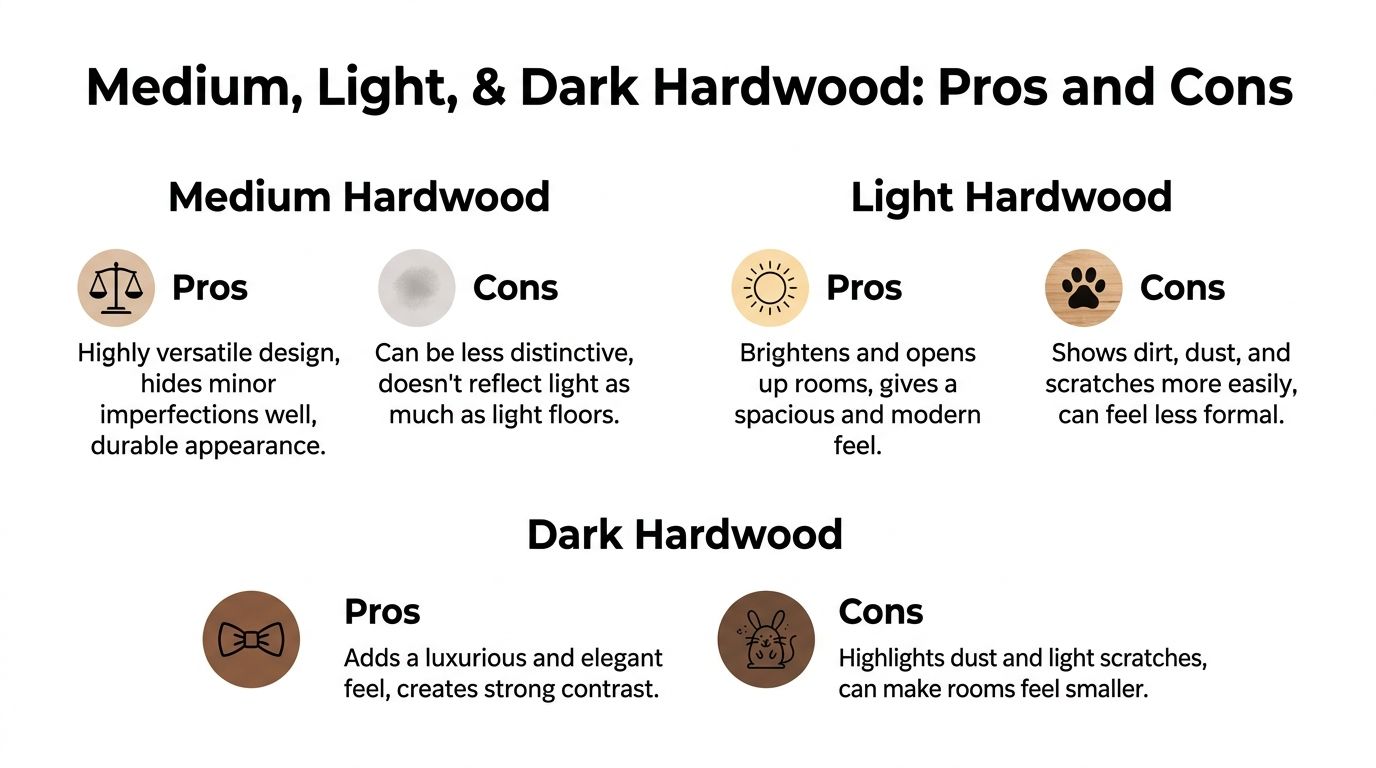
Side by side in daily use
| Floor tone | Where it shines | Where it struggles |
|---|---|---|
| Medium hardwood | Flexible with furniture and paint, hides minor imperfections better, feels warm without being heavy | Can feel less dramatic if you want a strong statement |
| Light hardwood | Brightens rooms, helps smaller spaces feel more open, works well in casual and modern interiors | Often reveals dirt, scratch contrast, and traffic marks faster |
| Dark hardwood | Feels elegant and high contrast, anchors large rooms, pairs well with lighter walls | Shows dust, pet hair, and surface wear more easily |
If you want a deeper dive on the two outer ends of the spectrum, this comparison of dark vs light hardwoods is useful.
Why medium wins for most busy households
Medium wood floors usually perform best in the middle ground because daily wear doesn’t stand out as aggressively. They don’t spotlight every crumb the way many dark floors do. They also don’t create the same “every mark shows” effect that some very light floors can create under direct light.
That doesn’t mean they hide everything. No real wood floor does. But they tend to age in a way homeowners find easier to live with.
Best fit by home type
- Family home with pets: Medium often gives the most forgiving look.
- Small condo or low-light room: Light may help the room feel more open.
- Formal dining room or dramatic office: Dark can still be the right call if you accept the upkeep.
Some floors impress you in a clean showroom. Better floors still look good after a week of ordinary living.
Tone also affects mood
Light floors usually feel airy and relaxed. Dark floors feel tailored and formal. Medium wood floors sit in the center and can move either direction depending on the board width, grain, and sheen.
That flexibility is what makes them useful in North Atlanta homes, where homeowners often want a floor that can support mixed furniture styles. A medium tone can handle antiques, painted cabinets, black fixtures, brass lighting, and neutral upholstery without the room feeling confused.
The honest trade-off
If you want your floor to be the star, medium may feel quieter than a dramatic dark stain or a very pale Scandinavian look.
But if you want the floor to support the home instead of dominate it, medium is hard to beat. It’s the option that most often looks intentional without looking forced.
Budgeting for Your Hardwood Installation in North Atlanta
When homeowners search for hardwood flooring installation in Woodstock, Acworth, Roswell, or Cumming, they usually want one answer. What’s this really going to involve?
The honest answer is that the total depends less on the square footage alone and more on what the house asks for before the first plank goes down.
What drives the total project cost
Material choice matters, but it’s only one part of the job. The bigger variables are usually hidden until the site is evaluated.
These factors shape the scope:
- Construction type: Solid hardwood and engineered hardwood install differently and don’t ask the same thing from the subfloor.
- Floor prep: Uneven areas, moisture concerns, or damaged subfloor sections can change the labor required.
- Existing flooring removal: Carpet, old tile, glue-down materials, and transitions all affect replacement complexity.
- Room layout: Stairs, tight closets, angled walls, and long continuous runs add detail work.
- Finish expectations: Site-finished and prefinished floors create different timelines and living disruptions.
A professional installer should walk you through those variables before work starts. If the quote seems too simple, it probably is.
Why installation quality still matters so much
Hardwood became much easier to install after key milestones like 1885, when tongue-and-groove technology changed the trade. That innovation made hardwood more accessible. It didn’t make skilled installation optional.
Real estate data still places hardwood floor replacement at over 75% ROI, which is one reason proper installation remains so important for homeowners in competitive North Fulton markets, as explained in this historical overview of the evolution of hardwood flooring.
Poor prep, rushed layout, and bad transitions can undercut that value quickly.
What the process should look like
A good installation process is usually straightforward for the homeowner, even if there’s a lot happening behind the scenes.
In-home consultation
Samples should be viewed in your lighting, next to cabinets, paint, and trim.Site evaluation
The installer checks the subfloor, room conditions, and any transition challenges.Clear scope of work
You should know what’s included, what happens to existing flooring, and what the timeline looks like.Installation and walkthrough
The final result should include clean edges, proper transitions, and clear maintenance guidance.
The cheapest quote often leaves out prep. Prep is the part that protects the floor.
When hardwood isn’t the best answer
Some spaces need a different solution.
If you’re finishing a basement, dealing with frequent moisture exposure, or want a more budget-conscious replacement, luxury vinyl plank can be a smart alternative. Good LVP gives homeowners a wood-look floor with waterproof performance and easier maintenance. In some homes, laminate also deserves consideration for secondary rooms where affordability matters.
The right flooring choice isn’t always the most expensive one. It’s the one that fits the room, the subfloor, and the way the house is used.
Maintaining and Refinishing Your Medium Wood Floors
A well-chosen floor still needs the right care. Medium wood floors are forgiving, but they’re not indestructible. The households that get the best long-term results usually follow a few consistent habits and avoid the common cleaning mistakes.
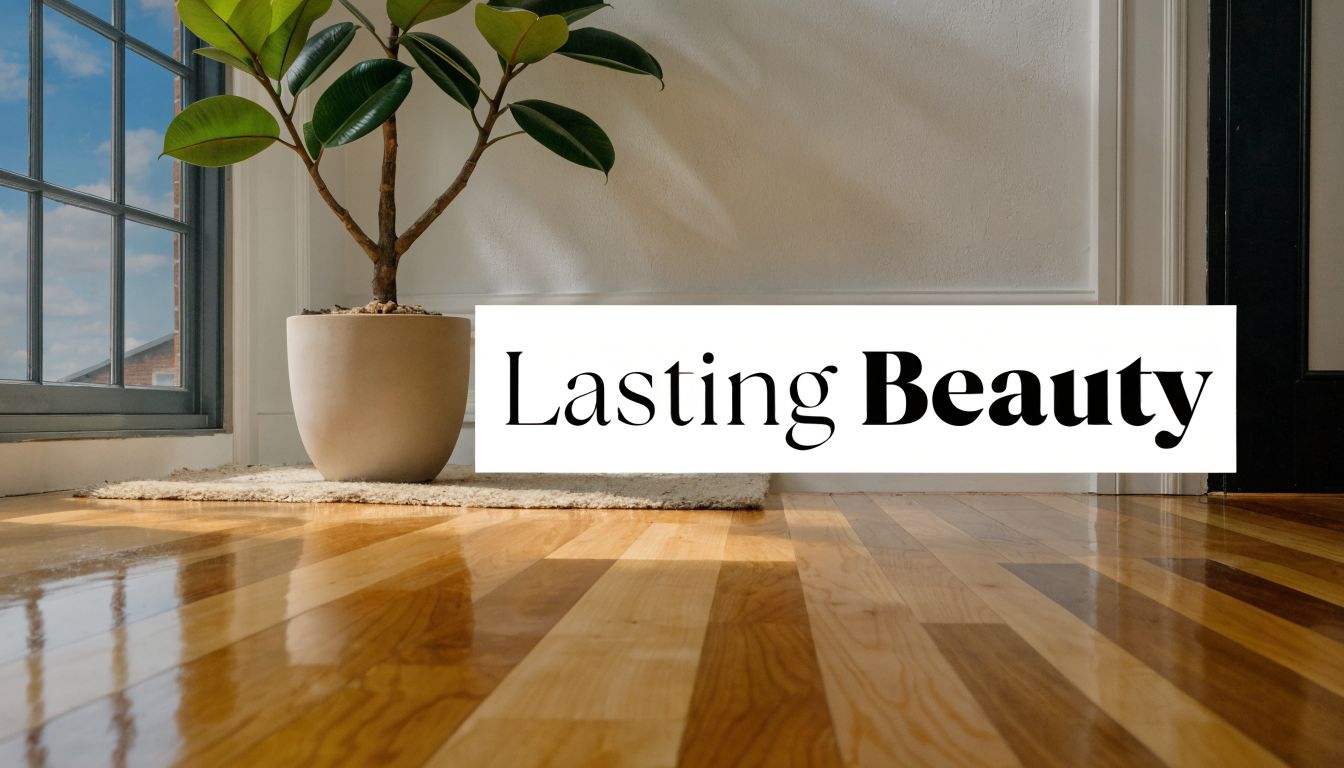
Daily and weekly care that actually helps
You don’t need a complicated routine. You need a safe one.
For high-traffic homes, homeowners can reduce visible wear by up to 40% by using pH-neutral cleaners and felt pads under furniture. In sunny Forsyth County homes, sheer UV-blocking curtains and rotating rugs can extend floor life by 5-7 years before refinishing is needed, according to this practical guide on light, medium, and dark wood floor care.
That lines up with what works on real floors every day.
The routine worth keeping
- Dry debris first: Use a soft broom, dust mop, or vacuum setting made for hard surfaces.
- Use microfiber, not excess water: A lightly damp microfiber mop is safer than soaking the floor.
- Choose the right cleaner: Stick with pH-neutral products made for wood floors.
- Protect contact points: Felt pads under chairs, stools, and movable furniture make a bigger difference than often realized.
What doesn’t work
A few habits shorten the life of wood floors fast.
- Steam mops: Heat and moisture are a bad combination for wood flooring.
- Wet mopping: Water that sits in seams and edges can create trouble.
- Harsh household cleaners: If the product isn’t made for wood, don’t guess.
- Ignoring sunlight: Sun-fading isn’t instant, but over time it changes color unevenly.
Keep the floor clean and dry, not soaked and shiny. Wood lasts longer when care is gentle and consistent.
When to refinish and when to replace
Not every worn-looking floor needs replacement. Some need a proper refinish. Others have reached the point where replacement is smarter.
Here’s the simple distinction:
| Condition | Better next step |
|---|---|
| Surface wear, dull finish, small scratches | Refinishing may solve it |
| Deep structural damage, severe movement, repeated moisture issues | Replacement is often the better route |
| Engineered floor with a sandable wear layer | Depends on wear layer thickness and condition |
| Older solid wood with enough material left | Often a strong candidate for refinishing |
There’s useful context in the long history of hardwood flooring. Properly cared-for wood floors can last for generations, and some hardwood formats can be refinished multiple times over a long service life. That’s one reason wood remains such a strong long-term material when the floor is chosen and maintained well.
High-traffic homes need prevention, not just cleanup
If you have dogs, children, or constant foot traffic, don’t wait for damage to show up before adjusting your setup.
Use runners where traffic repeats. Put mats at exterior doors. Keep pet nails trimmed. Rotate rugs so the floor ages evenly. Those small steps preserve the finish and keep the tone looking consistent across the room.
Medium wood floors are popular partly because they don’t make you obsess over every mark. Good maintenance keeps it that way.
Your Flacks Flooring Checklist for Projects in Cumming and Milton
By the time you’re ready to choose a floor, the most helpful thing isn’t another gallery of pretty rooms. It’s a set of questions that protect you from making an expensive mistake.
If you’re planning a project in Cumming, Milton, Johns Creek, or nearby parts of Forsyth County and North Fulton, bring this checklist into your in-home consultation.
Questions worth asking before you commit
Which medium tones fit my natural light best
A board that looks balanced in a showroom can pull much warmer or darker in your home.Should I choose solid or engineered for this specific room
The answer should be based on moisture conditions, subfloor type, and layout, not habit.What plank width suits the age and style of my home
A historic or traditional home often wants something different than a newer open-concept interior.Which finish will hide daily traffic better
Sheen level changes your maintenance experience more than is often expected.How will this floor transition into adjoining rooms
The details at doorways, stairs, and room breaks affect whether the install feels custom or patched together.What prep work is included before installation starts
The unseen work often determines whether the floor stays stable and attractive.
What a good answer sounds like
Good flooring advice is specific. It ties the product to the room, the light, the subfloor, and the household.
If the conversation stays vague, push for clarity. Ask to see samples in different parts of the room. Ask how the floor handles humidity. Ask what kind of wear pattern is realistic in a house with kids or pets. Ask what maintenance the finish needs.
A solid consultation should leave you with confidence, not pressure.
The goal isn’t just a beautiful floor
The goal is a floor that still feels right after the furniture is back in place, after a year of traffic, and after the novelty wears off.
That’s why medium wood floors stay relevant. They solve more problems than they create. They support resale. They work across home styles. And in North Atlanta, they’re one of the safest ways to get warmth, durability, and design flexibility into the same project.
If you’re ready to compare medium wood floors in your own lighting and get straight answers about hardwood, waterproof flooring, floor replacement, or pet-friendly options, schedule a consultation with Flacks Flooring. Their team serves homeowners across Cumming, Milton, Johns Creek, and the greater North Atlanta area with in-home guidance, wide product selection, and installation-focused advice built around long-term value.