
Picking a new floor can feel like a massive decision, especially when your house is full of kids, pets, and constant activity. You want something that looks fantastic but won't immediately start showing every scuff and scrape from daily life. This guide is here to cut through the marketing jargon and explain what scratch resistant flooring actually is, helping you set realistic expectations and find a durable floor that can handle everything from dropped toys to busy foot traffic.
What "Scratch Resistant" Really Means for Your Floors
When a flooring product is labeled "scratch resistant," it's vital to understand one thing right away: resistance is not the same as invincibility. There’s no such thing as a truly scratch-proof floor. What these durable materials do offer is an engineered defense against the kind of everyday wear and tear that would quickly ruin softer, less protected surfaces.
Think of it like the screen on a new smartphone. It’s built to resist getting scratched by the keys in your pocket, but a direct scrape from a sharp rock will still leave its mark. In the same way, a scratch-resistant floor is designed to hold up to daily life without showing signs of stress.
The Science Behind the Strength
A floor's toughness comes down to its construction, specifically what’s on top. For materials like Luxury Vinyl Plank (LVP) and laminate, this protective shield is called the wear layer. This clear top coat is the floor’s first line of defense against scuffs, abrasions, and minor scratches. The thicker and more robust that layer is, the better it protects the beautiful design you see.
With tile, on the other hand, scratch resistance comes from the raw hardness of the material itself, a quality that’s measured on a scientific scale. This is why digging into the "how" and "why" behind the label is so important—it helps you make a genuinely smart choice for your home.
The goal is to choose a flooring material whose defensive capabilities match the offensive challenges of your household—whether that’s a golden retriever’s claws, a toddler’s toy trucks, or the constant shuffle of shoes in a busy entryway.
Why It Matters for Your Home
Selecting the right scratch-resistant flooring goes beyond avoiding a few cosmetic blemishes. It's about protecting your investment and keeping your home's value intact for the long haul. A truly durable floor gives you:
- Less stress and worry about everyday life damaging your beautiful new surfaces.
- Lower maintenance costs over time, since you won't be paying for constant repairs or refinishing jobs.
- A home that looks better for longer, ensuring your space remains a source of pride and comfort.
Consider this guide your practical roadmap. We’ll break down the technical ratings, compare the most popular materials head-to-head, and help you turn the often-overwhelming process of choosing a floor into a confident decision you’ll love for years.
How Scratch Resistance Is Actually Measured
When you start digging into different flooring options, you'll hear a lot of technical terms thrown around. Don't let them intimidate you. These ratings aren't just marketing fluff; they're the real-deal specs that tell you exactly how a floor will stand up to the chaos of daily life.
Think of it like buying a truck. You wouldn't use a light-duty pickup to haul heavy equipment. In the same way, you need to match your floor’s durability rating to the traffic you expect in that room. Let’s break down the language of durability.
The Wear Layer: Your Floor's Screen Protector
For flooring like Luxury Vinyl Plank (LVP) and modern laminate, the wear layer is your first and most important line of defense. It's a completely clear, tough-as-nails top coat that protects the pretty part—the wood or stone design underneath—from scratches, scuffs, and spills.
The best way to think about it is like the screen protector on your phone. A flimsy one might stop a few minor nicks, but a high-quality, thick one can save your screen from a serious drop. The same principle applies here.
We measure this layer’s thickness in mils (one-thousandth of an inch). It sounds tiny, but in the world of flooring, the difference between a 6-mil and a 20-mil layer is night and day.
- 6-12 mil: Fine for very low-traffic spots, like a guest bedroom or a closet.
- 12-20 mil: This is the sweet spot for most homes, perfect for living rooms and home offices with average foot traffic.
- 20+ mil: The undisputed champion. If you have kids, big dogs, or a busy entryway, this is what you want. It’s built for the high-traffic zones of a busy household.
For a genuinely scratch-resistant floor in the most lived-in areas of your Cumming home, a wear layer of 20 mils or more is the benchmark.
AC Rating: The All-Around Durability Test
While the wear layer is all about thickness, the Abrasion Class (AC) rating is more like a comprehensive stress test. Used mainly for laminate and some vinyls, it grades a floor’s ability to handle everything from abrasion and impacts to stains and fading.
An AC rating doesn’t just tell you how a floor handles scratches. It’s a measure of its overall toughness against dropped objects, sliding furniture, and the general wear and tear of a busy home.
It’s all about matching the rating to the room:
- AC1 (Moderate Residential): Really just for places with almost no foot traffic, like a closet.
- AC2 (General Residential): Suitable for rooms that don't see a lot of action, like a formal dining room.
- AC3 (Heavy Residential/Moderate Commercial): This is the go-to for most homeowners. It's engineered to handle busy kitchens, hallways, and living areas.
- AC4 (General Commercial): Built for places like small offices or cafes, which makes it an incredibly durable option for any room in your home.
- AC5 (Heavy Commercial): The toughest you can get, designed for department stores and public buildings. Overkill for most homes, but it's out there!
For any active family in Forsyth County, an AC3 rating should be your minimum standard. It ensures your new floor is ready for whatever you throw at it.
The Mohs Scale: Measuring Hardness for Tile
When it comes to porcelain and ceramic tile, we use a different system altogether: the Mohs scale of mineral hardness. You might remember this one from science class. It ranks materials on a scale of 1 (softest, like Talc) to 10 (hardest, like a Diamond) based on what can scratch what.
Here’s why it matters: the dirt and grit tracked into your house often contain tiny particles of quartz, which sits at a 7 on the Mohs scale. If your tile is softer than that, that grit will eventually leave scratches.
For tile floors, look for a Mohs rating of 5 or higher to handle basic foot traffic and furniture. But for high-traffic zones like mudrooms, entryways, and kitchens, a rating of 7 or above is your best bet for keeping the floor looking new for years to come.
Comparing the Top Scratch-Resistant Flooring Materials
Alright, now that we’ve covered the technical ratings, let’s talk about how these floors actually perform in the real world. Choosing the right scratch-resistant flooring is always a balancing act—you’re weighing toughness against looks, cost, and how your family really lives.
Each material has its own personality, with distinct pros and cons. We'll compare three of the most popular and resilient options head-to-head: Luxury Vinyl Plank (LVP), modern Laminate, and classic Tile. This will give you a clear, practical picture of what to expect from each, helping you make the best choice for your home here in Cumming or Forsyth County.
Scratch Resistant Flooring Comparison Guide
To make things simple, here’s a quick-reference table that breaks down the top materials. It compares them on the factors that matter most: scratch resistance, cost, and where they shine.
| Flooring Type | Scratch Resistance | Average Cost (Installed) | Best For |
|---|---|---|---|
| Luxury Vinyl Plank (LVP) | Excellent | $5 – $10 per sq. ft. | Busy homes with kids and pets; any room, including kitchens and basements. |
| Laminate | Very Good | $4 – $8 per sq. ft. | Budget-conscious homeowners wanting a durable wood look in living areas and bedrooms. |
| Porcelain/Ceramic Tile | Superior | $8 – $20+ per sq. ft. | Highest-traffic areas like entryways and mudrooms; bathrooms and kitchens. |
This table gives you a great starting point, but the real decision comes down to the details. Let's dig a little deeper into what makes each of these materials a contender.
Luxury Vinyl Plank (LVP): The All-Around Performer
There’s a reason Luxury Vinyl Plank has become a go-to for so many homeowners. It’s the versatile workhorse of the flooring world, managing to deliver stunningly realistic wood and stone looks while being tough enough for the chaos of a busy household.
Its strength comes from a layered construction. A solid core provides stability, a high-def print layer gives it that beautiful appearance, and a thick, clear wear layer on top acts as a bodyguard against scratches, scuffs, and spills. Since it’s made from PVC, LVP is also 100% waterproof, which makes it a fantastic pick for kitchens, bathrooms, laundry rooms, and basements.
To get the full scoop on why it's so popular, check out our detailed guide on what is luxury vinyl plank flooring.
The only real downside? Premium LVP often costs a bit more than laminate. And while it’s incredibly durable, a very heavy or sharp object can still gouge it, so using furniture pads is always a smart move.
Modern Laminate: The Resilient Value Choice
If you haven't looked at laminate in the last 10 years, you’re in for a pleasant surprise. Today’s laminate is a completely different beast, thanks to huge leaps in technology that have dramatically improved its durability and water resistance.
Laminate is built with a dense fiberboard core, a high-resolution image layer, and an incredibly tough aluminum oxide top coat. This combination gives it fantastic scratch and dent resistance, and it often holds up even better than some vinyls in abrasion tests. It’s a brilliant way to get the look of real hardwood without the high price tag.
The industry has taken notice, and laminate is making a major comeback. We’re seeing it positioned as a serious contender again, especially with new features like sealed edges that provide water warranties for up to 72 hours. That means it can now stand up to the demands of kitchens and entryways, resisting scratches from pet claws and toy trucks alike. These advanced wear layers can stay crystal clear for 15-25 years, giving you long-lasting beauty.
Just keep in mind, while it's highly water-resistant, most laminate isn't truly waterproof. You'll still want to wipe up spills quickly to keep moisture from reaching the core.
Ceramic and Porcelain Tile: The Undisputed Durability Champion
When you need pure, uncompromising toughness, tile is in a class of its own.
Fired at incredibly high temperatures, porcelain and ceramic tile have a surface hardness that very few things in a typical home can scratch. This makes it the undisputed champion for the highest-traffic areas you can think of—mudrooms, entryways, and kitchens.
It laughs at pet claws, dropped keys, and dragged furniture. And since it’s completely waterproof, it’s a natural fit for bathrooms and laundry rooms.
For a floor that offers the absolute maximum defense against scratches, tile is the clear winner. Its incredible hardness means that sand and grit tracked in from outside simply can’t damage its surface.
But this legendary toughness does come with a few trade-offs. Tile is very hard underfoot, which can be uncomfortable if you’re standing for long periods. Dropped glasses or plates are almost guaranteed to shatter. And the grout lines, of course, need regular cleaning and sealing to stay looking fresh.
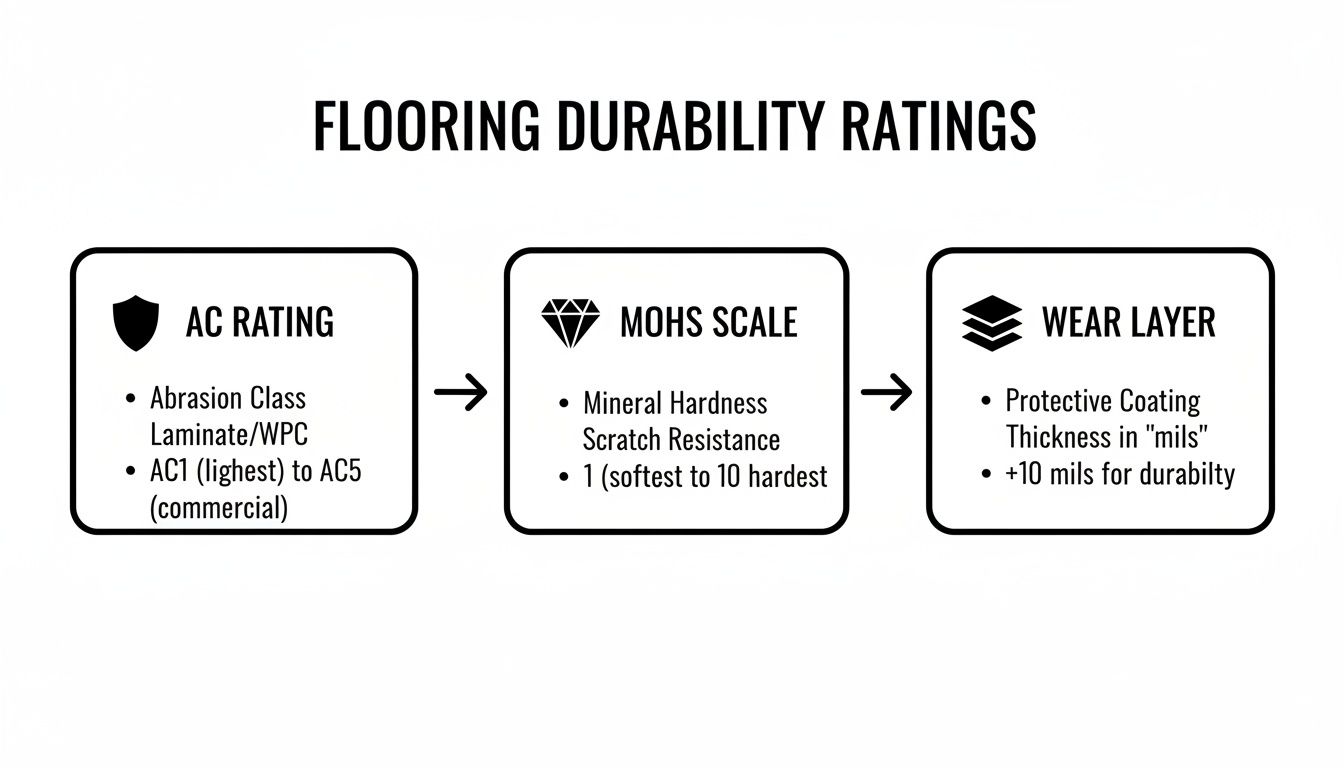
This visual shows how AC Ratings, the Mohs Scale, and Wear Layer thickness all work together to define a floor's ability to handle the rigors of daily life.
So, what's the verdict? If you need a waterproof, highly durable, and comfortable floor for a busy family, LVP is an incredible all-around option. If you’re after that beautiful wood look on a tighter budget, modern laminate delivers amazing value and toughness. And if your top priority is maximum, bulletproof durability, nothing beats the resilience of tile.
Choosing the Best Floor for Your Lifestyle
Knowing the technical ratings is helpful, but let's be honest—what really matters is how a floor holds up in your actual home. The "best" scratch-resistant flooring isn't just the one with the highest AC rating or the thickest wear layer. It’s the one that fits the unique rhythm of your household.
It’s time to move beyond the spec sheets and ask the real questions.
What kind of floor can handle a 70-pound Golden Retriever’s daily "zoomies"? Which surface will survive the constant barrage of dropped toys, spilled juice, and dragged chairs that comes with having young kids? The answer is different for everyone.
Matching the Floor to Your Family’s Footprint
Every home has its own personality and its own set of challenges. A quiet home office has completely different needs than a bustling entryway in a busy Cumming family home. The secret is to take an honest look at your daily life and pick a material built to handle your specific reality.
Let’s break down a few common scenarios:
- Homes with Large, Active Dogs: Your main enemy? Claws. You need a surface that can resist deep gouges. Luxury Vinyl Plank with a 20+ mil wear layer is often the go-to solution, especially with a textured or low-gloss finish that helps hide any minor scuffs. Of course, porcelain tile is practically invincible here—its surface is simply too hard for even the sharpest claws to damage. For a deeper dive, check out our guide to pet-proof flooring.
- Households with Young Children: Kids are a triple threat: dropped toys (impacts), dragged furniture (scuffs), and the inevitable spills (moisture). This is where the all-around toughness of LVP really shines. Its waterproof core and resilient wear layer can handle everything from a knocked-over glass of milk to a toy truck collision.
- High-Traffic Zones: Think about your entryway, mudroom, or that main path from the garage to the kitchen. These areas get hammered with dirt, grit, and nonstop foot traffic. The quartz and granite particles in our local Georgia clay act like sandpaper on softer floors. In these spots, the superior hardness of porcelain tile makes it the undisputed champion.
You Don't Have to Sacrifice Style for Durability
A question we hear all the time in our Forsyth County showroom is, "How do I get the look I want without giving up the durability I desperately need?" The great news is, you no longer have to choose between beauty and brawn.
Modern LVP and laminate can replicate the authentic look of hickory, white oak, or natural slate with stunning realism. You can get that warm, rustic farmhouse aesthetic or a sleek, modern vibe without the maintenance headaches of the real thing.
This blend of style and resilience is exactly why the demand for these floors is skyrocketing. In fact, resilient flooring captured an impressive 31.78% of the market in 2025. Homeowners are actively seeking durable, hard-surface solutions, pushing the industry from USD 106.42 billion in 2026 toward a projected USD 136.18 billion by 2031. Within that category, Stone Plastic Composite (SPC) vinyl is seeing massive growth, thanks to a rigid core that’s fantastic at resisting both scratches and dents.
The best flooring choice is a pragmatic one. It’s about finding that sweet spot where your design vision meets the non-negotiable demands of your daily life.
And remember, for homes with active pets, protecting your space goes beyond the floor. You might also want to look into things like cat scratch couch protectors to keep your furniture safe, too. It’s all part of a holistic approach.
By thinking through these real-world situations, you can confidently narrow down your options and choose a floor that you and your family will love for years to come.
Keeping Your Floors Looking Great: It’s All in the Care
You’ve picked out the perfect durable, scratch resistant floor. That’s a huge first step. But the real secret to keeping it beautiful for years isn’t some complicated, back-breaking chore list. It’s all about building a few smart habits that prevent damage before it ever has a chance to happen.
Think of it as a first line of defense. Even the toughest floors on the market appreciate a little proactive care, and the most effective strategies are usually the simplest ones. These tips work for almost any hard surface and make a world of difference in how your floors hold up over time.
Simple Habits for Daily and Weekly Care
So, what’s the biggest threat to your beautiful new floors? It’s not a dining room chair or a dropped toy. It’s the tiny, gritty bits of sand and dirt that get tracked in on the bottom of shoes. Day after day, this grit acts like fine-grit sandpaper, slowly scuffing the finish and creating a network of micro-scratches.
The good news is that stopping this is easy:
- Doormats are a must: A high-quality mat at every single door leading outside is your best friend. They trap the grit right at the source.
- Put pads on everything: This is non-negotiable. Stick felt or rubber pads on the bottom of all your furniture legs—especially chairs, tables, and sofas that get moved around. This one simple step is the #1 way to prevent those ugly, deep gouges.
- Wipe up spills right away: Even on waterproof floors, cleaning up spills immediately prevents sticky spots that just attract more dirt.
These little things create a powerful shield for your floor’s protective top layer, protecting it from the most common culprits of wear and tear.
Cleaning Tips for Your Specific Floor
Beyond the daily basics, different flooring materials need slightly different approaches to cleaning. Using the wrong cleaner can be a disaster, leaving a dull film behind or even damaging the protective wear layer you paid for.
Take luxury vinyl plank, for example. The North American LVT market, a huge driver of scratch-resistant flooring, hit USD 7,446.08 million in 2024 and is expected to grow by 10.2% annually as renovation booms continue in areas like Cumming. It's a popular choice for a reason, but it needs the right care. You can learn more about how to keep vinyl floors looking new with proper techniques.
For both LVP and laminate, stick to a pH-neutral cleaner. Stay far away from wax-based products or anything that promises a "shine," as they’ll just leave a cloudy residue. And for hardwood? Never, ever use a steam mop—it can force moisture deep into the wood and cause serious damage.
Pro Tip: When you’re not sure what to use, check the manufacturer’s care guide. Using a product they recommend doesn’t just get you the best results; it also protects your warranty.
Fixing Minor Scratches and When to Call for Help
Life happens. Even with the best intentions, a minor scratch might appear. For small dings on LVP, laminate, or engineered wood, you can often find a touch-up or wax repair kit from the manufacturer that will blend the damage in almost seamlessly.
And for those times when your floors just need a deep reset, professional floor cleaning services can bring back that fresh-install look. Ultimately, a simple and consistent maintenance plan is the true secret to making sure your floors look fantastic for their entire lifespan.
So, What's the Right Durable Floor for You?
Choosing the right scratch-resistant floor isn't about finding some mythical "best" material. It’s about finding the one that fits your life—your family, your budget, and the style you're trying to create in your home. We've talked through the technical ratings and compared the big players, but the final call always comes down to what works for you.
The best next step? Get out from behind the screen. Nothing beats seeing how that LVP sample looks in your own hallway or feeling the texture of a premium laminate plank under your feet. This is where the abstract ideas become real, and you can truly picture how it will all come together.
From Research to Reality
Making that final decision with total confidence usually means having a quick chat with someone who lives and breathes this stuff. A seasoned flooring pro can help you sort through those last-minute questions, like confirming you've chosen a tough enough wear layer for the entryway or the right waterproof core for the kitchen.
The real goal here is to find a floor that doesn't just put up with your life—it actually makes it better. You want something that gives you peace of mind and looks great while your family makes memories on it for years.
Getting that kind of personalized advice is priceless. An expert can help you find that sweet spot between looks and practicality, guiding you to a floor that can handle the chaos of pets and kids while perfectly matching your vision for your Cumming home. Seeing the options in person and talking through your specific situation turns what can be a stressful choice into an exciting final step in building a space you absolutely love.
Got Questions About Scratch-Resistant Flooring? We’ve Got Answers.
Even after diving into the details, you probably have a few specific questions swirling around. Let's tackle some of the most common ones we hear from homeowners right here in Cumming and Forsyth County.
What's the Best Flooring for Big Dogs?
If you've got a large, energetic dog, you know their claws can be a floor's worst enemy. While no floor is truly bulletproof, some stand up to the challenge much better than others.
Hands down, our top recommendation for homes with big dogs is Luxury Vinyl Plank (LVP). The secret is in its construction. You'll want to look for an LVP with a seriously thick wear layer—we're talking 20 mils or more. Think of this layer as a heavy-duty screen protector for your floor, shielding the beautiful design underneath from even the most enthusiastic zoomies.
Pro Tip: A textured or low-gloss finish is also your best friend. It does a fantastic job of hiding the minor scuffs and scratches that are just a part of life with pets.
Does "Scratch Resistant" Mean It's Also Waterproof?
That's a great question, and the answer is a firm "not necessarily." These two features don't always go hand-in-hand. It's crucial to check the specific product you're considering, because some floors are great at both, while others excel in only one area.
Here’s a quick rundown of what you can expect:
- Luxury Vinyl Plank (LVP): Yes! LVP is built to be 100% waterproof. Its PVC core just won't swell or warp, making it a perfect fit for kitchens, basements, and bathrooms.
- Porcelain & Ceramic Tile: Absolutely. Tile has been the go-to waterproof option for decades for a reason—water simply can't penetrate it.
- Laminate Flooring: It's more water-resistant than waterproof. Many modern laminates can handle a spill sitting for up to 72 hours, which is impressive. But it’s not invincible; if water seeps into its core, it can still cause damage.
- Hardwood Flooring: Definitely not. Both solid and engineered hardwood are vulnerable to water. They're a beautiful choice, but best kept out of moisture-prone areas like bathrooms.
Can I Actually Fix Scratches if They Happen?
The ability to repair a scratch really depends on the type of flooring and how deep the damage is. The good news is, for many minor issues, you can handle it yourself.
For light scuffs on LVP or laminate, a little bit of cleaner on a cloth can often do the trick. You might be surprised to learn that even a clean tennis ball can buff out some marks! For a deeper gouge, most manufacturers sell color-matched repair kits that do a surprisingly good job of filling and hiding the blemish.
Hardwood is a different story. If you have a very light scratch that's only in the top finish, a specialty polish might be all you need. But for deeper cuts that have dug into the actual wood, you'll likely need to call in a professional for a repair or even a full board replacement to get it looking perfect again.
Ready to find a durable floor that not only stands up to your family's lifestyle but also looks stunning? At Flacks Flooring, we’re all about expert guidance without the sales pressure. Schedule your free in-home consultation today and let us bring the showroom experience right to your door.