
Is your concrete subfloor uneven? Getting a perfectly flat surface is the most important step for a successful Luxury Vinyl Plank (LVP) installation in your Cumming, GA home. LVP is a fantastic choice for North Georgia families, but its long-term beauty and durability depend entirely on that smooth foundation. That's where self-leveling underlayment for LVP comes in. It's the professional’s secret weapon we use at Flacks Flooring to create a flawless canvas, ensuring your new LVP floor looks incredible and lasts for decades.
Ready to get a perfectly flat floor? Schedule Your Free Flooring Consultation Today!
Why a Flawless Subfloor Matters in Cumming
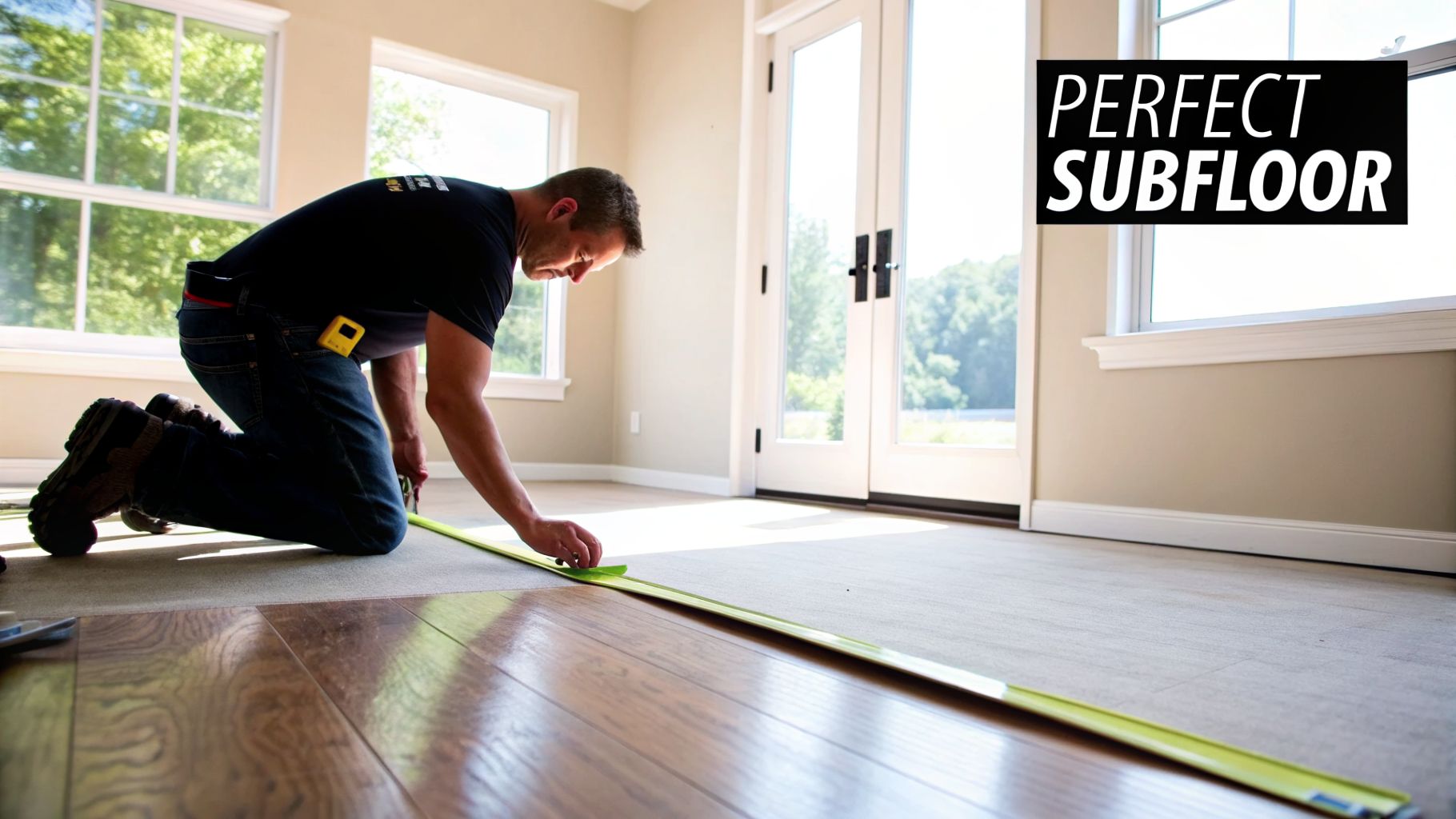
Think of your subfloor as the foundation of your home—if it isn't solid and level, everything you build on it will have problems. After over 30 years of installing floors across Forsyth County, our family has seen it all. From settled concrete slabs in finished basements in Cumming to uneven plywood in older lake homes near Dawsonville, these "minor" issues can spell disaster for a new LVP floor.
The Headaches Caused by an Uneven Subfloor in Cumming Homes
The most common problem we see is called "telegraphing." This is when every little bump, dip, or seam in the subfloor starts to show through the surface of your vinyl planks. LVP is a thin, rigid product, so it eventually conforms to the shape of whatever is beneath it. That small lump of old adhesive or a low spot in the concrete will create a noticeable imperfection, completely ruining the sleek, seamless look you wanted for your North Atlanta home.
Beyond just looks, an uneven subfloor puts constant stress on the LVP's locking mechanisms. When you walk across a plank that isn't fully supported, it flexes. This repeated movement can cause the click-lock joints to weaken, separate, or even break. The result? Annoying gaps, creaks, and a floor that feels flimsy underfoot—especially in high-traffic areas where kids and pets play.
This is exactly why flooring manufacturers have such strict flatness requirements. Most mandate that the subfloor can't have more than a 3/16-inch variation over a 10-foot span. If your subfloor in Cumming, GA doesn't meet that standard, it can void your product warranty, leaving you on the hook for any future repairs.
The flooring industry understands this better than ever. The market for self-leveling compounds was valued at $4.2 billion in 2024 and is projected to hit $7.6 billion by 2033. This massive growth is driven by the need for perfect subfloors to support modern flooring like LVP. For our clients in Cumming, Johns Creek, and Milton, a properly prepared subfloor is the only way to guarantee a beautiful, long-lasting installation. You can read more about trends in the self-leveling market to see just how critical this has become.
Common Subfloor Problems in Forsyth County Homes
In our area, from Alpharetta to Sugar Hill, we see a lot of the same issues pop up. The table below highlights some typical subfloor problems we find in homes around Cumming and Forsyth County and explains how our professional approach prevents them from ruining your new LVP.
Common North Georgia Subfloor Issues and LVP Solutions
| Common Subfloor Problem | Risk to Your LVP Floor | The Flacks Flooring Solution |
|---|---|---|
| Settled Concrete Slabs | Creates low spots, causing planks to flex, separate, and squeak underfoot. Common in basements. | Pouring self-leveling underlayment to create a perfectly flat, monolithic surface for lasting stability. |
| Plywood Seams & Warping | Seams can "telegraph" through, and warped areas from Georgia humidity create unsupported spots. | Feathering seams with a patch compound and using leveler to flatten the entire area before installation. |
| Old Adhesive or Debris | Small bumps and ridges show through the LVP, ruining the smooth finish you paid for. | Scraping and grinding the subfloor clean, removing all debris and that stubborn red clay dust. |
| High/Low Spots ("Birdbaths") | Prevents LVP from locking properly and leads to joint failure and hollow sounds when walked on. | Using a laser level to identify issues and filling low spots with a leveling compound for a perfect plane. |
Properly addressing these issues is the only way to protect your investment and ensure your new LVP floors look and perform their best for years to come.
A flat subfloor isn’t a luxury; it’s a requirement. For homeowners in Alpharetta, Milton, and Canton, investing in proper subfloor preparation is the single best way to guarantee your LVP floor looks stunning and lasts a lifetime.
Here at Flacks Flooring, we know the unique challenges of our North Georgia climate—from humidity affecting foundations to that stubborn red clay tracked in by the family—make professional subfloor prep an absolute must. Whether we're dealing with a concrete slab that needs moisture testing (you can learn more from our guide on how to test concrete for moisture) or a plywood subfloor that needs serious leveling, we never cut corners. We make sure the foundation is perfect before a single plank goes down.
How to Assess Your Subfloor for LVP Readiness
Before laying that first plank of beautiful new LVP in your Cumming home, there's a crucial step that can make or break the entire job: checking the subfloor. You don't need to be a flooring pro to get a good sense of its condition. A simple visual inspection and a long, straight board can tell you a lot about what you're up against.
For homeowners in Alpharetta and Johns Creek, doing this initial check helps you understand what a professional installer from Flacks Flooring is looking for. It's the first move toward a floor that not only looks fantastic but actually performs for years to come.
The Straightedge Test: A Homeowner's First Look
The easiest way to check for flatness is with something long and perfectly straight. An 8- or 10-foot-long straightedge is what we pros use, but a long, straight piece of lumber or even a long level works just fine.
Lay your straightedge across different spots on the floor. Get down low and look for gaps of daylight between the edge and the subfloor. See any? You've found a low spot, or what we call a "birdbath."
Now, try rocking the straightedge back and forth like a seesaw. If it rocks, you've located a high spot. We recommend grabbing a pencil and circling these problem areas right on the subfloor. This helps you map out the overall condition and see where the issues are.
The 3/16" Rule: The industry standard for any LVP installation is a subfloor that's flat to within 3/16 of an inch over a 10-foot span. That's roughly the thickness of two quarters stacked together. This tolerance might seem tiny, but it's absolutely critical for ensuring the LVP planks are fully supported and their locking systems don't flex, creak, or break over time.
Identifying Your Subfloor Type in Forsyth County
The type of subfloor you have often gives us clues about the kinds of problems to expect. Around Forsyth County and neighboring cities like Suwanee and Milton, we mostly run into two kinds of subfloors in local homes:
- Plywood or OSB: This is standard for most multi-story homes and new construction in Cumming. We often see issues like swollen seams from past moisture, boards warping from seasonal humidity changes, or high spots directly over the floor joists.
- Concrete Slabs: Found in basements and on the main level of many North Georgia homes, concrete can settle over the years. This can create surprisingly deep low spots or hairline cracks that must be addressed before LVP can be installed.
Finishing a basement is a hugely popular project here in the North Atlanta area, and getting that concrete slab perfectly level is the most important part of the entire job. A quick DIY check gives you a good starting point, but having a professional from a flooring store near you assess it is the only way to get it right.
Why a Professional Assessment Is Non-Negotiable in Cumming
While your initial inspection is a great first step, it can’t replace a professional evaluation. Our team at Flacks Flooring doesn't just use a straightedge; we use tools like laser levels to map out the entire subfloor with pinpoint accuracy. This lets us find every single high and low spot and calculate exactly how much self-leveling underlayment for LVP is needed to create a perfectly flat plane.
We’ve worked on everything from lake homes near Dawsonville to new builds in Buford, so we're familiar with the unique construction styles and challenges in our area. A professional assessment is your guarantee that the foundation for your new floor is perfect, which protects your warranty and ensures a beautiful, long-lasting result. To dive deeper into how underlayments work, feel free to check out our detailed guide on underlayment for vinyl plank flooring.
The Flacks Flooring Method: Our Process in Cumming, GA
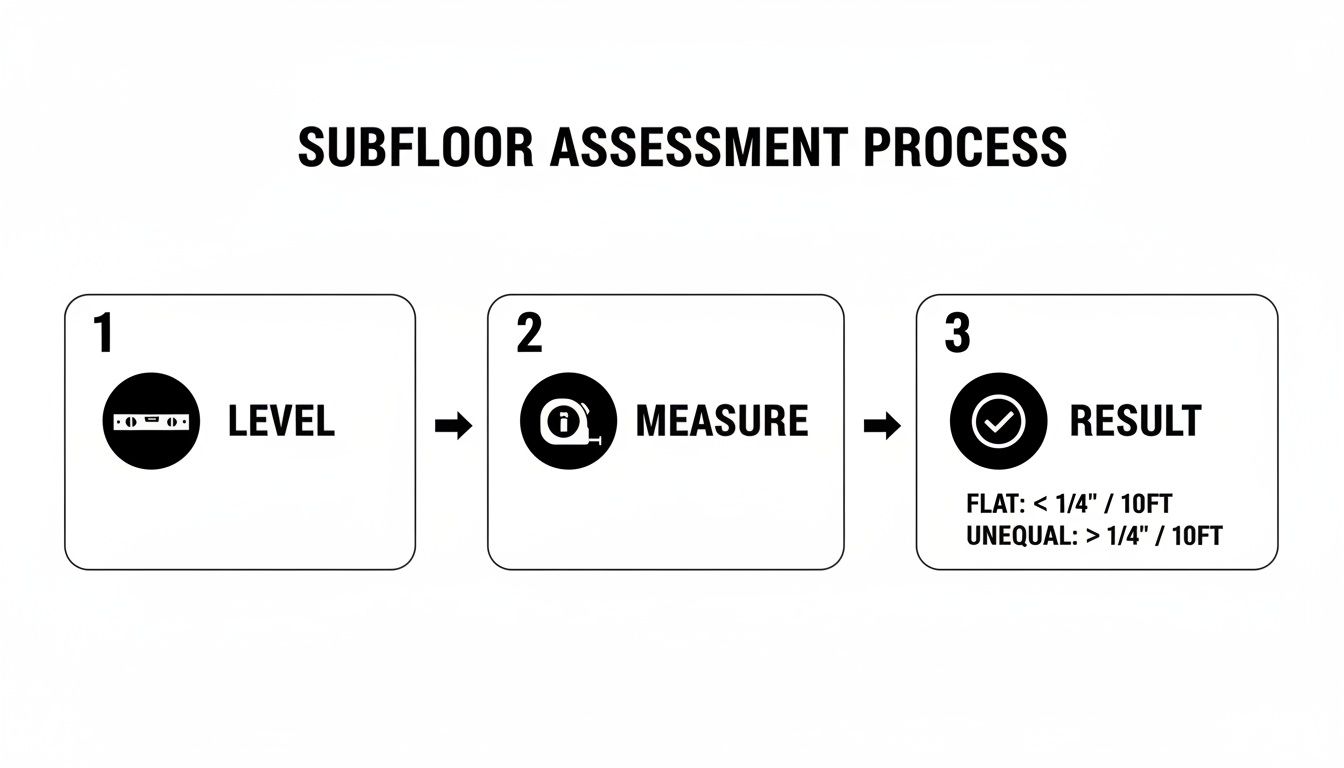
With over 30 years of experience laying floors for families right here in Cumming, we've fine-tuned our subfloor preparation into a science. We want to show you exactly what our professional installers do to build that perfect foundation for your new LVP. This isn't a DIY tutorial—it's an inside look at the meticulous, professional-grade process that ensures your floor performs flawlessly.
This is how we prevent the common headaches and expensive fixes that often come from a rushed or sloppy job done by a big-box installer.
Our Meticulous Subfloor Preparation in Cumming Homes
The very first thing our crew does on site—whether it's a new build in a Forsyth County subdivision or a classic home renovation in Johns Creek—is get to work on the subfloor. This is far more than a quick pass with a broom. We meticulously scrape and grind the entire surface, removing every bit of old adhesive, paint drips, and drywall mud. We’re especially vigilant about the fine dust that settles everywhere, including that stubborn Georgia red clay. A subfloor that isn't absolutely pristine won't create a lasting bond.
Why Priming Is Non-Negotiable
Once the subfloor is perfectly clean, we roll on a high-quality primer. For our team, priming is a non-negotiable step. Think of it like painting a room; you wouldn't just slap paint on a bare wall and expect a smooth finish. The same principle applies to your floors.
Primer serves two crucial purposes:
- It seals the subfloor. Porous surfaces like concrete or plywood can suck the water out of the leveling compound too fast, preventing it from curing properly and leaving it weak.
- It acts as a bonding agent. The primer ensures the subfloor and the new leveler fuse together permanently. Skipping this is asking for delamination, where the new surface eventually peels away.
Precision Mixing and Pouring
Next, we mix the self-leveling underlayment for LVP, and this is where expertise truly matters. Every bag has a precise water ratio. Too much water creates a weak surface; too little, and the mix is too thick to flow. Our installers are trained to nail this consistency every single time.
With the mix ready, we move fast. We pour the compound onto the subfloor, starting at the lowest point. While the product is called "self-leveling," it still needs an expert hand. Our team uses specialized tools like gauge rakes and smoothers to gently guide the material into every corner, ensuring it fills all dips and valleys.
The efficiency is incredible, often cutting installation timelines enough to save 15-20% on labor costs compared to old-school methods. You can explore more about the market for these materials in this self-leveling concrete market report. This methodical process, from assessment to pour, creates a surface as smooth as glass—the only way to guarantee a new LVP floor you'll be proud of for decades in your Cumming home.
To learn more about identifying and addressing these issues, check out our guide on how to level uneven floors.
Common Floor Leveling Mistakes We See in North Georgia Homes
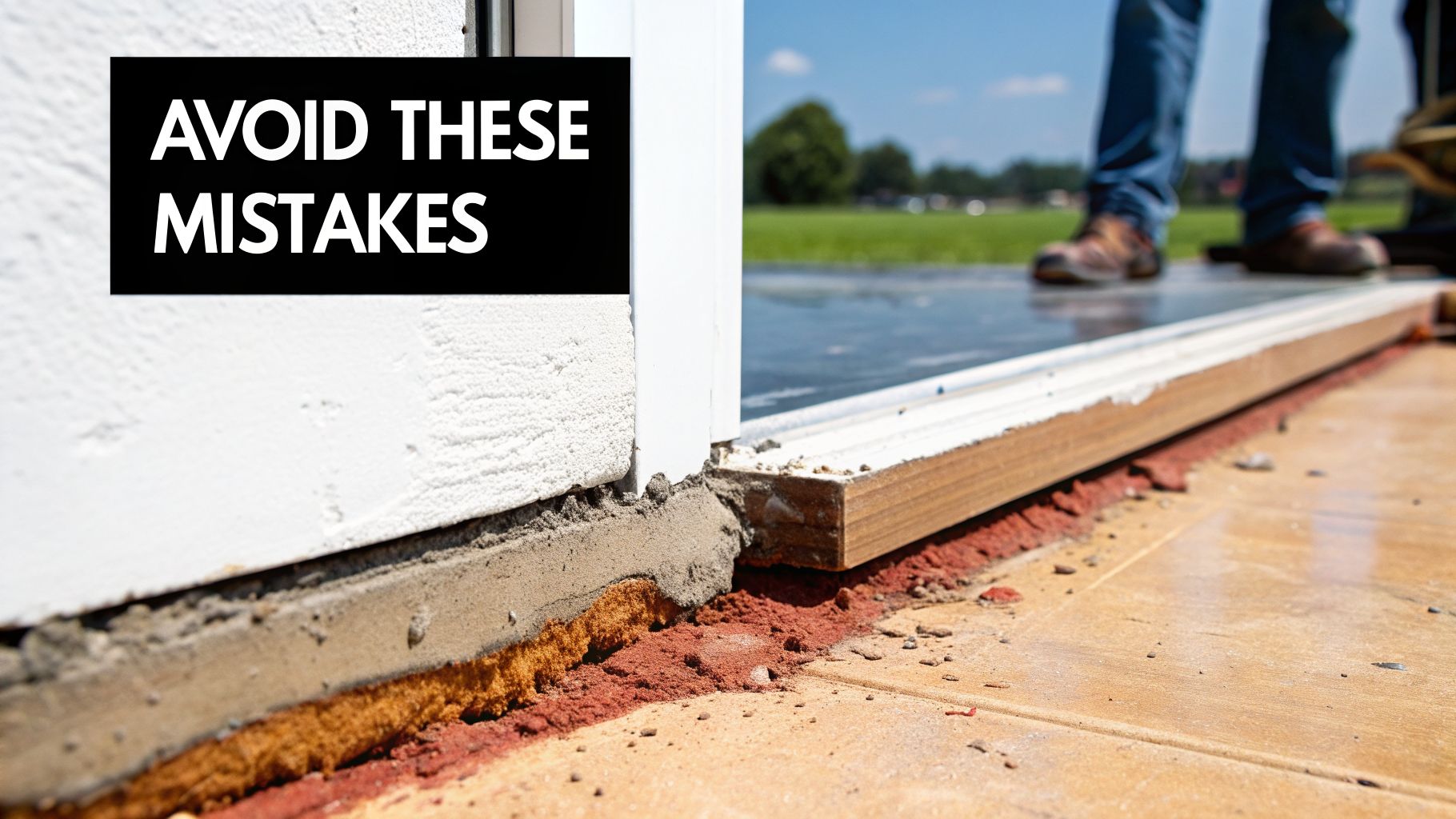
After three decades of installing floors in Cumming and across Forsyth County, we’ve also been called in to fix our fair share of projects gone wrong. More often than not, these issues are the result of DIY attempts or jobs by less-experienced installers who just don't grasp the unique challenges in North Georgia homes. Self-leveling underlayment is an amazing product, but it is far from foolproof. Learning what not to do is just as important as knowing the right steps.
Ignoring the Primer
This is, without a doubt, the number one mistake we see: skipping the primer. It feels like a small step, but it is the most critical part of getting a lasting bond. The primer’s job is to seal the subfloor and create a powerful grip for the leveling compound.
- On porous concrete slabs, common in North Atlanta basements, the primer stops the concrete from sucking water out of the leveling mix too fast. If that happens, the compound becomes weak and crumbly.
- On plywood subfloors, common in two-story homes from Suwanee to Milton, the primer ensures the compound bites into the wood instead of just sitting on top, waiting to delaminate.
Skipping this step guarantees your new surface will eventually lift or crack, taking your expensive LVP with it. It’s a completely avoidable failure.
Starting with a Dirty or Damp Subfloor
You can’t pour a perfectly level floor on a dirty one. Any dust, debris, or old paint left on the subfloor creates a barrier that prevents a proper bond. Here in North Georgia, that fine red clay dust that gets everywhere is a major culprit. A quick sweep won't cut it. The floor needs to be thoroughly scraped and vacuumed.
Pouring leveler over a damp subfloor is just as bad. Any moisture trapped underneath will break down the bond and can lead to mold and mildew, especially with our humid climate. That’s why a professional moisture test is a non-negotiable part of our process in every home, from Canton to Dawsonville.
Incorrect Mixing
Working with a self-leveling underlayment for LVP is a science. Every bag has a very specific water-to-powder ratio that must be followed. There is no room for guesswork.
We often see mix-related failures from jobs in Alpharetta and Johns Creek where someone tried to "eyeball it." The results are always poor, leading to a floor that’s weaker than intended and won't stand up to daily life in an active family home.
Here's what goes wrong when the mix isn't perfect:
- Too much water: The compound flows nicely but becomes weak and brittle once it cures. It won’t have the strength to support furniture and foot traffic.
- Too little water: The mix will be too thick to flow and self-level, leaving you with a lumpy surface that will show right through your new LVP.
Failing to Seal the Perimeter
Self-leveling compound starts as a liquid. If you pour it into a room without plugging all the exits, it will find every single crack and escape. This is a messy, wasteful, and surprisingly common mistake. Before we pour, we use foam sealant or build temporary dams to block off doorways, floor vents, and any gaps along the baseboards. This ensures the material stays exactly where we need it, creating a perfect, contained "pool" that can settle beautifully.
Why Choose Flacks Flooring in Cumming
When you’re looking at new flooring for your home in Cumming, GA, the planks are just the start. The real measure of a great flooring job is trust—trust that the team you hire understands our local homes, the North Georgia climate, and what it really takes to build a floor that lasts. For over 30 years, our family at Flacks Flooring has been earning that trust by doing it right from the very beginning.
For us, that begins with a deep, expert understanding of your subfloor. A beautiful floor is only as strong as its foundation, and we refuse to cut corners on preparation. We treat every home, from a lakeside property near Lake Lanier to a new build in a Buford HOA community, with the exact same meticulous care.
The Flacks Family Difference
Unlike the big-box chains, we’re not just a company located in Forsyth County; this is our community. We've seen firsthand how Georgia humidity can affect a home's foundation and how the local red clay soil can cause subtle shifts over the years. This isn't just something we read in a manual—it's practical, hands-on experience from thousands of installations in Cumming, Alpharetta, Johns Creek, and the surrounding areas. Our goal is to listen, properly assess your home's unique situation, and then install a beautiful, durable floor that your family will enjoy for decades.
"When we decided to finish our basement, we were worried about the uneven concrete. The team from Flacks didn't just cover it up; they took the time to perfectly level the entire floor before installing the LVP. The result is flawless. We couldn't be happier and recommend them to all our neighbors."
– A satisfied homeowner in Cumming, GA
Comparing Flacks Flooring with Big Box Chains
When you're investing in new flooring, it’s crucial to know who you’re really working with. Here’s the value of choosing a local, family-owned expert over a large chain for your flooring project in the North Atlanta area.
| Feature | Flacks Flooring (Your Cumming Expert) | Big Box Stores |
|---|---|---|
| Subfloor Prep | Meticulous, expert-led preparation using self-leveling underlayment is standard. We know North Georgia homes. | Often subcontracted out; prep quality can vary widely, and corners may be cut to save time. |
| Expertise | 30+ years of family-owned, local experience in Forsyth County. We are flooring specialists. | Staff may have general knowledge but often lack deep, specialized flooring expertise. |
| Accountability | You work directly with us from the free consultation in our Cumming showroom to the final walkthrough. | Your project may be passed between a salesperson, a project coordinator, and an unknown installation crew. |
| Process | A transparent, customer-first approach focused on long-term durability and satisfaction. | Often focused on volume and sales quotas, with less emphasis on personalized project details. |
Our commitment has always been to true craftsmanship. Whether your home is a new build in a Suwanee HOA community or a classic house in Milton, we make sure the foundation for your self leveling underlayment for LVP is absolutely perfect.
Ready to see the difference a local expert makes? Stop by our Cumming showroom or schedule your free, no-pressure flooring consultation with our family today.
FAQ: Self-Leveling Underlayment in Cumming, GA
As a family-owned flooring store in Cumming for over 30 years, we get a lot of questions about subfloor prep. Here are straightforward answers to what homeowners in Forsyth County ask us most about using self leveling underlayment for LVP.
Q: Is self-leveler really necessary for LVP in Cumming, GA?
A: In most cases, yes. While a brand-new construction home might be flat, many homes in Cumming and Forsyth County have settled, creating low spots. LVP requires a subfloor flat to within 3/16” over 10 feet. Anything more can void your warranty and cause plank joints to fail. We always check and will only recommend it if it’s needed to protect your investment.
Q: How much does self-leveling underlayment cost near me?
A: Professional installation in the Cumming and North Atlanta area typically costs between $2 and $5 per square foot. The final price depends on how uneven your subfloor is. A minor skim coat in an Alpharetta home will be on the lower end, while leveling significant dips in an older Canton basement will cost more due to material and labor. We provide a precise, all-inclusive quote after a free in-home assessment.
Q: How long does self-leveling underlayment take to dry?
A: One of the best parts is how fast it dries. The professional-grade compounds we use are typically ready for light foot traffic in just 2 to 4 hours. This minimizes disruption in your home. We can almost always begin installing your new LVP floor within 12 to 24 hours, which keeps your project on schedule, whether you're in Cumming or Johns Creek.
Q: Can you pour self-leveler over my old tile floor?
A: Yes, this is a great solution we often use in homes from Johns Creek to Suwanee. As long as the existing tile is stable and not loose, we can prime it with a special bonding agent and pour the leveler right over top. This fills in all the grout lines and creates a perfectly smooth surface for your new LVP, saving you the mess and cost of demolition.
Q: Does self-leveling underlayment waterproof my basement?
A: No, this is a critical point for our North Georgia climate. While the underlayment is water-resistant, it is not a waterproofing product. It will not stop moisture from coming up through a concrete slab. For basements in Cumming or any slab-on-grade room, we install a dedicated moisture barrier first, then pour the leveler on top. This is the only way to protect your floor from humidity damage.
Ready to make sure your new LVP floor is built on the perfect foundation? The team at Flacks Flooring has the local know-how and commitment to quality to get your project done right. Swing by our Cumming showroom or give us a call to schedule your free, no-pressure consultation today.