
When you picture a classic wood floor, you’re likely thinking of solid hardwood. Each plank is exactly what it sounds like: a single, solid piece of wood, milled directly from a harvested tree. There are no layers, no composites—just authentic timber through and through.
This pure, simple construction is the secret to its centuries-long legacy in homes, bringing a level of character and durability that’s hard to replicate.
What Exactly Is Solid Hardwood?
Think of a solid hardwood plank as a slice of nature itself. It’s a continuous piece of premium lumber, typically ¾-inch thick, crafted to stand the test of time. This honest-to-goodness structure is its biggest advantage, giving it an authentic feel that other flooring types can only mimic.
It’s no surprise that homeowners and builders continue to value it so highly. The global hardwood flooring market was valued at around USD 51.38 billion, a testament to its enduring appeal. People consistently choose solid wood for its unmatched beauty and legendary toughness, especially in projects where quality is the top priority. For a deeper dive into market trends, you can check out this detailed analysis from the IMARC Group on the hardwood flooring market.
This simple construction delivers some serious benefits:
- It’s Built to Last: That thick wear layer isn’t just for show. It allows the floor to be sanded and refinished multiple times over its life, literally erasing years of scratches, dents, and wear.
- One-of-a-Kind Beauty: The natural grain patterns, knots, and subtle color variations ensure that no two planks are ever identical. This creates a floor with unique character and warmth.
- A Solid Investment: A real hardwood floor is a huge selling point for homebuyers and can significantly increase a property’s resale value.
From a Log to Your Living Room
The journey from tree to floorboard is a fascinating one. The way the log is cut at the mill has a massive impact on both the plank’s stability and the visual beauty of its grain. For instance, exploring techniques like understanding what quarter sawn lumber is reveals how milling can produce stronger, more stable boards with a distinctive, straight grain pattern.
At its core, solid hardwood flooring is an investment in authenticity. It’s a flooring choice that doesn’t just get installed; it becomes an integral part of your home’s story, aging gracefully and gaining character over the years.
This guide will walk you through everything you need to know—from picking the right wood species and getting a handle on the real costs to installation and long-term care. We’ll help you see it not just as a purchase, but as a lasting addition to your home that you’ll appreciate for decades to come.
Choosing the Right Type of Solid Hardwood
Picking the perfect solid hardwood flooring isn’t just a construction choice; it’s like selecting a signature piece of furniture for your home. It needs to reflect your personal style, handle the chaos of everyday life, and ideally, look even better as the years go by. The options might seem overwhelming at first, but it all comes down to two big decisions: the species of wood and the type of finish.
Let’s start with the heart of the matter—the wood itself. Every species has a unique personality, from its color and grain to its ability to stand up to wear and tear. This is where the Janka Hardness Scale becomes your best friend. It’s a straightforward industry standard that measures how well a wood species resists denting. Simply put, a higher Janka number means a tougher floor.
Understanding Wood Species and Hardness
Think of the Janka scale as a toughness rating for wood. If your home is a bustling hub of activity with kids, pets, and constant foot traffic, you’ll want to lean towards a harder wood like Hickory or White Oak. Their high Janka scores mean they’re built to withstand dropped pans and scooted chairs without showing every little mark.
Softer woods, on the other hand, like American Walnut or Cherry, offer an incredible depth of color and sophisticated grain patterns. These are fantastic for lower-traffic spaces like a formal dining room or a quiet bedroom where their luxurious look can really shine. They just require a little more mindfulness to keep them looking their best.
To dive deeper into the world of wood grains and colors, check out our comprehensive guide to hardwood species to compare all your options side-by-side.
Key Takeaway: The golden rule is to match the wood’s hardness to your family’s lifestyle. Busy, high-traffic zones need a durable species with a high Janka rating. For quieter rooms where aesthetics are the top priority, a softer, more elegant wood can be a breathtaking choice.
This simple decision tree can help you visualize the first steps in your selection process.
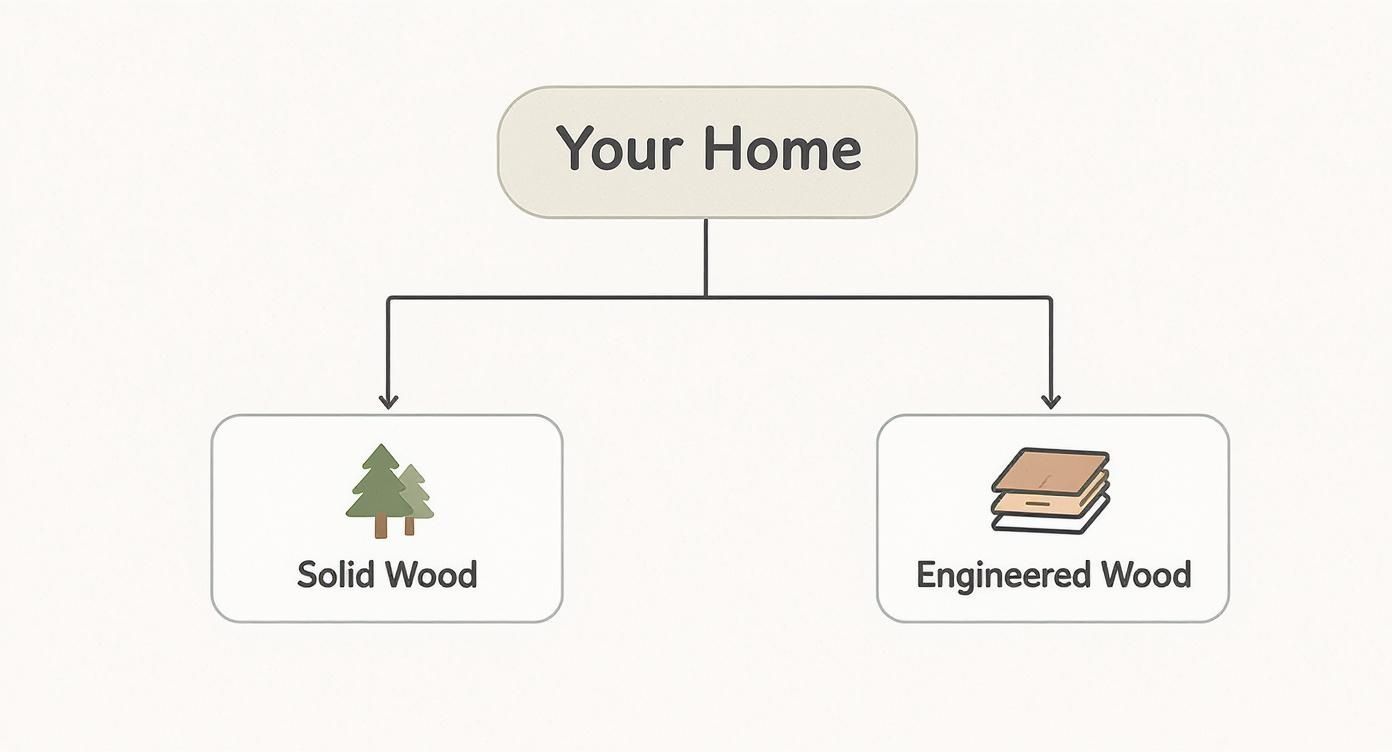
As the infographic shows, the very first fork in the road is often deciding between classic solid wood and its versatile cousin, engineered hardwood.
To make the species selection a bit easier, here’s a quick comparison of some of the most popular choices we see homeowners gravitate towards.
Comparing Popular Solid Hardwood Species
| Wood Species | Janka Hardness Rating (Approx.) | Typical Grain Pattern | Common Color Tones | Best For |
|---|---|---|---|---|
| Red Oak | 1290 | Pronounced, swirling grain | Light reddish-pink to warm amber | High-traffic areas, traditional homes |
| White Oak | 1360 | Straighter, finer grain than Red Oak | Light brown, gray, and golden hues | Versatile; modern and rustic styles |
| Hickory | 1820 | Dramatic color variation, bold grain | Creamy whites to dark reddish-browns | Busy households, rustic/farmhouse decor |
| Maple | 1450 | Subtle, fine grain | Creamy white with a slight golden tint | Contemporary, minimalist spaces |
| American Walnut | 1010 | Wavy, complex grain with burls | Rich, dark chocolate browns with purples | Low-traffic luxury areas, bedrooms |
This table gives you a snapshot, but seeing and feeling the wood in person is always the best way to find your perfect match.
Pre-Finished vs Site-Finished Hardwood
After you’ve landed on a species, the next choice is about the finish. This decision really shapes the installation process, the final appearance, and how the floor wears over time.
- Pre-Finished Hardwood: This is the modern, convenient route. The planks are sanded, stained, and sealed with an extremely durable, factory-applied coating before they ever arrive at your home. The biggest pros? Installation is fast, clean, and fume-free. You can walk on your new floors almost immediately. Plus, those factory-cured aluminum oxide finishes are often tougher than anything that can be applied in a home.
- Site-Finished (Unfinished) Hardwood: This is the classic, old-school method. We install raw wood planks first, then sand the entire surface perfectly smooth on-site. After that, we apply the custom stain color of your choice and seal it all with multiple coats of polyurethane. The payoff is total control over the color and a seamless, uniform surface without the beveled edges often found on pre-finished boards.
So, which path is for you? If you need your room back in action quickly and want the toughest finish available, pre-finished is the way to go. But if you’re chasing a very specific custom color or matching existing floors for a perfectly flat, uninterrupted look, site-finished offers unparalleled creative freedom.
Why Solid Hardwood Is a Lasting Investment
When you’re picking out new flooring, you’re not just making a design choice—you’re making a significant financial one. Lots of floors look fantastic right after they’re installed, but solid hardwood is in a league of its own. It’s not just a surface covering; it’s a true capital improvement to your home. Think of it as an investment that pays you back, not only with its timeless beauty but with real, long-term value that few other features can match.
So, what makes it such a premium choice that truly stands the test of time? It’s about so much more than just good looks. The real magic is in its construction and the unique benefits that come from it. Let’s break down the tangible advantages that make solid hardwood such a smart, lasting investment.
The Power of Longevity and Refinishing
The single biggest selling point for solid hardwood is its incredible lifespan. It’s better to think of it as a permanent part of your home’s structure rather than just a floor covering. Unlike laminate or vinyl that you have to rip out and replace once they look worn, solid hardwood can be brought back to life over and over again.
This is all thanks to its thickness. A standard ¾-inch plank has a substantial wear layer above the tongue and groove. This layer can be sanded down to erase decades of scratches, dents, and everyday wear and tear. Once it’s sanded smooth, a fresh coat of stain and finish makes it look brand new, all without the cost and hassle of a full replacement.
A typical solid hardwood floor can be professionally sanded and refinished 5 to 7 times over its life. This unique feature means a well-maintained floor can easily last for over 100 years, becoming a beautiful, multi-generational part of your home’s story.
This isn’t just a hypothetical benefit; it saves you real money in the long run. Instead of buying new floors every 15-20 years, you just refresh the one you have for a fraction of the price.
Boosting Your Home’s Resale Value
When it’s time to sell your home, certain features really make a property pop. Year after year, solid hardwood floors are at the top of homebuyers’ wish lists. It’s more than just a preference; it’s a feature people actively look for and are willing to pay a premium to get.
On average, installing hardwood floors can give you a Return on Investment (ROI) of 70-80%. That’s a figure that leaves most other flooring types in the dust. For potential buyers, it immediately signals quality and durability, making your home more attractive and helping it sell faster.
- Perceived Quality: Solid wood gives off an immediate impression of luxury and well-built construction.
- Move-In Ready Appeal: Buyers see a floor they won’t have to worry about replacing anytime soon, which means less future expense for them.
- Timeless Aesthetic: The classic look of hardwood appeals to almost everyone, making your home more marketable to a wider audience.
In short, putting money into solid hardwood is like making a direct deposit into your home’s equity. It’s a feature that actually appreciates right along with your property.
A Healthier Home Environment
Your home should be a healthy, comfortable sanctuary, and your flooring plays a surprisingly big role in that. One of the less-talked-about—but hugely important—benefits of solid hardwood is how it improves your indoor air quality.
Unlike carpet, which can become a haven for allergens, solid hardwood has a hard, non-porous surface. This means it doesn’t trap nasty particles like:
- Dust mites
- Pollen
- Pet dander
- Mold spores
These common irritants have nowhere to hide and are easily swept or vacuumed away. For families with allergies, asthma, or other respiratory issues, this can make a massive difference in their daily comfort. It literally helps you build a cleaner, healthier living space from the ground up.
Imagine a floor that doesn’t just wear out but ages gracefully, collecting memories right alongside your family. That’s the real story of solid hardwood—a choice that delivers value, beauty, and peace of mind for generations.
A Realistic Look at Flooring Costs
It’s easy to get swept away by the timeless beauty of solid hardwood, but for most of us, the conversation really starts with the budget. Figuring out the total cost isn’t about finding a single price tag; it’s about piecing together the full financial picture. Think of it less like a purchase and more like a capital improvement—a true investment in your home.
Your final number will always be a mix of three key things: the wood itself, the hands-on labor to install it, and the minimal upkeep needed to keep it looking fantastic for decades. By looking at each component, you can build a budget that makes sense and truly appreciate the lasting value you’re adding to your space.
Breaking Down the Material Costs
The first, and often most significant, piece of the puzzle is the cost of the wood. The price per square foot can swing pretty dramatically, and it all comes down to a few key factors. It’s a lot like car shopping—a reliable family sedan and a high-end European sports car will both get you where you need to go, but their price points are worlds apart for very different reasons.
The same idea applies here. Classic domestic woods like Red Oak are usually on the more affordable end of the spectrum because they’re readily available. On the other hand, if you’ve got your heart set on an exotic species like Brazilian Walnut or a particularly rare cut, you can expect the price to reflect its unique look and limited supply.
Here’s what really drives the material costs:
- Wood Species: As mentioned, staples like oak and maple are budget-friendly choices. Woods like cherry, walnut, and exotic imports sit at the premium end.
- Plank Width and Thickness: Wider planks (think 5 inches or more) are hugely popular right now, but they typically cost more than traditional 2-3 inch strips. This is because they require larger, more pristine cuts of lumber.
- Finish Type: Pre-finished hardwood might seem pricier upfront, but that cost is often balanced out by lower labor fees during installation since the finishing work is already done.
- Grade of Wood: Wood is graded by its appearance. “Clear” grade is the most expensive because it’s uniform with very few knots. “Select” and “Common” grades have more of the wood’s natural character and variations, making them more accessible options.
Factoring in Professional Installation
Once you’ve chosen your perfect wood, the next big line item is installation. It might be tempting to go the DIY route to save a few bucks, but installing solid hardwood requires a level of precision that really calls for a professional. It’s a worthwhile investment to protect your beautiful new materials and guarantee a flawless finish that will last a lifetime.
When you’re trying to budget, it’s helpful to see how flooring fits into the larger scope of home expenses by understanding the true cost of building a home.
Installation pricing isn’t a simple, flat fee. A straightforward, square room is going to cost less than a tricky layout full of angles, closets, and staircases. If you want to dive deeper into what goes into the labor side of the equation, our guide on hardwood flooring installation costs breaks it all down.
Considering Long-Term Value and Upkeep
Finally, let’s zoom out and look beyond the initial invoice. One of the most incredible things about solid hardwood is its ability to be refinished over and over again. This means that in 15 or 20 years, you won’t be tearing out your floors and starting from scratch. Instead, you can have them professionally sanded and refinished for a fraction of the cost of a full replacement.
That “reset button” is what makes solid hardwood such a smart long-term play. Yes, the upfront cost is higher than for materials like carpet or laminate, but its potential century-long lifespan means the cost-per-year of ownership is incredibly low. You’re not just buying a floor covering; you’re investing in a permanent feature that adds real, tangible value to your home and breaks the endless cycle of replacement.
Installation and Long-Term Care for Your Floors
Protecting your investment in solid hardwood flooring is a process. It starts long before the final plank is laid and continues for the life of your home. It’s about a combination of careful prep work and a simple, consistent maintenance routine.
This isn’t just about nailing boards to a subfloor. It’s about respecting the fact that wood is a natural material that breathes and responds to its environment. When you understand that, you can ensure your floors perform flawlessly for decades to come.
The Critical First Step: Acclimation
Before a single nail goes in, your new hardwood planks need to get used to their new home. We call this crucial process acclimation. Think of it like letting a new plant adjust to the sunlight in your living room before you repot it—the wood needs time to adapt to your home’s unique temperature and humidity.
Skipping this step is one of the biggest mistakes you can make. Wood naturally expands and contracts with moisture changes in the air. If you install boards fresh off the truck, they might shrink or swell dramatically once they settle into your home’s climate, creating ugly gaps or buckling.
The standard advice is to let the wood sit inside the room where it will be installed for at least 72 hours (3 days). Sometimes, it might even need a full week. This simple waiting game is your best defense against movement-related problems down the road.
The goal is to let the wood’s moisture content find its equilibrium with your home’s environment. A little patience here pays off with a stable, beautiful floor that fits together perfectly.
Professional Installation for a Perfect Finish
While the DIY bug can be tempting, installing solid hardwood is a true craft that demands precision, experience, and specialized tools. A flawless result is about much more than just keeping the lines straight; it’s about subfloor prep, layout planning, and knowing exactly how to fasten the boards.
Professional installers are trained to handle the tricky situations that can pop up, making sure your investment is protected from day one.
- Subfloor Assessment: They’ll check that your subfloor is clean, dry, and perfectly level—the non-negotiable foundation for a lasting installation.
- Expansion Gaps: Experts know to leave small expansion gaps along the walls (hidden by baseboards) so the floor can “breathe” as the seasons change.
- The Right Tools and Technique: Using a proper flooring nailer and the correct technique prevents damage to the tongue-and-groove system, ensuring every board fits together tightly and seamlessly.
Honestly, investing in a pro installation is almost always the smartest move. It guarantees the longevity of your floor, keeps your warranty intact, and ensures the stunning final product you envisioned.
Creating a Simple Maintenance Routine
Once your floor is installed, taking care of it is refreshingly simple. It’s not about intense labor, but about consistent, gentle cleaning. The goal is just to prevent the buildup of tiny, abrasive particles that can slowly dull the finish.
Start by sweeping with a soft-bristle broom or vacuuming (with a soft floor attachment) every day or two. This removes the grit and dust that act like sandpaper underfoot. For a deeper clean once a week, use a microfiber mop that’s just lightly dampened with a pH-neutral cleaner made specifically for hardwood floors.
What to Avoid at All Costs
Knowing what not to do is just as important. Some common cleaning methods can cause serious, irreversible damage to your floor’s protective finish, leading to expensive repairs.
Steer clear of these:
- Never Use a Steam Mop: The mix of intense heat and moisture can strip the finish and force water deep into the wood grain, causing warping and ugly discoloration.
- Avoid Harsh Chemicals: Cleaners with ammonia, vinegar, wax, or oil-based soaps are a no-go. They can leave a dull film behind or eat away at the polyurethane finish.
- Don’t Let Spills Sit: Always wipe up spills immediately with a soft, dry cloth. This stops moisture from seeping between the boards and causing damage.
Over time, you might notice a few squeaks as your home settles. That’s totally normal and often an easy fix. For anyone curious, you can learn more about how to fix squeaky hardwood floors with a few clever techniques. Proper care will keep your floors looking pristine for years, ensuring they remain a stunning centerpiece of your home.
Common Questions About Solid Hardwood
Making a big decision like choosing new flooring always comes with a few last-minute questions, and that’s perfectly normal. Solid hardwood is a significant investment in your home, so you want to be absolutely sure it’s the right call for your family and lifestyle.
We get asked these questions all the time, so we’ve put together some straight-to-the-point answers to clear up any confusion and help you feel confident about your choice.
Can I Put Solid Hardwood in My Kitchen or Bathroom?
This is probably the number one question we hear, and the answer isn’t a simple yes or no.
For a full bathroom—one with a shower or a tub—the answer is a hard no. The constant humidity, steam, and splashes create an environment that’s just too much for solid wood. It will inevitably lead to warping, cupping, and problems you just don’t want to deal with.
Kitchens, on the other hand, are more of a gray area. A lot of people love the seamless flow of wood running straight into the kitchen, and it can look beautiful. But it comes with a catch: you have to be vigilant. Spills need to be wiped up immediately. A few drops from the sink or a melting ice cube left for too long can easily stain or damage the wood.
If you love the look but worry about the upkeep, there are fantastic alternatives for these trickier spots:
- Engineered Hardwood: Its layered construction makes it much more stable and resistant to the temperature and humidity swings common in a kitchen.
- Luxury Vinyl Plank (LVP): This stuff is 100% waterproof. You get a convincing wood look without any of the moisture worries.
So, while you can install solid hardwood in a kitchen, it demands a level of constant care that might not be practical for a busy household.
How Many Times Can Solid Hardwood Be Refinished?
Here’s where solid hardwood really proves its worth over the long haul. Its ability to be sanded down and refinished again and again is what makes it a true lifetime floor.
A standard ¾-inch thick solid hardwood plank can be professionally sanded and refinished 5 to 7 times. Each time, a whisper-thin layer of wood is removed from the surface, completely erasing years of scratches, dings, and dullness. It’s like getting a brand-new floor without the tear-out.
This incredible longevity means a well-cared-for solid hardwood floor can easily last for over 100 years. Instead of replacing your floors every 15-20 years, you just refresh them. It’s an investment that pays for itself over and over again.
The exact number of refinishes depends on the wood’s original thickness and the depth of any damage, but its lifespan is second to none.
What Is the Janka Hardness Scale and Why Does It Matter?
Think of the Janka hardness scale as a toughness rating for wood. It’s a standardized test that measures how much force it takes to press a small steel ball into a piece of wood. The result is a number that tells you how well that particular species will stand up to dents and daily wear.
A higher Janka number means the wood is harder and more durable—a crucial detail if you have kids, large pets, or just a lot of foot traffic. It helps you pick a wood that can handle your life.
Here’s a quick breakdown with some popular examples:
- Tough Stuff (High Janka): Species like Hickory (1820) and Brazilian Cherry (2350) are incredibly hard. They’re fantastic for high-traffic zones like entryways, hallways, and family rooms.
- The Gold Standard (Medium Janka): Red Oak, with a rating of 1290, is the benchmark for the industry. It offers a great mix of durability and value, making it a perfect fit for most homes.
- Softer and Subtler (Low Janka): Woods like American Walnut (1010) are gorgeous but softer. They are best saved for lower-traffic areas where they won’t take as much of a beating, like a formal dining room or a bedroom.
Using the Janka scale is just a smart way to match the wood’s natural durability to the demands of a specific room.
Is Solid Hardwood an Eco-Friendly Choice?
Absolutely. When sourced correctly, solid hardwood is one of the most sustainable flooring options you can choose. Wood is a natural, renewable resource—trees are replanted, and forests can be managed responsibly to ensure they thrive for generations to come.
The key is to look for wood that’s certified. The gold standard is the Forest Stewardship Council (FSC) certification. When you see the FSC label, it’s a guarantee that your flooring came from a forest managed with the highest environmental and social standards.
Don’t forget, the incredible lifespan of hardwood is a huge part of its green story. A floor that can last for a century or more doesn’t end up in a landfill every couple of decades like carpet or vinyl. This reduces waste and conserves the energy and resources needed to manufacture new flooring, making it a genuinely sustainable choice for the long term.
At Flacks Flooring, we believe an informed decision is the best decision. If you have more questions or are ready to explore the timeless beauty of solid hardwood for your home in Cumming, Johns Creek, or Milton, our experts are here to help. Visit our showroom or schedule a consultation today to find the perfect flooring solution for your needs. Learn more at https://flacksflooring.com.