
A lot of homeowners find this article the same day they notice a floor that looks wrong. The hardwood feels raised under your sock. The laminate near the basement wall looks swollen. The carpet by the utility room feels damp, and you're hoping it's nothing.
In North Metro Atlanta, it usually isn't nothing. In Cumming, Johns Creek, Milton, and nearby parts of Forsyth County, floor problems often start with storms, basement moisture, appliance leaks, or slow plumbing failures that stay hidden under finished flooring. A water damage floor can go from inconvenient to expensive fast, but the first moves matter more than is often understood.
The good news is that not every wet floor means a full replacement. Some floors can be dried, repaired, or partially rebuilt if the damage is caught early and handled the right way. Others need to come out before the subfloor and framing get worse. The key is knowing which situation you're in.
What To Do Immediately After Discovering a Water Damaged Floor
The first hour is about control. Not repair. Not product selection. Just stopping the spread and protecting the structure underneath.
Water damage affects about 14,000 U.S. households daily, and claims happen in 1 out of every 60 insured homes annually. Even a minor appliance issue soaking carpet can cost $1,600, while 1 inch of water in a small home can push damage past $11,000, according to water damage statistics compiled by iPropertyManagement. That's why speed matters.
Your first 60 minutes
Cut power if water is near outlets or appliances
If water is close to floor plugs, extension cords, refrigerators, washing machines, or baseboard outlets, turn off power to that area before stepping in. If you can't do that safely, stop and call for help.Stop the water source
Shut off the nearest fixture valve if it's a sink, toilet, dishwasher, or ice maker line. If you can't identify the source quickly, shut off the main water supply. If the leak appears to be from plumbing and you need a practical example of how pros trace valve and leak issues, this guide on Las Vegas water leak repair shows the kind of source-first troubleshooting that applies anywhere.Move furniture and rugs off the wet area
Lift items. Don't drag them. Dragging can scratch a softened finish or tear wet carpet fibers. Put foil, blocks, or plastic under furniture legs if you can't move larger pieces right away.Remove standing water with what you already have
Use towels, a wet vacuum, a mop, or absorbent cloths. Start where the water is deepest, then work outward. On hardwood, don't let puddles sit while you gather better equipment.Get air moving immediately
Turn on ceiling fans, box fans, and your HVAC if conditions allow. Open windows only if outdoor humidity is lower than indoor air. In Georgia, that isn't always the case, especially after rain.
What not to do
- Don't ignore the edges of the room. Water often runs under baseboards and below visible flooring.
- Don't assume the floor is fine because the surface looks dry.
- Don't use heat aggressively on hardwood or laminate. Fast, uneven drying can make the surface distort more.
Practical rule: If water came from above, remove it fast. If water came from below or through the slab, assume there's hidden moisture until testing proves otherwise.
If the smell is musty, the floor feels soft, or the water keeps returning, treat it as more than a surface cleanup.
How to Assess the Severity of Floor Water Damage
After the immediate cleanup, the next job is diagnosis. A flooring contractor looks at three things first. What kind of water got in, how long it sat there, and what material took the hit.
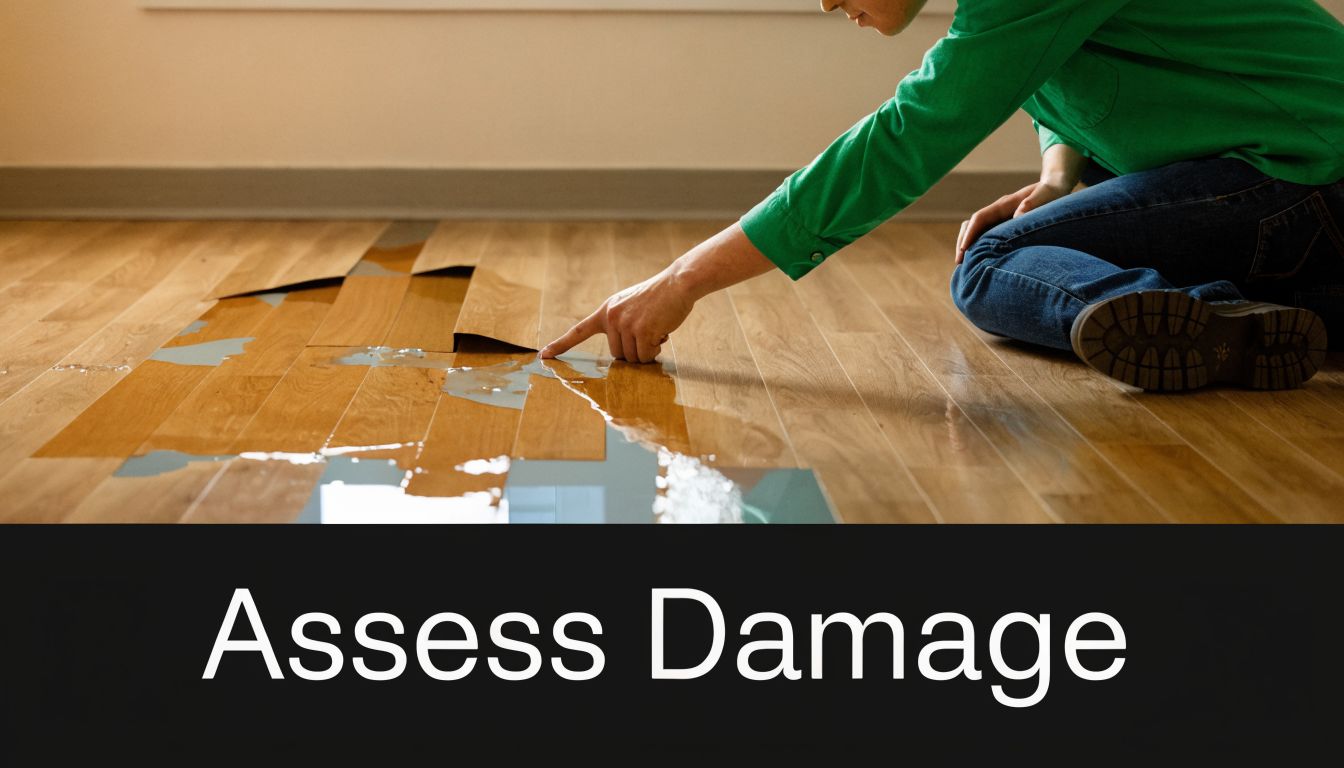
Start with the source
Clean water from a supply line or sink overflow is different from water that came through a basement wall, backed up from a drain, or sat long enough to turn dirty. The more contaminated the source, the less reasonable a DIY save becomes, especially with carpet and pad.
Then look at time. A floor that got wet and was dried promptly may be repairable. A floor that stayed damp underneath for days often has a different story, even if the top layer doesn't look dramatic yet.
Read the floor like a pro
Different materials signal damage in different ways:
- Hardwood cupping means the board edges rise higher than the center.
- Buckling means boards lift away from the subfloor.
- Laminate delamination means the layers start separating, often with swollen seams or bubbled surfaces.
- Carpet saturation often shows up as odor, discoloration, and a damp cushion underneath.
- Tile problems are usually less about the tile face and more about moisture reaching grout lines, underlayment, or adjacent rooms.
In Georgia's humid conditions, hidden moisture is the primary danger. In humid climates like Georgia, where average humidity exceeds 70%, untreated subfloor water damage can reduce wood framing strength by up to 50% within a year due to rot. The same source notes that 68% of hidden subfloor issues in the Southeast lead to joist failure if not properly addressed with moisture meters, according to Advanced DRI's review of hidden water damage areas.
Surface dryness can fool homeowners. A board can feel normal on top while the subfloor underneath is still carrying moisture.
Signs that push this into professional territory
Use this quick triage list:
- Soft or spongy feel underfoot means the problem may be below the finish floor.
- A musty odor usually means moisture stayed trapped too long.
- Dark staining or seam swelling points to water absorption, not just a surface spill.
- Repeated dampness in the same zone often means the source was never fixed.
- Changes near exterior walls or basement areas can indicate slab or drainage pressure, not plumbing.
If your hardwood has started lifting, what causes hardwood floors to buckle is worth reading because buckling often tells you the issue has moved beyond a simple wipe-up.
A simple way to think about severity
Think like a doctor checking a patient.
- Minor case: limited wet area, known clean source, quick cleanup, no visible distortion.
- Moderate case: visible swelling, odor, or repeated dampness, but damage appears contained.
- Serious case: contaminated water, basement seepage, structural softness, or flooring that has lifted, bubbled, or separated.
The last category is where homeowners lose time by waiting.
A Homeowner's Guide to Repairing Different Flooring Types
Not all water damage floor problems behave the same way. Hardwood can sometimes be saved. Laminate usually gives you less room for error. Tile may survive while the layers below it don't. That's why the repair plan should match the material, not just the stain or puddle you can see.
In areas like Forsyth County, hydrostatic pressure from saturated soil is a primary cause of water seeping through concrete slab floors in basements. That pressure can force water through micro-cracks and cause laminate and engineered wood cores to swell up to 300%, leading to bubbling and failure within 48 hours, according to Angi's explanation of water seeping through floors. Pre-install moisture testing is one of the most important steps in avoiding repeat failures.
Water damage effects by flooring type
| Flooring Type | Common Water Damage Signs | Repair Potential | Likely Solution |
|---|---|---|---|
| Hardwood | Cupping, staining, lifted edges, soft spots | Moderate, depends on source and how fast drying began | Drying, board replacement, sanding and refinishing, or full replacement |
| Engineered wood | Surface ripple, seam lift, plank movement | Limited to moderate | Partial replacement or full replacement if core is compromised |
| Laminate | Swollen seams, bubbling, edge lift, soft feel | Low | Replace affected planks, often with larger section replacement |
| LVP | Water under planks, shifting, trapped moisture odor | Moderate to high if material itself is intact | Remove, dry subfloor, reinstall or replace affected sections |
| Carpet | Damp pad, odor, staining, tack strip issues | Low to moderate | Pad replacement, drying, cleaning, or full replacement |
| Tile | Loose tiles, cracked grout, damp underlayment | Moderate to high | Regrout, reset tile, dry substrate, repair underlayment |
Hardwood and engineered wood
Hardwood gives you the most salvage potential if the water was clean and the floor was dried correctly. What matters is whether the boards only changed shape temporarily or whether the wood fibers and subfloor stayed wet long enough to deform permanently.
A common mistake is sanding too soon. If the wood hasn't stabilized, sanding can lock in problems or create an uneven floor. In some homes, the right approach is controlled drying first, then replacing isolated boards, then refinishing once moisture readings are acceptable. If you're comparing repair options, this guide on how to fix warped wood floor explains the signs that separate cosmetic warping from deeper failure.
For broader restoration context, a specialist resource on professional wood restoration in Los Angeles is useful because the wood behavior itself is similar even if the climate differs.
Laminate and LVP
Laminate is one of the least forgiving materials after a leak. Once the core swells, it rarely returns to its original shape. Homeowners often hope the floor will flatten after drying, but laminate usually tells the truth early. If seams are raised and edges are frayed, replacement is typically more realistic than repair.
LVP is different. The plank itself can handle water much better, but that doesn't mean the whole assembly is safe. Water can still sit underneath, soak the underlayment, and affect the subfloor. In basements around Cumming and Milton, this is a common issue after storm-driven seepage.
If the plank survived but the substrate didn't, the job is still a floor repair job, not just a cleanup job.
Carpet and tile
Carpet can sometimes be cleaned and dried after a small clean-water event, especially if action was quick. Once the pad stays wet or the odor turns musty, replacement becomes the safer path. The visible carpet may not be the primary issue. The wet cushion underneath often is.
Tile usually survives the best on the surface. But if grout cracked, tiles loosened, or water got into the backer or adjacent wood areas, the repair can spread wider than expected. Tile is durable. Assemblies under tile are not always as durable.
What works and what usually doesn't
Usually works
- Fast extraction
- Controlled drying
- Moisture testing before repairs
- Selective board or plank replacement when damage is localized
Usually doesn't
- Waiting to “see if it dries out”
- Installing new flooring over a damp subfloor
- Reusing laminate with swollen edges
- Treating basement seepage like a one-time accident
DIY Repair vs Calling a Professional in Cumming GA
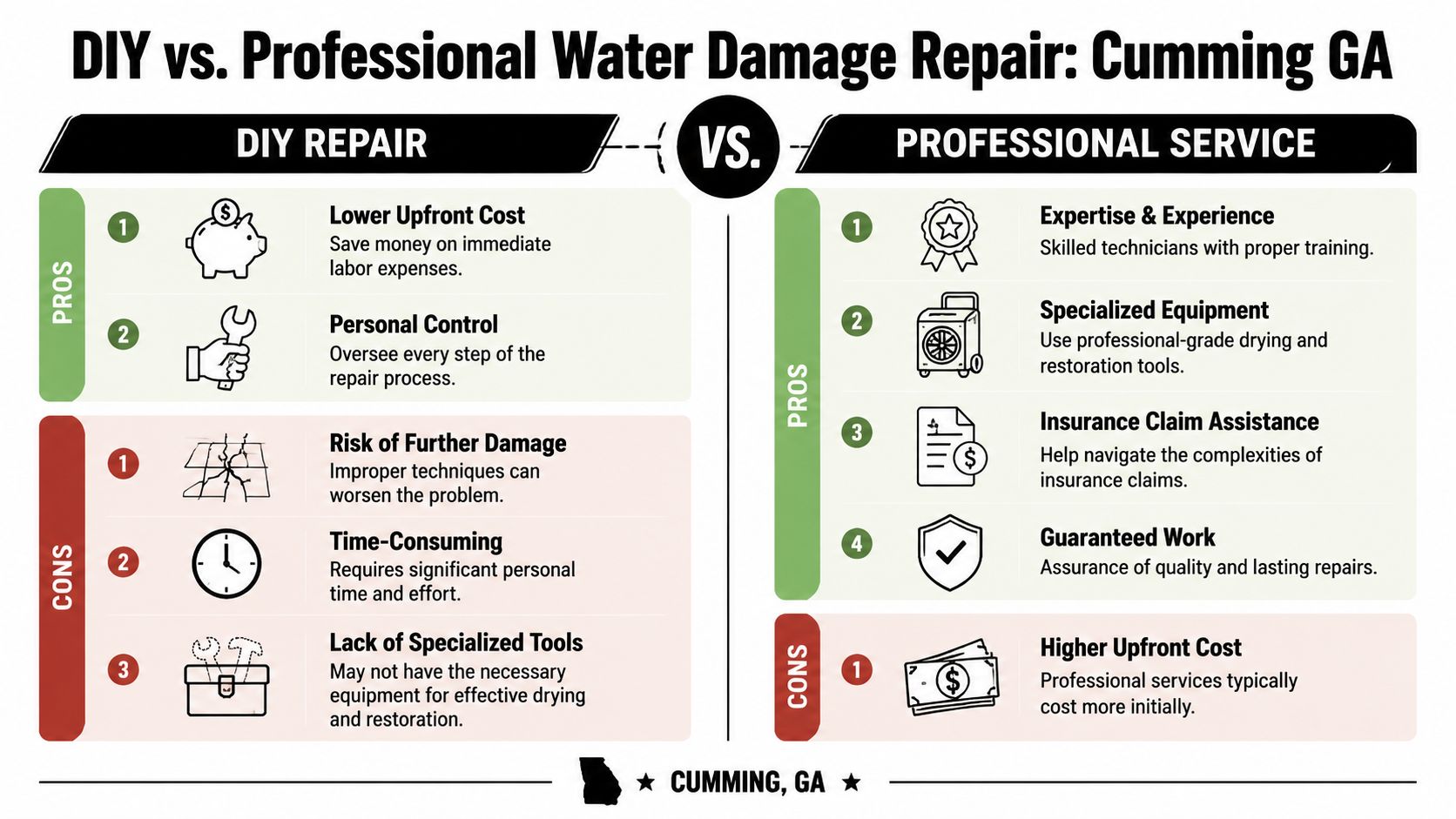
Some water damage floor situations are reasonable for a homeowner to handle. Many aren't. The hard part is that the risky ones often look manageable on day one.
When DIY makes sense
DIY can work if the water stayed on the surface, the source was clean, and the affected flooring is forgiving.
A few examples:
- A small spill on tile that didn't reach adjacent wood or underlayment
- A pet water bowl overflow on LVP caught quickly and dried underneath after removing trim where needed
- A minor appliance drip where you can confirm the subfloor is dry and there's no odor, swelling, or softness
For those situations, a homeowner can often extract water, improve airflow, watch for movement, and keep the area under observation.
When calling a pro is the smart move
The moment you have uncertainty about the subfloor, contamination, repeated water entry, or material distortion, the job changes.
Call a professional when:
- Hardwood is cupping or buckling
- Laminate seams are swelling
- The same area keeps getting damp
- Basement flooring is involved
- The floor feels soft
- You smell mustiness
- Water came from a drain backup, outdoor intrusion, or unknown source
Professional help protects you from the expensive second job. One option in Cumming is Flacks Flooring, which handles flooring assessment, replacement planning, and waterproof flooring options after the source issue is addressed. The value isn't just installation. It's matching the replacement strategy to the cause so the problem doesn't return under the new floor.
The real trade-off
DIY usually lowers the immediate bill. It also increases the chance that moisture stays trapped where you can't see it.
Professional assessment costs more upfront, but it changes the quality of the decision. A pro can pull transition strips, check edge movement, test suspect sections, and tell you whether you're dealing with surface damage or structural moisture.
Decision shortcut: If you need to ask whether the subfloor is wet, you're already at the point where testing matters more than guessing.
A practical standard for North Georgia homes
In Cumming, Johns Creek, and Milton, I'd be cautious with any floor near a basement wall, slab edge, laundry room, or older plumbing line. Those are the jobs that fool people. The top looks recoverable. The base layer is where the trouble sits.
DIY is fine for small, clean, obvious incidents. Once the source is hidden or the floor shape changes, professional evaluation is usually the cheaper choice in the long run.
Understanding Repair Costs and Homeowners Insurance
Most homeowners ask two questions right away. “How bad is this going to cost me?” and “Will insurance cover it?” The honest answer is that both depend on documentation, source, and scope more than on the visible stain.
Just 1 inch of water can cause up to $25,000 in damage, and water damage plus freezing ranks as the second most common homeowners insurance claim, with average payouts between $13,954 and $15,400, according to Wagner Meters' review of moisture-related flooring losses. That same source notes a 15% rise in claim denials for undocumented hidden damage, which is why evidence matters so much.
What drives repair cost
The biggest cost factors are usually straightforward:
Flooring type
Hardwood restoration is a different scope than replacing carpet pad or reinstalling LVP.How far the water spread
A localized leak near one wall is different from moisture that reached the subfloor across multiple rooms.Subfloor involvement
Once the damage reaches the layers underneath, labor and drying complexity rise.Source of water
Clean supply-line water is treated differently than contaminated water.Matching and availability
A repair gets harder when the original product is discontinued or faded by age and sun exposure.
How to document a claim the right way
If there's any chance you'll file, start documenting before cleanup changes the scene too much.
Use this checklist:
- Take wide photos first that show the full room
- Then take close-ups of seams, buckling, stains, swollen edges, and wet contents
- Record video while narrating where the leak started and where water traveled
- Save damaged materials if an adjuster may need to inspect them
- Write down a timeline of when you found the problem, when water was stopped, and what steps you took
- Keep receipts for emergency mitigation, fans, temporary lodging if applicable, and contractor visits
Timestamped photos are especially important when hidden moisture becomes visible later.
What insurance often misses
Floor claims get complicated when the visible material is only part of the loss. An adjuster may focus on the damaged planks or carpet and overlook the moisture that moved into the underlayment, baseboards, or subfloor.
That's why vague wording hurts homeowners. If you're speaking with your carrier, describe the issue plainly:
- visible floor damage
- suspected subfloor saturation
- moisture migration under finished flooring
- damage from a sudden leak versus long-term neglect, if that applies
A weak claim file often starts with poor photos and a cleanup that removed the proof before anyone documented it.
Common claim mistakes
Waiting too long
Delays make it easier for insurers to question when the damage happened.
Only photographing the obvious area
Wide and close images both matter.
Throwing away damaged pieces too early
Keep samples when possible until the claim is clear.
Using vague language
“Wet floor” is less useful than “hardwood boards lifted at seams after supply line leak.”
A clean, organized claim file gives you a better chance of getting paid for the full scope, not just the part that was easiest to see.
Choosing Waterproof and Water-Resistant Flooring for Prevention
Once a homeowner has dealt with a water damage floor, the next conversation usually changes. It's no longer just about replacing what failed. It's about choosing something that fits the way the house lives.
In North Metro Atlanta, that means thinking about basements, storm seasons, pets, heavy traffic, and humidity. The right flooring in a Roswell kitchen isn't always the right flooring in a finished basement in Cumming or a pet-heavy family room in Johns Creek.
Where waterproof flooring makes the most sense
If the room has a history of moisture risk, I lean toward materials that reduce panic when life happens.
Best fit for high-risk spaces
- LVP flooring for basements, laundry rooms, mudrooms, and busy main levels
- Tile flooring for bathrooms, entries, and spaces where direct water exposure is most likely
- Waterproof flooring systems where the surface and the installation method both support moisture control
For homeowners comparing options, this guide to waterproof flooring gives a useful overview of where these products perform best.
Waterproof versus water-resistant
These terms get mixed up all the time.
Waterproof flooring is built to tolerate water exposure without the plank or tile itself being ruined easily. Water-resistant flooring can handle minor moisture for a while, but it still has limits.
That distinction matters in real homes:
- In a Canton basement, waterproof is usually the safer call.
- In an Alpharetta living room, a water-resistant hardwood product may be fine if moisture risk is lower and aesthetics matter more.
- In a Marietta home with dogs, scratch resistance and easy cleanup may matter as much as water performance.
Matching flooring to household needs
A good replacement choice solves more than one problem.
For pets and high traffic
LVP is often a practical answer because it handles claws, bowls, muddy paws, and routine cleanup well. It also fits homeowners searching for pet-friendly flooring, scratch-resistant flooring, and affordable flooring options without forcing a purely utilitarian look.
For classic style
Hardwood still has a place. In lower-risk rooms, properly selected and installed hardwood gives a warm, timeless result that many homeowners still prefer over any printed plank. The key is not putting it where repeat moisture is likely.
For basements and slab homes
Tile and quality waterproof LVP are usually the most forgiving. In these areas, the installation details matter as much as the product itself. A beautiful floor over a damp slab is still a bad assembly.
The best prevention plan isn't “buy the toughest floor.” It's “put the right floor in the right room over a properly prepared base.”
What works in North Metro Atlanta homes
Homes in Woodstock, Acworth, Alpharetta, Canton, Roswell, Marietta, Cumming, and Johns Creek all have different layouts, but the pattern is familiar. Moisture-prone rooms reward practical choices. Dry, lower-risk rooms leave more space for style-first decisions.
If you're replacing after damage, ask these questions before picking a product:
- Did the water come from above, below, or both?
- Is this room on a slab, over a basement, or above another living area?
- Are pets, kids, or heavy foot traffic part of daily use?
- Do you want the floor to be repairable, replaceable, or low-stress?
That's how you choose a floor that solves tomorrow's problem, not just today's.
Your Floor Water Damage Questions Answered
Can my water-damaged hardwood floor be saved?
Sometimes, yes. If the source was clean, the affected area was limited, and drying started quickly, hardwood can often be dried, evaluated, and in some cases repaired with board replacement and refinishing. If boards have lifted badly, the subfloor is wet, or staining and odor are present, replacement becomes more likely.
How long does it take for mold concerns to become serious?
It doesn't take long once moisture is trapped under flooring. The exact timeline depends on airflow, humidity, material type, and how much water got below the surface. What matters most is this. If the floor still smells damp or the subfloor hasn't been verified dry, the risk is active.
What policy wording should I look for?
Look for language about sudden and accidental discharge, exclusions related to long-term seepage, and any limits involving hidden or repeated leakage. Also look closely at whether the policy addresses only the damaged material or also related tear-out, drying, and access work.
Can laminate ever be repaired after water damage?
Minor edge issues from a brief event may allow isolated plank replacement if matching material is available. Once the core swells, bubbles, or softens, laminate usually doesn't recover well.
What's the biggest mistake homeowners make?
Waiting for the floor to “settle down” on its own. That delay often turns a manageable flooring repair into a larger subfloor and insurance problem.
If your home in Cumming, Johns Creek, Milton, or nearby Forsyth County has a water damage floor issue, Flacks Flooring can help you sort out what's salvageable, what needs replacement, and which waterproof or water-resistant options make sense for your space. A calm assessment early usually saves money, stress, and a second round of repairs later.