
At its heart, laminate flooring isn't one single material. It's a clever, multi-layered synthetic product, with each layer fused together to create a durable, stable, and great-looking floor. Think of it as a composite sandwich of four distinct layers, each with a specific job to do.
Breaking Down the Layers of Laminate Flooring
The best way to understand laminate is to picture it like a carefully constructed layer cake. Each layer brings something unique to the table, and when they're all combined through a high-pressure lamination process, the result is a product that's far tougher and more versatile than any single component could be on its own.
This layered design is precisely how laminate can look so much like real hardwood or stone while standing up to the chaos of everyday life. Let’s peel back those layers and see what makes it all work.
The Four Essential Components
Every piece of laminate flooring, no matter the brand or style, is built from the same fundamental four-part structure.
- The Wear Layer: This is the invisible shield on top. It’s a tough, clear finish made of melamine or aluminum oxide that protects the floor from scratches, stains, and fading from sunlight.
- The Decorative Layer: Right below that protective shield is a high-resolution photograph. This is what gives the floor its look, realistically mimicking everything from the rich grain of oak to the cool veining of marble.
- The Core Layer: This is the backbone of the plank. It's almost always made from high-density fiberboard (HDF)—a material created by compressing recycled wood fibers with resin. This dense core is what gives the plank its stability and impact resistance. The global production of HDF for flooring is massive, exceeding 10 million cubic meters in 2023 alone. You can find more insights about the laminate flooring market and its materials online.
- The Backing Layer: The very bottom layer provides support and a crucial barrier against moisture. Usually reinforced with melamine, this layer keeps the plank from warping or bowing, ensuring your floor stays flat and stable for years.
Key Takeaway: Laminate flooring is a true engineered product. Its strength and beauty don't come from a single material but from the synergy between a tough wear layer, a high-definition design, a rigid HDF core, and a stabilizing backing.
To help you visualize how these parts come together, here's a quick summary.
Quick Guide to Laminate Flooring Layers
| Layer Name | Primary Material | Key Function |
|---|---|---|
| Wear Layer | Aluminum Oxide or Melamine | Protects against scratches, stains, and UV fading. |
| Decorative Layer | High-Resolution Photographic Film | Provides the visual appearance (wood, stone, etc.). |
| Core Layer | High-Density Fiberboard (HDF) | Creates structural stability and impact resistance. |
| Backing Layer | Melamine-Infused Paper | Prevents warping and provides foundational support. |
This table neatly breaks down how each component contributes to the final product's performance and longevity.
This diagram offers a great visual breakdown of how each layer stacks up to create a single, durable plank.
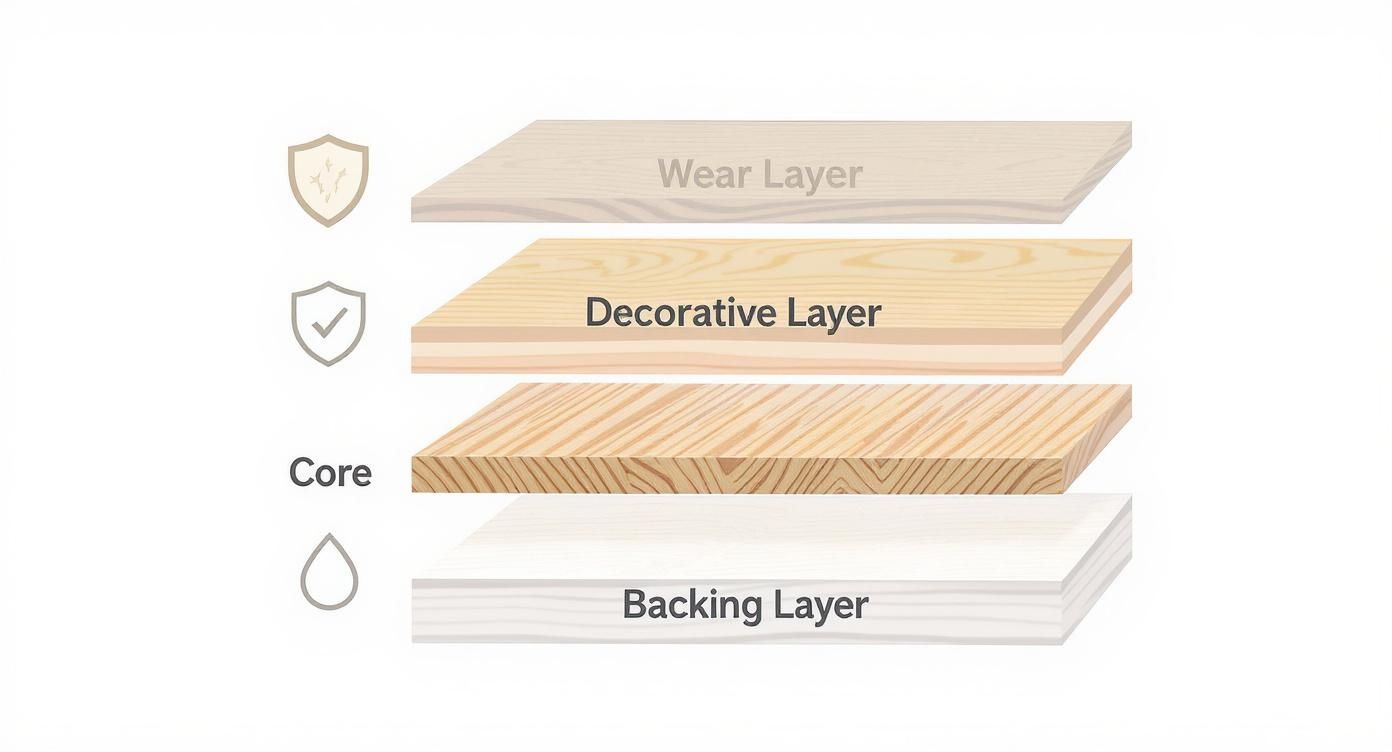
As you can see, the core layer makes up the bulk of the plank's thickness, which really underscores its importance for the floor's overall strength and durability.
Exploring the Core Materials in Each Layer
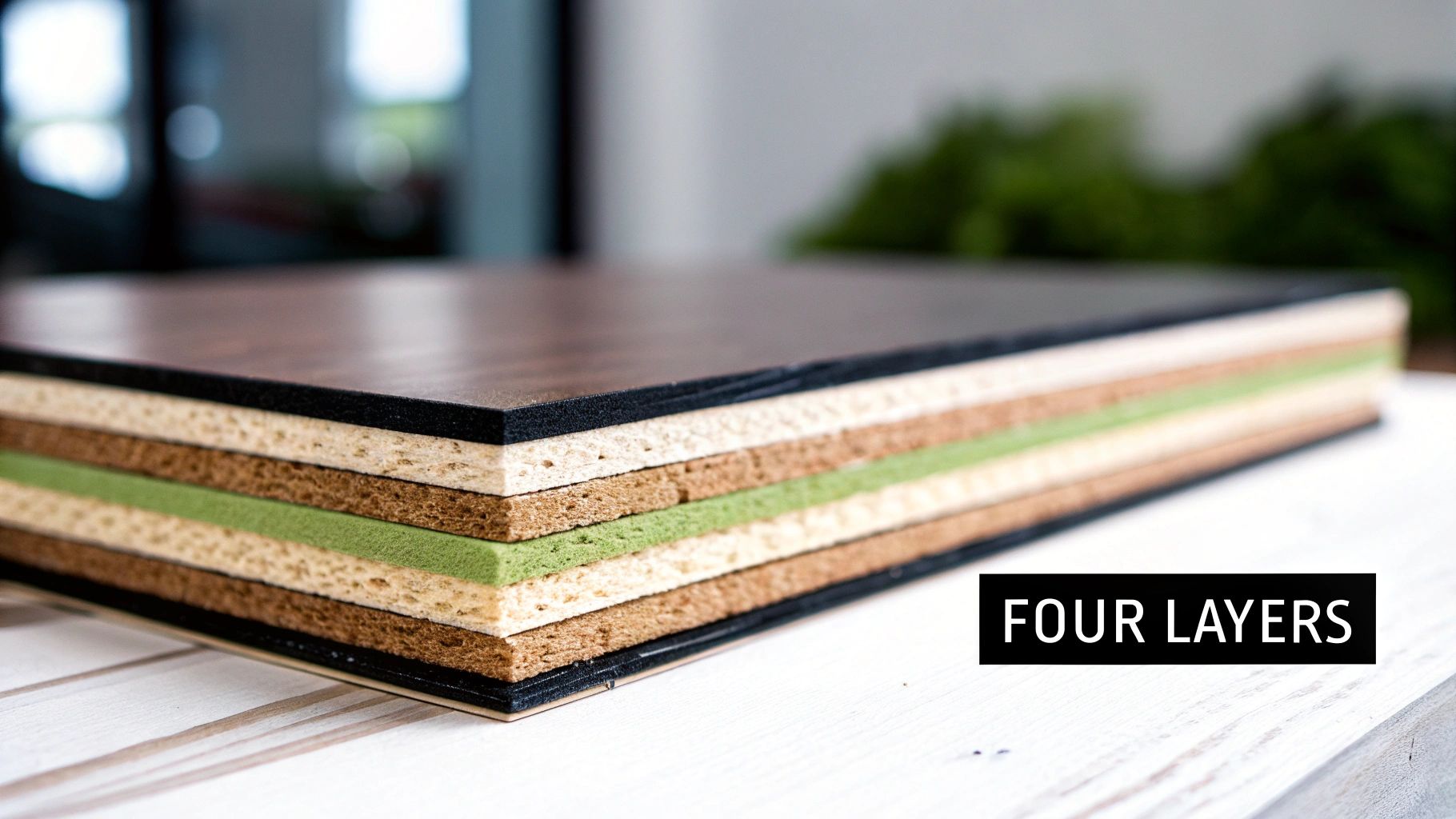
Knowing about the four-layer structure is a good start, but the real secret to laminate's performance lies in what those layers are actually made of. The specific ingredients determine everything from how well it resists scratches to the solid feel it has under your feet.
Let's take a closer look at the raw materials that give each layer its unique job.
The Clear Shield of the Wear Layer
Think of the wear layer as your floor's invisible bodyguard. It’s a transparent topcoat that takes all the daily abuse, protecting the beautiful design underneath. This layer is usually a powerful combination of melamine resin and aluminum oxide particles.
Melamine is essentially a liquid plastic that, when cured with heat, becomes incredibly hard and tough. To really crank up the durability, manufacturers mix in microscopic flecks of aluminum oxide—one of the hardest minerals on earth. This potent duo creates a shield that stands up remarkably well to scuffs, stains, and scratches.
This infusion of aluminum oxide is a big deal. It’s what gives quality laminate the guts to handle constant foot traffic, dropped keys, and even the nails of your family pets without showing every little mark.
This hardened, non-porous surface is also why laminate is so famously easy to clean. Spills just bead up on top instead of soaking in, making cleanup a simple wipe-down affair.
The Wood and Stone Beneath the Core
The core is the heart of a laminate plank—it's the thickest layer and provides all the structural integrity. In almost every case, this is made from High-Density Fiberboard (HDF), which gives the plank its rigidity, stability, and resistance to impacts.
HDF is an engineered wood product made by breaking down recycled wood fibers (think sawdust and wood chips) and fusing them back together with a strong resin under intense heat and pressure. The result is a board that's far denser and more stable than a natural piece of wood could ever be.
So, why is HDF the go-to material for laminate cores?
- Superior Density: HDF is much denser than its more common cousin, Medium-Density Fiberboard (MDF). With a density often over 50 pounds per cubic foot, it’s much better at resisting dents from heavy furniture or a dropped can of soup.
- Moisture Resistance: Because it's so compressed and full of resin, HDF has a built-in resistance to swelling or warping from humidity—a huge plus in a climate like we have here in North Georgia.
- Precision Machining: HDF's uniform consistency is perfect for milling the complex tongue-and-groove locking systems. It allows for incredibly precise cuts, which is why the planks click together so tightly and seamlessly during installation.
The Foundation of the Backing Layer
Last but not least, the backing layer is the unsung hero that keeps the whole plank balanced and stable. It’s what prevents your floor from warping over its lifetime. This bottom layer is typically made from paper or wood fibers that have been treated with melamine resin.
This melamine treatment does two critical things. First, it acts as a moisture barrier, protecting the HDF core from any dampness wicking up from the subfloor. Second, it provides "balancing pressure." During manufacturing, all the force applied to the top layers has to be countered from below. This melamine-infused backer provides that opposing force, which keeps the plank from bowing or cupping over time and ensures it lays perfectly flat once installed.
How a Laminate Plank Is Made
Ever wonder how a few simple materials like wood fibers and paper are transformed into a plank that can withstand years of foot traffic? The process is a fascinating blend of brute force and incredible precision. It’s what turns a simple four-layer sandwich into the durable, beautiful flooring we recognize.
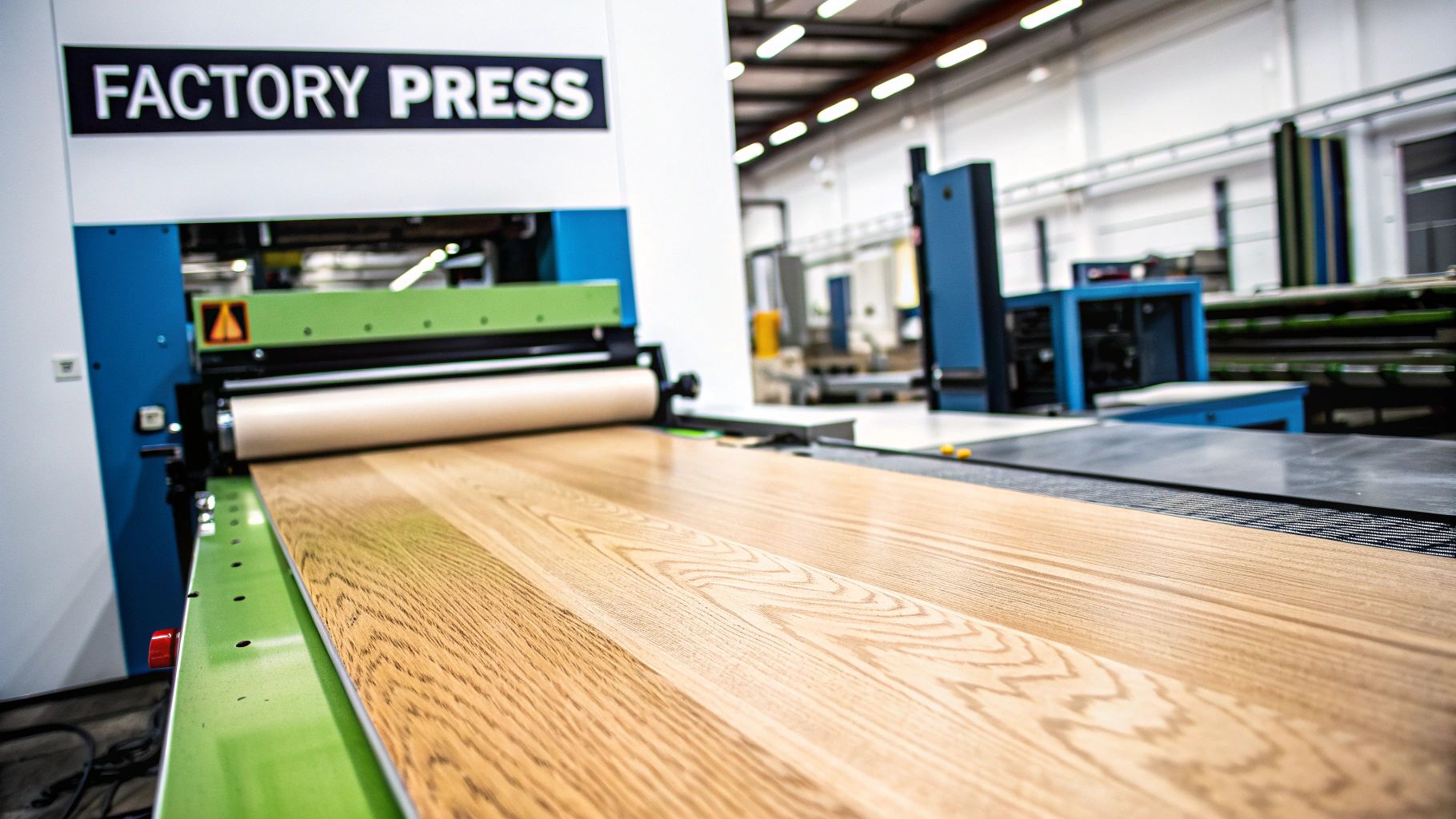
The most common method today is Direct Pressure Laminate (DPL) construction. The best way to picture it is like making a high-tech panini. All four layers—the backing, the HDF core, the decorative print, and the top wear layer—are stacked up and put into a massive press.
That press then does two things at once: it cranks up the heat to over 300°F and applies crushing pressure, sometimes more than 600 pounds per square inch. This intense combination melts the melamine resins infused throughout the layers, fusing them into one single, incredibly dense and stable plank. It's not just glued together; it's thermally bonded for life.
Creating Textures You Can Feel
This is where modern laminate truly separates itself from its older, plastic-looking ancestors. Today's manufacturing doesn't just create a picture of wood; it adds a texture that matches the visual, a technique known as embossing in register (EIR).
During that high-pressure fusion process, a textured steel plate presses down on the top layer. With EIR, this plate is a perfect mirror image of the wood grain photo on the decorative layer.
- Synchronized Knots: If you see a knot in the wood design, you can actually feel a subtle knot texture right on top of it.
- Aligned Grain Patterns: The fine lines of an oak or hickory grain in the image are perfectly matched by tiny grooves on the surface.
- A Realistic Feel: This synchronization is what tricks the eye—and the hand—into believing it’s real wood.
This attention to detail is a huge part of the evolution of laminate, turning a budget-friendly option into a genuinely sophisticated one.
Milling the Edges for a Perfect Fit
After the massive fused sheets have cooled, they’re cut into individual planks. But the final, and arguably most critical, step is milling the edges to create the interlocking system. This is the secret behind laminate's famous DIY-friendly reputation.
Using incredibly precise diamond-tipped tools, a tongue is milled onto one side of the plank and a corresponding groove is cut into the other. There is zero room for error here. Even the slightest miscalculation would lead to gaps between the boards or make installation a nightmare.
This click-lock system is what allows the planks to snap together so tightly, creating a "floating floor" that doesn't need glue or nails. The precision of this lock is also vital for water resistance, as a tight seam is the first line of defense against spills seeping through to the subfloor.
From the intense pressure of the press to the pinpoint accuracy of the milling machines, every stage is designed to build a final product that’s tough, beautiful, and refreshingly easy to work with.
How to Measure Laminate Quality and Durability
Knowing what goes into a laminate plank is just the first step. To make a smart investment, you need to understand how to judge its quality and durability. Not all laminate is created equal, and a product that's perfect for a quiet bedroom would be a disaster in a busy entryway.
Thankfully, the flooring industry gives us some clear, standardized ratings to help match a product’s toughness to your specific needs. The most important one to know is the Abrasion Class, or AC rating.
Decoding the AC Rating System
Think of the AC rating as a simple durability score for the wear layer—that invisible shield we talked about earlier. This system, originally developed in Europe, puts flooring through a series of tests measuring its resistance to scratches, stains, impacts, and even cigarette burns.
The concept is simple: the higher the number, the tougher the floor. Picking the right AC rating means you get a floor that will last without overpaying for commercial-grade toughness you just don't need at home.
To help homeowners choose the right laminate for different parts of their home, here’s a quick guide to what those ratings really mean in practice.
Laminate Flooring AC Rating Guide
| AC Rating | Recommended Use | Typical Traffic Level | Example Area |
|---|---|---|---|
| AC1 | Moderate Residential | Very Light | Guest bedrooms, closets |
| AC2 | General Residential | Medium | Formal dining rooms, living rooms |
| AC3 | Heavy Residential / Moderate Commercial | Heavy | Hallways, kitchens, family rooms, small offices |
| AC4 | General Commercial | Very Heavy | Small shops, cafes, busier offices |
| AC5 | Heavy Commercial | Extreme | Department stores, public buildings, busy restaurants |
For most homeowners around Cumming or Johns Creek, an AC3-rated floor is the sweet spot. It delivers more than enough durability for any room in the house, ensuring your investment stands up to family life, pets, and entertaining for years to come.
Pro Tip: While you might see AC1 or AC2 laminate at tempting prices, I almost always recommend starting at AC3. The jump in durability is significant and provides peace of mind that your floor can handle the busiest parts of your home.
Water-Resistant vs. Waterproof Laminate
Another crucial factor is how the flooring handles moisture, which is a big deal here in Georgia’s humid climate. In the past, water was laminate’s Achilles' heel; just a bit of moisture could cause the HDF core to swell, bubble, and basically ruin the floor.
Today, the technology has come a long way, but it's vital to understand the difference between two key terms: water-resistant and waterproof.
Water-resistant laminate is designed to handle everyday spills and splashes, but only for a limited time. It pulls this off with a few key features:
- A dense, moisture-resistant HDF core.
- Tightly milled click-lock joints that keep surface water from seeping between planks.
- Wax-sealed edges on some premium products for an extra barrier.
This level of protection is often perfectly fine for most rooms, as long as you wipe up spills within a few hours.
Waterproof laminate, on the other hand, is a whole different beast. Instead of just treating a wood-based core, these products often use advanced core materials that are completely impervious to water. This means they can withstand standing water for 24, 48, or even 72 hours without swelling or damage.
This makes waterproof laminate an excellent choice for kitchens, bathrooms, laundry rooms, and basements. Understanding this distinction is critical for a lasting installation—while water-resistant options have improved dramatically, true waterproof laminate provides the ultimate peace of mind.
Is Laminate Flooring a Healthy and Eco-Friendly Choice?
When you’re digging into what laminate flooring is made of, it's only natural to wonder about its impact on your home's air quality and the environment. Laminate's reputation used to be tied to some pretty harsh chemicals, but thankfully, the industry has come a long way, with a real focus on safer, more sustainable manufacturing.
These days, we're all more aware of the products we bring into our homes. We want something that looks great but also keeps our families healthy and our environmental footprint small. Understanding the certifications and materials behind modern laminate helps you do just that.
From High-Emission to Health-Conscious
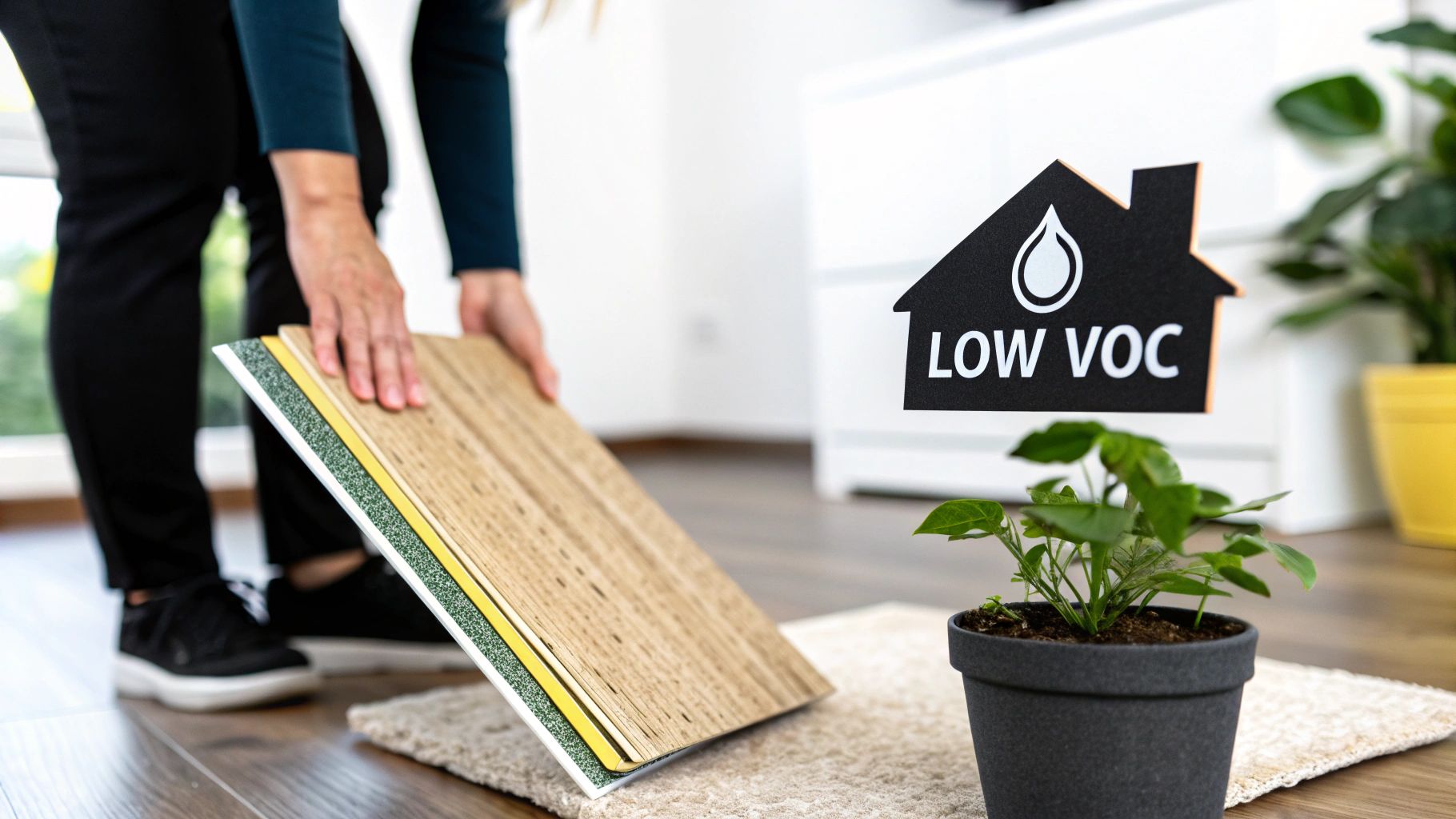
One of the biggest concerns has always been Volatile Organic Compounds (VOCs), especially formaldehyde. It’s a key ingredient in the resins that bind the HDF core together, and in older products, it could release—or "off-gas"—into the air, impacting indoor air quality.
Manufacturers got the message loud and clear. They’ve largely abandoned those old, high-emission formulas. Today, the composition of laminate flooring is completely different, with the industry moving to low-emission resins like melamine-formaldehyde, which is now used in over 90% of global laminate flooring production. This single change has drastically cut down on potential off-gassing, making modern laminate a much safer bet for your home. You can dig deeper into the evolution of materials in the global laminate market to see how far things have come.
The bottom line? The air in your home stays cleaner, which is a huge plus for families with kids, pets, or anyone with allergies or asthma.
Key Takeaway: The laminate industry didn't just tweak its formulas; it fundamentally reformed its practices. The shift to low-VOC resins means today's products are significantly safer for indoor air quality than the laminate of a decade or two ago.
How to Spot the Good Stuff: Look for Certifications
While the industry as a whole has improved, you don't have to just take a manufacturer's word for it. The easiest way to know you're buying a safe, low-emission floor is to look for a third-party certification label on the box. These seals of approval mean the product was independently tested and met strict standards.
When you're shopping, keep an eye out for these two heavy hitters:
- FloorScore: This is one of the most trusted and recognized certifications in the flooring world. If you see the FloorScore logo, it means the product has been thoroughly tested and meets stringent indoor air quality requirements.
- GreenGuard: This certification comes in two flavors: GreenGuard and GreenGuard Gold. The Gold standard is even tougher, making it the benchmark for products safe enough for schools and hospitals.
Choosing a laminate with one of these certifications is the simplest way to get peace of mind. You know you're installing a floor that's contributing to a healthier home, not taking away from it.
Sustainability From the Inside Out
Beyond air quality, there's a great sustainability story inside every plank. The real environmental hero of laminate is its HDF core. It’s not made from freshly cut trees; instead, it's typically made from recycled, pre-consumer wood waste. We’re talking about the sawdust, wood chips, and other leftovers from sawmills and furniture factories.
By giving these wood byproducts a second life, laminate production reduces the need to harvest virgin timber and keeps a massive amount of material out of landfills. It's a fantastic example of smart, circular design—turning industrial waste into a beautiful, durable floor for your home.
Choosing the Right Laminate for Georgia's Climate
Living in Cumming, Milton, or anywhere in North Georgia, we all know what the climate can throw at our homes. That persistent humidity, especially during our long, warm summers, can be incredibly tough on building materials. When you understand what laminate flooring is made of, you can confidently pick a product that's built to handle our specific conditions.
The real secret to a long-lasting floor in our area lies in the core layer. A plank with a high-density, moisture-resistant HDF core isn't just a nice-to-have; it's practically a necessity. This dense core is your main line of defense against the slow, sneaky warping and swelling that humid air can cause over time, making sure your floors stay flat and stable year-round.
Prioritizing Moisture Protection
When you're thinking about kitchens, bathrooms, or basements—anywhere spills or dampness are a possibility—upgrading to a waterproof or highly water-resistant laminate is one of the smartest investments you can make. These products feature specialized core materials and incredibly tight-locking joints that create a formidable barrier against moisture, giving you some serious peace of mind.
This focus on durable, moisture-resistant materials isn't just a local trend. Across North America, most laminate is made with HDF sourced from regional softwoods like pine and spruce. The United States is a significant force in this space, responsible for about 30% of global HDF production for laminate flooring. Projections show total demand soaring to 1.4 billion square meters by 2029.
Local Insight: For homes in Forsyth County and Johns Creek, a waterproof laminate in basements is especially critical. Our local climate can contribute to higher-than-average subfloor moisture, and choosing a fully protected plank is a simple, preventative measure that can save you a lot of headaches down the road.
The Importance of Professional Local Installation
Picking the right product is only half the equation. The quality of the installation is what truly locks in your floor's performance and longevity. Here in our humid climate, a couple of steps are absolutely non-negotiable for a good result.
-
Acclimatization: Your new laminate planks need to sit inside your home for at least 48-72 hours before they're installed. This gives the HDF core time to adjust to your home’s unique temperature and humidity levels, which is the key to preventing buckling or gapping later on.
-
Subfloor Preparation: A seasoned local installer knows that the job starts with a subfloor that is perfectly clean, dry, and level. They'll also know exactly which vapor barrier and underlayment to use—a crucial step we cover in detail on our guide to padding for laminate floor installation.
To make sure your new floor fits perfectly with your home's style, it can be helpful to visualize your design with interior design mood boards. Then, a skilled local installer can take that vision and bring it to life with the precision it deserves.
Frequently Asked Questions About Laminate Flooring Materials
Even after breaking down the layers, people always have a few more questions. It makes sense. You want to know how that technical sandwich of layers actually performs and feels under your feet in your own home.
Let's dig into some of the most common questions we hear from our customers in Cumming and the surrounding towns. We'll clear up the confusion so you can feel confident about your choice.
Is Laminate Flooring Just Plastic?
This is easily the biggest myth out there. While laminate flooring does use synthetic materials—like tough melamine resins for protection—its soul is actually wood-based. The core of every plank is High-Density Fiberboard (HDF), which is made from real wood fibers fused together with intense heat and pressure.
That wood-based core is what makes laminate a totally different beast from something like Luxury Vinyl Tile (LVT), which is plastic through and through. The HDF gives laminate a rigid, solid feel that many people find more substantial underfoot. So, no, it's not "just plastic." A better term would be a wood composite product. We bust a few more of these common misunderstandings in our article on the top myths about laminate flooring.
Can You Refinish Laminate Like Real Wood?
It's a fair question, especially since today's laminate looks so convincingly like real hardwood. The short and simple answer, however, is no. The reason why comes down to its layered DNA.
Solid hardwood is the same wood from top to bottom, so you can sand away the top layer to reveal fresh wood underneath. Laminate isn't built that way. Its beautiful wood grain is actually a highly detailed photograph printed on a decorative film, sitting just below a transparent wear layer.
If you tried to sand a laminate plank, you wouldn't be smoothing out a wood surface. You'd be grinding right through the protective finish and destroying the photographic image underneath for good.
This is a crucial distinction. You can't give the whole floor a facelift, but small scratches or dings can often be fixed with a color-matched repair putty. For anything more serious, the solution is to simply pop out the damaged plank and click a new one in its place—one of the big advantages of its installation system.
Why Does Some Laminate Sound Hollow When You Walk On It?
We've all been there—walking across a floor that makes a loud, clicky, hollow sound with every step. It’s a common complaint, but it’s not a problem with laminate itself. That sound almost always comes down to two things: the quality of the plank's core and the underlayment used beneath it.
-
Core Density: Budget-friendly laminates often have a less dense fiberboard core. A plank with a thicker, heavier HDF core is better at absorbing sound and resisting dents, giving it a much more solid, hardwood-like sound and feel.
-
Underlayment Quality: This is the real game-changer. The thin layer of padding that goes between your laminate and the subfloor is critical for sound absorption. A cheap, flimsy foam does almost nothing, but a quality underlayment will deaden that echo and make for a much quieter, more comfortable floor. Cutting corners on the underlayment is one of the biggest mistakes you can make.
By investing in a quality plank with a dense core and pairing it with the right underlayment, your laminate floor will sound just as good as it looks.
At Flacks Flooring, we believe a knowledgeable customer is a satisfied one. If you have more questions about laminate materials or need a hand picking the right floor for your home in Cumming, Johns Creek, or Milton, our team is ready to help. See what’s possible for your space at https://flacksflooring.com.