
Flooring labeled oak is usually red oak, while white oak is only about 5 percent harder at roughly 1,360 versus 1,290 lbf; the room, finish, and moisture plan decide the winner. Buying white oak just because someone calls it tougher is poor specification.
For homeowners comparing oak vs white oak, the better purchase usually comes down to undertones, grain, existing trim, and how the house handles humidity. A well-installed red oak floor is a better investment than white oak installed over a damp subfloor, and neither is the right answer for every room in North Metro Atlanta.
Oak vs White Oak Flooring at a Glance
Oak versus white oak flooring specifications
| Criterion | Typical oak (red oak) | White oak |
|---|---|---|
| Species buyers usually receive | Northern or mixed red oak | White oak (Quercus alba and related white oaks) |
| Color and grain | Pink to amber, bold open grain and medullary rays | Neutral tan, honey, or gray-brown with straighter, calmer grain |
| Janka indentation | About 1,290 lbf | About 1,360 lbf, roughly 5 percent higher |
| Average clear-wood density | About 699 kg per cubic meter | About 756 kg per cubic meter, roughly 8 percent denser |
| Pore structure | Large open pores visible on end grain | Pores often plugged with tyloses, less permeable |
| Tangential shrinkage green to about 6 percent MC | About 7.8 percent | About 7.2 percent |
| Incidental spills | More open, stains faster if finish is breached | Slightly more forgiving, still not waterproof |
| Where it usually wins | Warm traditional rooms and scratch camouflage on a budget | Neutral modern or farmhouse looks and higher-traffic specification |
The flooring benchmarks of 1,290 lbf for red oak and 1,360 lbf for white oak, documented in the U.S. Forest Service hardness reference, support a modest advantage, not a different class of floor. Both are heavy interior hardwoods, and neither is waterproof.
The table's density and shrinkage figures describe particular wood comparisons, not guaranteed performance for every carton. They're useful buying context, but they shouldn't outweigh the actual product construction or the condition of your home.
Choose the look before paying for the label
White oak isn't red oak with a lighter stain. Its neutral base makes pale finishes easier to coordinate with white cabinetry, muted stone, and modern furnishings. Red oak brings warmth and stronger figure, which can work beautifully with stained trim and classic interiors.
That busier red oak grain can also camouflage small surface marks. White oak's quieter face may make the same marks easier to notice, particularly with a smooth finish and strong side lighting.
For coordinating wood floors with long-lived furniture, Tyner Furniture's heirloom wood guidance for Ann Arbor shoppers offers useful context about choosing wood for appearance and intended use. Treat furniture and flooring as related design decisions, not materials that must match exactly.
Buying rule: Compare complete flooring specifications, not species names printed above a price.
Before comparing quotes, require red oak or white oak, solid or engineered construction, grade, and finish system. Otherwise, the less expensive quote may describe a different product.
What the Word Oak Means on a Quote
Say you're replacing carpet in a Cumming living room. One estimate lists oak hardwood, while another specifies engineered white oak in character grade. Those aren't equivalent offers, even if the sample boards look similar under showroom lighting.
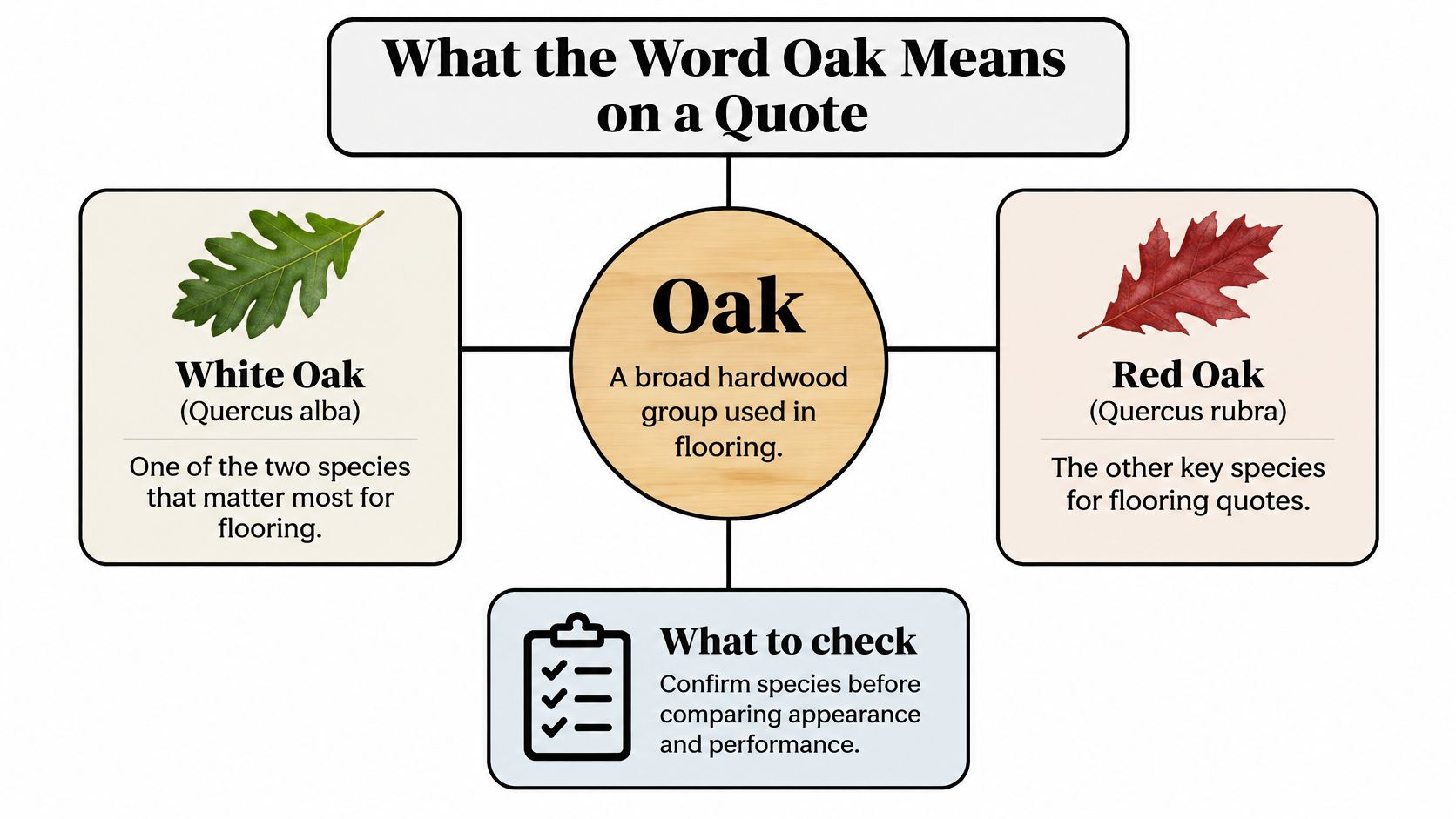
Oak is a broad hardwood group. The U.S. Forest Service white-oak profile identifies Quercus alba as native across much of eastern North America, including Georgia. Northern red oak, Quercus rubra, is another important eastern and Midwestern flooring species.
Turn the sample into a written specification
A domestic Appalachian white oak product won't necessarily resemble European white oak. Plain-sawn boards show different figure from rift- or quarter-sawn boards, while select and character grades create different expectations for knots and color variation.
For homeowners in Cumming, Forsyth County, Johns Creek, and Milton, a quote reading only oak is incomplete. Require these details:
- Species named as red oak or white oak. Don't accept a color name as species identification.
- Origin if known. Record the stated sourcing rather than assuming every white oak product is domestic.
- Cut and grade. Identify plain sawn, rift, or quarter sawn, together with the manufacturer's grade description.
- Thickness and wear layer if engineered. Ask for the actual product specification, not just overall plank thickness.
- Solid or engineered core. For engineered flooring, identify the core construction.
- Prefinished or site finished. Include the finish product or factory finish system.
A character-grade plank can be the right choice for a relaxed farmhouse room and the wrong choice for a tightly controlled contemporary design. Neither grade is automatically better.
These details also affect installation waste, board selection, movement, and future refinishing. You're buying a complete flooring assembly, not just a tree species, and each item changes what you receive before price enters the conversation.
Hardness Density and Everyday Wear
Dent resistance and scratch resistance aren't interchangeable. A dropped pan compresses wood; grit under a chair abrades the finish. Choosing a harder species addresses only part of that problem.
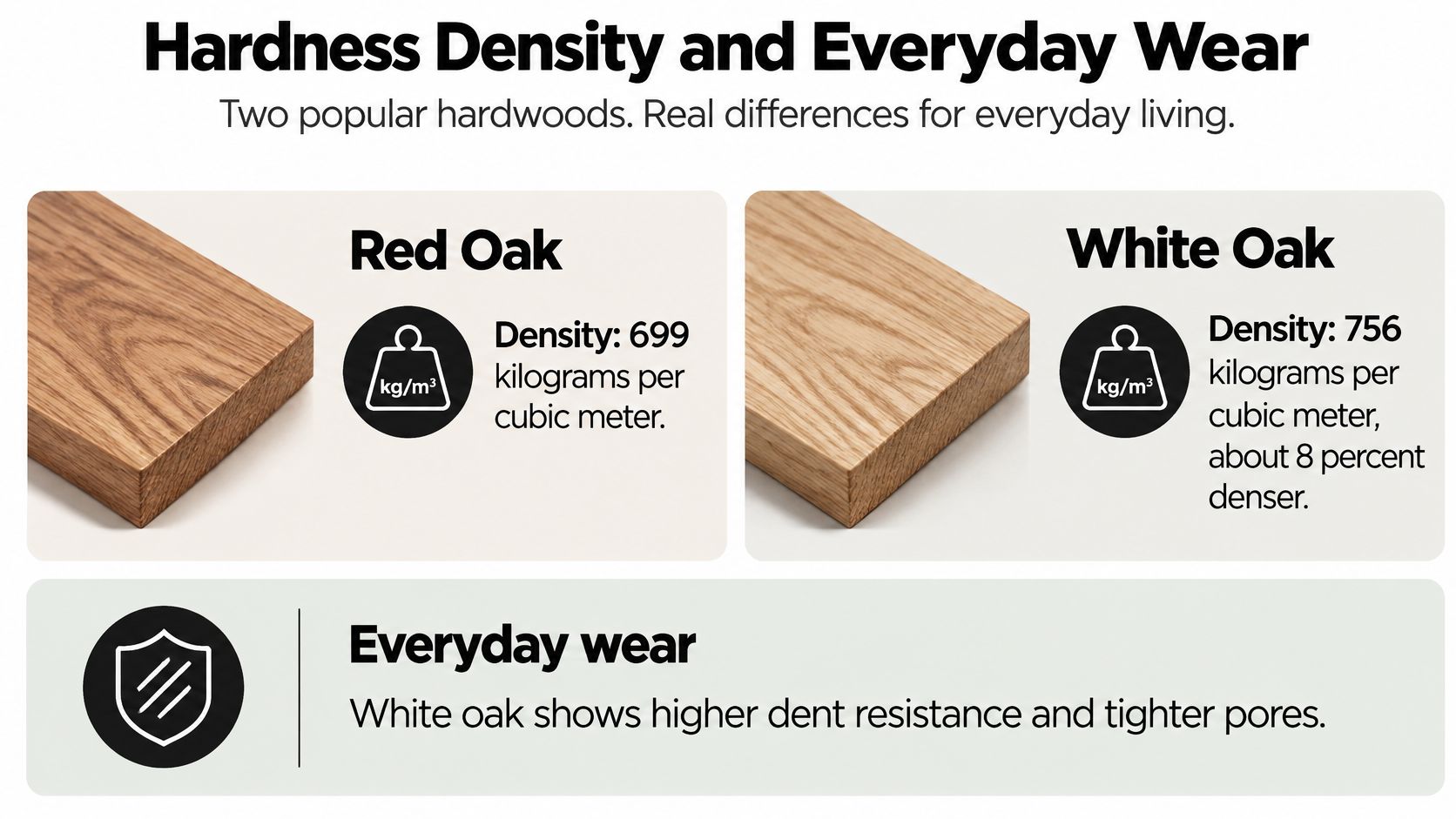
In a comparative clear-wood study, red oak averaged 699 kilograms per cubic meter and white oak 756 kilograms per cubic meter, making white oak about 8 percent denser. The same study measured mean Janka hardness at 6.1 versus 6.3 kilonewtons, a difference of roughly 3 percent.
Those specimen averages aren't the same dataset as commonly quoted flooring benchmarks. The useful conclusion is consistent: white oak has an edge, but it's not a dramatic leap in household durability.
What laboratory hardness leaves out
Janka testing compares resistance to indentation, not complete floor lifespan. It helps evaluate potential dents from concentrated loads, but it doesn't tell you whether a particular coating will tolerate grit, pet claws, or a rolling office chair.
A separate U.S. Forest Service wear comparison found white oak had the least thickness loss among five U.S. hardwood species tested. That supports choosing it for demanding rooms, without turning it into scratch-proof flooring.
For a broader explanation of matching hardwood to daily use, the Slone Brothers Furniture hardwood guide is useful when coordinating flooring with furniture that must also withstand wear.
Protect the surface you actually walk on
For pet-friendly flooring and busy living areas, put these details ahead of a small species advantage:
- Felt pads on furniture legs. Check them regularly because trapped grit turns a protective pad into an abrasive.
- Entry mats at exterior doors. Catch soil before people carry it across the finish.
- A suitable finish system. Compare factory aluminum-oxide coatings with the proposed site-applied finish, including maintenance and repair requirements.
- Prompt cleanup. Vacuum grit with a hard-floor attachment and wipe spills rather than leaving moisture against board edges.
With dogs or rolling chairs, specify species, wear layer, and finish together. Use an appropriate chair mat and keep pet nails maintained.
If scratch-resistant flooring for dogs is your main purchasing requirement, compare an actual finished sample against suitable nonwood alternatives. Don't buy either oak expecting it to tolerate standing water.
Grain Color Stain and Finish Behavior
Judge finished boards, not raw wood photographs. Red oak's warm undertones can remain visible beneath a pale stain, while a clear coating can make either species look warmer than the unfinished sample.
The USDA Forest Products Laboratory oak reference describes the important pore distinction: red oak has larger open pores, while white oak's pores are commonly blocked by tyloses, structures that reduce permeability. That helps explain white oak's traditional use in barrels, but it doesn't make a finished floor waterproof.
Match the finish to the undertone
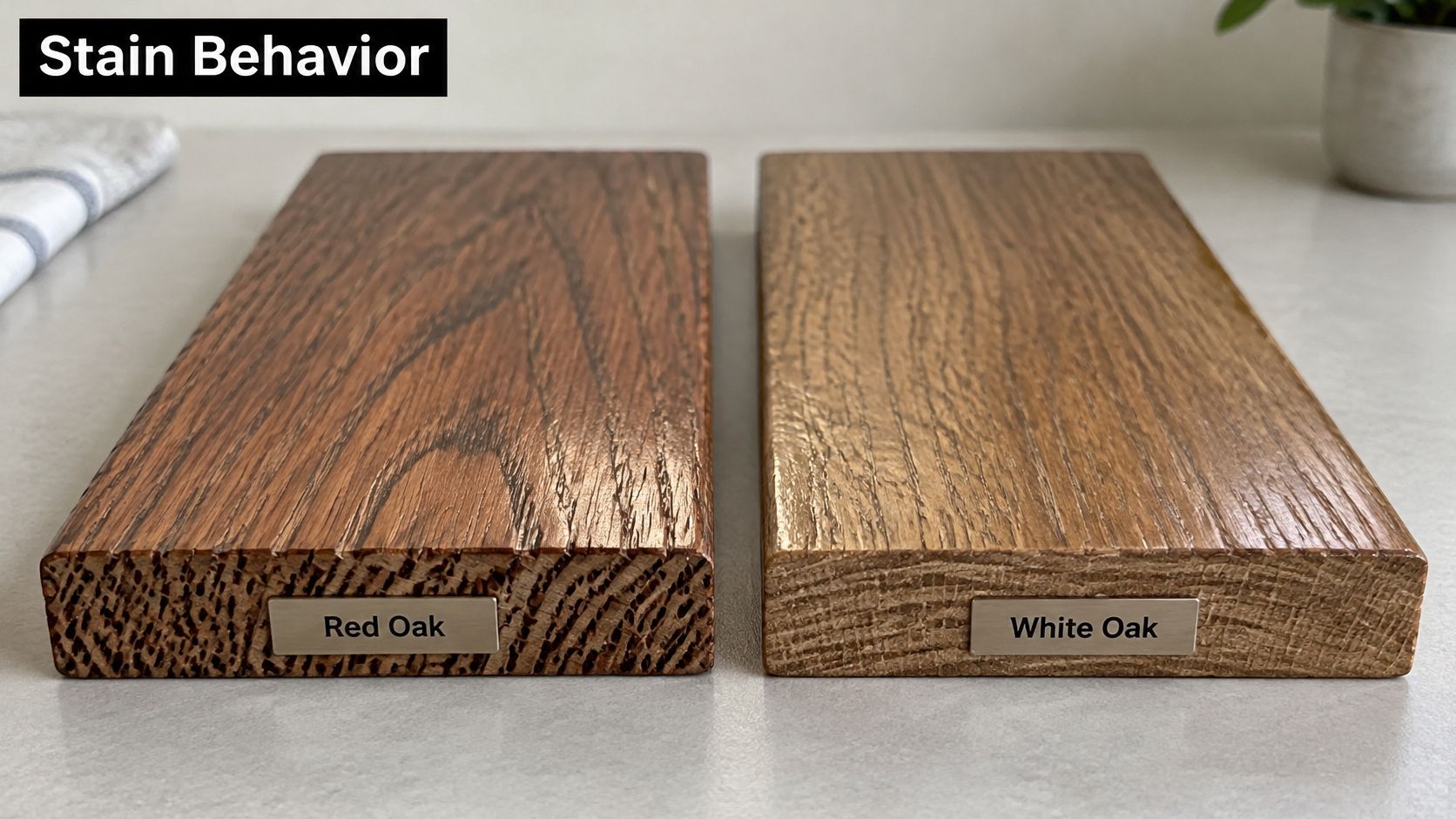
Red oak's open grain often becomes more pronounced when stain collects in it. Medium browns and warm classic colors work with that character instead of fighting it.
White oak is generally the easier starting point for whitewash, light gray, natural-oil looks, and low-sheen neutral schemes. Its appearance still changes with sanding, grade, stain chemistry, and application technique, so don't assume every white oak accepts color identically or without blotching.
Our white oak flooring buying guidance helps distinguish product choices before you commit to a particular look. Ask to see full-length boards, especially when comparing character-grade European products with domestic rift white oak.
A small sample shows color. Several full boards show the floor you're buying.
Factory finish or custom color
Prefinished hardwood offers a consistent factory-applied coating and avoids on-site sanding and coating work. Aluminum-oxide finishes are worth comparing for wear, but also ask how localized damage can be repaired.
Site-finished hardwood gives the finisher more control over stain, sheen, and transitions to existing wood. It also adds sanding dust, coating schedules, and cure restrictions that must be built into the renovation.
Sunlight matters as much as the showroom stain rack. Both oaks can amber, and gray or whitewashed floors may read warmer over time, particularly near south-facing glass.
View samples beside cabinetry and trim in morning and afternoon light. If a cool gray appearance is nonnegotiable, discuss the wood's natural color change before ordering, not after installation.
Movement Moisture and Georgia Installations
Moisture control is more important than the species upgrade. White oak can still cup, gap, or buckle when the jobsite is wrong, and engineered construction doesn't excuse a wet subfloor.
The USDA Forest Products Laboratory technical sheet reports representative red oak shrinkage from green wood to approximately 6 percent moisture content at about 7.8 percent tangential, 3.7 percent radial, and 11.0 percent volumetric, with corresponding white oak tangential shrinkage around 7.2 percent. These are drying measurements, not predictions that your installed floor will change by those amounts.
Verify the house before opening cartons
For hardwood flooring installation in Woodstock, Acworth, Alpharetta, Canton, Roswell, Marietta, Cumming, and Johns Creek, summer humidity and winter heating make jobsite verification essential. A damp crawl space, recently poured slab, or building without working climate control can undermine an otherwise sound product choice.
Follow a practical installation sequence:
- Confirm flatness. Check the subfloor with a straightedge and identify humps, low spots, and loose panels before installation.
- Test moisture. Use the appropriate meter for wood and the specified concrete test for slab conditions. Record results for both flooring and substrate.
- Acclimate to lived-in conditions. Operate the home's climate-control system and follow the product's acclimation requirements rather than using an arbitrary waiting period.
- Leave perimeter expansion. Maintain the required clearances at walls, columns, cabinets, and fixed obstructions.
- Maintain indoor humidity. Keep conditions within the flooring manufacturer's stated range after move-in.
Our guide to flooring for humid climates can help you compare materials when humidity control is a concern.
Know when hardwood is the wrong specification
Engineered planks generally reduce width movement compared with solid boards. They can still suffer damage if water reaches the wear layer, adhesive bonds, or core.
Installation priority: Don't schedule hardwood over unresolved moisture just to protect the move-in date.
For a basement with recurring dampness, solve the water source first. Waterproof flooring for basements is a separate product decision, and a waterproof plank surface doesn't repair slab moisture problems.
In bathrooms and laundry splash zones, compare luxury vinyl plank (LVP) flooring with tile flooring designed as part of an appropriate moisture-managed assembly. Stone flooring also requires substrate and sealing decisions of its own. Don't sell either oak as a substitute for those systems.
Matching Red or White Oak to Rooms and Styles
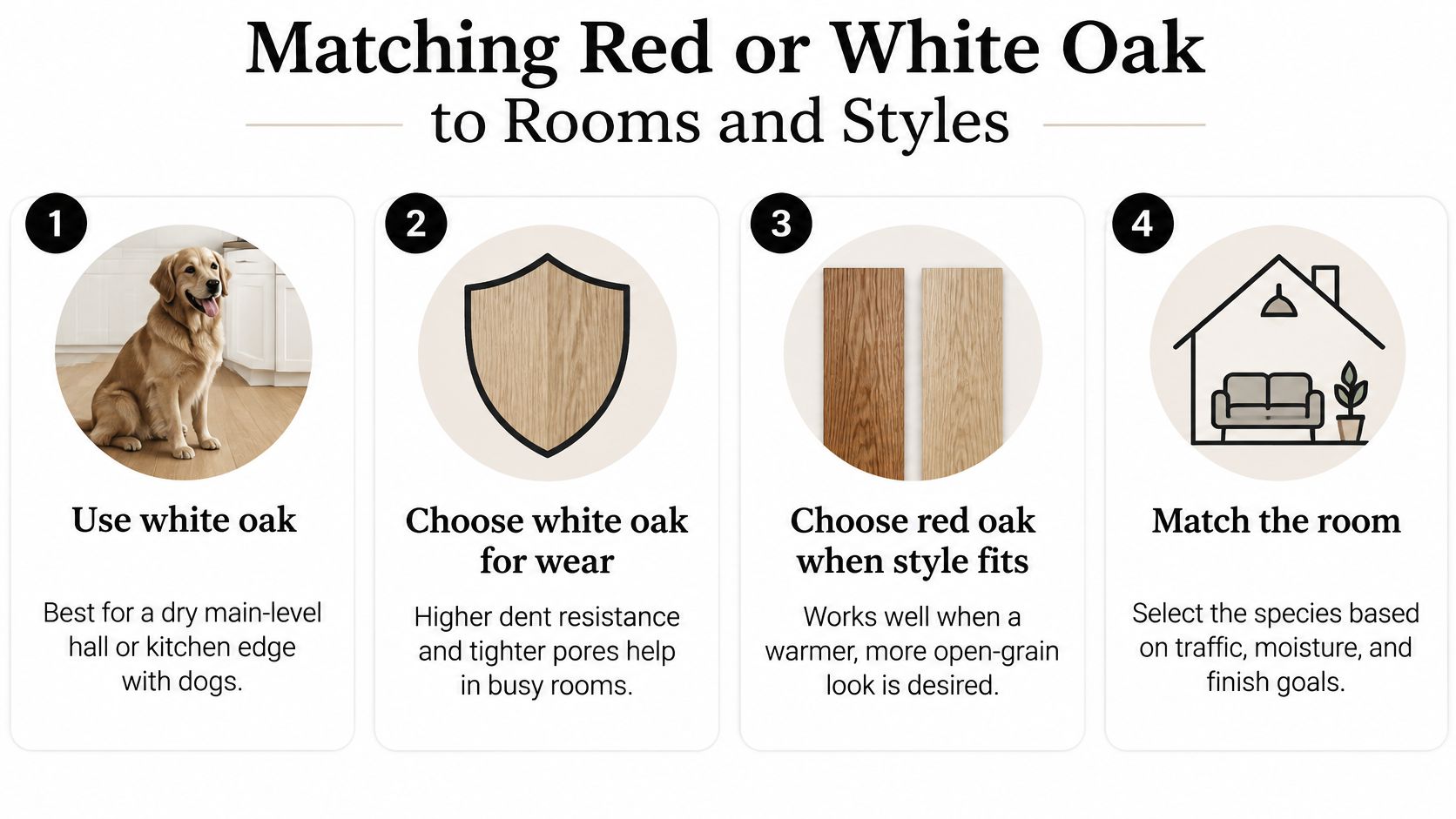
Specify by room, not by popularity. For a dry main-level hall or kitchen edge with dogs, white oak with a suitable finish is a sensible hardwood choice. For a warm craftsman interior, red oak may look more natural and make better use of the budget.
The National Hardwood red oak and white oak comparison supports choosing between them on color, grain, finish, and household use rather than treating hardness as the deciding factor.
Which oak to specify by household brief
| Situation | Better hardwood choice | Why | When to leave oak |
|---|---|---|---|
| Dogs and high traffic on a dry main level | White oak with a tough finish | Modestly higher dent resistance and tighter pores | Heavy claw abrasion plus wet paws; consider scratch-focused waterproof plank |
| Warm traditional or craftsman interior | Red oak | Pink-amber grain matches stained trim and hides small marks | Buyer wants a pale gray modern floor |
| Modern, farmhouse, or light neutral scheme | White oak, often rift or select | Calmer grain works well with whitewash and natural finishes | Budget or lead time cannot support the grade |
| Rental, flip, or fast listing prep | Prefinished oak in stock | Installation readiness and factory finish consistency matter most | Timeline or price favors luxury vinyl or laminate |
| Basement, bath, or laundry splash zone | Neither | Both move with moisture and aren't waterproof | Waterproof flooring is the right specification |
| Sunlit south-facing great room | Sample both in that light | Both can amber; gray washes may shift warmer | Color must stay cool regardless of sun |
Match the house rather than chasing a trend
For agents preparing listings in Cobb County, Cherokee County, North Fulton, and Forsyth County, coordinate the floor with what stays. White oak can support a neutral staging palette, but replacing sound red oak solely to follow that look may be unnecessary.
The Lott's Furniture guide to hardwoods offers complementary guidance for matching wood character to the rest of the room.
When shoppers ask for the best flooring for pets or best flooring for high traffic areas, start with their tolerance for marks and maintenance. Compare laminate flooring for abrasion-focused needs and properly rated waterproof LVP for spill-focused needs; don't assume all laminate is waterproof.
For renters, permanent floor replacement may not be appropriate without owner approval. Our area rugs and runners offer another way to change the room without making a species decision for the whole property.
What Drives the Cost of Oak Flooring
The cost to install hardwood or LVP isn't just the board price. A low material quote can rise once removal, subfloor work, stairs, and trim are included. Compare the work each estimate covers before judging which floor costs less.
Species availability, grade, cut, construction, and finish all affect an oak estimate. Rift- or quarter-sawn boards are not a like-for-like comparison with ordinary plain-sawn stock. Engineered flooring should be compared by its construction and usable wear layer, not overall thickness alone. The oak hardwood flooring cost guide offers more context for reviewing the work behind an estimate.
Compare the installed scope
Ask for a written, room-by-room scope. Check that it identifies:
- Removal and disposal of the existing floor, including difficult adhesives or attached underlayment.
- Subfloor flattening and flooring repair, with any allowances clearly identified.
- Moisture testing and mitigation, distinguishing routine testing from corrective work.
- Transitions, trim, and stairs, including how adjoining floor heights will be handled.
- Acclimation and installation scheduling, plus finishing restrictions where applicable.
Flacks Flooring states that its all-inclusive pricing covers installation and site preparation. Your written estimate should still spell out what the specific project requires, so you can compare the same scope across quotes.
Value isn't the lowest material price
For affordable flooring options, first consider whether an existing wood floor needs replacement. Localized repair or refinishing may preserve a usable floor if its condition and remaining sanding thickness allow the work.
A refinishable hardwood floor offers a different ownership path from a surface that must be replaced when it wears out. Compare expected use, repairability, and disruption alongside the purchase cost. The lowest material price may not be the lowest-cost choice over the floor's useful life.
If you're comparing carpet installation, hardwood, and LVP for different rooms, choose by room needs rather than forcing one material through the whole house. Ask whether the quoted price covers the full installed scope. If financing is offered, request the terms in writing and compare the total project cost, not just the monthly payment.
Lock the Species and Schedule Before You Order
Start your consultation with a room list, pet and traffic notes, and target installation window. That gives the estimator enough information to recommend construction and finish alongside species.
White oak also competes with veneer, high-grade lumber, and barrel production. The University of Kentucky delivered timber price report reports high-quality white-oak lumber-log prices up 12.8 percent from 2025 and lower-quality logs up 15.4 percent, with demand projected to remain strong in 2026 as several industries compete for the species. Those are log-market figures, not flooring-price increases, but they're a reason to verify availability before scheduling demolition.
Confirm the order before booking demolition
Use a short purchasing checklist:
- Stock status and timing. Distinguish available inventory from mill-order material, and confirm the complete quantity.
- Origin and sourcing. Record the stated origin and any certification relevant to your project.
- Waste and spare boards. Include the installer's allowance and retain matching material for future repairs.
- Finish documentation. Review emissions information, cleaning requirements, and repair options.
- Payment terms. Ask about financing options, total cost, and any conditions before signing.
Red oak can be the practical alternative when its warmer color works and suitable stock is available. Don't delay a sensible renovation solely to obtain a fashionable species.
Walk on the choices before deciding
Our selection includes carpet, pre-finished hardwood, sand and finished hardwood, luxury vinyl, laminate, area rugs, and runners. The showroom has over 25 room-sized samples that customers can walk on and visualize.
Whether you searched for flooring Cumming, flooring Johns Creek, or flooring near me, bring samples into the actual rooms through an in-home consultation. Confirm the look, moisture suitability, written scope, and schedule together, especially when fast installation is important.
Visit Flacks Flooring to walk on room-sized samples and compare oak with luxury vinyl, laminate, and carpet for the way your household lives. Bring your room measurements, photos, and target installation window, then arrange an in-home consultation to check color, site conditions, and the complete installation scope before you order.