
When you’re setting up a home office, finding the right flooring is a balancing act. You need something that holds up to rolling chairs, feels good underfoot, and matches your professional style. While there are plenty of options, Luxury Vinyl Plank (LVP) is a standout contender for good reason. Its tough-as-nails durability, combined with a high-end wood look and a price that's hard to beat, makes it a near-perfect fit for today's remote workspaces.
Laying the Groundwork for a Productive Space
Your office floor isn't just something you walk on—it’s the foundation of your entire workspace. The right flooring can make your video calls sound clearer, keep you comfortable during those long days, and pull the whole room's design together. It's a choice that quietly impacts your daily productivity. That's why planning your office redesign from the ground up is so important.
Before you start looking at samples, think about what you really need your floor to do. Your decision should hinge on a few key things:
- Durability: How well will it handle the daily grind of an office chair rolling back and forth?
- Acoustics: Will it help muffle sound and prevent echoes, or will it amplify every little noise?
- Comfort: Is it a surface you can stand on for a while without your feet aching?
- Maintenance: How much time are you willing to spend cleaning it to keep it looking sharp?
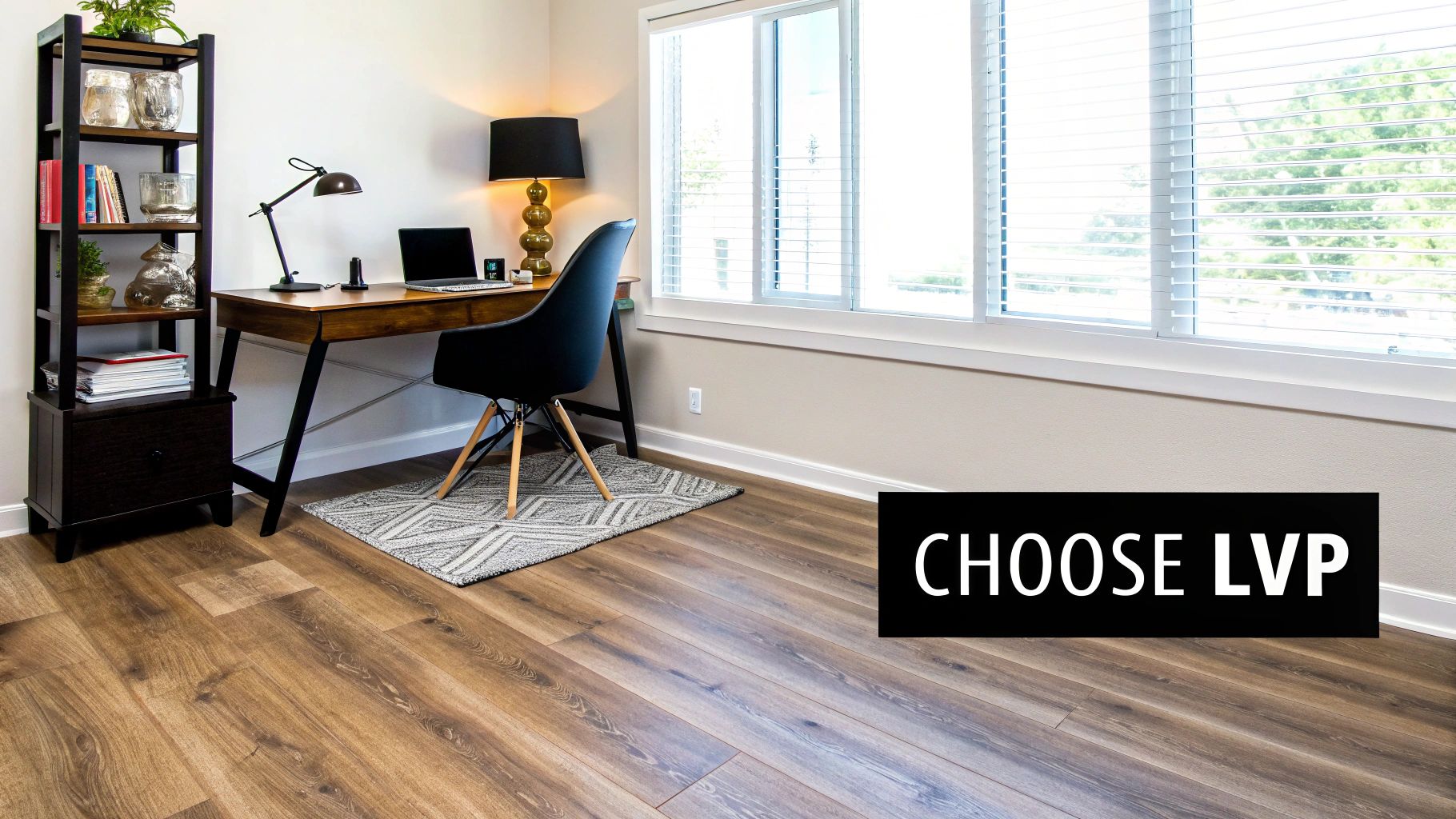
The Most Popular Flooring Options Head-to-Head
Materials known as "resilient flooring," which includes luxury vinyl, have taken over both home and commercial offices. It's not just a fad; the numbers show a clear trend. The resilient flooring market is expected to pull in around $8.38 billion in revenue in the U.S. alone in 2024. This boom is all about people wanting floors that are tough, look great, and don't require a ton of upkeep—exactly what a home office demands.
So, let's break down the most popular choices. I've put together a quick-glance table to help you compare the main contenders before we get into the nitty-gritty of each one.
Home Office Flooring Options at a Glance
This table gives you a snapshot of what to expect from the most common flooring types, helping you zero in on the best fit for your needs and budget.
| Flooring Type | Durability Rating (1-5) | Comfort Level | Typical Cost per Sq. Ft. | Ideal For |
|---|---|---|---|---|
| Luxury Vinyl Plank | 5 | Moderate | $2 – $7 | High-traffic areas needing durability and style. |
| Hardwood | 4 | Moderate | $5 – $15 | Professionals seeking a timeless, premium look. |
| Carpet | 3 | High | $2 – $6 | Offices where sound absorption and comfort are top priorities. |
| Laminate | 4 | Low | $1 – $5 | Budget-conscious setups requiring a durable surface. |
This overview should give you a solid starting point. Now, let's explore what makes each of these materials tick, so you can make a choice you'll be happy with for years to come.
Hardwood vs. LVP: A Head-to-Head Comparison
When it comes to flooring for a home office, the classic choice of hardwood and the modern contender, Luxury Vinyl Plank (LVP), are often the final two. Both can give your workspace a sharp, professional look, but they get there in very different ways. We're going to dig deeper than just appearances to see how each holds up to the real-world demands of a home office.
This isn't just about looks. We'll get into the nitty-gritty of daily use, from the constant wear of an office chair rolling back and forth to how the floor impacts sound during important calls. The goal is to help you figure out which material truly fits your work habits, your budget, and what you expect from your floor years down the road.
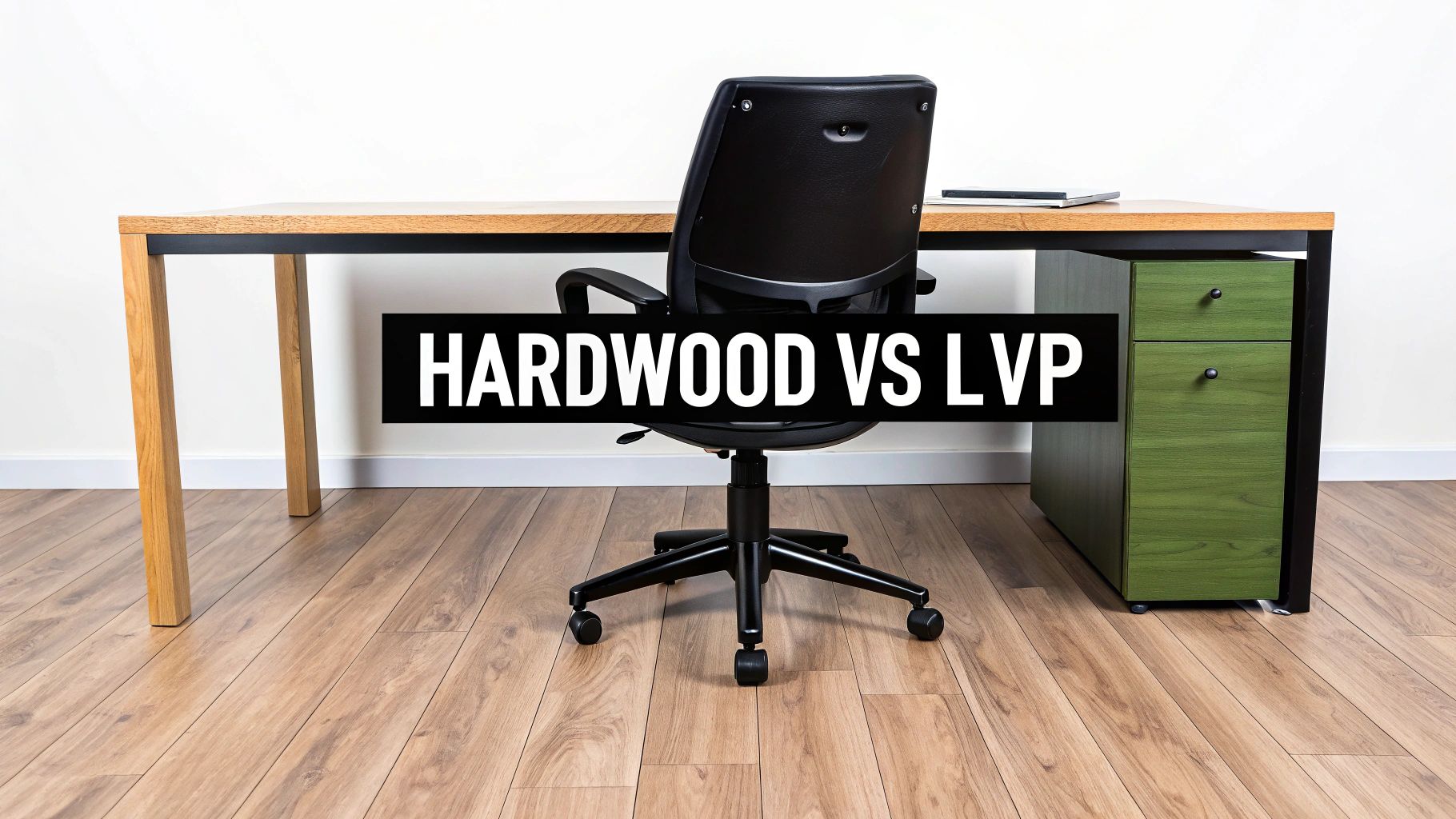
Durability Under Office Conditions
Hardwood floors bring a timeless warmth and undeniable value to any room, and the office is no exception. Whether you choose solid hardwood or engineered planks with a real wood veneer, you're getting a beautiful, natural surface. But that beauty comes with a catch—it’s vulnerable to the unique wear and tear of a workspace.
The number one enemy? Your office chair. The constant rolling of casters can grind down the finish over time, leading to scratches, scuffs, and even dents in the wood itself. A good-quality chair mat isn't just a recommendation here; it's a must-have to protect your investment.
Luxury Vinyl Plank, on the other hand, was practically born for this kind of environment. It’s built in layers, topped with a tough-as-nails transparent wear layer designed to fend off scratches, scuffs, and stains. This built-in resilience makes LVP a fantastic, worry-free option for a busy office where you need the floor to look good without constant babying.
Key Takeaway: If you're looking for pure, day-one durability against office chairs and foot traffic, LVP has the clear edge. Hardwood offers that classic, elegant look but demands you protect it to keep it that way.
Cost and Long-Term Value
Looking at the initial price tag, LVP is almost always the more wallet-friendly choice. That affordability, paired with its robust performance, makes it a high-value pick from the start. Hardwood flooring sits at a higher price point, which makes sense for a premium, natural material that can add significant resale value to your home.
But the full financial picture goes beyond the initial layout. Hardwood’s biggest superpower is its longevity. A solid hardwood floor can be sanded and refinished every 10-15 years, essentially hitting the reset button and erasing years of wear. With proper care, it can literally last for generations.
LVP doesn’t have that same trick up its sleeve. Once the wear layer is heavily scratched or a plank is gouged, it can't be refinished. Your only option is to replace the damaged plank. A quality LVP floor can last 20-30 years, which is impressive, but it doesn’t offer the same potential for renewal as real wood. For a deeper dive into how these two stack up, check out our in-depth guide on vinyl plank flooring vs. hardwood.
Maintenance and Installation
When it comes to day-to-day cleaning, both floors are pretty straightforward. A quick sweep or vacuum and the occasional damp mop will keep them looking great. The real difference emerges when accidents happen. LVP is virtually waterproof, meaning a spilled coffee or a tipped-over glass of water is no big deal. That peace of mind is huge, especially if your office is in a basement or a multi-use area.
Hardwood, however, is wood’s worst enemy. Spills need to be wiped up immediately to prevent the planks from staining, cupping, or warping. It's simply not as forgiving.
Installation is another area where they diverge sharply:
- LVP: Most LVP comes with a simple click-lock system, making it a favorite for DIYers. It goes down fast with minimal mess.
- Hardwood: Putting in hardwood is a job for the pros. It requires nailing or gluing, precise cuts, and often on-site finishing, which means more time, more money, and more disruption.
Aesthetics and Style
Ultimately, this may come down to personal taste. Nothing can perfectly replicate the authentic, unique beauty of real hardwood. Every plank tells a story with its own grain, knots, and subtle color variations, giving your office an organic, high-end feel.
That said, LVP technology has come an incredibly long way. Thanks to high-definition printing and embossed textures that mimic wood grain, it can be surprisingly difficult to tell LVP from the real thing at a glance. You also get a much wider array of design options with LVP, from rustic, reclaimed looks to sleek, modern grays. As more people work from home, LVT and LVP are seeing huge growth, with an estimated 500 million square feet of commercial-style flooring space expected to switch to materials like LVP by 2025. It’s a trend that reflects a shift toward durable, stylish, and practical solutions for the modern home office. For more on this market shift, you can read about commercial flooring demand insights.
Exploring Soft Flooring: Carpet and Cork Options
If hard, slick surfaces just don't fit your vision for a home office, it's time to consider the softer side of flooring. Options like carpet and cork bring a completely different feel to a workspace, one built around comfort, warmth, and quiet focus. These materials are your best bet when acoustics and a comfortable feel underfoot are your main goals.
They are natural sound absorbers, which is a huge plus for minimizing distractions during those crucial video calls or deep work sessions. Forget the sharp click-clack of shoes on a hard floor; soft flooring dampens the noise from dropped pens, rolling chairs, and everyday foot traffic. This is a game-changer, especially for second-story offices where sound can easily travel and disturb the rest of the house.
Let's break down how classic carpet and the eco-friendly standout, cork, compare when put to the test in a modern home office.
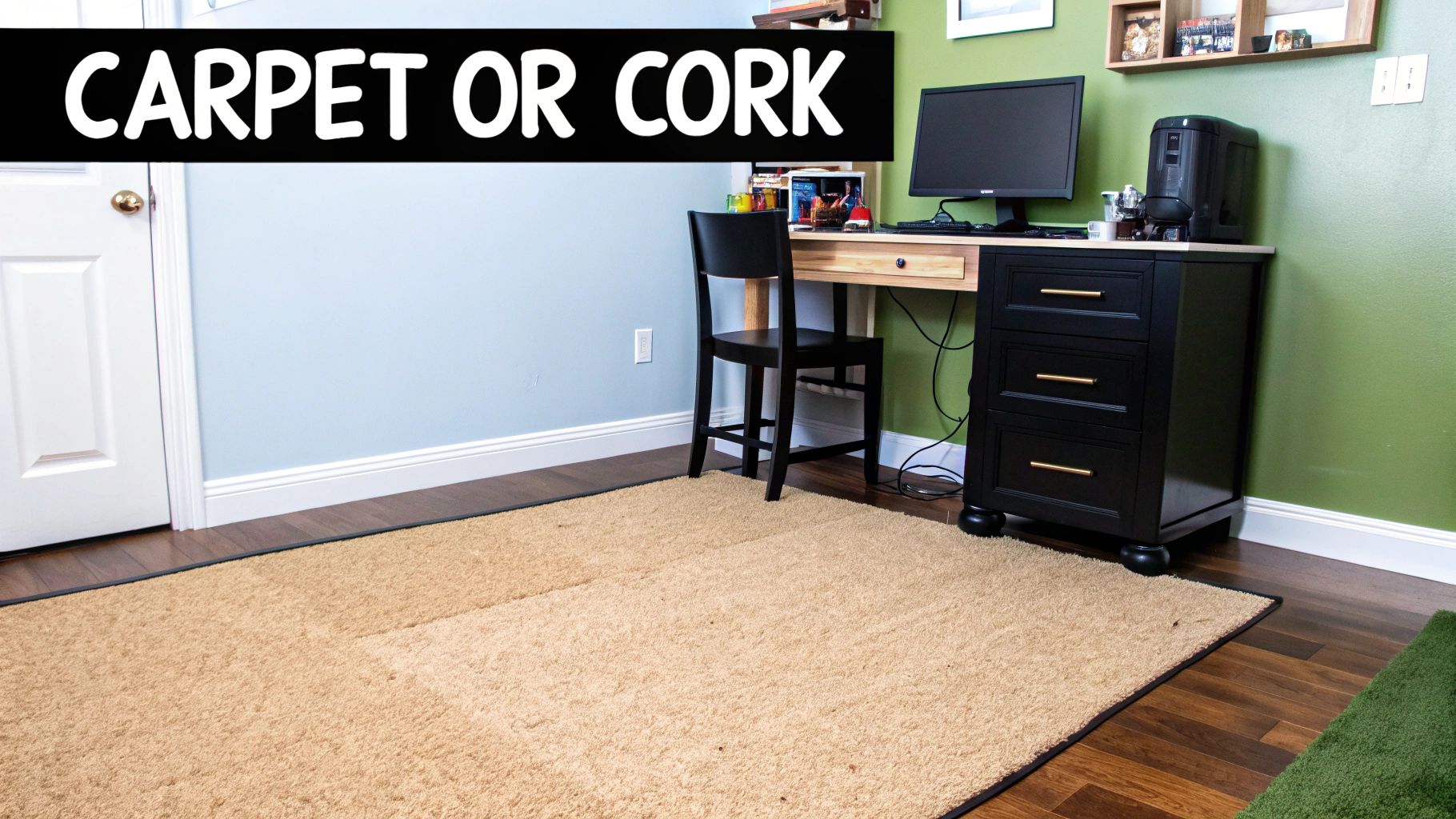
The Case for Carpet: Comfort and Quiet
Carpet has always been the go-to for spaces where comfort is king, and for very good reason. Its plush fibers create a soft cushion underfoot that can seriously reduce fatigue, a real benefit for anyone who uses a standing desk or just paces while thinking. That inherent softness also makes it an undisputed champion of sound absorption.
But for a home office, you can't just pick any carpet. You have to find that sweet spot between comfort and practicality, especially with an office chair rolling around all day.
- Low-Pile Carpet: This is, hands down, the most sensible choice for an office. The dense, tight weave lets your chair glide smoothly without getting stuck, giving you the easy movement of a hard surface but with all the sound-dampening perks.
- Carpet Tiles: These offer a brilliant compromise. You get the comfort of carpet with the convenience of a modular system. Spill your morning coffee? No problem. Wear out a patch under your desk? Just swap out the damaged tile instead of redoing the entire room.
A word of caution: stay away from plush, high-pile carpets. While they feel amazing, they are a nightmare for an office. The long fibers will tangle in your chair's wheels, making it a struggle to move and causing the carpet to wear out ridiculously fast. Stick with commercial-grade or low-pile styles to get it right.
Cork: A Sustainable and Unique Alternative
Cork flooring is a standout choice that brings a unique, eco-conscious vibe to a home office. It’s harvested from the bark of cork oak trees without ever cutting them down, making it a fantastic renewable resource for anyone looking to make a greener choice. But its appeal goes way beyond sustainability.
Cork has a natural honeycomb-like cellular structure that is filled with air. This is what gives it some truly remarkable properties for a workspace. It’s a natural insulator, so the floor feels warm in the winter and cool in the summer, adding a subtle but significant layer of comfort.
A Natural Sound Barrier: Those tiny, air-filled cells make cork a fantastic acoustic insulator. It absorbs sound from within the room and from the floor below, creating a quiet, focused atmosphere without needing bulky rugs or padding.
This unique material has a gentle give underfoot that’s easy on your joints—similar to carpet, but with a bit more firmness. If this blend of eco-friendly design and real-world benefits has you curious, you can learn more about what cork flooring is and see if it’s the right fit for your space.
Practical Scenarios: Where Soft Flooring Wins
The decision between soft and hard flooring really comes down to your specific work style and home setup. Here are a couple of situations where carpet or cork is the undeniable winner.
Scenario 1: The Upstairs Office
Your office is on the second floor, right above the living room or a bedroom. Every time you roll your chair or walk across the room, it creates a racket for everyone downstairs.
- Recommendation: Carpet is the superior choice here. Its sound-absorbing qualities will muffle noise far better than any hard surface, keeping the peace throughout the house.
Scenario 2: The Creative Studio
You're a podcaster, musician, or anyone who records audio. Hard surfaces are your enemy, reflecting sound and creating a harsh echo that can ruin a perfect take.
- Recommendation: Both cork and carpet are excellent for reducing echo. Cork offers a clean, modern look while dampening sound, whereas carpet provides maximum absorption for studio-level quiet. The right choice here really depends on your style and just how much sound control you need.
Durability and Long-Term Maintenance: A Reality Check
Picking the right flooring for your home office is about more than just how it looks on day one. The real test comes months and years down the line, after countless trips in your rolling chair, the occasional spilled coffee, and daily wear and tear. You need to think about how each material will stand up to the unique pressures of a workspace.
A floor's durability is its first line of defense. Just think about the daily grind. Your office chair concentrates a surprising amount of pressure onto those tiny caster wheels, creating a constant source of friction that can wreak havoc on the wrong surface. This is where a material's inherent toughness really comes into play.
Likewise, maintenance isn't just about a quick sweep. It’s about the real effort needed to keep your floor looking sharp and professional, and what the upkeep will cost you over its entire lifespan.
The Impact of Daily Office Use
Different flooring materials handle the rigors of an office in completely different ways. Take hardwood, for instance. It's undeniably gorgeous, but it demands a certain level of care. Its surface can easily get scratched or dented by chair casters, which makes a good-quality protective mat a non-negotiable accessory.
Luxury Vinyl Plank (LVP), on the other hand, was practically engineered for this kind of abuse. Its tough wear layer is specifically designed to fend off the scuffs and scratches that are just part of life in a busy office. That resilience means less worrying for you and a floor that keeps its good looks with minimal effort.
When you're thinking about the long-term impact of heavy desks and rolling chairs, it's crucial to know how to protect your floors from furniture damage.
Carpet, especially low-pile carpet tiles, strikes a nice middle ground. While it’s softer and will eventually show wear paths, its modular design is a huge plus. If you get a bad stain or a tile gets worn down, you can just swap it out without having to tear up the entire room.
Situational Recommendation: If your home office is a high-traffic zone that also sees family activity, LVP is probably your best bet for a blend of toughness and low-stress maintenance. For a quieter, executive-style office with less foot traffic, the classic appeal of a well-protected hardwood floor might be worth the extra attention.
Long-Term Upkeep and Costs
It's no surprise that the global flooring market, valued at around $416.56 billion in 2024, is booming. Homeowners are increasingly looking for materials that deliver both style and long-term performance without a ton of hassle. This trend shows that people want floors that not only look great but also last without demanding constant, expensive care. For a deeper dive into this market trend, you can read the full research about the global flooring market.
The true cost of any floor reveals itself over its lifetime. Hardwood flooring, for example, has a higher initial price tag, but it has a unique advantage: it can be sanded down and refinished multiple times. You can essentially get a brand-new-looking floor every decade or so, which can extend its life for generations.
In contrast, you can't refinish LVP or laminate. Once their protective top layers are worn through, the planks are done for and need to be replaced. Still, with high-quality products lasting an average of 20-30 years, they represent fantastic long-term value, especially when you factor in their lower upfront cost.
Long-Term Flooring Maintenance Comparison
To put it all into perspective, I've put together this table. It gives you a practical, at-a-glance look at the daily care, future needs, and overall resilience you can expect from the top home office flooring choices.
| Flooring Type | Daily Cleaning Routine | Long-Term Maintenance | Average Lifespan (Years) | Resistance to Chair Casters |
|---|---|---|---|---|
| Luxury Vinyl Plank | Sweep and damp mop | Minimal; replace damaged planks as needed | 20-30 | High |
| Hardwood | Sweep and dust mop | Refinish every 10-15 years | 50+ | Low (Requires Mat) |
| Carpet Tiles | Regular vacuuming | Deep clean annually; replace worn tiles | 15-20 | Moderate (Low-Pile) |
| Laminate | Sweep and damp mop | Minimal; replace damaged planks as needed | 15-25 | Moderate to High |
Ultimately, choosing the right flooring means balancing that initial "wow" factor with the reality of long-term care. A floor that matches how much (or how little) maintenance you're willing to do will keep your workspace a place you’re proud of for years to come.
How to Choose the Right Flooring for Your Workspace
Picking the perfect flooring for your home office really comes down to how you work. After weighing the durability, comfort, and style of different materials, the best choice is the one that fits your specific daily routine. It’s less about finding one universally "best" floor and more about finding the right one for you.
So, let's move past the general pros and cons and get into some practical, real-world situations. By matching flooring features to different work styles, you can pick a surface that doesn't just look good but actually helps you be more productive.
Matching Flooring to Your Work Style
Think about what your workday really looks like. The way you use your office should be the ultimate guide for your flooring decision. Are you constantly rolling around in your chair or worried about spills? Or is your biggest concern the echo on your Zoom calls? Let’s find your profile.
The High-Traffic Multitasker
If your office doubles as a high-traffic zone—maybe it’s also a craft room, a homework spot, or just on the main path through your home—you need a floor that can take a beating. We're talking constant foot traffic, rolling chairs, and the inevitable spills.
- Top Recommendation: Luxury Vinyl Plank (LVP) is the clear winner here. Its tough, commercial-grade wear layer is built to resist scratches and scuffs from chair wheels and heavy use. Plus, it's waterproof, so you won't have to panic over a spilled cup of coffee. Cleanup is a breeze, letting you focus on your work, not your floor.
The Quiet Creative
For writers, designers, or anyone who spends a lot of time on video calls, silence is golden. Echoes and background noise aren't just distracting; they can sound unprofessional. Your top priority is a floor that absorbs sound, creating a calm, focused atmosphere.
- Top Recommendation: Low-pile carpet tiles are your best bet. They do a fantastic job of dampening sound, making your space perfect for recording audio or ensuring your voice comes through clearly on calls. The low pile still allows your office chair to glide easily, and the modular tile format is a lifesaver—if one area gets stained or worn out, you can just replace a single tile.
The Budget-Conscious Professional
You're setting up a functional, professional-looking office but need to keep a close eye on the budget. The goal is to find a cost-effective option that doesn't compromise on durability or style.
- Top Recommendation: Laminate flooring strikes an excellent balance between price and performance. You get a tough, scratch-resistant surface that looks convincingly like real hardwood but at a fraction of the cost. It’s a smart, practical choice for a startup home office where you need a great-looking, durable floor without the hefty price tag.
Final Questions Before You Decide
Before you pull the trigger, run through this quick checklist. Thinking through these points will make sure you’ve covered all your bases. For a deeper dive, our guide on how to choose flooring can walk you through even more details.
- What's my all-in budget? Don't forget to factor in costs like underlayment, removal of the old floor, and professional installation.
- Who is doing the installation? Are you planning to DIY it with something user-friendly like LVP, or will you need to hire a pro for a more demanding material like hardwood?
- Does it need to match adjacent rooms? Think about how the new floor will flow with the rest of your home to keep your aesthetic consistent.
- How much maintenance am I really willing to do? Be honest. Do you want a floor you can basically ignore, or are you okay with a bit more upkeep?
This handy infographic breaks it down even further, focusing on the two most common priorities: durability and quiet.
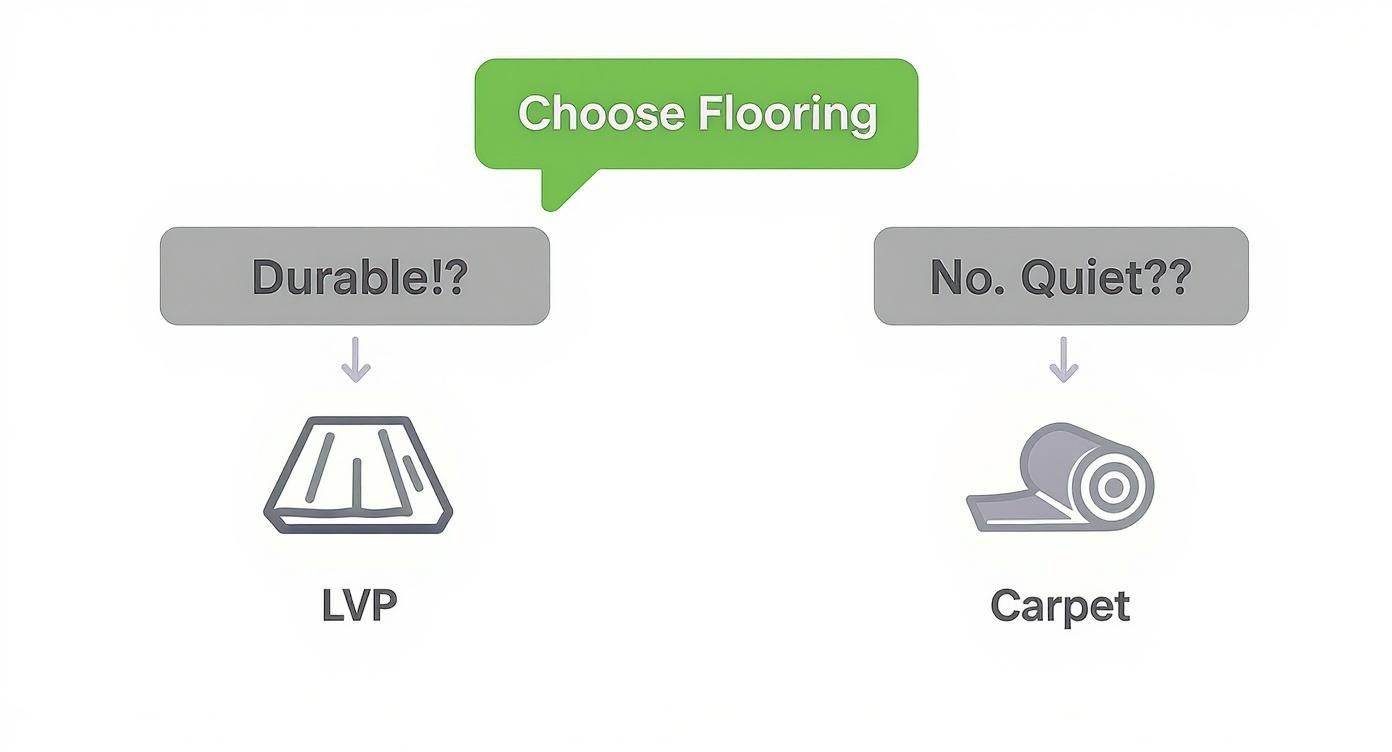
As you can see, if durability is your main concern, LVP is the way to go. If you’re trying to cut down on noise, carpet is the clear solution.
Got Questions? We’ve Got Answers.
Even after weighing the pros and cons, you probably have a few practical questions swimming around. That's completely normal. Choosing the right flooring often comes down to the nitty-gritty details, like how it will stand up to your rolling chair or whether it will turn your office into an echo chamber.
Let's tackle some of the most common questions we hear from homeowners.
What’s the Best Flooring for an Office Chair on Wheels?
For the daily grind of a rolling office chair, you can't beat Luxury Vinyl Plank (LVP) or a commercial-grade, low-pile carpet tile. LVP is tough as nails, with a protective wear layer built to resist the scuffs and scratches from casters rolling back and forth all day. It gives you a smooth, effortless glide.
If you prefer something softer underfoot, low-pile carpet tiles are an excellent alternative. Their dense, tight weave won't get chewed up or snagged by the wheels, which is a constant problem with plusher carpets. And while solid hardwood looks incredible, it's just too prone to getting dented and scratched over time without serious protection.
A Pro's Take: If you're set on hardwood, a high-quality chair mat is non-negotiable—it’s the only way to protect your investment. A mat is still a good idea for LVP to keep it looking pristine for years, but the floor itself is far more resilient to the abuse.
How Do I Stop My Home Office from Sounding Like a Cave?
Acoustics are huge for a productive workspace, especially with so many of us on video calls. The last thing you want is an echo that makes you sound like you're broadcasting from a canyon. To kill that echo, you need materials that absorb sound, not bounce it around.
Hands down, the champions of sound absorption are carpet and cork. Wall-to-wall carpet is fantastic at muffling ambient noise and killing echo, creating a much quieter and more focused atmosphere. Cork is another great choice; its natural structure helps insulate against sound, which is perfect if your office is on an upper floor.
If you're going with a hard surface like LVP or hardwood, don't worry—you can still manage the sound effectively.
- Lay down an area rug: A large, thick rug under your desk area works wonders for soaking up sound waves.
- Don't skip the underlayment: A quality acoustic underlayment beneath LVP or laminate can make a surprisingly big difference in dampening noise.
At Flacks Flooring, we know every home office is different. If you're in Cumming, Johns Creek, or anywhere in Forsyth County, our team can give you the expert advice you need to find the perfect flooring. Come see our huge selection of hardwood, carpet, and waterproof options that can build the foundation for your best work. Stop by our showroom or schedule an in-home consultation with us today.